Aero Launches on October 21: A Unified Liquidity Layer Spanning 7 Chains, How Can It Challenge Uniswap?
Author: Official Research Team at Aero
Compiled by: TechFlow

Architecture Overview: The Unified Ethereum Liquidity Layer and Core Terminology Definitions
• Aero officially launched on October 21: an on-chain spot exchange designed to serve as the unified liquidity base for the entire Ethereum ecosystem.
• Aero brings together Aerodrome and Velodrome, two DEXs that hold absolute dominance in their respective ecosystems, and expands their battle-tested, fully upgraded trading models across seven major public chain networks.
• Aero provides higher returns to liquidity providers (LPs), offering them a channel to earn AERO tokens. When these tokens are staked, holders gain statutory claims over all revenue sources across the exchange network.
• Aero's architecture revolves around three core objectives: First, Win the Flow. Network expansion increases the potential market size nearly fourfold, continuously extending Aero's mature capability to attract high-value on-chain asset categories. Programmable fee rebates unlock more retail order flow. Active Tick rewards combined with market-adaptive fees and revenue mechanisms significantly boost capital efficiency, forming a snowballing competitive advantage through deepened liquidity. Second, Increase the Value of That Flow. Fully upgraded dynamic fees paired with an MEV tax mechanism substantially increase per-trade fees and protocol revenue. Fee-earning LPs secure higher yields through risk-adaptive smart fees and initial unstaked fees of 0% to 5%. AERO-earning LPs enjoy richer rewards, with multiplier designs set to 1.2x the tracking value of long-tail pool revenues. Finally, Optimize the Token Economy. Predictive Allocation leverages market dynamics to guide emission budgets toward high-potential incumbent and emerging markets before actual demand arises. Gauge Caps anchor potential AERO reward values to expected revenue, preventing overspending, while allowing dynamic increases in incentive ceilings during extreme volatility. The MinStake minimum stake duration mechanism ensures incentives are only distributed to truly useful, settled liquidity. The Momentum Fund utilizes market-perception-driven intelligent buybacks to control circulating supply and has the authority to directly burn AERO and sAERO. The REV engine introduces diversified revenue streams that require no new AERO emissions, increasing per-token revenue value. Unstaked fees can be gradually raised as ecosystem dominance grows, driving synchronized growth in revenue and market share.
• Long-term quantitative modeling demonstrates that Aero will exhibit stronger competitiveness and higher capital productivity as it scales.
Before diving into each mechanism, we first outline the core terms involved in this article. These concepts build upon one another, jointly forming the structural framework of Aero's economic operations:
I. Core Participant Roles:
• Traders: Any entity conducting token swaps on Aero, ranging from retail end-users to professional institutional trading desks.
• Liquidity Providers (LP): Market makers who deposit token assets into trading pools, providing the depth required for traders to execute swaps.
• Token Operators: Entities that stake AERO to obtain governance positions, responsible for directing incentive emissions to various liquidity pools and capturing the exchange's network-wide revenue.
• Token Issuers: Teams and protocols that establish and expand liquidity markets for their project tokens on Aero.
II. Fee Structure:
• Trading Fees: The standard fees paid by traders on each swap. All exchanges charge this type of fee, which often represents the maximum yield LPs can obtain on most traditional platforms.
• Smart Fees: Aero's brand-new innovative mechanism encompassing all income generated by trading pools from trades. It includes base trading fees, plus dynamic fee premiums triggered during periods of severe market volatility when corresponding modules are enabled, and MEV taxes levied on transactions paying high priority packing fees. Meanwhile, programmable fee rebates aim to offer lower fees to registered aggregators, routing gateways, and professional trading desks to fiercely compete for order flow. Other exchanges typically only provide one of these strategies at a time, leading to severe fragmentation of liquidity across different modes; Smart Fees seamlessly integrates all three into a single core product.
III. Participating Positions & Market Making Types:
• sAERO: Governance and yield-bearing positions obtained by users staking AERO according to self-selected lock-up periods.
• AERO-earning / Staked Liquidity: Market-making positions staked to a Gauge to earn AERO rewards. All Smart Fees generated by these positions are forwarded to Token Operators.
• Fee-earning / Unstaked Liquidity: Market-making positions not participating in Gauge staking. These market makers retain the Smart Fees they generate directly, deducting only a small unstaked fee forwarded to Token Operators (set between 0% and 5% initially, depending on pool type and network).
IV. Protocol Revenue Composition:
• Liquidity Payments: Incentive funds paid by token issuers to incentivize Token Operators to direct AERO emissions to their specific pools.
• Launch Payments: Liquidity payments specifically invested by token issuers to support the cold-start launch of new assets.
• Pool Revenue: The total sum of all earnings paid by a specific trading pool to the Token Operator directing incentives to it, including Smart Fees generated by staked liquidity, all unstaked fees, and the liquidity and launch payments provided by token issuers.
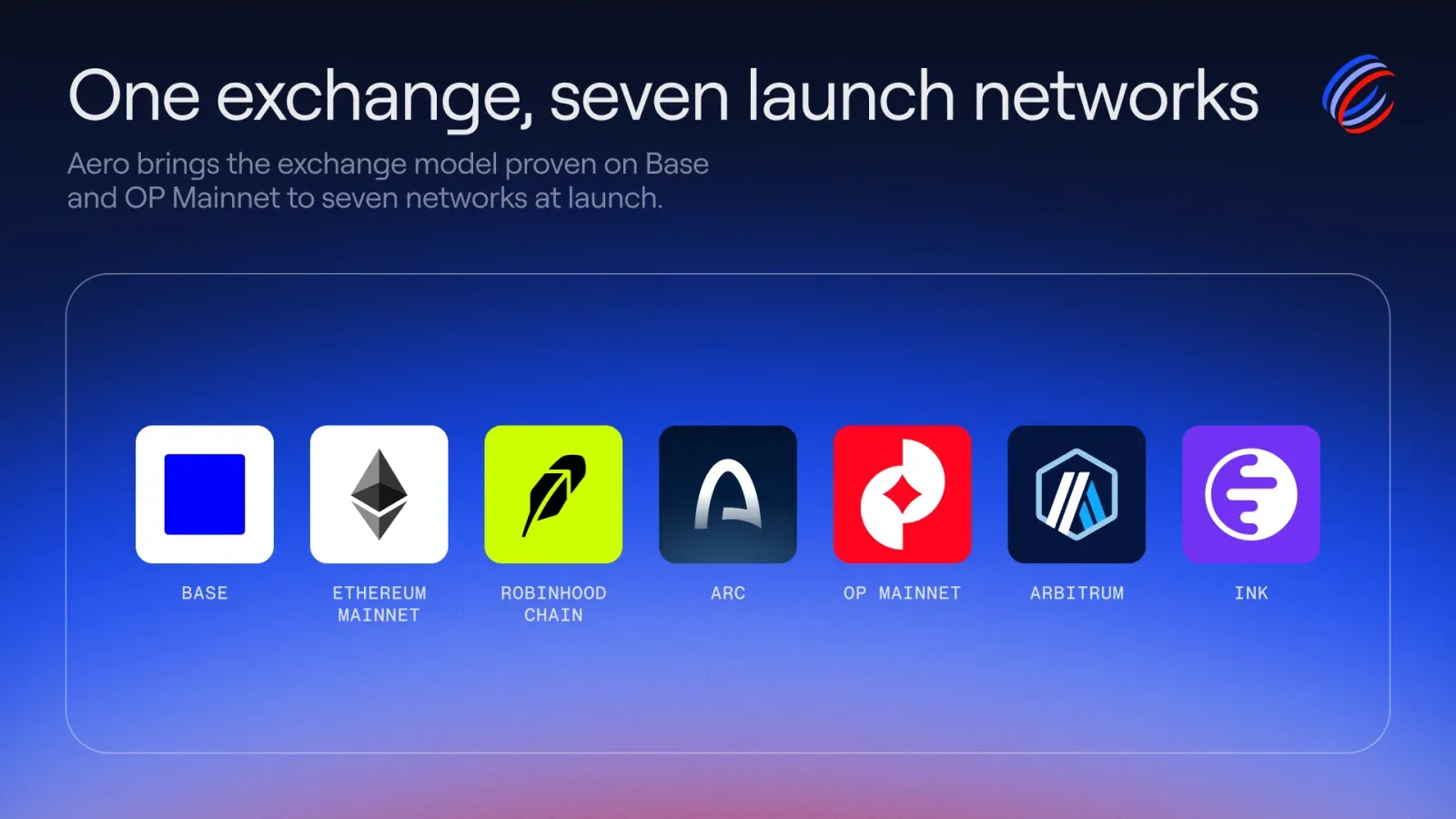
Figure 2: One exchange, seven launch networks
• Service Revenue: Fees derived from derivative products and services built around the exchange ecosystem, rather than directly from pool trades. Examples include secondary markets for sAERO trading, automated liquidity management tools, and cross-chain swaps. All service revenue will be recycled to bolster token value, primarily through buybacks or burns, requiring absolutely no additional token emissions for LP rewards.
• Exchange Revenue: The aggregation of all value captured by Aero across all networks and pools, equal to network-wide Pool Revenue plus derivative service revenue. Its scope of value capture far exceeds single Smart Fees alone, while sAERO serves as the unified claim certificate for this entire vast cash flow system.
V. Rewards & Cap Controls:
• AERO Rewards: Token rewards streamed in real-time to AERO-earning staked market makers. These rewards are directed by Token Operators at weightings and are only minted instantaneously upon actual claiming by market makers.
• Gauge Caps: The value of AERO rewards accessible to each trading pool is set as a specific multiple cap of its pool revenue, with a long-term network-wide target multiplier of approximately 1.2x. Caps adjust dynamically with market volatility and employ elastic allocation models: raising incentive quotas during drastic market swings and lowering expenditures during stable periods. Token Operators' voting allocation determines where AERO rewards flow, while Gauge Caps lock in the maximum quota each pool can obtain.
The fund flow of the entire economy is clear and straightforward: Various revenues aggregate upward toward Token Operators and the AERO token; AERO rewards are then precisely drip-fed downward to liquidity market makers providing depth.
Aero officially debuted on October 21. Built on Dromos Labs' brand-new MetaDEX03 architecture, Aero represents a comprehensive upgrade of the trading model that previously drove Aerodrome and Velodrome to hegemony in their respective ecosystems. It pushes this mature model onto more entirely new public chain networks, scaling DEX spot trading volume to nearly four times the combined total of Base and OP Mainnet.
The timing of the launch could not be more perfect. An increasing number of strategic assets and high-value financial markets are accelerating their migration on-chain, while traditional AMM models face unprecedented severe challenges. New matching technologies (such as Proprietary AMMs) are increasingly encroaching on retail order flows. LP returns for market makers continue to face compression, making it impossible to determine whether decentralised exchanges can structurally offer higher returns to market makers—a key test of core competitiveness in a new cycle.
Aero was born precisely for this historical turning point.
Its positioning is the unified liquidity layer for the entire Ethereum ecosystem: serving strategic markets, facilitating the on-chain tokenization of more high-value assets, and returning the vast majority of value they create directly to all participants in the open network.
The first step in fulfilling this grand blueprint is to create more value, thereby paying liquidity providers (LPs) more attractive, substantial returns.
Fair and adequate compensation for LPs is the core proposition that every on-chain exchange driven by AMMs must solve. Market makers bear real inventory risk and impermanent loss costs when establishing liquidity positions, whereas discrete, point-in-time instantaneous fees often fail to cover these expenses. As more financial-grade strategic assets go on-chain, AMMs must be able to reasonably compensate making capital based on its comprehensive value to the entire network, and not merely rely on instantaneous matching fees. Platforms possessing this panoramic compensation capability will ultimately win dominance over these massive markets.
The decentralized exchange sector inherently possesses a strong "winner-takes-all" Matthew effect. Over time, making capital inevitably flows to locations with the highest comprehensive returns, while traders follow the deepest order book depth. When a pool becomes the dominant trading venue, denser order flows exponentially improve the production efficiency of making capital, generating more fees and making it nearly impossible for competitors to match returns. Platforms capable of sustaining generous remuneration amidst market turbulence will firmly lock in traders, creating powerful compounding effects on their leading position.
Providing fair and above-market returns to LPs is both an urgent necessity for industry health and Aero's core competitive moat.
The key to achieving this breakthrough lies in Aero paying LPs a token that carries network-wide revenue claims. When staked, it represents a claim on cash flows from the exchange's total comprehensive income, no longer limited merely to scattered transaction fees occurring per block. This enables Aero to distribute incentives based on the contribution of each making deposit to the network's overall effects, naturally surpassing traditional DEXs that can only mechanically forward their own fees.
Simultaneously, this mechanism perfectly solves the so-called "Alignment Trilemma" prevalent in the industry. In many traditional DeFi systems, core contributors, external investors, and underlying LPs often engage in zero-sum games, competing for limited protocol inflow value. However, when the sole network token carries claims on all business revenues, holding and staking it becomes the common path for everyone to share Aero's developmental dividends, highly aligning interests across the ecosystem. As developers, asset issuers, and ecosystem partners widely hold sAERO, more stakeholders gain solid motivation to bring high-quality assets, abundant liquidity, and massive user bases to Aero.
We have previously introduced Aero's specific technical details on multiple occasions. Today, we completely unveil how these innovative modules integrate into a unified economic model, establishing long-term dominance over the on-chain spot trading sector against the backdrop of accelerating real-world asset tokenization.
The entire Aero economy consists of three core pillars, with all mechanism designs precisely serving one or more of the following objectives:
• Win the Flow: Go all out to secure on-chain trading activity, particularly orders from strategic-grade markets and high-value asset categories.
• Increase the Value of That Flow: Dynamically raise fees while ensuring sustainability, and actively pioneer new protocol revenue streams.
• Optimize the Token Economy: Strictly control token circulating supply, efficiently constraining inflation dilution throughout the protocol's long lifecycle.
The three pillars empower each other, forming an unbreakable positive cycle. Highly competitive incentive policies attract abundant liquidity, helping Aero capture massive order flows; extracting greater commercial value from these flows allows the protocol to maintain high making returns long-term without increasing token emissions; business scale expansion strengthens the resilience of the underlying economics, while a healthier economy reciprocally injects continuous momentum into larger-scale market expansion.
For professional practitioners eager to deeply deconstruct Gauge Caps mechanisms, market-adaptive compensation rates, dynamic fees, active Tick rewards, MinStake durations, and the Momentum Fund, this article will provide the most rigorous and detailed technical and economic guide.
Winning the Flow: Building a Deep Liquidity Base
The journey to winning the flow begins with a comprehensive expansion of the strategic footprint.
On day one, Aero will fully deploy simultaneously across 7 mainstream networks: Ethereum Mainnet, Base, Arbitrum, OP Mainnet, Ink, Arc, and Robinhood Chain. Each network will receive complete product functionality implementation, coordinated across the network via Predictive Allocation for AERO reward distribution.
When Aero officially announced this launch plan, the original networks served by Aerodrome and Velodrome accounted for only about 17% of the total Ethereum EVM spot trading volume. Yet by mid-October, the DEX spot trading scale supported across these 7 first-launch networks reached nearly four times the combined volume of Base and OP Mainnet. Beyond the organic macro growth of on-chain volumes, this grants Aero an extraordinarily broad space for incremental capture.
More importantly, a profound paradigm shift has occurred in the asset categories flowing into these markets.
Stablecoin market capitalization has broken through the $300 billion mark, demonstrating the astonishing scale traditional financial assets can achieve on-chain. Tokenized stocks follow with explosive growth. Within 2026 alone, tokenized stock size expanded nearly fourfold, surging from ~$8.4 billion to $35 billion. Yield-bearing assets like tokenized US Treasuries have accumulated ~$147 billion across various products, rapidly becoming the core underlying foundation for on-chain savings, credit lending collateral, and portfolio management. As adoption leaps forward, the potential to build highly liquid spot markets around these yield-bearing assets is immeasurable.
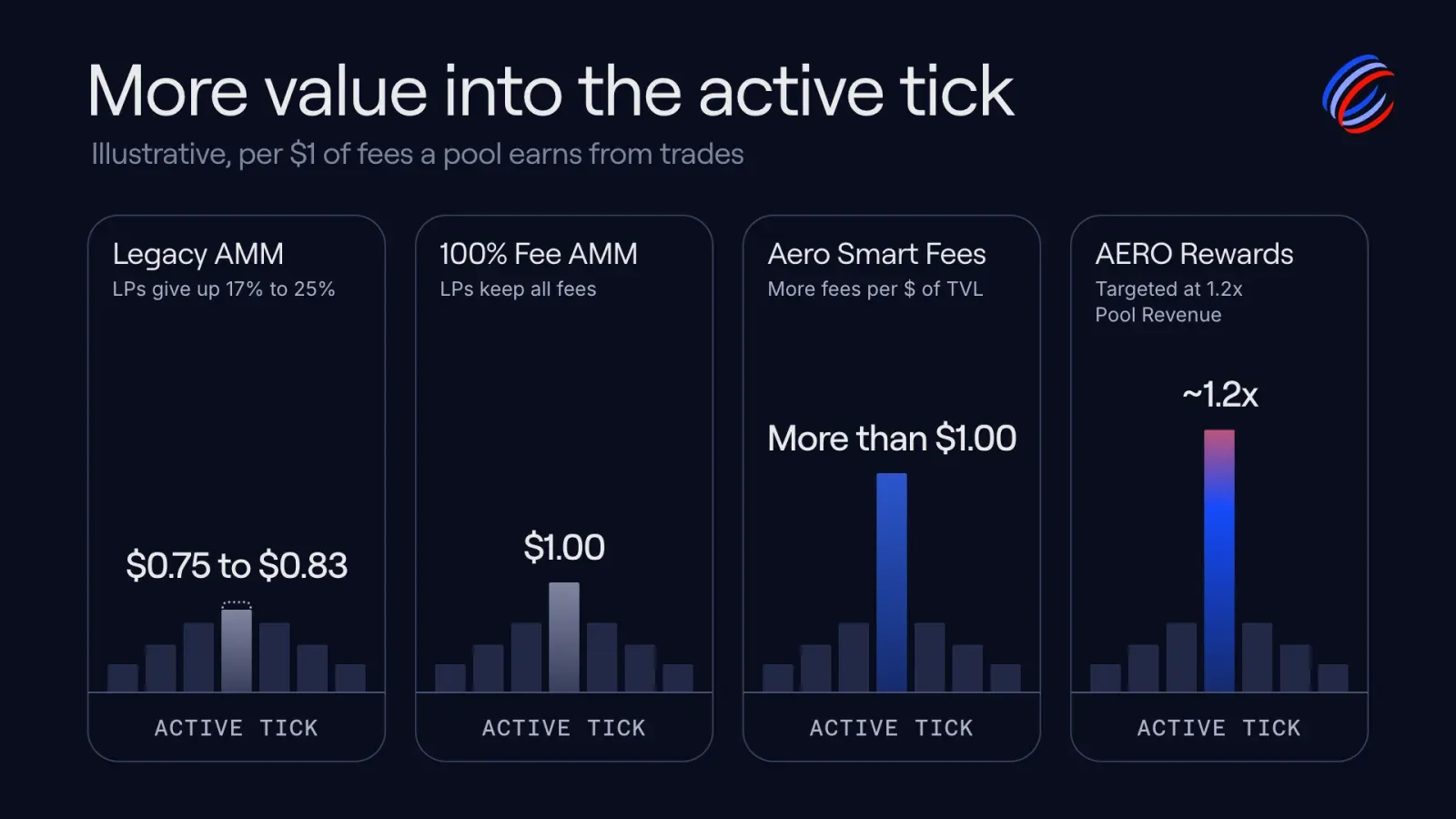
Figure 3: More value into the active tick: per $1 of fees a pool earns from trades, LPs keep $0.75 to $0.83 on a legacy AMM, $1.00 on a 100% fee AMM, more than $1.00 with Aero Smart Fees, and about 1.2x Pool Revenue with AERO Rewards
Aero's horizontal expansion allows it to directly tap into these trillion-dollar massive funds. When high-quality assets compliant with regulatory and technical standards open for trading and integration, they desperately seek reliable liquidity support, highly competitive matching execution quality, and seamless connectivity across the entire chain financial ecosystem. Predictive Allocation assists liquidity in migrating dynamically with market demand, even completing preemptive deployment before market explosions. The Slipstream V3 engine maximizes capital output per unit of making funds; while Metaswaps cross-chain swap technology flawlessly projects this liquidity depth across all supported network endpoints.
This endows Aero with two concurrently advancing potent growth drivers: on one hand plundering larger market share in existing saturated mature markets; on the other hand aggressively assisting incremental markets pioneering entirely new asset categories on-chain.
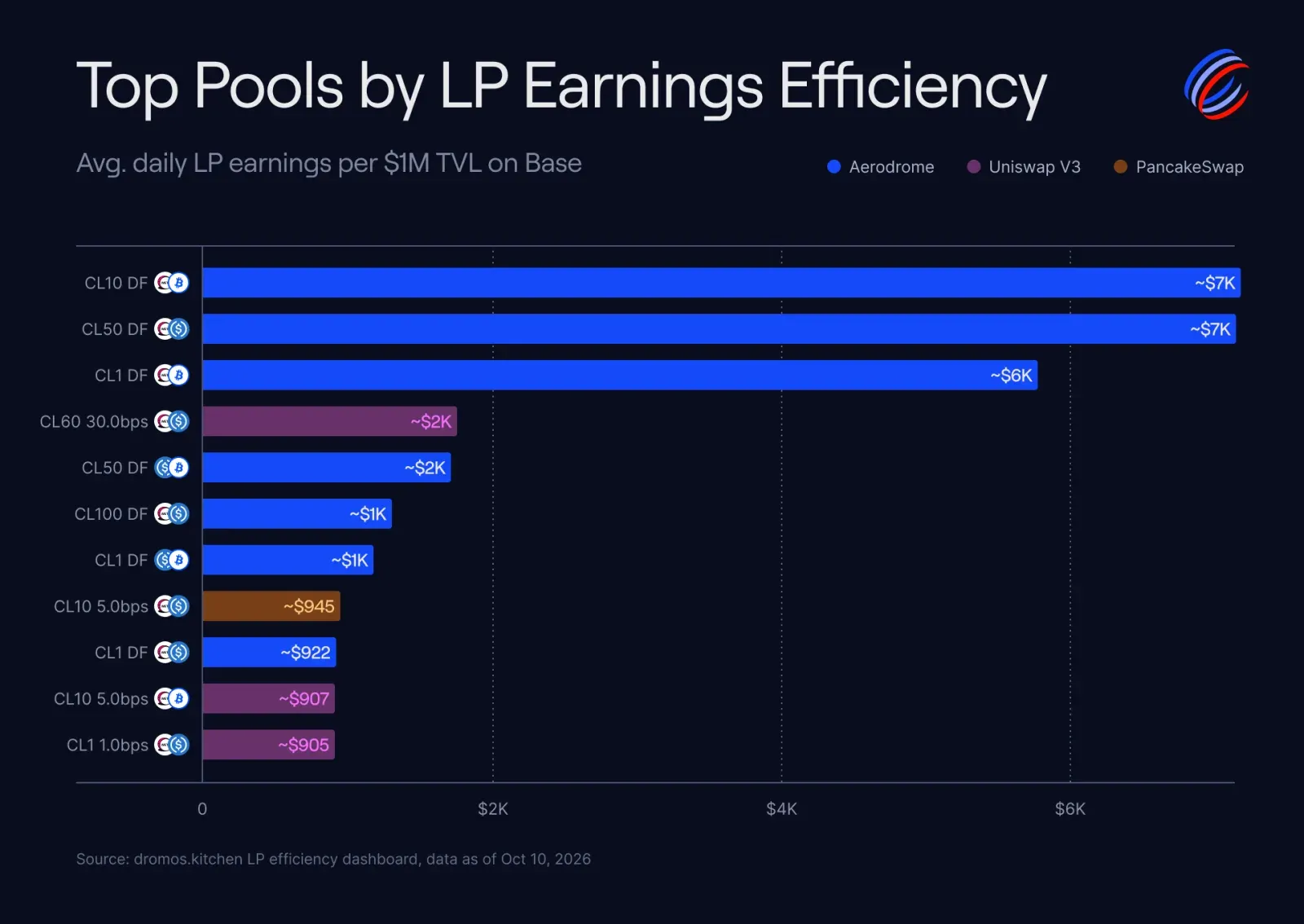
Figure 4: Top pools by LP earnings efficiency: average daily LP earnings per $1M TVL on Base
To win these markets, Aero must become the premier destination for network-wide making capital configuration. Liquidity providers need fair and lucrative returns, traders need extremely low-slipage execution experiences, and newly born assets require efficient aggregation of foundational making capital at minimal friction costs before establishing historical trading records.
Aero's underlying architecture tightly intertwines these three elements.
Higher Capital Efficiency Liquidity: Slipstream V3
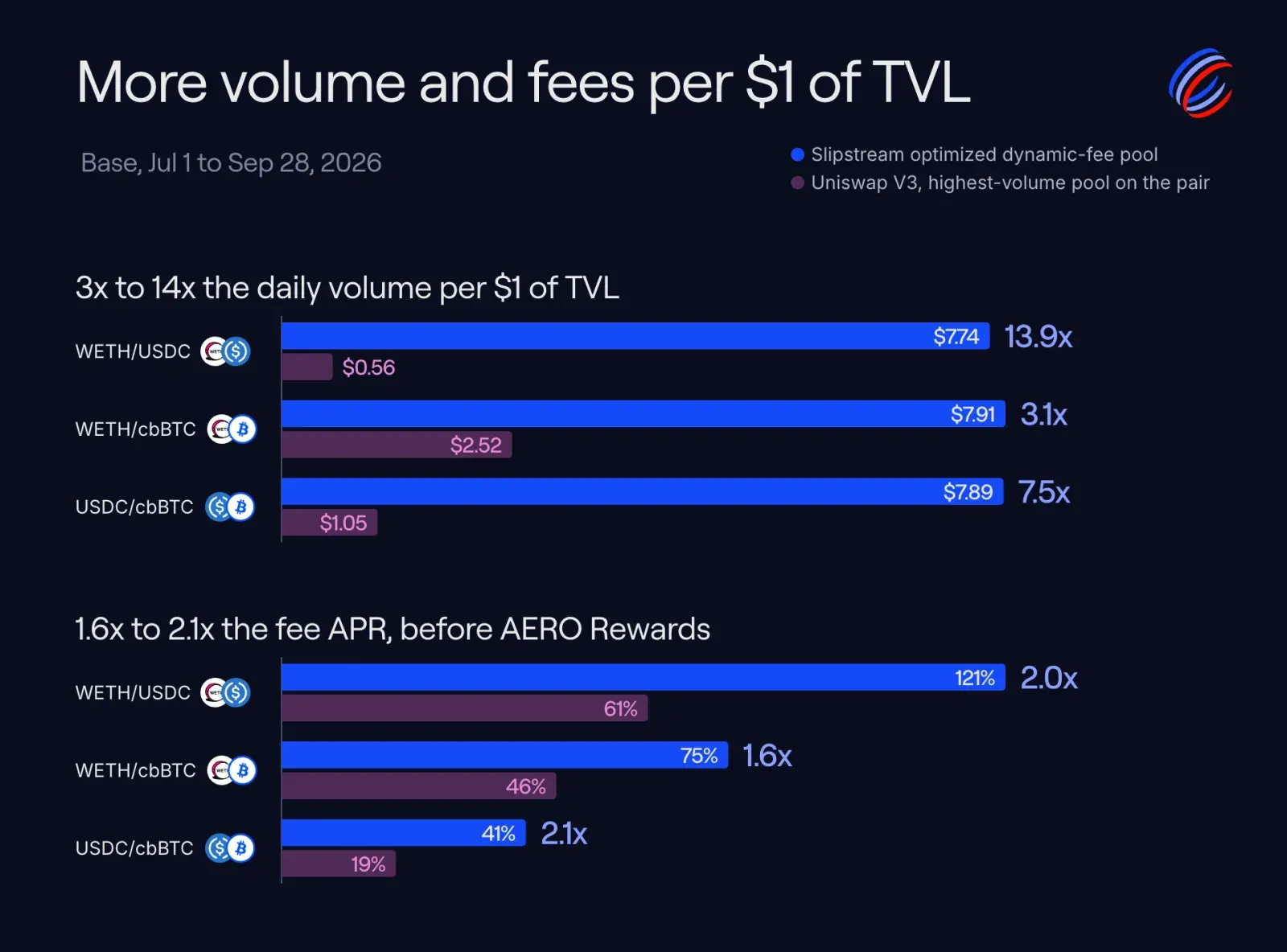
Figure 5: More volume and fees per $1 of TVL: Slipstream optimized dynamic-fee pools against Uniswap V3
Slipstream's prior massive success stemmed from unparalleled ultra-high capital efficiency: given identical Total Value Locked (TVL), it nurtures vastly larger trading volumes, extracts richer fees, and generates weaker slippage impact. This extreme efficiency primarily owes to two core mechanisms: First, AERO rewards are strictly allocated solely to making positions within Active Ticks (the price range where actual trading occurs), ensuring every cent of protocol subsidy pays for practical depth truly utilized by traders. Second, adaptive dynamic pricing precisely adjusts this effective depth based on instantaneous market volatility.
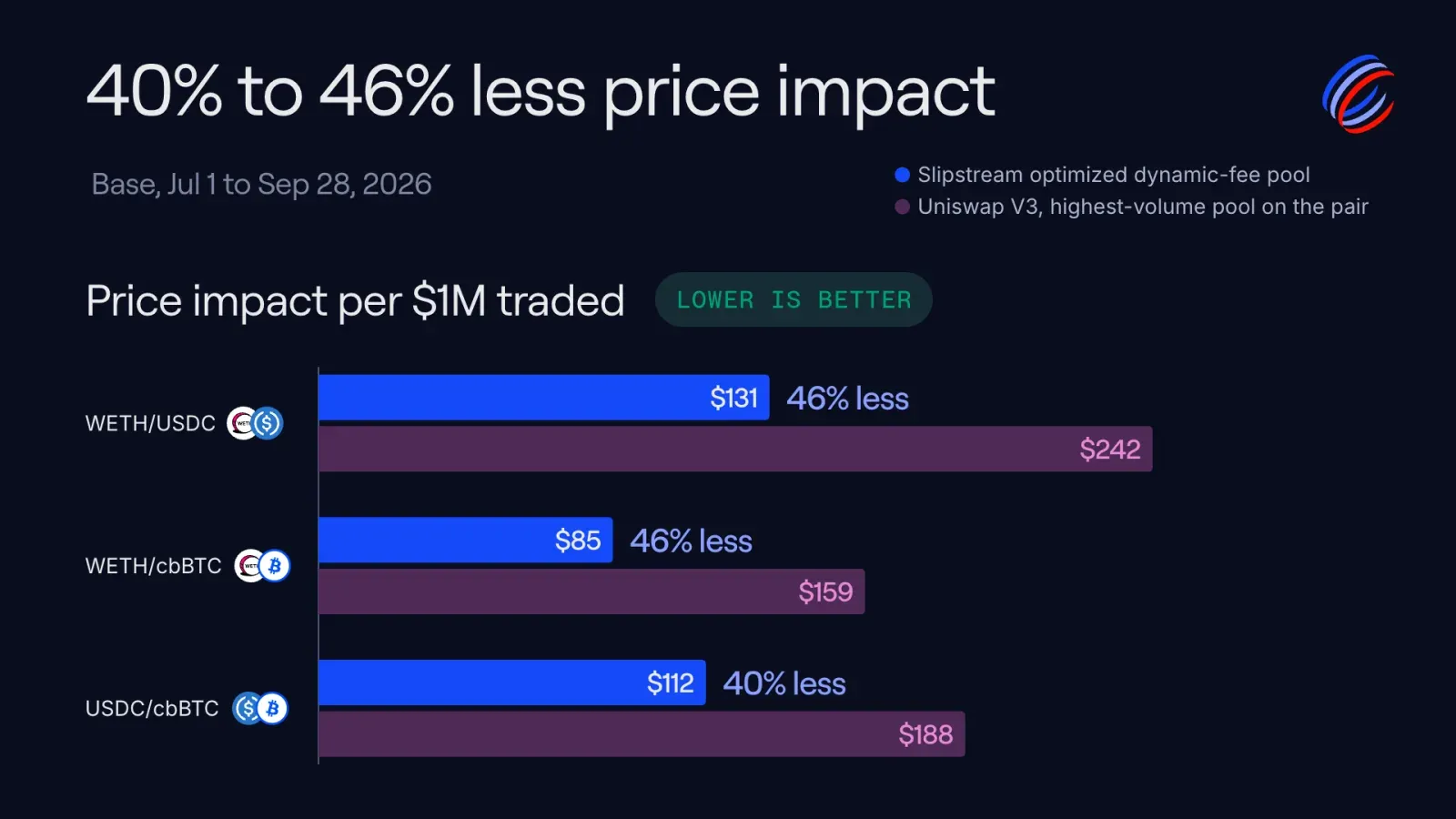
Figure 6: 40% to 46% less price impact per $1M traded
Ultra-high capital efficiency enables newly created pools to rapidly become viable with minimal startup capital, while mature pools continuously absorb larger order flows. For LPs, this means deposited making principal supports more active trading turnover; for traders, it translates to optimal network-wide matching execution quality.
Building on this foundation, Slipstream V3 further introduces higher-precision fee models and diversified fee sources, aiming to infinitely approximate LP's actual making yields to their real making costs. But its core cornerstone for competing for order flow remains unchanged: inheriting and elevating Slipstream's ultimate rule for fame—maximizing productivity for every dollar within the making pool.
Real operational data on Base from July 1 to September 28, 2026 fully proves this: Among Aerodrome's three optimized Slipstream dynamic-fee pools, the volume per dollar of liquidity support reached 3x to 14x that of the largest-cap pools in Uniswap V3's respective trading pairs! On $1 million large-scale swaps, Aero's price impact was reduced by 40% to 46% compared to industry rivals, and excluding any additional AERO token rewards, fees earned per dollar of liquidity from trades were 1.6x to 2.1x those of competitors!
Competition for High-Value Retail Order Flow
Slipstream V3 also empowers Aero with more diverse, aggressive tactics to capture highly commercially valuable trading behavior.
Just as any mature financial market exhibits, verifiable retail order flow on Aero poses far lower adverse selection risk to LPs than trades initiated by informed traders and arbitrage bots. Therefore, Aero can fully afford to charge lower base fees to retail traders while ensuring pools still record highly attractive aggregate fee totals.
As a crucial pillar of the Smart Fees system, Programmable Fee Rebates are specifically designed to implement differential discounted rates under public, globally auditable rules for registered DEX aggregators, routing gateways, and professional making desks. This enables Aero to directly confront fierce diversion and competition for high-value retail order flows by emerging technologies like "Proprietary AMMs".
The core purpose of this mechanism is to closely match the friction cost of trade execution with the actual making risk borne by servicing that trade, thereby capturing more high-quality order flows across the network that improve the health of the making ecosystem.
Drastically Lowering Entry Barriers for New Assets & Markets
Aero's ultimate goal is to establish absolute dominance in every niche segment it enters, meaning it must become the optimal destination for all types of market makers, including traditional LPs preferring direct fee cash flows. During the initial startup phase of new networks and entirely new trading pairs, when Token Operators haven't yet started directing massive AERO rewards to these pools, these fee-seeking LPs play an irreplaceable cold-start grounding role.
During initial launch, fee-earning unstaked liquidity will enjoy highly attractive preferential unstaked fees:
• 0% fee rate: Ethereum Mainnet, Arbitrum, and Robinhood Chain;
• 5% fee rate: Arc, OP Mainnet, Ink, and Base.
By comparison, among the same-size competitor exchanges network-wide, market makers passively only receive point-in-time trading fees, with 17% to 25% of high shares directly extracted by the platform protocol layer. On Aero, market makers directly earning fees can retain 95%乃至 100% of Smart Fees during initial launch. Importantly, the base for Smart Fees itself exceeds ordinary trading fees; it encompasses base trading fees, dynamic volatility premiums activated in specific pools, and MEV taxes. Thus, market makers on Aero divide a larger share of the cake within a much larger fee base.
This means that even after deducting a 5% unstaked fee, an ordinary LP who never stakes anything on Aero will still see final net-yield significantly outperform market makers retaining 100% traditional trading fees on competitor platforms.
Such a fee design prioritizes ecosystem adoption. For traditional LPs unfamiliar with Aero's token rewards and locking governance mechanisms, directly collecting fees remains the most familiar and intuitive making mode; while extremely low entry barriers make making capital migration psychologically effortless. Every new market maker's influx further widens the moat of depth for subsequent traders and other making capital, making every niche segment Aero conquers progressively unassailable.
As pool depth continually settles and eventually establishes monopolistic advantages, unstaked fees can flexibly rise moderately without harming competitive edge. Higher unstaked fees will conversely highlight the immense appeal of AERO-earning staked liquidity, driving more liquidity to switch from pure making to staking, forwarding 100% of generated Smart Fees to Token Operators.
Increasing the Value of That Flow: Reconstructing Fees & Capture Mechanisms
Winning the flow builds the foundation of the economic empire, while extracting higher commercial value from each passing order flow injects continuous power into the grand edifice erected upon it.
In the Aero system, this value amplification process begins first with Smart Fees.
Every asset swap executed on Aero requires paying base trading fees, and in pools enabling dynamic modules, Smart Fees additionally stack two critical yields: first, a dynamically adjusted fee premium automatically levied during severe market swings; second, an MEV tax levied on arbitrage trades paying high priority packing fees. These incremental yields massively elevate total revenue generated for identical trading volumes, allowing LPs and Token Operators to extract overwhelmingly rich returns from equivalent trade volumes.
Dynamic Fees: Adaptive Pricing Based on Market Volatility
To achieve fair compensation for LPs, the foremost principle is granting ample compensation in harsh market environments where their making risks peak. Dynamic fees, as a core component of the Smart Fees system, essentially function as real-time adaptive pricing for liquidity supply-demand tightness: competitively low fees in calm periods inevitably lead to LPs barely covering severe impermanent losses if left static during violent volatility; while permanently setting fees too high during volatile periods deters normal turnover during calm times due to heavy transaction costs. Traders' psychological demands differ sharply between environments: during sharp unilateral trends, traders' core pain point is rapid execution, remaining insensitive to minor fee fluctuations; during flat consolidation periods, traders meticulously calculate even slight bps of slipage and fees.
Slipstream's dynamic fee framework evolved precisely from this profound market insight. Phase 1 allowed pool fees to flexibly customize based on underlying asset attributes; Phase 2 successfully introduced dynamic algorithms adaptively raising fees during high-volatility periods.
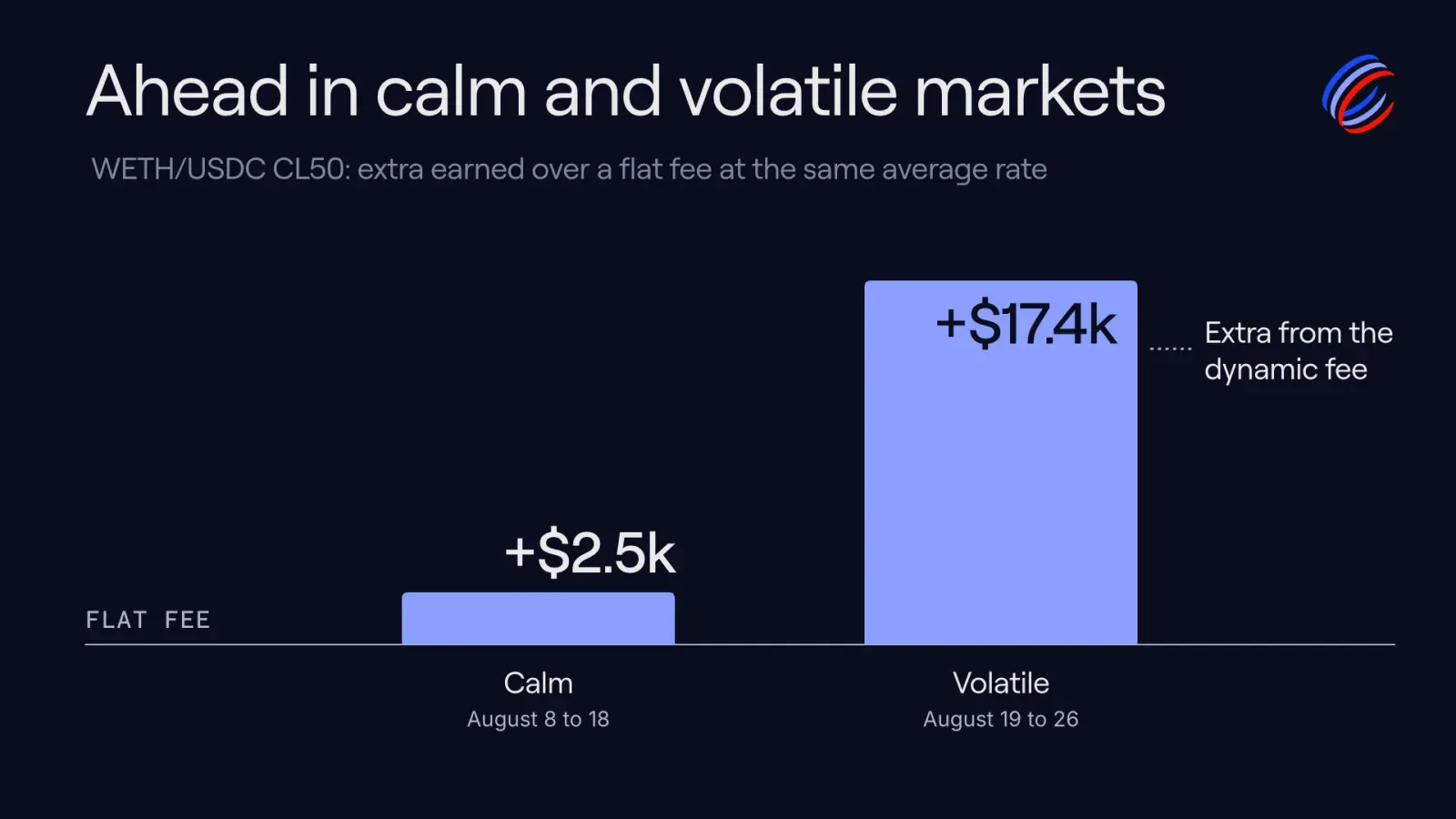
Figure 7: Ahead in calm and volatile markets: extra earned over a flat fee on WETH/USDC CL50
Aero launched equipped with a newly optimized dynamic fee algorithm honed over nearly a year of research and rigorous backtesting, targeting maximal premium capture at moments when making liquidity value is most priceless. Rigorous comparative backtesting against identical historical swap counts and traditional fixed-fee pools confirms the massive superiority of adaptive dynamic pricing. Across all 9 tested pool windows (covering full cycles of calm, violent volatility, and volatility subsidence across three distinct pools during August and September 2026), dynamic fees comprehensively crushed fixed-fee counterparts set at identical average rates. Taking WETH/USDC CL50 as an example, during the calm window from Aug 8 to 18, dynamic fees captured an extra $2,500; during the violently volatile week of Aug 19 to 26, excess yields skyrocketed to $17,400!
Where does this significant value scissors difference originate? Data provides an exceptionally clear answer: In the WETH/USDC CL50 pool, the dynamic fee algorithm averaged charging merely 3.9 basis points (bps) during the most calm phases, adaptively spiking to 8.3 bps during the most volatile high-risk phases. Between Sept 11 and Oct 6, 2026, high-volatility trading sessions accounting for only 15% of the pool's total volume inexplicably contributed a staggering 25% of the pool's aggregate fee revenue!
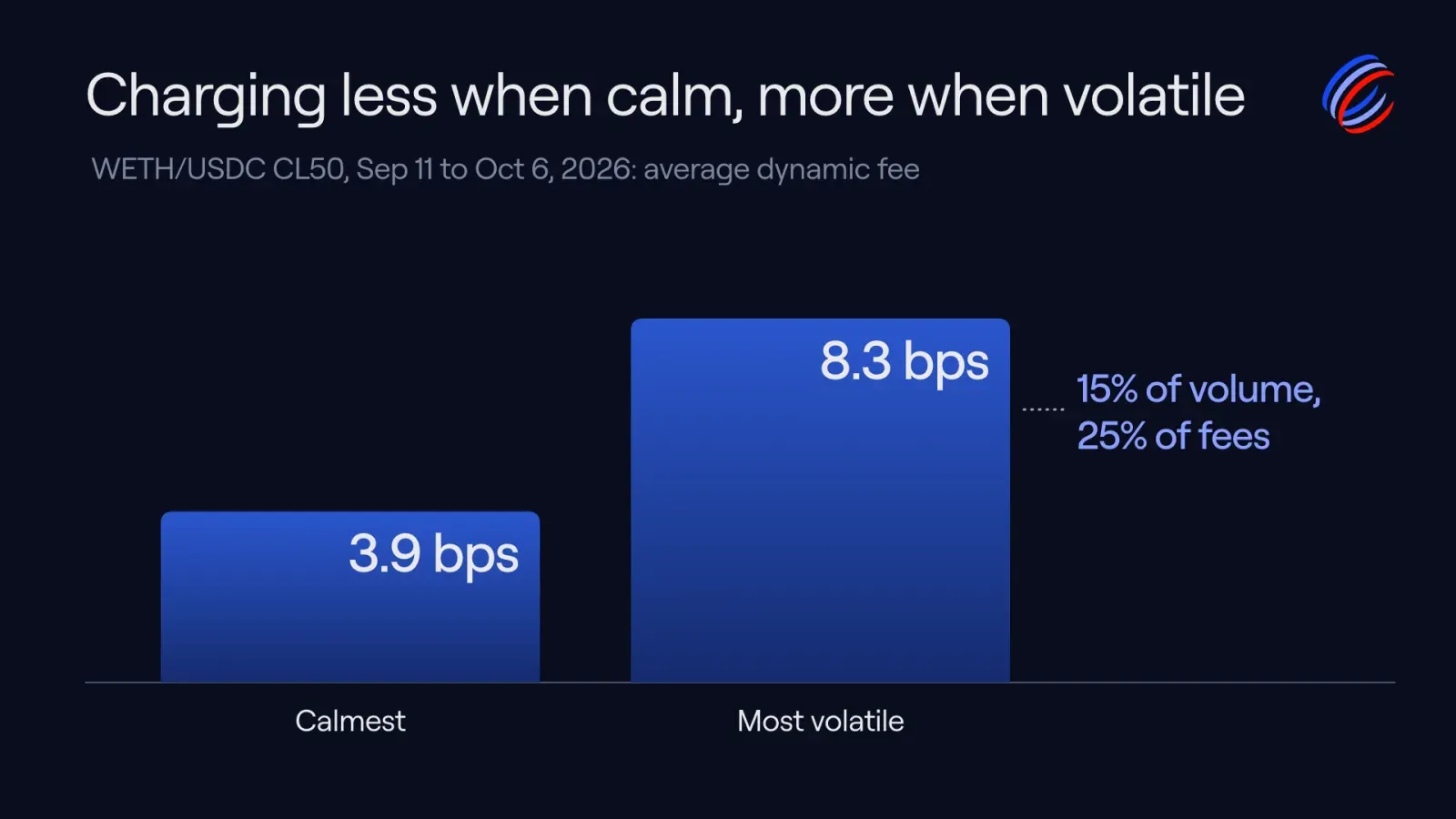
Figure 8: Charging less when calm, more when volatile: WETH/USDC CL50 average dynamic fee
This architecture possesses not only adaptability but extreme extensibility, continuously stacking specialized optimization algorithms across different asset classes, making pool depths, and extreme market scenarios. Thanks to Slipstream V3's highly cohesive modular architecture, all cutting-edge algorithm upgrades can be deployed natively to existing pools in the future without market makers manually migrating positions, ensuring the entire protocol's liquidity depth never fragments due to contract version iterations. The network's deepest, most frequently traded core pools will immediately enjoy fresh pricing dividends alongside algorithmic innovations.
As Aero captures more order flows, the vast majority of network-wide trades will be precisely priced based on their instantaneous market environments: during violent agitation, LPs reap lavish premiums perfectly matching incurred risks; during calm waters, traders enjoy the lowest transaction costs on the network.
MEV Tax Mechanism: Capturing Extraordinary Value from Urgent Trades
Providing fair remuneration to market makers necessitates solemnly confronting their exposure, and in the on-chain world, most making risk stems directly from informed traders and high-frequency arbitrageurs. Mirroring HFT quant institutions in traditional finance, these arbitrageurs exploit stale quotes from un-updated on-chain pools to buy low and sell high by front-running in milliseconds. Every cent of superprofit they earn is built squarely on exploiting LP impermanent losses. Yet on the transparent blockchain ledger, these arbitrage actions leave an unmistakable physiological fingerprint: voluntarily paid excessive Priority Fees to compete for priority packing rights, blatantly exposing when arbitrage is underway and how huge profit margins sit within each swap.
To execute ahead of ordinary trades, arbitrageurs ruthlessly throw massive Priority Fees. Under traditional on-chain architectures, these huge packing fees are entirely swallowed by underlying Sequencers or block validators, while the true foundation of the trade—the liquidity depth silently laid by LPs bearing risk—receives not even a drop.
Aero's globally pioneering MEV Tax module completely reverses this injustice, forcibly intercepting and capturing this otherwise lost extraordinary value for the pool.
When a transaction's Priority Fee exceeds the threshold set for ordinary retail daily trades, the pool triggers algorithms to levy an additional special fee gradient-linked to the Priority Fee. Ordinary trades below normal thresholds remain completely unaffected, paying zero extra tax. This MEV Tax, serving as Smart Fees' second major incremental puzzle, follows the protocol's consistent distribution logic: If belonging to fee-earning unstaked LPs, unstaked fees are deducted before fully distributing to LPs; if belonging to AERO-earning staked pools, 100% transfers to Token Operators directing incentives to that pool.
This mechanism's strike target is extremely precise, exclusively targeting one specific trade type: malicious arbitrageurs ruthlessly bidding up Priority Fees to front-run arbitrage. Conventional retail swaps and routine modest tips remain completely undisturbed; underlying sequencers still collect all Priority Fees paid by arbitrageurs as usual. What fundamentally changes is the distribution flow of high-frequency arbitrage profits. Within the current Ethereum ecosystem, enormous profits from the largest-arbitrage exchange are mostly cashed out by external MEV searchers, leaving LPs only fragmented capital erosion. By forcibly intercepting a substantial proportion of these profits and injecting them back into market maker pockets providing liquidity support or returning them to Token Operators, pool liquidity gets doubled in depth. Deeper liquidity yields tighter slippage quotes, attracting more genuine transaction volume across the entire public chain, ultimately pushing on-chain custody to host vastly larger financial markets.
Historical trades on Aerodrome alone show traders cumulative Priority Fee payments totaling hundreds of millions of dollars. Aero's emergence finally allows this massive peripheral value generated around trades to flow back and nourish the protocol network itself providing underlying support.
The MEV Tax module will roll out steadily in a phased manner, gradually expanding applicable pool ranges based on live data. We expect this mechanism to unleash the most astonishing value increments in super flagship pools characterized by fiercest competition, densest trading, and craziest Priority Fee wars.
Dynamic fee premiums and the MEV Tax combined significantly elevate the Smart Fees cash flow density each unit of making capital creates. Precisely this rigorous combination punch allows Aero to generously pay LPs returns exceeding peers while crafting astonishing surging profits for Token Operators.
Optimizing the Token Economy: Precision Incentives & Flywheel Closed Loop
Smart Fees innovation causes genuine fees generated per trade to multiply, yet a considerable portion of Aero's remuneration to market makers still manifests as native AERO tokens.
Every decentralized exchange must somehow pay the price for its settled liquidity. What truly determines life or death is who bears this cost and who ultimately receives remuneration. Platforms boasting handing 100% of trading fees entirely to market makers appear seemingly costless to the protocol superficially, but off-camera, someone quietly shoulders hundreds of millions in huge expenses for R&D, deployment, and sustained operations, usually manifesting as astronomical early investor unlocks causing dump pressure or treasury bleeding.
Within the Aero system, this making cost reflects transparently through token emissions. Paying market makers in AERO implies minting new tokens: every newly issued AERO reward is freshly minted, and each new token dilutes and spreads the exchange's overall revenue cash flow across a larger supply base. However, this cost precisely constitutes Aero's most powerful dimension-striking advantage. Through token emissions, Aero converts the entire network's future potential growth dividends into immediate, lavish current remuneration for market makers—a feat entirely beyond reach for traditional platforms shackled by meager instantaneous fee revenues. More strategically, the emission mechanism cleverly shifts ownership focus from passive holders lying dormant without contributing substance to the network, forcefully transferring it to active market makers and Token Operators truly building prosperity.
As brilliantly articulated in Dromos Labs' classic paper "On Issuance": if designed properly, token emissions essentially mean "growing the pie" rather than slicing an originally narrow pie thinner. Crucially, since Aero strictly sets making incentives within a USD-denominated dynamic budget framework, the higher AERO's secondary market valuation, the fewer new tokens need emitting to maintain equivalent fiat purchasing power for making remuneration. Conversely, if poorly designed and emissions run rampant outpacing genuine revenue growth, intrinsic value claims per token face severe corrosion. Thus, Aero's entire token economic system constructs triple ironclad defenses ensuring emissions rigorously anchor to genuine business value:
• Precisely directing emissions to fertile ground with highest marginal output: Predictive Allocation lets Token Operators proactively layout rewards ahead of market demand, completely eliminating traditional lagging weekly voting subsidies based on "last week's historical fees", preventing pools already losing trade output from mechanically receiving subsidies. Coupled with Active Tick rewards and MinStake mechanisms, ensuring the protocol only pays for genuinely efficient, usable effective making depth.
• Drastically slowing token dilution rates mathematically: Gauge Caps strictly bind total rewards distributed to pools to genuine revenue-generation capacity, completely replacing rigid fixed-schedule emissions and mindless weekly Rebase inflation; meanwhile, Momentum Fund utilizes genuine protocol cash for market-perception-driven intelligent buybacks and active destructions, completely withdrawing token supply from circulation.
• Maximizing purely incremental protocol endogenous revenue completely independent of token emissions: Liquidity and launch payments provided by token issuers directly inject massive external capital into the protocol ecosystem; while unstaked fees and derivative service revenue sourced from the REV engine create pure cash flow increments for the protocol entirely without needing proportionally push up Gauge Caps emission ceilings.
The ultimate vision of this exquisite mechanism suite is guaranteeing LPs consistently receive fair, industry-leading excess returns while driving healthy steady appreciation in revenue cashflows embedded per token. Subsequent sections will individually deconstruct micro-operation mechanics of these mechanisms.
Predictive Allocation: Guiding Liquidity Injection Ahead of Market Demand
Providing liquidity is essentially a forward-looking game full of foresight. Throughout DeFi history, the most valuable liquidity must often position itself well before mature markets formally crystallize.
An emerging strategic asset must first establish sufficiently deep pools capable of handling massive capital throughput before institutional capital dares formally enter allocation; a new trading pair must demonstrate long-term stability and unbroken matching execution quality before various dApps dare integrate its depth into their business logic; and innovative financial derivative use cases for LP positions must rely on initial capital volume scale before achieving self-sustaining commercial viability.
However, precisely guiding abundant liquidity to where it's most urgently needed at the right time has always been an exceptionally thorny core problem in modern finance. Asking market makers to solo shoulder such massive exploratory risks during pioneering periods is unrealistic; while having asset issuing teams, public chain ecosystem funds, or exchange platforms handle everything themselves incurs prohibitive management and capital costs. This causes many emerging high-quality markets to either die in infancy due to liquidity droughts or instantly fall into liquidity exhaustion shock states during turbulent market swings. Aero's Predictive Allocation mechanism thoroughly conquers this chronic disease by introducing a brand-new decentralized market mechanism: Token Operators compete in open markets leveraging professional insights to predict future genuine demand, with those making excellent predictions reaping the richest excess returns. Leveraging group intelligence via market game theory mobilizes cognitive and capital forces far surpassing any single core team or centralized quant model limits.
Predictive Allocation allows sAERO positions to act as coordinating cores for this pioneering capital, typically forming powerful synergistic resonance with liquidity and launch payments directly streamed by token issuers to corresponding Token Operators.
Token Operators proactively direct AERO reward quotas to potential pools they firmly believe will nurture massive Pool Revenue futures, ensuring scarce emission resources precisely flow to highest marginal gains. These forward-looking reward quotas provide solid making incentives for market makers, while Token Operators' voting allocation itself serves as the strongest market signal released network-wide, clearly pointing where the next value trend will explode.
This elevates Predictive Allocation into an era-defining financial underlying primitive: it rewards Token Operators who provide valuable market guidance to LPs through economic incentives, while LPs earn highly certain return streams by supplying effective liquidity absorbing that demand. Their benign interaction fundamentally reshapes underlying on-chain making economics.
Resulting deep order book depth significantly optimizes swap execution quality, subsequently magnetizing larger genuine trading volume, letting the entire market rapidly mature into the prosperous scene Token Operators initially envisioned. As the market matures and expands, it reciprocally contributes more explosive protocol revenue to the entire Aero network.
Aerodrome's brilliant track record on Base has repeatedly validated this model's massive power: When Coinbase's official Bitcoin wrapped token cbBTC first emerged, Coinbase Ventures and the Aerodrome team took the lead in establishing strategic-grade pool depth, allowing this emerging asset to quickly settle as the most liquid Bitcoin trading venue on-chain within its debut week, trading volume soaring relentlessly.
The same mechanism shines equally brightly in mature trading markets.
Suppose a tokenized US stock asset remains tranquil amid light trading before announcing heavyweight quarterly earnings, yet market consensus expects an explosion in trading volume post-reveal. Token Operators can prospectively raise AERO reward weights for that pool prior to earnings release, proactively build an unassailable making depth defense line for the asset before the network-wide trading frenzy sweeps in.
The final fruit yielded by this mechanism is exceptionally sweet: Emerging markets debut with unfathomably deep liquidity immediately, while most visionary, earliest arriving pioneering liquidity providers successfully win the brightest lavish spotlight returns.
Gauge Caps Mechanism: Market-Perception Dynamic Compensation Budget
Within Aero's system, AERO rewards aren't settled monthly or weekly centrally, but streamed millisecond-by-second to staked LPs via each pool exclusive Gauge per second. These Gauges ensure every second capital dwells inside the pool instantly accrues value returns.
However, the actual realization rate market makers finally receive is strictly constrained and regulated by a revolutionary new mechanism: Gauge Caps.
Each pool relies on on-chain algorithms to dynamically predict future revenue generation capacity, there by adjusting in real-time the maximum reward rate ceiling potentially distributable.
These caps set exceptionally tight red lines for making compensation budgets per pool, firmly curbing unnecessary excessive incentives and inflation waste from mathematical foundations: terminating the absurd historical phenomenon where trading pairs whose volumes had cliff-dived continued enjoying astronomical token subsidies merely due to habitual voting.
Yet simultaneously, Gauge Caps possess equally pivotal reverse burst capability: rapidly surging reward quotas upward under specific market conditions.
When multiple on-chain market signals indicate a pool faces excellent growth breakout opportunities, that pool's Gauge Cap can adaptively break upward past conventional limits within extremely short windows, allowing AERO rewards flowing into the pool to pour toward market makers at explosive rates, precisely absorbing sudden massive making demands.
At the entire protocol macro level, this means Aero permits token dilution rates to briefly pulse upward upon certainty of major strategic opportunities, swiftly retracting as markets normalize.
Long-term core anchored pursuit of the whole network is strictly controlling total distributed AERO reward value across the protocol roughly within ~1.2x of Pool Revenue.
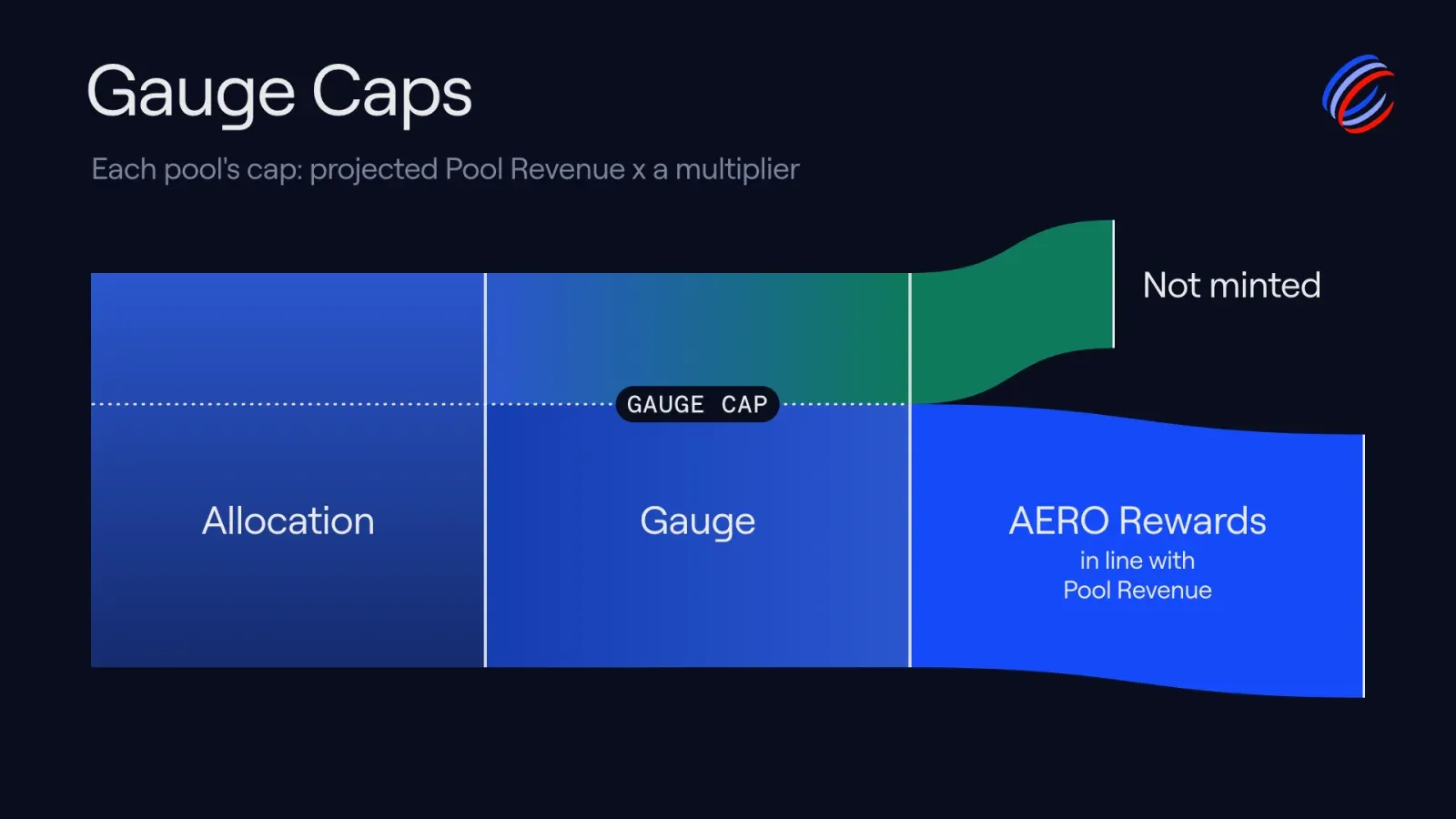
Figure 9: Gauge Caps: each pool’s cap is projected Pool Revenue times a multiplier; allocation above the cap is not minted, and AERO Rewards stay in line with Pool Revenue
Naturally, individual pools' actual multipliers will flexibly fluctuate around this mean based on developmental stages and competitive environments: aggressive pools in strategic cold-start may temporarily exceed the baseline, while absolute monopoly mature cash-cow pools will significantly lag below it.
This mechanism allows Aero to consistently provide LPs excess premium returns significantly exceeding ordinary Smart Fees while executing extremely precise mathematical controls on the token dilution cost of these premiums at the system layer.
Its core purpose is vigorously subsidizing high-productivity liquidity continuously capturing premium value for the network at rational costs matched to genuine market capacity.
Active Tick Rewards & MinStake Duration: Only Paying for Genuinely Effective Liquidity
Aero insists solely rewarding making capital residing within Active Tick zones, even if that interval isn't directly penetrated by specific trades at certain moments.
Valid pending order depth awaiting real trader swaps inherently holds massive commercial value, and reasonable compensation for this high-value waiting state is Aero's core secret to continuously maintaining the tightest network-wide quote depth.
However, to prevent malicious arbitrage capital exploiting this rule for fast-in-fast-out fake making, MinStake mechanism was born, firmly locking token rewards with truly stable, settled effective liquidity depth. Without this constraint, some speculative hot money could flash-deposit funds to plunder rewards seconds before large trades arrive, immediately withdrawal flee seconds after execution, harming ecosystem long-term stability and severely diluting legitimate rights of loyal long-term market makers.
Under MinStake, any market maker unauthorizedly withdrawing liquidity before the set minimum lock period expires will be directly forcibly confiscated of all accumulated token rewards during this period, with confiscated rewards flowing back along the original path to Token Operators' overall budget pool.
Pool minimum stake durations aren't one-size-fits-all but high-precision calibrated per underlying asset class and instant market environment: for highly volatile high-risk long-tail asset pools, lock periods designed relatively short granting necessary rebalancing agility; for highly stable homogenous token pairs or stablecoin pools with almost no decoupling risk, lock periods stretched to days or even weeks securing rock-solid ultra-deep base pools.
Active Tick rewards, highly sensitive responding Gauge Caps, and MinStake seamlessly interlock, allowing Aero to precisely maintain the network's deepest, most resilient, always-callable high-availability liquidity network at admiringly low marginal costs.
Maturity Period Profit Multiplication: Protocol Control & Revenue Capture
For LPs, pool depth itself is the strongest safety source. As Aero's trading pairs continuously accumulate depth and gradually transform into undisputed hegemonic trading venues chain-wide, the underlying making economics of pools will undergo gorgeous qualitative transformation.
During initial launch, extremely low unstaked fees (0% to 5%) draw massive amounts of traditional LPs suffering 17% to 25% platform tax exploitation from competitor platforms to under their banner at near-zero friction costs. This phase focuses on aggregating making scale, establishing absolute dominance.
Once a pool establishes unshakable dominance, Aero gains strategic initiative to moderately raise unstaked fees while still guaranteeing LP net yield beats external competitors. More wonderfully, this adjustment represents perfect win-win for the ecosystem: a portion of LPs naturally switch positions to staking to avoid unstaked fees, consequently contributing 100% Smart Fees cash flow; another portion choosing to remain unstaked directly amplify total protocol Pool Revenue volume.
Regardless of final yield payout mode chosen, pool absolute depth irreversibly continues thickening, driving pool revenue and network-wide trading volume into synchronized accelerating expansion.
Momentum Fund: Smarter Buybacks Efficiently Hedging Inflation
Momentum Fund isn't castles in the air; its predecessors, Public Goods Fund and Flight School, achieved extremely brilliant results in practical combat over past quarters: cumulatively buying back or permanently locking >110M AERO tokens across ecosystems like Base, playing pillar roles stabilizing token value center.
With full sailing of cross-chain Aero, this core stabilization fund operation logic welcomes comprehensive elevation. Given Gauge Caps already constrain new token emissions at frontend from source to within reasonable multiples of pool revenue, Momentum Fund sheds past mechanical passive shielding to focus on deploying genuine business surplus for devastatingly effective intelligent hedging.
Core missions mainly comprise three pillars:
• Launch large-scale token buybacks when secondary market valuations face irrational severe undervaluation;
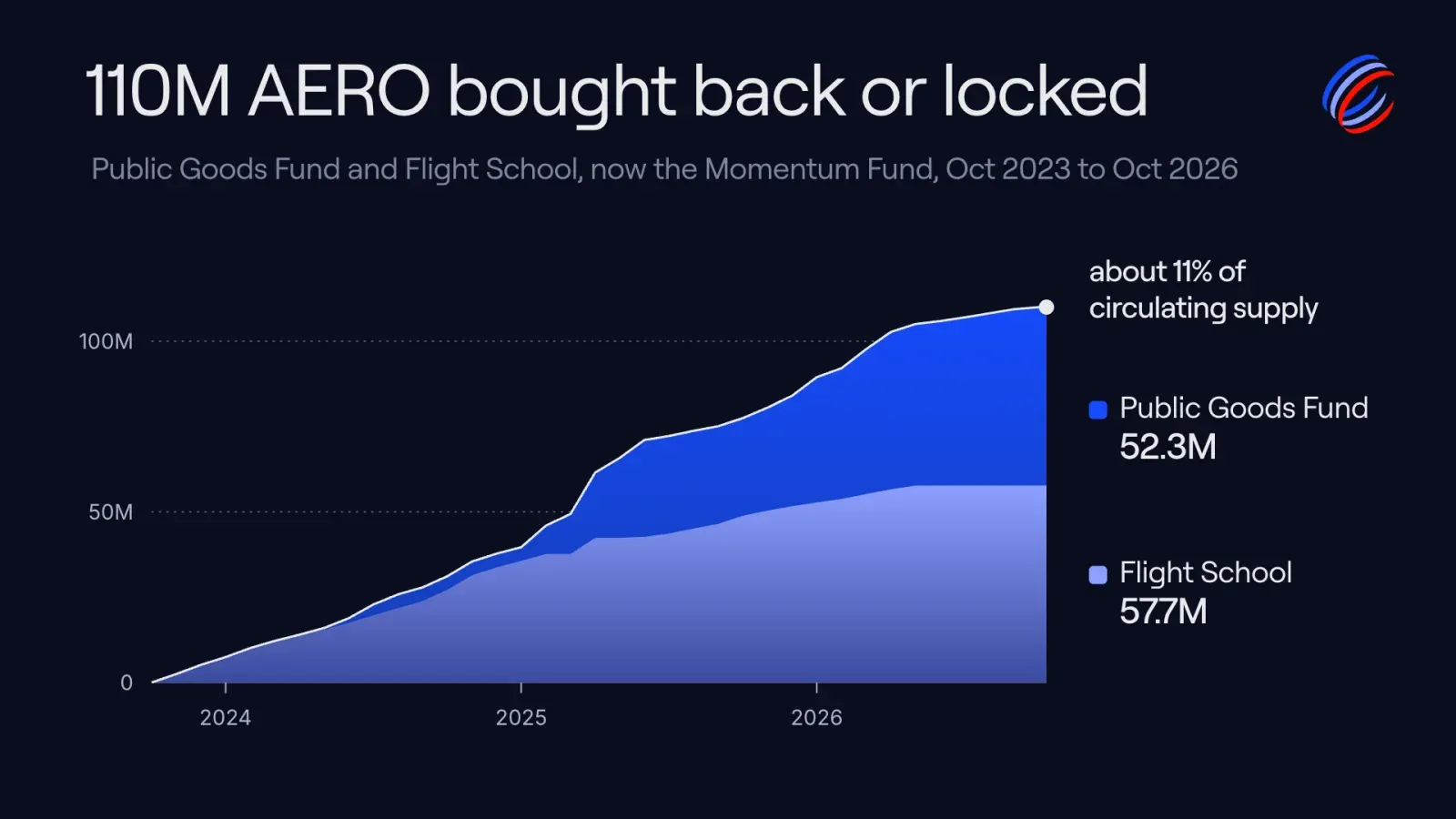
Figure 10: 110M AERO bought back or locked by the Public Goods Fund and Flight School
• Flexibly conduct permanent deflationary burns or re-lock as protocol-owned long-term liquidity assets based on macro market cycles;
• Construct an unbreakable underlying liquidity stabilization reservoir for the entire Aero economy, providing sufficient shock-absorbing buffers for the ecosystem during external black swan events.
Momentum Fund ammunition for these buybacks originates entirely from its own massive genuine endogenous revenue: fund itself holds top-tier network-wide sAERO governance positions, allowing legitimate Token Operator status to continuously directly draw endless high cash flow dividends from the massive trading network generating every second across the protocol.
Traditional mechanical buyback strategies executed via fixed calendar schedules harbor fatal flaws: whether token prices sit at inflated bubble peaks or face irrational bloody dumps, it must rigidly pull out identical fiat amounts to buy, easily becoming sucker buying bags at highs. Momentum Fund pioneeringly adopts market-perception buyback algorithms: when valuations are irrationally trampled, prices severely detached from fundamentals, buyback engines adaptively activate max horsepower, swallowing massive tokens from circulation at extremely low discounts; when prices surge wildly with market frenzy, buyback pace automatically slows, sedimenting precious cash reserves into treasury ammunition.
Public Goods Fund completely validated this adaptive strategy's exceptional power in real market turbulence since Oct 2025: during multiple extreme unilateral downtrends, fund cleared massive panic selling at astonishingly low costs, making token circulation extinguished per dollar of buyback funds reach multiple times traditional mechanical buybacks.
More critically, AERO tokens captured by Momentum Fund buybacks possess supreme authority to directly enter black holes for permanent burning: meaning circulating supply is genuinely, permanently erased, directly elevating per-unit value embedded in existing tokens without diluting any existing holder equity whatsoever.
Subsequent collaborative landing calculations will use most intuitive mathematical models to present comprehensively to readers the profound deflationary reshaping token burns exert on network-wide long-term circulating supply.
REV Engine: Brand-New Revenue Pillar Requiring Zero Additional Emissions
REV Engine design intention is to construct a super engine of pure incremental service revenue requiring absolutely zero additional making emission costs for the Aero economic skyscraper.
Typical application scenarios include but are not limited to:
• sAERO trading liquidity secondary market: allowing locked users to flexibly transfer governance rights and collect fees while retaining underlying positions;
• Institutional-grade automated liquidity management and position hedging tools: providing customized strategies to professional market makers and extracting tech service fees;
• Cross-chain seamless instant swaps (Metaswaps) & routing value-added services: capturing high value-added service fees during cross-chain settlement processes.
Early in business rollout, targeting independently developed native tools and external strategic partner ecosystems, REV Engine will adopt highly aggressive low-pricing strategies to vigorously drive product adoption and user penetration. Long-term strategic objective: let protocol overall income geometrically expand with infinite enrichment of user interaction dimensions, while ensuring every new inflow of exchange service revenue absolutely requires zero proportional AERO making reward additions at the expenditure end.
Thus making REV Engine Aero's ultimate structural competitive advantage dominating the entire DeFi sector: opened an entire set of pure profit business lines completely requiring zero LP making subsidies. This powerful endogenous blood-making ability is absolutely unreachable by competitors attempting to rush blades with Aero through aggressive emission money-flushing. External competitors might grab eyeballs short-term via liquidity subsidies, but absolutely cannot replicate Aero's massive genuine business cash flows forged through years of deep cultivation, profound ecosystem cooperation networks, and network-wide highly synchronized governance cohesion.
Multiple Mechanisms Synergistic Landing: How Three Pillars Form Flywheel Synergy
Aero ultimate strategic course is to drive continuous stable appreciation of revenue cashflows embedded per token, while unyieldingly paying most competitive excess remuneration to LPs at expenditure ends, firmly consolidating indisputable ultimate liquidity hub status across the industry.
Starting point of this grand opportunity lies in explosive leap of potential market volume: wider multi-chain network coverage, accelerating trillion-level strategic assets flooding on-chain, continuously expanding retail order flows grant Aero trading volumes severalfold previous magnitude. Unparalleled making compensation and silky-smooth extreme matching experiences swallow these order flows whole, while Slipstream V3 doubles/handles multiplier leverage per dollar making capital extracted fee ceilings via adaptive dynamic fees & innovative MEV tax.
As Aero ecosystem map approaches maturity, capturable value long broke narrow Smart Fees boundaries: liquidity & launch payments from issuers continuously inject massive external funds; once pool depth & dominance established, unstaked making fees contribute stable plentiful cash flow goldmine; while REV Engine independently carves multiple pure profit business lines outside trades completely dependent on emission subsidies.
Meanwhile, Gauge Caps & MinStake push making compensation capital utilization efficiency to extremes at expenditure end, paired with Momentum Fund massive intelligent buybacks & permanent burns, effectively offsetting most new emissions from business expansion. This precision-meshed machinery runs synchronously, ensuring Aero explodes increasingly terrifying market competitiveness with daily scale growth, while pushing genuine business income growth rates comprehensively outrun token circulating volume growth.
Core mathematical logic here lies in a massive positive difference scissors gap between Aero's actually captured total income and required making remuneration to sustain massive depth: AERO rewards strictly anchor to pool revenue at expenditure ends, but Exchange Revenue scope far transcends this, additionally absorbing derivative service revenue requiring absolutely zero additional making remuneration. Liquidity & launch payments directly count toward pool income, therefore naturally raising Gauge Caps incentive ceilings like ordinary fees; however, unstaked fees & REV engine service revenue directly bring pure cash flow increments to protocol without proportionally pushing any incentive ceilings.
This creates extremely rare economic miracle: protocol income growth rate completely surpasses LP making premium costs. Aero absolutely needs not sacrifice making profits to optimize balance sheets; instead, it wholly achieves protocol net profit rapid advancement relying on diversified non-trading incomes while letting LPs make fortunes.
Aerodrome's real financial data on Base long gave irrefutable empirical support to this theoretical model: in mere 4 weeks of Sept 2026, total real income distributed to veAERO holders guiding rewards reached shocking $14.9M, containing not only $6.1M directly pierced trading fees, but $8.9M external liquidity & launch payments. By contrast, under old fixed schedule emission models, concurrent actual AERO distributed to LPs totaled only $10.5M. Protocol captured real income already comprehensively surpassed all making incentive costs paid!
For sAERO stakers, even at current staking ratios, this mathematical ledger still shows extremely tempting profit certainty: sAERO currently locks ~half network circulating AERO supply, yet enjoys 100% pool revenue distribution rights; thus, even keeping AERO rewards to market makers at long-term 1.2x pool revenue highs, sAERO actual hard cash income far exceeds marginal token dilution suffered by its governance positions!
Perfect operation of this economic closed loop is facilitated precisely by three indispensable core pillars:
• Token emissions strictly link to genuine value: higher AERO secondary market valuation = fewer new tokens needed to maintain equal making remuneration;
• Intelligent burns forcefully suppress inflation curvature: Momentum Fund high-frequency buybacks & permanent burns completely withdraw supply from circulation, drastically lowering income growth thresholds required to maintain "per-token revenue growth";
• Expansive incremental markets spanning 7 chains enlarge per-token value: more networks, strategic assets & new derivative rollouts open ceiling for protocol long-term exponential income leaps.
Dynamic Token Emission Model Linked Closely to Value
Introduction of Gauge Caps fundamentally reshapes secondary market token valuation impact paths on total supply.
In traditional fixed-schedule mechanical emission models, regardless of bull/bear cycles, absolute emitted quantity per block is constant/rigid, while fiat purchasing power represented wildly bounces with secondary market. Aero completely subverts this inefficient mode: allows emissions to dynamically float within strictly controlled upper bounds, deeply bundling distributed reward value with pools' anticipated pool income.
When a pool hits Gauge Cap upper bound, higher AERO secondary price = fewer tokens needed to satisfy fixed USD budget; conversely, if price drops, more tokens emit to maintain incentives, but process strictly bound by protocol macro emission hard caps.
Note: this model applies to theoretical deduction upon hitting upper bounds, does not constitute any prediction of secondary market prices.)
As intuitive quick-calc benchmark rule: Aero annual actual new emissions % of total supply ≈ Gauge Cap multiplier × network annual pool revenue total ÷ AERO FDV. Example: if AERO valuation multiple set to 10x annual pool revenue, 1.2x multiplier yields ~12% annual actual emission; if market recognition rises, AERO valuation climbs to 20x annual pool revenue, annual emission instantly halves to ~6%! Currently, AERO actual annualized emission rate hovers ~11%; under current market valuation & existing Smart Fees levels, fully switching to 1.2x Gauge Cap mechanism will further plummet annualized rate to ~8%!
Builds direct healthy negative feedback regulation mechanism between protocol valuation, income growth & token supply inflation: thriving DEX sustains larger making reward budgets, higher secondary valuation reciprocally satisfies budgets with fewer tokens. Subsequently, Momentum Fund buybacks & burns further hedge considerable new emissions. Even if AERO price stages pressure requiring more tokens to maintain remuneration, every dollar of Momentum Fund buyback cash similarly clears exponentially cheap chips from circulation bottoms.
Gauge Caps also make assessing per-AERO embedded cash flow claim substantive thickening unprecedentedly simple/transparent: in any annual cycle, as long as protocol total income CAGR > token total supply inflation rate, real income allocable per AERO inevitably rises; and per above benchmark, supply growth rate depends almost entirely on AERO relative pool revenue valuation & Momentum Fund actual burned token totals.
Thus, at any given market valuation, protocol income needs only maintain growth pace matching supply inflation to ensure per-AERO embedded cashflows rock-solid; Momentum Fund continuous burns continuously lowers this must-achieve growth passing line.
More decisively, since sAERO stakers enjoy direct full distribution rights to protocol pool income, their threshold for realizing capital appreciation across cycles is far lower than pure external liquidity holders merely relying on secondary market "per-token yield expectations".
Token Burn Mechanisms & Broader Cross-Chain Market Space
Momentum Fund continuously strips tokens from circulation via high-frequency smart buybacks & permanent burns; every token sent to black hole burn objectively lowers protocol income growth threshold must-achieve to drive "per-token income" continuous climb. Meanwhile, full rollout of 7 core public chains, accelerated onboarding of high-value institutional strategic assets, & diverse derivative product matrix around REV Engine delivering massive order flows & endless non-trading novel revenue sources, granting boundless imagination space to protocol long-term income ceiling.
When these 3 forces converge, a self-improving grand closed loop leaps off page: under varying secondary valuation systems, deducting normalization 30%-scale revenue buybacks/burns, assuming protocol total income steadily compounds ~15% annually (meaning doubling in 5 years), within all intervals where income growth outspeeds net emission rates, underlying value borne per AERO welcomes explosive unidirectional growth.
Endgame Target: Born to Win Chain-Wide Order Flow
DEX sector endgame destined for extremely ruthless "winner-takes-all" great purge: as global high-value real assets flood on-chain worlds unprecedentedly, platforms ultimately standing atop throne will inevitably be super hubs truly achieving fair/plentiful LP compensation, while traditional making models relying merely on scattered discrete instantaneous fees long appear powerless before era rolling forward torrents.
Aero's epoch-defining answer is a super token carrying total value sedimentation of all network nodes & products: LPs obtain exceeding industry standard lavish making remuneration, Token Operators coordinate liquidity strategic flows, while every builder dedicated to enlarging network effects holds unshakable common interest in same ultimate asset. Upgraded Smart Fees maximize per-trade monetization efficiency, Gauge Caps firmly anchor emissions to pool revenue solid tracks, Momentum Fund relies genuine blood-making to continuously extract inflation pressure from circulation, while REV Engine injects fresh profits incessantly into empire without adding any emission burden.
This precision macroeconomic model's partial pillars weathered severe tests in real firestorms, especially stunning capital absorption capabilities shown by issuer liquidity & launch payments; while another frontier pillar contains infinite blue ocean opportunities awaiting joint ecosystem excavation. As revenue pillars grow daily, Gauge Caps ensure every penny emission precisely rewards most productive effective depth, while Momentum Fund continuous burns provides most solid seawall for managing macro dilution.
Aero's ultimate ambition: construct an on-chain super liquidity financial center exhibiting stronger overwhelming competitiveness & higher productivity as scale grows daily: Here, LPs capture industry highest capital returns every moment making risk exposed; traders & ecosystem builders enjoy network deepest/most resilient order execution depth anytime; sAERO stakers exclusively dominate highest equity of massive cashflow empire whose expansion rate inevitably comprehensively surpasses token circulating supply.
This is Aero's ultimate path defending LP dignity, winning chain-wide all order flows, letting every ecosystem builder share long-term compound dividend dividends.
Join TechFlow official community to stay tuned
Telegram:https://t.me/TechFlowDaily
X (Twitter):https://x.com/TechFlowPost
X (Twitter) EN:https://x.com/BlockFlow_News
 @aeroxyz