J.P. Morgan Research Note Analysis: Risk-Reward Balanced After Intel's 36% Drop, Upgraded to Neutral
Author: Rita
Intel closed at $89.85 on October 16, just about 5% away from JPMorgan’s $85 price target for December 2027. In its report dated October 18, 2026, JPMorgan upgraded Intel’s (INTC) rating from Underweight to Neutral. This move points to a key conclusion: the multi-year bearish trade on Intel has largely played out, and current risk-reward is nearly balanced.
JPMorgan’s rationale centers on execution. Following leadership changes, competitiveness in data center CPUs has improved, with the Data Center and AI (DCAI) group reporting $2.5 billion in operating profit in Q2 2026, surpassing client computing for the first time. 18A-P has entered risk production, and 14A is committed to high-volume manufacturing in 2028. Custom integrated circuit (ASIC) services are generating near-$2 billion in annualized revenue, up roughly 3x year-over-year. JPMorgan believes these developments are sufficient to remove the Underweight rating.
JPMorgan has not shifted to an Overweight view. External foundry scale remains small, and management noted that 2027 free cash flow will be “more challenging,” making incremental dilution a key risk. The upgrade addresses downside protection; evidence for upside requires watching four validation points.
Bearish Trade Narrows After 36% Decline
Intel’s stock pulled back approximately 36% from its June peak, compared to a 20% to 25% decline for the semiconductor sector during the same period. Since JPMorgan downgraded it to Underweight in November 2022, the SMH, SOX, Broadcom (AVGO), and AMD have outperformed Intel by 65%, 37%, 115%, and 148%, respectively. JPMorgan considers that most of the multi-year Underweight thesis has already been priced in.
Valuation multiples are also converging. Intel currently trades at roughly 25x JPMorgan’s 2028 EPS estimate of $3.60, against a sector multiple of 24x. This sell-off has compressed Intel’s relative premium to the peer group for most of 2026. JPMorgan sets its $85 price target for December 2027 using a valuation methodology of applying a sector 20–25x P/E, picking 24x, multiplied by the 2028 EPS of $3.60.
Dilution pressure is already factored into the baseline. Floats have increased from approximately 4.4 billion shares a year ago to roughly 5.1 billion. Includes the conversion of the US government’s 9.9% equity stake, NVIDIA’s $5 billion investment ($23.28/share), and SoftBank’s $2 billion placement, totaling approximately $20 billion in cumulative funding. JPMorgan believes further significant dilution risk is now more fully reflected in the current stock price.
DCAI Becomes Largest Profit Pool
DCAI operating profit reached $2.5 billion in Q2 2026, exceeding client computing for the first time. The report identifies servers as Intel’s largest profit pool, describing demand for Granite Rapids as “extremely tight,” with long-term agreements (LTAs) from customers like Google extending visibility into 2027. The client business continues to be driven by ASP growth and product mix shifts, with AI PCs accounting for two-thirds of the client portfolio.
Manufacturing progress shows step-change improvements. 18A-P is in risk production, 14A is fully committed to high-volume manufacturing in 2028, risk production targets are set for the second half of 2027, and the 0.9 process design kit (PDK) launched in October. JPMorgan also notes improvements in yield, process design rule compatibility, and advanced packaging, with EMIB-T advanced packaging backlog ramping toward 2027.
ASIC services offer additional optionality. JPMorgan estimates this segment at near-$2 billion in annualized revenue, up ~3x YoY, with a path pointing to $4 billion. This business leverages Intel’s IP portfolio, system-on-chip design capabilities, and leading-edge internal manufacturing. Hyperscaler spending on custom chips is accelerating, raising the strategic importance of ASIC services to Intel.
Foundry Revenue Still Two Orders of Magnitude Behind
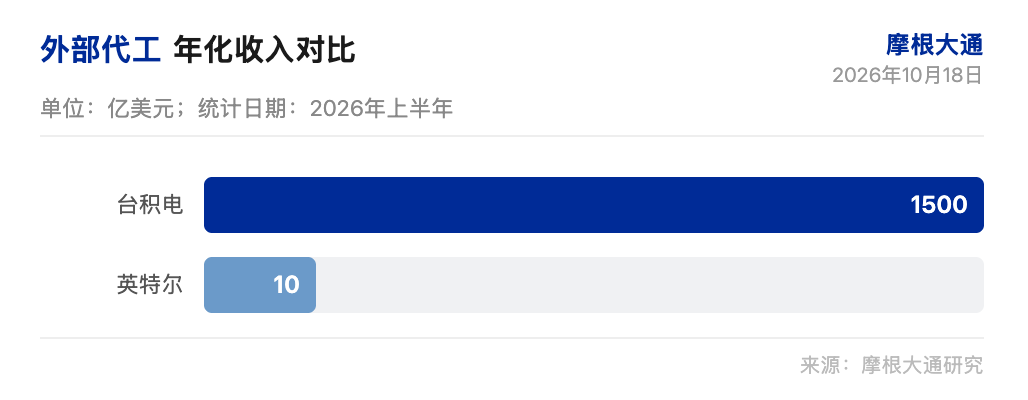
External foundry annualized revenue approaches $1 billion, compared to TSMC’s $150 billion for the same period—a difference of two orders of magnitude. JPMorgan acknowledges Intel’s progress in yields and new customer engagement, but external foundry scale remains small. For foundry to become a valuation anchor, it requires named anchor customers and verified economics for leading-edge nodes.
Capital structure remains another constraint. Management explicitly flagged 2027 free cash flow as “more challenging,” potentially necessitating another visit to the capital markets. JPMorgan lists incremental dilution as a key risk. The relatively cautious stance over the past 12 months was heavily influenced by pending dilution; much of this now sits in the baseline, but 2027 capital needs have not disappeared.
JPMorgan maintains Neutral, awaiting foundry customer confirmations. The report lists external foundry anchor customers as both an upside catalyst and a validation point for maintaining a wait-and-see stance. With external foundry operations at near-$1 billion in annualized revenue for H1, this figure remains far from altering the profit structure. JPMorgan does not cite foundry progress as the primary driver for the upgrade.
Four Validation Points Determine Next Steps
The first validation point is execution on the data center CPU roadmap and competing against AMD’s Turin, Venice, and Verano, which determines whether DCAI’s margin trajectory can hold. The second is the broader AI compute strategy, including the ramp of the Crescent Island GPU (recently renamed “D-Series”) and disclosure of wins in AI ASIC and inference accelerator designs.
The third is securing external foundry customers. The fourth is strengthening data center networking capabilities, either organically or via M&A. JPMorgan views networking as the fastest-growing layer in the AI stack; bolstering this capability would reshape Intel’s position in AI compute. Until these four validation points play out, the Neutral rating corresponds to “the market needs patience.”
On earnings forecasts, the report projects 2028 EPS at $3.60, approximately 15% above market consensus. Upside risks include faster CPU roadmap execution, foundry anchor customers landing, and accelerated wins in ASIC designs. Downside risks include next-generation node delays, memory-driven BOM inflation dragging on PC demand, and AMD continuing to gain share in clients and servers.
The bearish trade has largely played out; bullish evidence remains incomplete.

Disclaimer
This article compiles and interprets a third-party brokerage research report (JPMorgan, October 18, 2026) by TechFlow Research, supplemented with public market information. The ratings, price targets, earnings forecasts, and related judgments cited herein reflect only the views of that brokerage’s analysts, represent solely their institution’s positions, do not represent TechFlow Research’s views, and do not constitute any investment advice.
Investments carry risk, and decisions must be independent. This article should not be used as the basis for buying or selling any securities.
Join TechFlow official community to stay tuned
Telegram:https://t.me/TechFlowDaily
X (Twitter):https://x.com/TechFlowPost
X (Twitter) EN:https://x.com/BlockFlow_News
 @chaoxiangooo