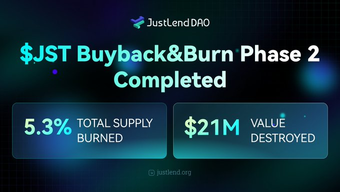
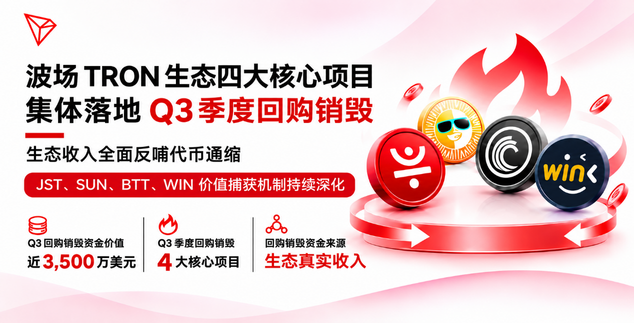
JST's five rounds of buyback and burn destroy 1.881 billion tokens, accounting for 19% of the total supply.
Author: TechFlow
On October 19, 2026, JustLend DAO officially released its latest audit data, formally announcing the cumulative results of the first five rounds of its native token JST buybacks and burns. Data indicates that the five operations have cumulatively burned 1,881,973,007 JST tokens, accounting for 19.01% of the token's initial total supply, with an estimated total burn value of approximately $118.15 million. This deflationary measure is executed round by round, fully leveraging the protocol's genuinely accumulated lending and staking fee revenues. All cancellation records are completely disclosed via on-chain transaction hashes, signaling the core lending network within the TRON ecosystem's profound advance toward a normalized value repatriation mechanism.
A Tiered Deflation Model Backed by Real Protocol Cash Flow
Governance tokens of decentralized finance protocols have long endured issues of inflationary dilution and excessive sell pressure, whereas JustLend DAO has opted for a pathway that supports asset deflation through verifiable profitability. As the largest decentralized money market and liquidity hub in the TRON ecosystem, JustLend capitalizes on its substantial lending pool accumulation to consistently capture native protocol revenue across asset deposit-lending spreads, liquidation penalties, and flash loan mechanisms.
This buyback and burn mechanism does not depend on illusory ledger adjustments fueled by token inflation incentives or reserved funds. Instead, it funnels the real cash flows accumulated from protocol operations directly into the secondary market for phased buybacks, which are then routed to a blackhole address for irreversible cancellation. With the completion of the fifth round, the cumulative network-wide burn volume nears the 1.9 billion mark, representing nearly one-fifth of the overall token supply. The timestamp, average buyback price, and burn hash for every transaction are available for real-time public verification on-chain, establishing transparent financial execution standards under community governance.
Restructuring Token Valuation Logic Through Reduced Circulating Supply
From a microstructural perspective of token supply and demand dynamics, the permanent removal of nearly 20% of the foundational supply is fundamentally altering JST's market pricing baseline. Within the crypto lending sector, most projects still rely on aggressive token unlocks to sustain Total Value Locked (TVL). This strategy, which caters to market makers and liquidity farmers, typically subjects secondary market liquidity to persistent downward pressure.
Through five rounds of high-intensity burns, JustLend DAO has substantially depleted the inventory of potential sell-side positions, thereby increasing the concentration of ecosystem equity represented per circulating token. Coupled with the steady expansion of on-chain stablecoin settlement volumes on TRON, the revenue foundation generated by the lending protocol continues to strengthen. Consistently cementing the surplus value generated by the protocol into a rigid reduction of token supply evolves JST's long-term valuation paradigm from a mere governance voting right to a productive asset underpinned by clear cash flow metrics.
Governance Evolution Toward Normalized Ecosystem Value Accrual
The smooth conclusion of the five buyback and burn rounds signifies that JustLend DAO's tokenomics governance has transcended its initial trial phase, stepping into an institutionalized and normalized new paradigm. In market cycles where competition in decentralized lending reverts to fundamentals, protocols that maintain robust cash flow accumulation and consistently deliver value rewards to token holders are rapidly fortifying their trust moats among institutional investors and core communities.
As subsequent buyback and burn initiatives roll out rhythmically in accordance with established governance proposals, the ongoing contraction of circulating supply will furnish ecosystem assets with a more resilient buffer against market volatility. JustLend's deep engagement in lending and liquidity management is gradually converting DeFi's positive financial externalities into long-term value outcomes shared equitably between the protocol and its holders.
Join TechFlow official community to stay tuned
Telegram:https://t.me/TechFlowDaily
X (Twitter):https://x.com/TechFlowPost
X (Twitter) EN:https://x.com/BlockFlow_News
 深潮TechFlow