Strategy Spends $1.6B to Rescue the Market, Does the STRC Preferred Stock Buyback Loop Face Liquidity Challenges?
Author: Jeff Albus, Unchained
Compiled by: TechFlow
TechFlow Summary: MicroStrategy (renamed Strategy) previously designed the STRC preferred stock, which carries an annual coupon rate of up to 12%, aiming to continuously supply dollar firepower for its relentless Bitcoin accumulation through premium secondary market offerings. However, since STRC broke below its $100 par value in May, this financing channel has completely stalled. To push the share price back above $100, the company launched a massive buyback program at the end of July, having already spent a staggering $1.6 billion. This buyback tug-of-war not only forces the company to spend up to nine times more on weekly preferred stock purchases than on buying Bitcoin, but also compels it to subsidize these operations by selling MSTR stock and even Bitcoin itself. As the buyback budget nears exhaustion, how much longer can this self-sustaining cycle hold?

Headline image: Michael Saylor-led MicroStrategy (renamed Strategy) is navigating the capital operation balance between its preferred and common stock.
To fuel its endless Bitcoin acquisition campaign, MicroStrategy (now renamed Strategy) meticulously engineered STRC: a high-yield preferred stock paying dividends of up to 12% annually. Under the original design, when STRC trades at or above its $100 par value in the market, the company can continuously issue new shares, pay semi-monthly dividends to investors, and funnel all raised cash directly into Bitcoin purchases.
However, this fundraising machine has been completely stalled since mid-May.
In late June, STRC plummeted to a historical low of $74.57, trading at a deep discount of nearly 25% below its $100 baseline par value. To rescue this core funding vehicle, Strategy launched a cost-irresponsible weekly buyback campaign starting in late July. According to a tally of the company's weekly regulatory filings, Strategy has now spent a cumulative $1.6 billion propping up the stock in the secondary market. As of Tuesday's close, STRC settled at $99.90, just 10 cents short of its $100 target price.
Last week marked the most aggressive period in Strategy's history for STRC buybacks: weekly expenditures reached $192.4 million, roughly nine times its concurrent Bitcoin purchase spending (approximately $21 million). Under the company's established policy, it will not issue a single new share of STRC in the market until STRC firmly anchors at $100.
Where does the buyback funding come from? How long can the cash pool sustain it?
So, is this costly buyback cycle draining the company's cash reserves?
The answer is: not yet exhausted, but the window is rapidly closing.
The board-approved preferred stock buyback budget, if continued at last week's pace of nearly $200 million, will be completely exhausted in approximately two weeks. Of course, the board retains full authority to pass another resolution, as it did in September, to double the buyback authorization to a higher amount (having previously doubled it from $1 billion to $2 billion).
A more immediate constraint lies in cash reserves. At last week's consumption rate, current available liquidity will only last a little over three weeks. Crucially, Strategy's primary funding channel for this astronomical buyback bill comes from continuously issuing and selling additional MSTR common stock in the open market, or tapping into the cash pool accumulated from previous MSTR reductions. As long as MSTR maintains robust secondary market liquidity and its stock price remains firm, the company can continue selling shares to raise funds.
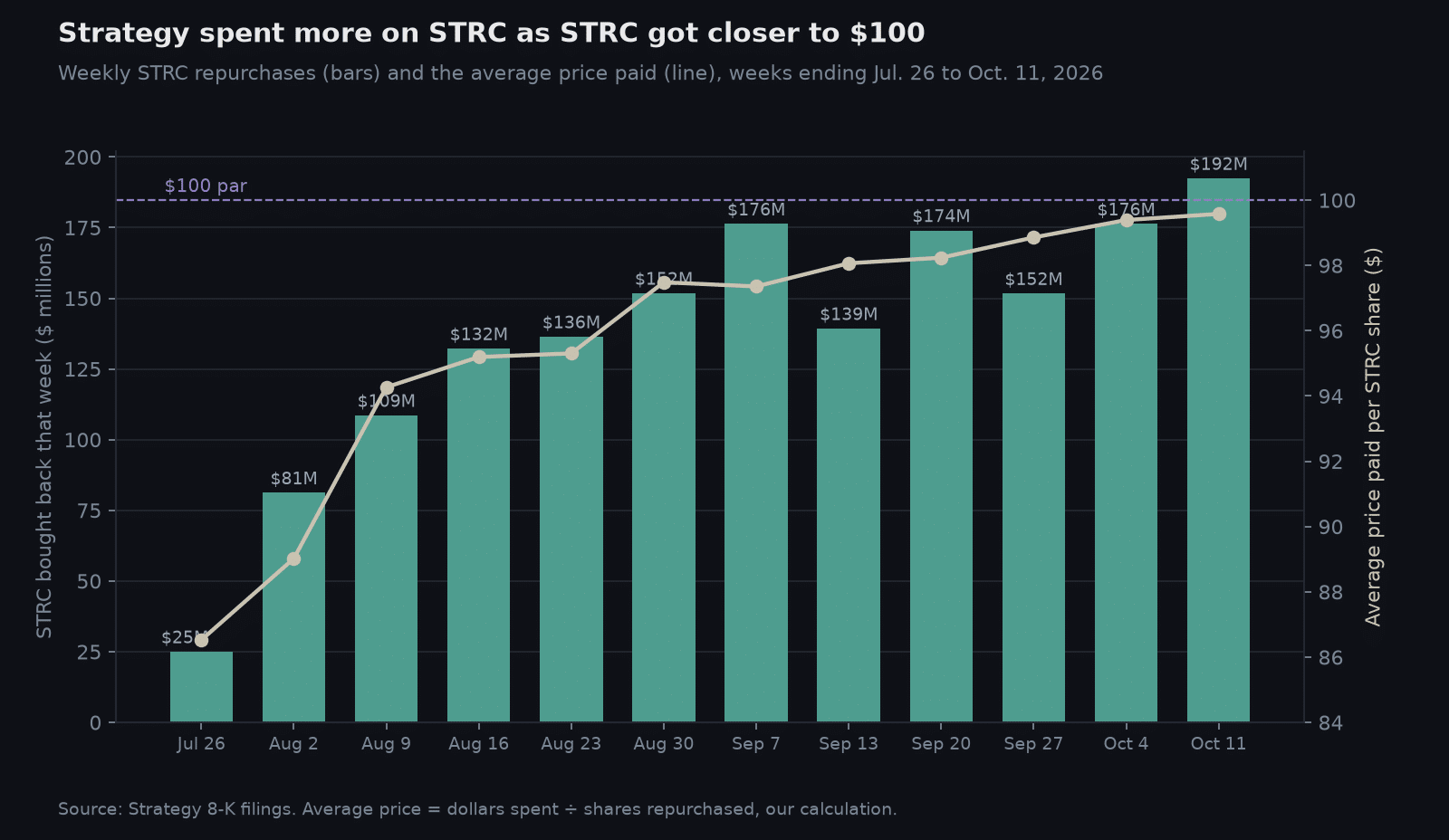
Chart: Comparison of the weekly STRC buyback amounts by Strategy since July versus the upward trajectory of STRC's market price.
From a Bitcoin Leverage Tool to a Burden Requiring Massive Capital Infusions
Strategy's rise to become the largest corporate Bitcoin holder globally rests on two foundational pillars: first, the US dollar will inevitably depreciate over the long term; second, global capital markets have an insatiable demand for a compliant, high-leverage Bitcoin allocation tool. To satisfy this, the company has rolled out a series of preferred stock instruments, attempting to build a perpetual flywheel for Bitcoin accumulation.
Yet today, STRC has morphed into a heavy burden that requires massive capital just to barely prop up.
Over the past several months, the vast majority of capital raised from selling MSTR stock has not flowed into the Bitcoin market, but has instead been entirely diverted to buy back and retire STRC. During the summer this year, the company was even forced to sell portions of its Bitcoin holdings to gather sufficient buyback funds.
From a pure financial actuarial model perspective, as long as MSTR common stock continues to trade above approximately $131, issuing MSTR at higher prices to buy back and retire STRC at a discount would not materially dilute existing MSTR shareholders on a net asset value per share (NAV) basis.
However, at the level of investment logic and capital structure, this operation brings an extremely subtle qualitative shift: it is substantially reducing MSTR's elastic leverage relative to Bitcoin. The capital engine once dedicated to aggressively buying Bitcoin is now trapped patching up internal preferred stock discounts.
Buyback Execution Details and Market Dependency Risks
Strategy disclosed its support strategy for STRC in its Q2 earnings report: as long as the STRC price falls below $100, the company will intervene continuously, "increasing purchases when the discount widens and gradually scaling back as the price approaches par."
In the first week of late July, the company's entry was quite measured, purchasing only $25 million worth of STRC at an average price of about $87 in the open market. However, as prices climbed, weekly expenditure checks expanded exponentially. Last week, Strategy's buyback average price hit $99.58, fully entering the company-defined resistance zone between $99 and $100.
This sustained large-scale sweeping of orders has made Strategy itself the largest absolute liquidity provider in the STRC market. On-chain and order book monitoring data from crypto market maker Keyrock indicates that during September's total weekly STRC trading volume, Strategy's proprietary buybacks accounted for one-fifth to one-quarter (20% to 25%).
Keyrock bluntly points out that existing data makes it impossible to measure: how many genuine independent buy walls would actually remain in the market once Strategy reaches the $100 target and withdraws its floor-supporting buyback capital. If weak external buying causes STRC to decouple and fall below par again, this multi-billion-dollar self-rescue cycle will be forced to restart.
Join TechFlow official community to stay tuned
Telegram:https://t.me/TechFlowDaily
X (Twitter):https://x.com/TechFlowPost
X (Twitter) EN:https://x.com/BlockFlow_News
 @Unchained_pod