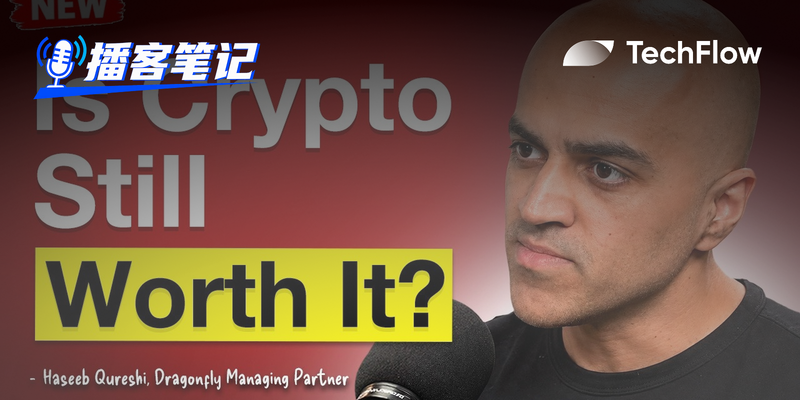
Interview with Dragonfly Partner Haseeb: AI Agents Do Not Need Crypto, Privacy Is the Real Killer App for Cryptocurrency
Written & Hosted by Mr. Z (@168MrZ)
Cards have already taken over agent payments; crypto’s true value is shifting toward privacy, financial autonomy, and agentic UX. Hyperliquid is expanding the market rather than merely cannibalizing CEXes, while Robinhood Chain still needs to prove its case for RWAs and developer ecosystems.
Monday, October 12, 2026, 2:00 PM. 168X welcomes back Dragonfly Managing Partner Haseeb Qureshi (@hosseeb). It has been over half a year since we last met in Hong Kong. The crypto market has experienced a significant drawdown and is now beginning to warm up again. Crypto feels a bit boring this year, but he believes the bull market is returning.
Just back from TOKEN2049 Singapore, what Haseeb sees is no longer the crypto driven by parties, memes, and pure retail speculation from the previous cycle. This year, TOKEN2049 still drew around 25,000 attendees, but a more telling detail is this: during past Token Weeks, the Marina Bay Sands Marquee was almost booked every day by crypto projects. This year, however, it remained fully operational as a regular nightclub all week without any crypto buyouts.
The most significant shift has happened in AI. Early this year, Haseeb also subscribed to a widely popular thesis: once AI agents become truly autonomous, they will inherently need stablecoins and crypto rails. But now that agents are actually here, the answer is completely different: agents didn’t wait for crypto. They adopted cards first.
In this conversation, we cover everything from AI agents, privacy, and agentic finance to Robinhood Chain, Hyperliquid, HIP-3, equity perpetuals, Dragonfly’s next phase, and why Haseeb believes the “crypto VC” category might not even exist in the future.
1. TOKEN2049’s Most Honest Indicator: The Marquee Goes Unbooked for the First Time
Mr. Z: You just returned from TOKEN2049 Singapore. What was the biggest difference on-site compared to your original expectations?
Haseeb: TOKEN2049 should now be the world’s largest retail crypto conference, drawing roughly 25,000 attendees this year. But if you ask me what best reflects the current state of crypto, I’d point to the Marquee. Every year during Token Week, the Marina Bay Sands Marquee had been booked nightly by some crypto project. But this is the first time I’ve seen it run as a normal nightclub for a full week without any crypto buyout.
Haseeb: That speaks volumes about how the industry has shifted. Retail activity, volatility, and project trends are still there, but the energy from the frantic speculation of past cycles is noticeably lower. Conversely, one of the most important events at TOKEN2049 this year was a closed-door institutional gathering, with many hedge funds, asset managers, founders, and regulators flying specifically to Singapore to attend.
Haseeb: Conferences still hold alpha. Keeping up with conversations always gives you insight into where capital is flowing and which projects are gaining attention. But the industry is undeniably aging, maturing, and becoming more institutional. People used to come mostly for the party; now, more and more are genuinely here for business, deals, and flows.
2. AI Agents Never Waited for Crypto: Cards Win Payments First
Mr. Z: You publicly revised a stance in your speech at TOKEN2049. At the start of the year, many argued that AI agents would inherently require crypto, but you’re now saying otherwise. What made you change your mind?
Haseeb: Early this year, many people, myself included, believed crypto would become necessary infrastructure for AI. The logic is intuitive: AI agents don’t have driver’s licenses or Social Security Numbers. How do they complete KYC, open bank accounts, or use traditional payment rails? Naturally, we deduced that stablecoins would become the primary payment method for agents.
Haseeb: The thing is, agents were highly theoretical early this year. Now that’s no longer the case. Enterprise and consumer adoption are accelerating rapidly, allowing us to finally observe what they’re actually using. The answer is straightforward: they are primarily using cards.
Haseeb: Visa, Mastercard, and companies built on top of card networks like Rain, Ramp, and Stripe quickly delivered exactly what agentic payments needed. Spending limits, risk limits, and permissions can be directly integrated into existing card rails. We originally assumed traditional finance wouldn’t adapt this fast, but they solved this problem quicker than expected. So we should just admit it outright: we got this wrong.
3. Crypto Doesn’t Need to Be the Default Agent Payment Layer: It’s Only Used When Truly Superior
Mr. Z: If cards can already handle the bulk of agent payments, what truly defensible advantage does crypto have left?
Haseeb: An agent will use crypto for essentially the same reasons humans do: when it’s the best tool for the job. If I need to send an international remittance and a stablecoin is cheaper and faster, my agent will naturally realize crypto should be used. If an on-chain market offers functionalities that traditional finance lacks, it will adopt it too.
Haseeb: The mistake was assuming, “Because it’s software, it must prefer crypto.” That’s simply not true. Agents have no ideological loyalty to crypto; they only optimize. Sometimes the answer is cards, sometimes it’s APIs, sometimes it’s stablecoins, and only sometimes is it an on-chain protocol.
Haseeb: I think this thesis is actually healthier. Crypto doesn’t need to win all payments; it only needs to win where its architecture genuinely holds an edge. Ultimately, the market will force crypto to answer a more fundamental question: which financial actions are objectively better executed via blockchain than through traditional rails?
4. The Real AI & Crypto Intersection: Your Agent Becomes Your “Crypto Guy”
Mr. Z: If payments isn’t the biggest story, then how will AI actually transform crypto?
Haseeb: The biggest shift will happen at the interface. Today, you have to manually bridge tokens, monitor gas fees, hunt for yields, compare Aave and Morpho, rebalance portfolios, and find the lowest trading fees. Many of these tasks will disappear in the future. You’ll just tell your agent, “I want to achieve X.”
Haseeb: Your agent becomes your “crypto guy.” It finds the best yields, lowest fees, and optimal entry paths, while handling due diligence for you. Every time you interact with a smart contract, it audits the code, checks the team, scans LinkedIn, searches X, identifies honeypots, Ponzi schemes, and rug pull risks, and never skips checks out of laziness or succumbs to FOMO.
Haseeb: Today’s agents will obviously still make mistakes, but today represents their absolute worst performance going forward. With every model release, they only get better. Like self-driving cars, which were less safe than humans five years ago but are vastly different today. So the truly interesting takeaway might not be that AI makes crypto more machine-friendly, but that AI finally makes crypto safe and simple enough for ordinary people to actually use.
5. Privacy Is the True Killer Use Case: The Stronger AI Gets, the More Individuals Need Crypto
Mr. Z: Dragonfly recently invested in Venice AI (@AskVenice) and Sapiom (@sapiom). Where do you see the core intersection between AI and crypto right now?
Haseeb: I think the most critical piece is privacy. AI itself poses a severe threat to privacy because every time you hand data over to an AI, you’re typically handing it to a third party. Psychologically, we treat our interactions with AI as deeply private—an extension of our own minds—but from a technical and legal standpoint, that data isn’t necessarily contained within your own private space.
Haseeb: AI also dramatically lowers the barrier to large-scale surveillance. Data once scattered across different platforms can now be instantly aggregated, analyzed, and even de-anonymized by models. Therefore, as AI amplifies the capabilities of nations and large institutions, there needs to be a parallel technology stack to empower individuals. This is the entire premise behind privacy-preserving cryptography, Zcash, Monero, and private AI infrastructure.
Haseeb: Venice is a prime example. You can absolutely use traditional logins and credit cards, but if you truly want strong privacy, you can leverage a crypto wallet, pay with crypto, and combine it with encrypted inference. If you use a credit card, the platform will definitely know your identity. But if you use crypto alongside true end-to-end encryption, the platform might not even know your name, location, or which model you’re using.
Haseeb: So I’ll say something quite different now from early this year: crypto isn’t meant to be used by your AI agent; it’s meant to be used by you. Your agent merely uses it on your behalf.
6. What Agentic Finance Will Eliminate First Is the “Lazy Tax” Charged by Banks and Brokers
Mr. Z: You’ve also been discussing agentic bank runs recently. If everyone’s agent starts automatically managing money, could that make the financial system more fragile?
Haseeb: What happens in Phase 1 probably won’t be a bank run at all. Instead, countless business models built on human laziness will get dismantled. Imagine parking a massive cash balance in a JPMorgan checking account earning rock-bottom rates, while money market funds could deliver significantly higher yields. Why don’t people move their money daily to the highest-yielding option and transfer it back when they need to pay? The answer is simple: people are lazy.
Haseeb: Agents aren’t lazy. They operate 24/7, check your funds hourly, and automatically shift idle cash to the optimal destination. Cheap deposits form the bedrock of many large banks’ business models. Because consumers are too lazy to move money, banks can lend at extremely low funding costs and pocket the spread. The same applies to many brokers; a massive chunk of Schwab and Fidelity’s economics comes from customers leaving cash in sweep accounts.
Haseeb: Agents will arbitrage away this “human laziness tax.” The most likely outcome isn’t a sudden run on every bank, but banks being forced to raise deposit rates to retain capital. As a result, funding stops being so cheap, compressing margins and ROEs across both banks and brokerages.
7. Amazon Already Started Blocking Agents: Agent-First Companies and Local Agents Will Win
Mr. Z: Won’t these incumbents just sit idle while agents siphon off their profits?
Haseeb: Of course not. The second path is to directly block agents. This trend is already emerging. If a platform’s profitability relies heavily on advertising, sponsored placements, or intentional user friction, an agent that genuinely acts in the user’s interest becomes a direct threat. Because an agent doesn’t care what a sponsored result looks like; it will simply surface the outcome that’s best for the user.
Haseeb: Banks will eventually face the exact same incentives. They won’t say, “We don’t want your agent moving deposits to higher-yielding venues.” Instead, they’ll claim, “It’s unsafe,” “There’s compliance risk,” or “AI might hallucinate.” But the underlying conflict of interest remains identical.
Haseeb: So long-term, I’m particularly bullish on two things. First, agent-first companies that embrace agentic commerce from day one. Second, local agents. If the agent you use is fundamentally owned by Meta or another third-party platform, they can easily block those companies. But if AI actually runs on your own computer, manipulating your browser just like a human would, it becomes nearly impossible for them to block you.
Haseeb: Ultimately, the greatest power shift will move from “platforms deciding what you can do” to “your agent acting strictly in your best interest.”
8. 2026 Predictions Review: $150K BTC Is Hard, but Fintech Chains Were Indeed Overvalued
Mr. Z: You released a long list of 2026 predictions late last year. Looking back now, which calls were most accurate, and which need correction?
Haseeb: Overall, I think the call held up well, though certainly not perfectly. I pegged BTC hitting $150,000 by year-end. Given current pricing levels, getting there would require nearly doubling the price, which carries very high difficulty. However, I still believe reclaiming the $100,000+ range remains plausible.
Haseeb: Regarding fintech chains, I feel the directional thesis was largely correct. Last year, the market briefly believed that Tempo, various fintech chains, and Robinhood Chain would leverage their distribution channels to siphon massive amounts of stablecoins and RWAs, potentially challenging Ethereum and Solana. To date, none of that projected scale has materialized.
Haseeb: Robinhood is still early, so I won’t jump to conclusions just yet. But the vast majority of newly minted RWAs are still happening on Ethereum and Solana. Distribution matters immensely, but distribution alone does not automatically build a blockchain ecosystem.
9. Robinhood Isn’t the Next Solana Yet: What’s Missing Are RWAs and Developers
Mr. Z: I’ll push back on that. Robinhood Chain has recently rolled out Agent Finance, programmable hooks, stock token liquidity, perpetuals, and new market structures. Do you still think it’s far from competing with Solana?
Haseeb: I currently consider Robinhood Chain a TBD (To Be Determined). There’s definitely a lot of meme activity right now, but Robinhood never aimed to build a meme chain; its core thesis revolves around RWAs. Yet on-chain RWA activity remains minuscule, capturing only a fraction of the total RWA market.
Haseeb: Then there’s the developer issue. I’m not seeing a sustained influx of independent developers building novel applications or pioneering new ideas on Robinhood. Right now, it’s dominated by meme farming, meme cycles, and occasional market structure experiments. While perpetuals and DeFi market structure innovations are worth watching, comparing absolute metrics reveals Robinhood Chain remains significantly smaller than Hyperliquid, Arbitrum, BSC, Tron, Base, and Solana.
Haseeb: I’m not saying it won’t succeed. I simply feel the market prematurely equated “Robinhood has distribution” with “Robinhood Chain will swallow everything,” which hasn’t been proven to date. The real metrics to track are whether it can generate sustained RWA activity, attract independent developers, and foster native applications that build their own flywheels independently of the Robinhood brand.
10. PerpDEX Consolidation Won’t Leave Just Hyperliquid: Equity Perps Represent the Structural Opportunity
Mr. Z: You previously predicted perp DEXs would ultimately consolidate into a handful of major venues. With Hyperliquid dominating so strongly, does that assessment still hold?
Haseeb: If you actually look at the numbers, we’re not terribly far from my initial projection. In today’s 24-hour snapshot, Hyperliquid reports roughly $4 billion in volume, while Variational (@variational_io) and Lighter (@Lighter_xyz) each sit around $1.5 billion. It’s not yet the exact 40/30/20 split I forecasted, but a clear oligopoly structure among a few major venues is already emerging.
Haseeb: Full disclosure: we are investors in both Variational and Lighter and hold a position in HYPE. Nevertheless, I maintain that as these venues’ liquidity flywheels mature, the market structure will continue to consolidate.
Haseeb: Another area where I’m fairly confident in our call is equity perpetuals. Early this year, that market was effectively near zero, and it’s now gaining tangible traction. I believe one of the most critical growth vectors for DeFi derivatives going forward will be migrating stocks and broader traditional assets into a shared perpetual infrastructure.
11. HIP-3 Isn’t as Permissionless as Hyped: TradeXYZ (@tradexyz) Looks More Like a Deep JV
Mr. Z: I personally love HIP-3. Jeff basically told everyone they can hop on Hyperliquid, launch their own casino, set custom rules, and just pay rent. So why are you somewhat skeptical of this model?
Haseeb: If this model were inherently flawless, we should have already seen numerous success stories before TradeXYZ emerged. That’s simply not the case. TradeXYZ is undoubtedly a massive success, but it wasn’t just a random team walking through the front door and automatically succeeding via HIP-3.
Haseeb: It already shares a deep history with the Hyperliquid ecosystem, including prior collaborations around spot infrastructure, among other areas. This leads me to view it more as a deep partnership—or even a quasi-JV—rather than proof that a purely neutral, permissionless marketplace spontaneously births great companies.
Haseeb: If you’re actually trying to build a massive market, you’ll quickly hit a pragmatic reality: why should you build your entire company on someone else’s land, commit to heavy long-term rent, and accept platform risk from potential future rule changes? If you’re aiming to be the next Polymarket, you’d likely prefer owning your own infrastructure.
Haseeb: Hyperliquid can provide excellent rails, but it won’t automatically execute market development for you. Taking a brand-new category from zero to one still demands founders, a complete team, capital, and distribution. A protocol primitive reduces execution friction, but it cannot replace actual company-building.
12. Hyperliquid Isn’t Cannibalizing CEXes: It’s Actually Creating a New Market
Mr. Z: The prevailing narrative is that Hyperliquid is stealing market share from Binance, OKX, Bybit, and Bitget. Why do you disagree with that framing?
Haseeb: If you actually map out the unique addresses transacting on Hyperliquid and cross-reference them with CEX usage, you’ll find the overlap between user bases is far lower than commonly assumed.
Haseeb: Three or four years ago, the global landscape was littered with non-KYC CEXes, whose user bases more closely resemble Hyperliquid’s current demographic. Today, however, all major CEXes operate under strict regulation and universally mandate KYC. A substantial segment of users lacking viable CEX access due to regional restrictions, compliance barriers, or other factors now has a legitimate venue to trade. For them, Hyperliquid isn’t about switching from Binance; it’s about finally having anywhere to play.
Haseeb: If Hyperliquid were truly eating CEX market share, you would expect Hyperliquid volume to climb while CEX volume declines. Instead, we see both growing simultaneously. Therefore, I argue this is closer to pure market expansion rather than market share displacement.
13. HYPE’s Next Growth Curve: Pre-IPO Has PMF, but Crypto Core Remains the Foundation
Mr. Z: Traditional markets will inevitably converge closer to 24/7 trading. Once “around-the-clock trading” ceases to be a moat, where does Hyperliquid’s next growth curve lie? Pre-IPO, private markets, or HIP-3?
Haseeb: Pre-IPO equity demand is undeniable, and product-market fit is clearly established. TradeXYZ still has massive runway for expansion. But if you ask me what Hyperliquid’s single largest product vector will be next, I don’t have a definitive answer right now.
Haseeb: That said, I often feel people get overly fixated on “how Hyperliquid breaks out of crypto” and overlook the sheer strength of its native crypto business. I remain relatively optimistic about the crypto market over the next twelve months, so if the broader cycle recovers, both the HYPE token itself and exchange-centric crypto trading ecosystems will benefit from favorable tailwinds.
Haseeb: The ideal scenario isn’t Hyperliquid severing ties with crypto, but rather the crypto core continuing to compound organically while equity, pre-IPO instruments, and broader financial assets systematically expand the TAM layer by layer.
14. Dragonfly Beyond the “East-West Bridge”: Evaluating Holistic Global Crypto in the Next Phase
Mr. Z: One of Dragonfly’s earliest defining positions was co-founder Bo Feng bridging China’s first-generation internet capital with global crypto. With the US-China geopolitical environment completely transformed today, should Dragonfly still be framed as an East-West bridge?
Haseeb: When I first entered crypto, China’s stance toward the broader industry was actually quite constructive. Sure, the 2018 ICO crackdown happened, but crypto never fully vanished underground. By 2020, as the market entered hypergrowth, there was a palpable sense that crypto would ultimately evolve into a globally accepted technology.
Haseeb: Post-2021, China banned crypto and mining outright. Many founders who originally built in China relocated to Singapore, Hong Kong, followed shortly after by Dubai and the US. So today, I wouldn’t frame Dragonfly’s role as merely connecting China and the US. Crypto is inherently global.
Haseeb: The Chinese diaspora remains a vital pillar of this industry; they’re just geographically dispersed now. Our LP base includes Asian capital as well as American institutions. I constantly emphasize that if you truly want to excel at crypto investing, you must see the entire elephant, not just tap the side.
Haseeb: That’s precisely why we maintain operational hubs in both Singapore and New York. We want to identify founders creating genuine value wherever they emerge, rather than letting corporate registration locations dictate investment merit. Long term, I also believe China will eventually reach an inflection point to re-realize that crypto has grown too large to ignore. It’s too strategically important, and too foundational to the 21st century, to be sidelined indefinitely.
15. Why “Crypto VC” Will “Disappear”: Only True Investors Will Survive Into 2030
Mr. Z: You’ve mentioned before that as crypto matures, the “crypto VC” label may vanish entirely. By 2030, what kind of fund will actually earn its place in the industry?
Haseeb: I’m not saying crypto investment firms will all cease to exist, but we simply won’t categorize them as “crypto funds” anymore. Crypto has moved into water utility status. Stablecoins will power fintech backends, neobanks will integrate crypto natively, consumer products will ship with embedded wallets, and tech companies will quietly layer blockchain rails into their infrastructure.
Haseeb: We used to use the term “internet investor.” When the web first emerged, that distinction made perfect sense. But once every company became an internet company, the phrase faded until only “investing” remained. I believe crypto will inevitably converge to the exact same endpoint.
Haseeb: This transition will be brutally unforgiving to funds whose sole competitive edge is “we know how to scoop tokens.” Back in 2020 and 2021, you could raise a fund, buy a few tickers, flip some shitcoins, and legitimately call yourself a crypto VC. That playbook will grow exponentially harder to replicate.
Haseeb: The sustainable edge will shift to questions like: do you fundamentally understand the industry? Do you possess authentic relationships? Can you actively solve problems for founders? Beyond claiming “you know crypto,” what tangible value do you inject? If the answer is nothing, you won’t survive this transition. But if you bring genuine depth, I actually see massive opportunity ahead.
Mr. Z: So, with your current trip to Asia, who do you most want to meet—researchers, investors, or someone else?
Haseeb: Always founders. I want to connect with builders crafting new things and generating novel ideas. We’ve always operated on the belief that great concepts can emerge from anywhere in the world.
Mr. Z: Wrapping up this episode, I think we can distill four key takeaways. First, AI agents didn’t default to crypto as a payment rail as many anticipated early this year; cards secured the bulk of consumer payments much faster. Second, the actual intersection between AI and crypto may offer even greater upside: agents will rewrite crypto UX, while privacy emerges as critical infrastructure for protecting personal autonomy in the AI era. Third, Hyperliquid is currently forging a new market rather than merely stealing volume from centralized exchanges, and HIP-3 alone won’t magically birth a world-class company. Fourth, crypto is evolving from an isolated vertical into the foundational infrastructure of the broader financial and technology landscape—eventually rendering the “crypto VC” taxonomy obsolete. Thank you, Haseeb, for joining 168X once again!
Join TechFlow official community to stay tuned
Telegram:https://t.me/TechFlowDaily
X (Twitter):https://x.com/TechFlowPost
X (Twitter) EN:https://x.com/BlockFlow_News
 @168X_Fortune