Behind the Stock Tokenization Boom: Who’s Making Money, and Who’s Doing the Heavy Lifting for Others?
Author: Decentralisedco
Compiled by: AididiaoJP, Foresight News
Tokenized Stocks: Who Makes Money?
In 2017–2018, Ethereum proved smart contracts worked, and we once considered moving everything on-chain. But over the following months, fragile infrastructure harshly educated the market. Then the dream shifted: What if crypto assets could be bought, sold, and held alongside traditional assets in the same brokerage account? That’s how crypto ETFs came to be. Now, we stand at a similar crossroads again: tokenizing every financial asset to make it more usable and accessible than today.
Currently, traders and investors hold over $6 billion in on-chain equity exposure through two paths.
The first is tokenization. A company buys shares, hands them to a custodian, and issues a corresponding token. All on-chain equity tokens combined are worth $3.21 billion, up 10% over 30 days. The second is a synthetic path: paying for price movements via perpetual contracts without anyone actually buying the underlying shares. On trade[XYZ] alone, open interest for stock, index, and ETF perp contracts reaches $3.01 billion, accounting for 94% of the total value of all on-chain equity tokens.

So, starting from the $3 billion scale, where does this go next? We see four stages for tokenized equities.
Today, what you mostly buy is wrapper: an offshore claim issued by some entity. Next, tokens become collateral, allowing you to borrow against NVIDIA even when markets are closed. The step after that: brokers let you convert existing holdings into tokens without selling. This is the trillions-level market—foreign investors alone hold nearly $20 trillion in US equities. Finally, companies record the shares themselves on-chain, eliminating the need for wrappers. A small batch of public companies is already doing this.

All You’re Getting Is an IOU
When you buy NVIDIA through a broker, the official shareholder register lists Cede & Co., the nominee for the Depository Trust Company (DTC); your broker’s ledger then shows you as the holder. Most equity tokens are essentially claims on this record-keeping arrangement.
Take Robinhood, for example. BBVI, or Bitstamp Global (a Robinhood subsidiary), buys the shares, while Alpaca acts as both broker and custodian. Robinhood Assets (Jersey) then issues you a debt security. In practice, this means each token is a debt obligation valued at one share. Dividend reinvestments and stock splits adjust how many shares each token represents. It carries no voting rights and grants no direct equity ownership. If the issuer goes bust, the securities agent liquidates the underlying stock to repay holders.
Who keeps the token price pegged to the stock? Authorized minters. Minters arbitrage between the stock and the token: they buy cheap on one side, swap to the other, and sell to pull the price back to parity. At Robinhood, only BBVI can do this, restricted to Monday 2:00 AM CET through Saturday 2:00 AM CET. Outside these windows, no one can mint, so the token price depends entirely on what sellers among other holders are willing to accept.
Issuers vary on who mints, where they trade, and what holders can do with them. They all acquire shares through Alpaca. Binance, Robinhood, and Coinbase own their own exchanges, so they distribute tokens directly to their clients. xStocks is the exception. Kraken agreed to acquire it in December, but you can also find xStocks-issued tokens on OKX, Bybit, and Gate. If you want to borrow against equity tokens today, the xStock version is most likely available, as it’s supported by most lending markets.

The familiar faces behind your broker
The top 100 tokenized equities added $950 million in value over 90 days, rising from $2.09 billion to $3.03 billion.

Over the past three months, Binance and Robinhood accounted for 86% of new address growth. BNB Chain added 1.72 million addresses, while Robinhood Chain added 1.55 million. BNB Chain also drove $517 million in value, surpassing the sum of all other chains. Given its massive non-US user base, this isn’t surprising. However, whether this pace can be sustained depends on users finding practical use cases. Solana and Ethereum together brought in 518,000 new holders. Clearly, holder counts are driven by applications that control most of the value chain and possess large existing distribution networks.
Of course, 4 million holders does not equal 4 million investors. Looking at the holding structure across four chains: of 2.5 million addresses, 97.5% hold less than $100; only about 18,000 wallets hold more than $1,000.

Where is the money concentrated? xStocks’ minting wallet holds $1.13 billion in unsold tokens on Solana and $552 million on Ethereum. Of the $2.6 billion held outside these two wallets, exchanges account for 40%. On BNB Chain, Binance’s own wallet holds 81% of all bStocks, meaning most bStocks never leave the exchange. Wallets worth over $100,000 account for another 40%; on Ethereum, such wallets represent 80%, with half sitting in 32 Safe multi-sig wallets, likely belonging to prop trading firms. Contracts make up 14%, including trading pools and lending markets. Wallets below $100,000 account for just 7%.
Thus, Phase 1 is essentially a “brokerage account plus a blockchain receipt.” If the exchange holds the tokens for you, it offers no advantage over keeping stocks in your standard brokerage account.
Equities Start Their Second Gig
Why put equities on-chain? Two reasons: buying, selling, and holding are cheaper; and you can put them to other uses.
Buying $1,000 of NVIDIA xStocks via the Jupiter router and immediately selling costs roughly $0.20 in spreads and pool fees. The Jupiter app adds another 0.1% per side, totaling about $2.20. For a $100,000 trade, round-trip routing costs hover around 0.6%. Off-chain, the most expensive step for overseas buyers is funding a US brokerage. Indian app INDmoney charges 0.5%–1.2% for currency conversion, plus additional fees later. Revolut’s standard plan caps fees at 1% for monthly transfers exceeding €1,000. Conversely, if you already hold stablecoins, these costs disappear.
More interestingly, the composability of on-chain equities makes financialization easier, bringing cheap and accessible credit. Kamino accepts xStocks as collateral, lends out USDC at 5.75%, and allows up to 73% loan-to-value for S&P 500 tokens. Jupiter Lend sits at 4.88%. Ether.fi enables borrowing via Aave at roughly 4%, allowing stock tokens in the collateral mix and letting you spend loans using their card. US clients borrowing under $25,000 pay 12.075% at Schwab and 5.38% at Interactive Brokers. Foreign retail investors, however—the exact target audience for these tokens—are typically locked out. On-chain infrastructure is opening new doors for those previously unable to access US equities financing.
How big can this get? There are two reference points.
One reference point is wrapped Bitcoin (WBTC). In 2019, no major lending platform accepted WBTC as collateral, and supply hovered below 600 BTC. In January 2020, Aave listed WBTC; in May, Maker opened WBTC vaults; in July, Compound accepted it as collateral. By end of 2021, supply reached 258,000 BTC, a 415x increase from Jan 2020.

Another reference point is wrapped Bitcoin (WBTC). In 2019, no major lending platform accepted WBTC as collateral, and supply hovered below 600 BTC. In January 2020, Aave listed WBTC; in May, Maker opened WBTC vaults; in July, Compound accepted it as collateral. By end of 2021, supply reached 258,000 BTC, a 415x increase from Jan 2020.
The second is stablecoins. In Jan 2020, total stablecoin supply was ~$5 billion, similar to today’s equity tokens. By May 2021, it surpassed $100 billion, becoming the base asset for borrowing, lending, and trading across every DeFi app. Lending markets and exchanges adopted them first, triggering explosive supply growth. Equity tokens are just starting down this path. Kamino and Jupiter Lend hold $37 million in xStock collateral, backing $9.7 million in loans—just 6% of equity tokens outside Solana’s minting wallet.
Stablecoins also found uses beyond trading: payments, remittances, and proxy finance, all drawn by cheap transfers and near-instant settlement. What about parallel scenarios for equity tokens?
First is access. Living in Lagos or Jakarta without a US brokerage account? You can buy $50 of NVIDIA with USDT from your wallet. This is “stablecoin-style access for equities,” matching on-chain data showing 97% of positions sit under $100. Second is spending: Ether.fi’s card already lets you cash out loans taken against equity tokens. Third is credit—where the real capital lies.
Credit has ceilings. Kamino maxes out loan-to-value at 73% for S&P 500 tokens, 55% for NVIDIA and Tesla, 40% for Apple, and 30% for Strategy, Circle, and Robinhood. Borrowers are nowhere near these limits yet, but caps dictate how far this phase can stretch. Lenders must retain the right to liquidate your collateral anytime, including Sundays—when equities markets close and token activity thins. Here lies friction for equity tokens.
Wall Street Closes Weekends; On-Chain Equities Don’t
Unlike traditional equities, on-chain equity tokens trade on weekends, with Sunday hosting the deepest and most active perpetual markets. If perps track Monday’s opening price well, lenders extend higher limits; significant deviations force lenders to slash caps. Weekend pricing thus dictates borrowing capacity against equity tokens.
How accurate is this tracking? We sampled 19 stocks and indices across 30 weekend periods since March, comparing trade[XYZ] perp price swings from Friday close to Sunday 8 PM ET against Monday’s opening gap.

When the gap exceeds 1%, perps guess the direction correctly 69% of the time. Yet by Sunday night, they price in only ~25% of the move, with a median of 26%. By Monday 9 AM, after overnight and premarket trading, pricing efficiency jumps to 91%. On Monday, June 15, Strategy opened up 7.5%; perps had already captured 6.4% by Sunday night. On Monday, Sept 21, Circle opened +6.9%, while perps moved just 0.1%.
Perps provide useful directional signals but poor weekend price discovery. Continuous, accurate price feeds remain the bottleneck. The better perps capture weekend pricing, the more viable equity tokens become as collateral; tighter hedging needs for collateral drive up perp volume.
Bring Your Stocks On-Chain
As of late June 2025, foreign investors held $19.86 trillion in US equities, representing 18.3% of total US market cap. Current on-chain equity tokens equal just 0.016% of foreign holdings. Reaching $500 billion hits 2.5%; $1 trillion equals 5%.
Crypto flows alone can’t bridge that gap. Moving just 10% of stablecoin supply into equity tokens would add ~$31 billion, with slight premium from gaps. Remaining growth must come from existing off-chain brokerage holdings.
This happens only when mature institutions find tokenized equities profitable. Once one proves successful, the floodgates open.
In 2021, Franklin Templeton tokenized a US Treasury money market fund, becoming the first registered US fund to record ownership on public chain. For three years, it fought alone. In March 2024, BlackRock launched BUIDL, then tokenized treasuries featured only 17 products worth $1.1 billion. Followed by WisdomTree, Fidelity, Invesco, and JPMorgan, the sector now hosts 109 products at $15 billion. Franklin proved the pipeline works; BlackRock’s entry got everyone moving.
In equities, who leads? Robinhood. It’s the only major traditional broker currently issuing tokenized equities, spanning 120+ countries. Its token volume hit $6.6 billion in September, capturing 42% of all on-chain equity turnover. Robinhood Chain collected over $30 million in fees that month. Fees are declining, but at least we know the ceiling.
Interactive Brokers holds the highest conversion potential. It manages 5.19 million accounts with $930 billion in client equity, mostly off-shore by late 2024. Converting just 5% of client assets to tokens would expand the market ~15x.
Its CEO stated in July 2025 that equity tokens “look like a great opportunity, one that could outperform buying common stock significantly.” The reasoning: wide bid-ask spreads and thin liquidity naturally create opportunities. IBKR clients already trade 24/5 at 5.38% margin rates, lacking incentive a year ago. But conditions shift. Cross-border trade volumes rose from 3.8 million to 10.9 million in Q2. Clients clearly want extended hours, and tokens offer an easier route.
Stablecoins prove waiting is costly. Circle launched USDC in Sept 2018 when stablecoins were merely hundreds of millions strong; now it commands 24% supply. PayPal released PYUSD in Aug 2023 amid a $124 billion stablecoin market, yet now holds just 0.9%. Stripe paid $1.1 billion for Bridge in Oct 2024 instead of building in-house. Traditional incumbents won’t wait once product-market fit evidence emerges.

Crypto exchanges recognize the potential. Binance, Robinhood, Kraken, Coinbase, OKX, Bybit, and Bitget all sell equity tokens. We believe Robinhood plays the role for tokenized equities that Circle did for stablecoins in 2018.
True Shares Finally Hit the Chain
By Phase 4, masks come off. Company transfer agents record actual shares on-chain: no offshore issuers, independent custodians, or claims on third-party accounts. Token equals equity.
What changes? You gain embedded rights like voting and dividends. Arbitrage gaps vanish between token and share since they’re identical. Transfer-agent-approved wallets enable instant, seconds-settling transfers. Companies finally see actual holders instead of a single line reading “Cede & Co.”
Who’s already done it? A handful. Galaxy and Forward Industries record shares on Solana via Superstate, a transfer agent updating ledgers as tokens move; Exodus also connects to Solana through it. Securitize operates as a transfer agent too, having tokenized for Currenc Group and itself: its stock has traded as an Avalanche and Solana token since listing on NYSE July 2. By Oct 8, under 100 wallets held $329 million in SECZ. Figure issues shares on its own chain.
Native on-chain shares already work. Forward Industries equity is Kamino’s largest single stock collateral position at $23 million, exceeding the combined total of all ten xStocks on Kamino.
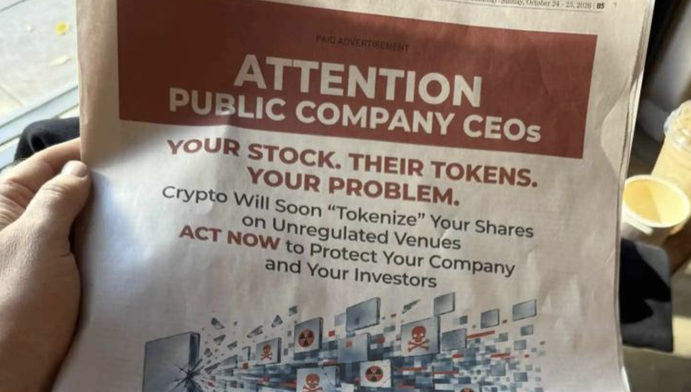
Domestic markets are shifting too. DTC’s tokenization service launches fully in October; Nasdaq plans Q2 2027 equity tokens; the SEC granted a Sept exemption allowing US venues to trade tokenized equities within licensed pools, capped at 0.25%–2.5% of daily volume. None yet unlock open lending markets. Once achieved, offshore wrappers lose their primary rationale, along with Alpaca’s rented custodial layer for issuers.
Funds Flow to Frontend Apps
Up to ten entities stand between on-chain equities and end users.

Every firm listed besides Backpack uses Alpaca. Alpaca is a US broker offering APIs for execution, clearing, and self-custody. Backpack uses RQD Clearing, another US clearinghouse providing similar services via intermediary broker Atomic Vaults Securities.
Financial firms profit either by safeguarding assets or facilitating movement. Launchpads became distribution engines earning trade fees. On Robinhood Chain, Pons and Long let anyone issue memecoins priced in equity tokens, making every purchase equivalent to buying equity. StonkFun mirrors this on Solana with xStocks; pump.fun added equity pairs in early September.
Launchpads charge per trade. Pons earned $23 million in September; StonkFun took in $27 million. They also pump the tokens themselves. Early Sept, a memecoin pool held 53% of all tokenized HIMS on Robinhood Chain; a mere $39k buy pushed it to $132.64 vs NY closing at $28.84, until BBVI minted more. Pons’ daily fees subsequently dropped ~90% from peak.
Issuers barely monetize. Robinhood mints free, charging only 0.05% redemption post-90 days. xStocks sets main fees to zero; Binance converts freely; Ondo avoids mint/burn fees, profiting from bid-ask spreads. Stablecoin issuers earn T-bill interest; in September alone, issuers pocketed $740.7 million. Equity issuers hold stock but pass dividends to users. Like stablecoin issuers minus interest income, major platforms attach to exchanges or apps.
Backpack illustrates unprofitable issuance. It launched Backpack Securities in June, minting its first token on day one of a related IPO. Tokens traded $1.12B on Solana DEXs in June, $1.04B in July. Briefly, it dominated most tokenized SpaceX and Micron volume. But trades occurred on decentralized exchanges it didn’t own. On its own exchange, spot stock trades average ~$1M/month; Sept perps hit $165M. Standard rates yield max ~$120k revenue. Backpack discloses nothing. Tokens worth ~$30M (~1% of total equity supply) represented ≤5% of Sept on-chain volume. Winning name recognition doesn’t win assets or fees.
Revenue lives in the applications.

Kraken app charges 1% spread on xStocks; Kraken Pro takes just 0.08% on the same token. Robinhood Wallet takes 0.8% swaps + 0.05% routing fee. Issuers take zero across all routes. Same exchange earns $10 or 80 cents depending on which interface you open. Premium users drive vastly higher volume at lower rates. Apps waive fees to secure high-value clients.
Ondo demonstrates the flip side: it “rents” clients from partners. Summer saw Bitget paying users to swap Ondo tokens for its own. Bitget reported handling 89% of Ondo’s tokenized stock volume in Dec 2025.
Nineteen Variants of NVIDIA Equity Tokens
The second monetization point lies in default tokens per stock. NVIDIA exists as 19 contracts, 8 issuers, 11 chains. Lending markets and perp venues accept only select standards, concentrating liquidity.

Lenders hold 40% of Solana xStocks-NVIDIA, 10% Robinhood, <1% Binance. On Solana, xStocks serve as accepted collateral for Kamino, Jupiter Lend, and Bybit, dominating DEX liquidity. Stablecoins follow suit: USDT and USDC now command 82% supply. Ultimately, expect 2–3 tokens per stock. Currently, xStocks rank best to become the USDC of equity tokens.
Everyone Wants to Be a Broker, Until Nobody Does
The weakest leverage points are chains and custodians.
Chains are commoditized. Gas fees on Robinhood Chain dropped 98% over the 30 days ending Oct 5, yet equity balances remained flat. Will chains act as broker equivalents earning basis points per trade? Unlikely.
Custodians show little profitability. Not a single Alpaca client discloses paying custody fees. It monetizes via order flow and stock lending, sharing portions downstream. Binance captures half Alpaca’s customer order flow revenue and 65% of stock lending profits. Vulnerable to replacement as clients build in-house brokers. Binance runs Nest Trading but still routes orders to Alpaca; Ondo acquired broker Oasis Pro. Transfer agents can fully substitute custodians.
Before Betting, Ask Who Profits and What You Own
To participate, start by identifying who profits during your equity token usage. Robinhood and Binance hold captive audiences. xStocks gain lender and competitor exchange adoption. Hyperliquid attempts to price equities during Bloomberg terminal downtime.
Every edge carries risk. You can borrow against NVIDIA anytime, but liquidation requires buyers. Tokens are only as sound as underlying claims. Issuers may fail. Traditional brokers might eventually deliver identical benefits sans offshore wrappers.
Even picking winners demands asking: what do you actually own? Does your asset grant upside participation? Owning a token tied to a growing business doesn’t auto-yield revenue share. Tokenizing billions in equities guarantees minimal gas revenue.
Track investor behavior shifts next. Will they borrow against collateral? Trade more frequently on-chain? You already buy NVIDIA-tracking tokens. Real alpha awaits utility scaling.
Join TechFlow official community to stay tuned
Telegram:https://t.me/TechFlowDaily
X (Twitter):https://x.com/TechFlowPost
X (Twitter) EN:https://x.com/BlockFlow_News
 @Decentralisedco