Robinhood On-Chain Dark Forest: 2 Months, 53 Platforms, How a Syndicate Drained $18 Million?
Author: Gemini, TechFlow
As the free Gas subsidy period nears its end in late September, the Meme trenches on the Robinhood chain are experiencing a visibly receding tide. The weekly trading volume of the Pons V2 launch platform shrank significantly in mid-September, and the clamor of tens of thousands of tokens launched per day is rapidly cooling down.
As Buffett said, you only find out who is swimming naked when the tide goes out.
And on the RH chain, after the tide recedes, we see not only retail traders swimming naked, but also those "water pumps" frantically churning underwater and artificially creating massive pump + Rug Pull operations.
Overseas on-chain analyst Wazz revealed yesterday a harvesting network hidden beneath the frenzy of this chain:
Over the past two months, a highly coordinated gang has executed at least 53 projects through an assembly-line token creation workflow, siphoning up to $18.43 million in liquidity directly off-chain.
Their timing perfectly coincided with the peak speculative frenzy from July to early September, when Pons fees once surpassed Solana's during that "giant wave." While everyone rushed blindly into new launches, no one bothered to carefully verify chip distribution and Funding sources;
It was only after the tide receded that this industrialized harvesting machine became so glaringly obvious.

The Catalyst $DEED: A Phantom Launch That Couldn't Even Crack the Top Ten Crime List
The investigation into this gang began with what appeared to be an ordinary shitcoin crash.
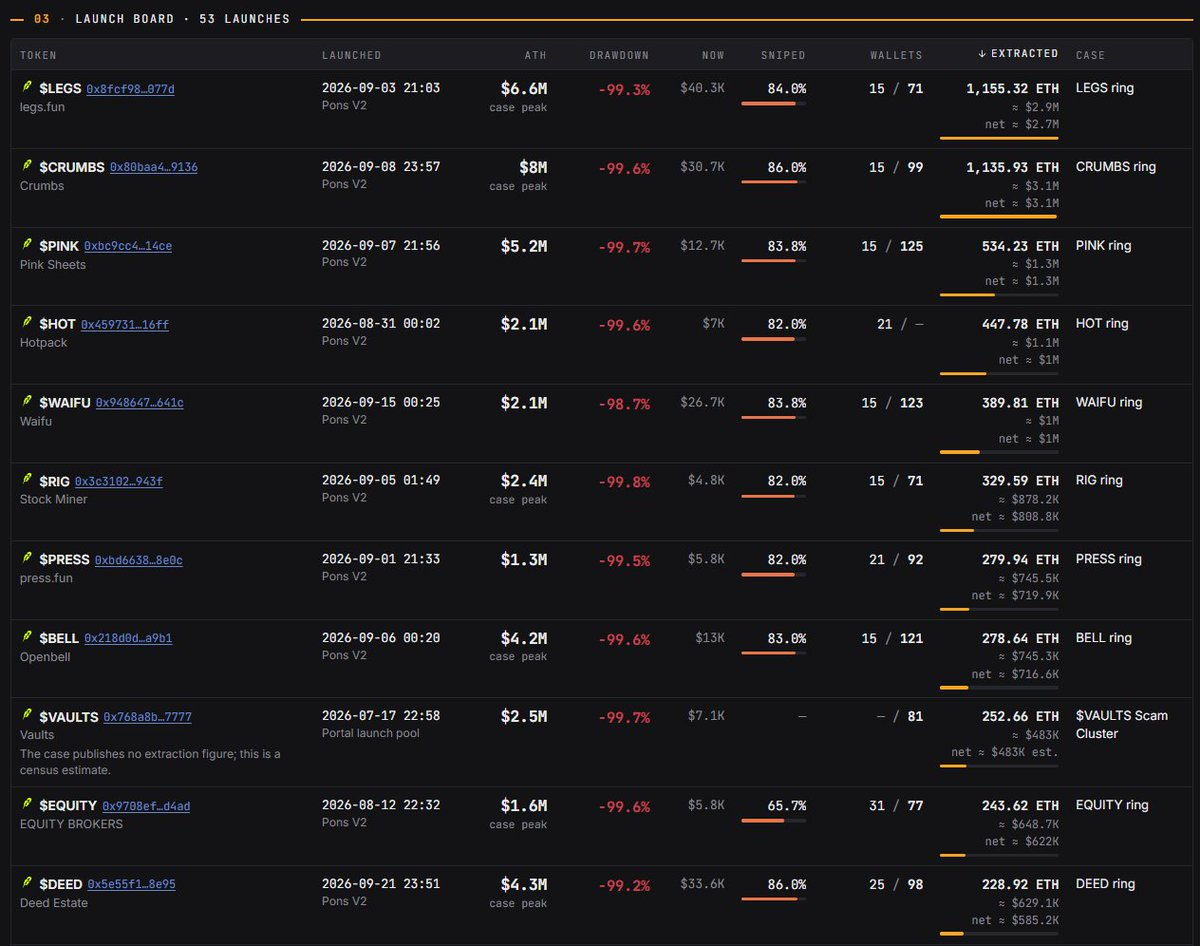
When analyzing a token called $DEED, analysts found extremely standard "assembly-line harvesting" characteristics: the moment it launched, it was sniped by approximately 98 wallet addresses in a bundled attack, instantly grabbing 86% of the total supply. Once retail buy pressure pushed up the market cap, these wallets instantly dumped in unison, driving the market cap to zero in quick succession.
But tracing upstream along $DEED's "token issuance funding account" (the core private key specifically used to pay issuance fees and inject initial liquidity), a much larger capital network surfaced.
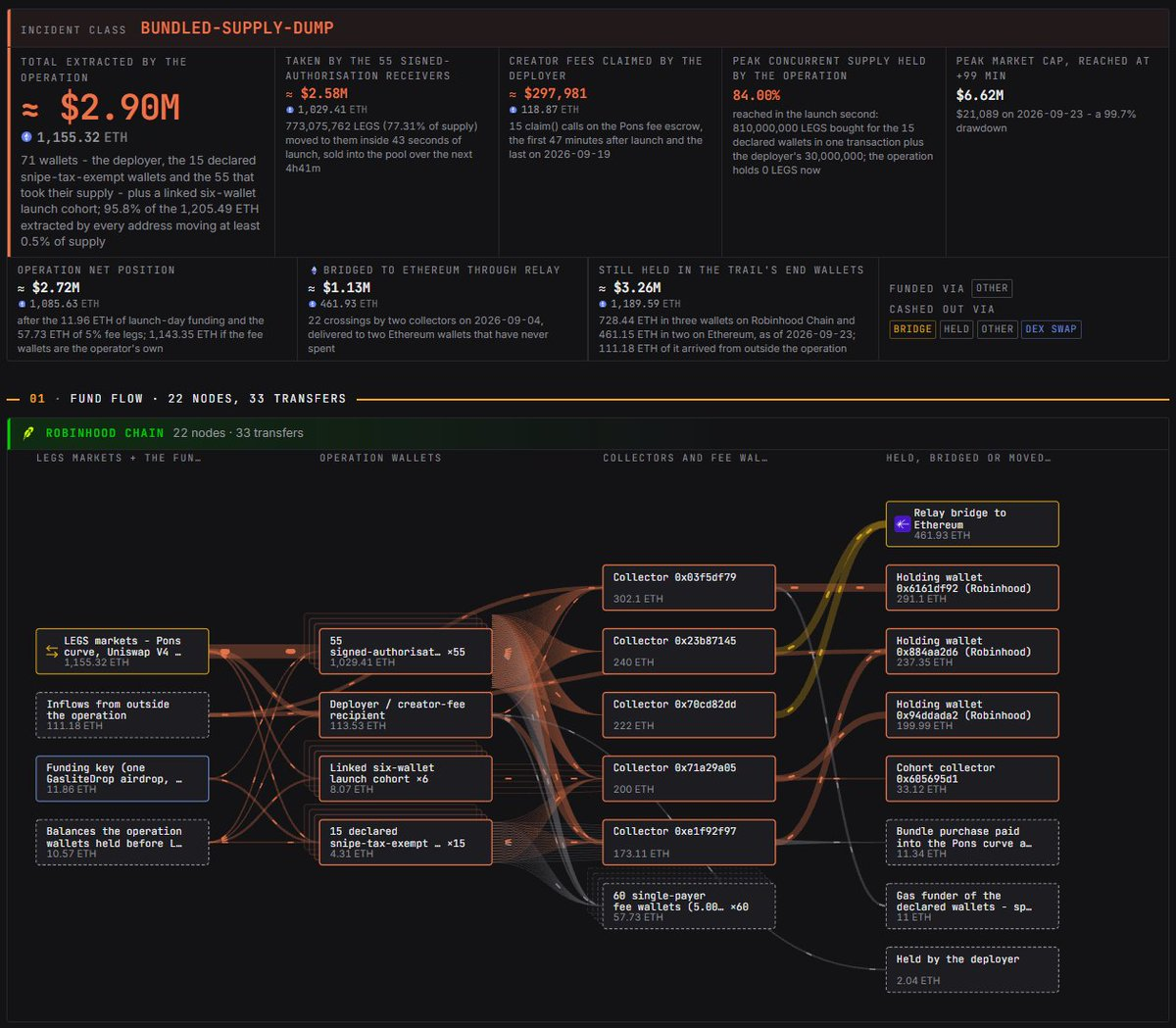
What's alarming is that DEED doesn't even rank in this gang's harvesting portfolio. The real heavy hitters are CRUMBS ($3.12 million drained in one go across 92 bundled wallets), LEGS ($2.9 million drained), and PINK ($1.44 million drained). All these projects exhibited extreme concentration of holdings and cliff-like market cap liquidations without exception.
The Perfect Crime: Fake Contracts for Hype, Privileged Backdoors, and a 16-Second Capital Loop
Further analysis reveals that this team is far from the typical retail hot money that "shoots once and moves on"; instead, they have a tightly integrated, fully automated "launch-to-fund-launches" assembly line.
According to Wazz's tracking, the gang's methodology can be broken down into three highly mature steps:
Step One: Fake Contract Warm-up (Fake Launch)
Before launching the main contract, they first deploy two or three fake contracts with identical names. They use these fake contracts to hype sentiment and "pre-harvest" impatient FOMO funds. After pulling market attention to its peak, they then reveal the actual contract address to maximize profits.
Step Two: Leveraging Privileged Backdoors for Absolute Control
At launch on the token issuance platform, creators directly grant their 70 to 200 wallet addresses an exemption from anti-sniping taxes. This means that at second zero of the launch, these bundled wallets can essentially acquire 70% to 86% of the absolute supply with near-zero friction, leaving retail traders in the secondary market with endless bags.
Step Three: 16-Second Rapid Money Laundering to Kick Off the Next Launch
This is the most hardcore part of the entire operation and irrefutable evidence of their coordinated crimes. After one harvest completes cash-out, the illicit funds are quickly consolidated into a transit wallet, then immediately transferred into the "token issuance funding account" of the next new launch.
Wazz captured an extreme example: right after the previous launch (DRAFT) swept the cashed-out 179 ETH into the transit station, the funds were routed to recharge $DEED's issuance account with 20 ETH. Just 16 seconds later, this account automatically paid the $DEED issuance fee and completed the launch signature.
Out of the 53 discovered launches, 45 were directly strongly bound through this rapid fund routing, forming a completely self-sustaining fraud funding flywheel.
Tuition Fees During the Frenzy Period
Currently, most of this $18.43 million in profit has already been bridged back to the Ethereum mainnet, leaving virtually no room for on-chain freezing on the Robinhood chain.
According to investigators, this isn't even the only gang; there are at least two other serial operation networks that haven't yet been fully mapped into this graph.
The Robinhood chain itself hasn't cooled down. Its TVL, stablecoin reserves, and officially promoted RWA and tokenized stock businesses are still operating. What truly cooled was just the frantic shitcoin arena propped up by extremely low issuance thresholds, easily bypassable anti-sniping mechanisms, and the initial free Gas subsidies.
In this arena, retail investors thought they were participating in a liquidity feast brought by a traffic giant, but in reality, they were often just providing fuel for this precisely calibrated water pump.
When the late September Gas subsidies are completely exhausted and the cost structure for launching and wash trading changes, this artificial giant wave will eventually subside. And that over $18 million in swiped funds represents the most expensive tuition ever paid by retail traders on a new chain during its cold-start speculative phase.
Join TechFlow official community to stay tuned
Telegram:https://t.me/TechFlowDaily
X (Twitter):https://x.com/TechFlowPost
X (Twitter) EN:https://x.com/BlockFlow_News
 深潮TechFlow