Robinhood's On-Chain Endgame: After Tokenized Stocks, It Wants to Devour the Entire Financial Market
Author: David Feld
Compiled by: TechFlow
TechFlow Summary:Rocketing up $2.1 billion in assets within two months of launch, but founding-level executives acknowledge this is merely the beginning. This article breaks down the brokerage giant's true on-chain ambition: it's not about building a single chain, but about migrating stocks, private equity, real estate, and even AI agents onto the blockchain. For industry professionals, this represents the clearest signal yet of how a traditional finance powerhouse intends to enter the space.
No matter how novel Robinhood Chain, tokenized equities, and the company's increasingly aggressive crypto positioning may appear, Robinhood's overarching thesis aligns precisely with a conclusion we're already familiar with:
The era of distinct "crypto markets" and "traditional markets" is over. There will be only one unified market, increasingly operating on blockchain rails.
This stands out as one of the clearest takeaways from our recent conversation with Johann Kerbrat, head of Robinhood's crypto division. He reinforced a long-standing perspective: blockchain serves as an upgrade for outdated elements within existing markets—restricted trading hours, fragmented venues, sluggish settlement speeds, geographic barriers, and financial products trapped within siloed systems.
Robinhood is convinced blockchain will revolutionize these domains, and I share that conviction, envisioning markets that operate continuously around the clock with capital flowing freely across applications.
This transformation is already underway, and Robinhood is clearly positioning itself to capture a significant share.
Current Status of Robinhood Chain
Despite Robinhood's lofty ambitions here, one of the most insightful segments of the discussion was Johann's observation that the integration between Robinhood Chain and the core Robinhood app remains in a very nascent phase.
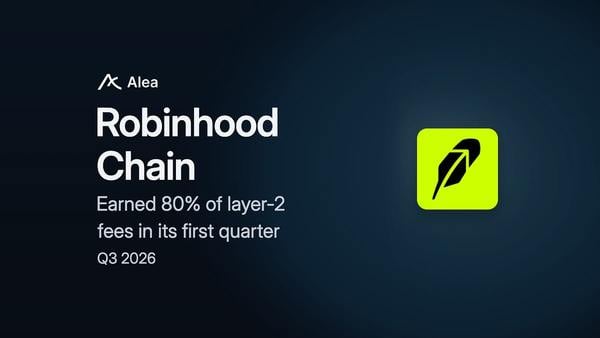
In just two months since going live, the network has amassed $2.1 billion in tokenized assets, with $1.5 billion already deployed across various applications, while trading volumes continue hitting fresh highs. Yet Johann noted that the greater internal surprise wasn't the headline metrics, but the level of developer engagement.
Robinhood invested years in architecting this chain, initially anticipating that attracting third-party builders would prove challenging. Johann claims, however, that developer activity ranks among the top tier across all ecosystems, and the team has already shipped products Robinhood itself hadn't forecasted. The most prominent example involves Meme coins paired with tokenized stocks, which have fueled the current momentum sweeping through Solana and Base.
While these developments have helped Robinhood Chain gain traction, Johann emphasized that we're still in the early phases of weaving this chain into Robinhood's broader product ecosystem. Robinhood Earn became one of the inaugural features integrated into the main application, enabling eligible U.S. users to lend USDG through Morpho for yield generation; meanwhile, Robinhood Wallet has already connected to Robinhood Chain alongside other on-chain venues.
The critical insight to draw from this is that Robinhood Chain has already achieved considerable activity ahead of Robinhood activating its proprietary distribution engine.
The next logical step involves embedding the value proposition of Robinhood Chain and the wider on-chain economy directly into products that Robinhood's existing user base already relies on daily.
What Robinhood Aims to Build
To achieve this objective, Robinhood is concentrating on three core product verticals.
The first centers on co-running tokenized spot assets and derivatives side by side.
When consolidated, traders can use perpetual contracts to hedge spot exposure, establish leveraged positions, exploit price discrepancies between the two markets, or engineer hybrid strategies.
Robinhood has already facilitated early access to this capability via Robinhood Wallet and Lighter, though currently restricted to non-U.S. users, with plans to expand access rapidly.
The second priority involves broadening the spectrum of tokenizable assets.
Johann stressed that equities are just the starting point. He cited private equity, real estate, fine art, and additional commodity classes, noting Robinhood intends to self-tokenize assets where regulatory frameworks permit, or collaborate with established issuers already offering comparable instruments.
The objective remains straightforward: migrate a larger share of global assets onto a single programmable ledger, then allow market participants and developers to experiment with what can be constructed atop them.
The third frontier is AI agents.
As detailed earlier this year, intelligent agents can help financial platforms synthesize previously fragmented products and datasets into a cohesive operational framework.
For Robinhood, this connectivity materializes through agent-driven trading powered by MCP. Users can delegate their agents to query Morningstar research or ingest granular market data, cross-reference it with a custom on-chain metric, and surface high-probability execution opportunities.
Layered atop Robinhood's rapidly expanding product matrix, you effectively get a engine capable of seamless operation across perpetuals and spot, equities and digital assets, on-chain and off-chain environments.
Johann personally noted that his agents have already identified trading setups he himself hadn't conceived.
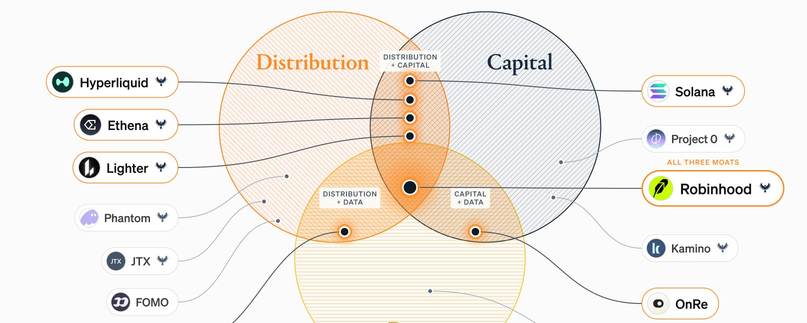
Crucially, while Robinhood's on-chain aspirations may be expansive, its strategic focus remains sharply defined. Johann reiterated that Robinhood has zero interest in monopolizing every layer of this emerging financial stack. Instead, the firm prefers to concentrate exclusively on verticals where it holds inherent advantages—namely distribution scale, UX optimization, and legacy brokerage infrastructure—while seamlessly integrating foundational crypto infrastructure already established by the broader ecosystem.
I emphasize this distinction because, as the underlying networks mature, we can reasonably expect increased adoption of on-chain dApps feeding into Robinhood's interface.
What's Slowing Momentum?
The overriding constraint is regulation—or more accurately, regulatory fragmentation.
Robinhood is already deploying certain offerings internationally that remain inaccessible to U.S. retail accounts. Its new tokenized equity listings are blocked for American users, and its Lighter integration has yet to go live domestically.
While the regulatory landscape is undeniably evolving, Johann repeatedly highlighted that it remains highly disjointed.
The friction stems from overlapping SEC and CFTC mandates, disparate state-level licensing requirements, jurisdiction-dependent staking protocols, and lingering ambiguities around lending mechanics, DeFi compliance, perpetual contract classification, reporting standards, and tax treatment.
Even the SEC's recently proposed innovation exemption for tokenized securities (which Johann characterized as a meaningful breakthrough) carries a five-year sunset clause alongside caps on asset size and daily volume. Navigating these waters presents substantial complexity for a publicly listed broker, and Robinhood remains highly sensitive to potential policy reversals.
The full broadcast covers substantially more ground, and I highly recommend catching the complete episode.
If this network continues scaling while Robinhood systematically weaves more components into its brokerage operations, the firm will progressively function as the default gateway, ushering everyday retail participants into the efficiency gains blockchain-enabled markets promise for global finance.
This is not financial or tax advice. Bankless content is strictly for educational purposes, does not constitute investment advice, and does not constitute an offer to buy or sell any asset or render any financial decision-making guidance. This newsletter is not a substitute for professional tax counsel. Consult your CPA. Conduct independent due diligence. Disclosures. We may occasionally feature affiliate links to tools and services we utilize. Purchases made through these links may generate compensation for us. Furthermore, the Bankless team maintains direct holdings in digital assets. Review our Investment Disclosure | Terms of Service | Privacy Policy
Join TechFlow official community to stay tuned
Telegram:https://t.me/TechFlowDaily
X (Twitter):https://x.com/TechFlowPost
X (Twitter) EN:https://x.com/BlockFlow_News
 Bankless