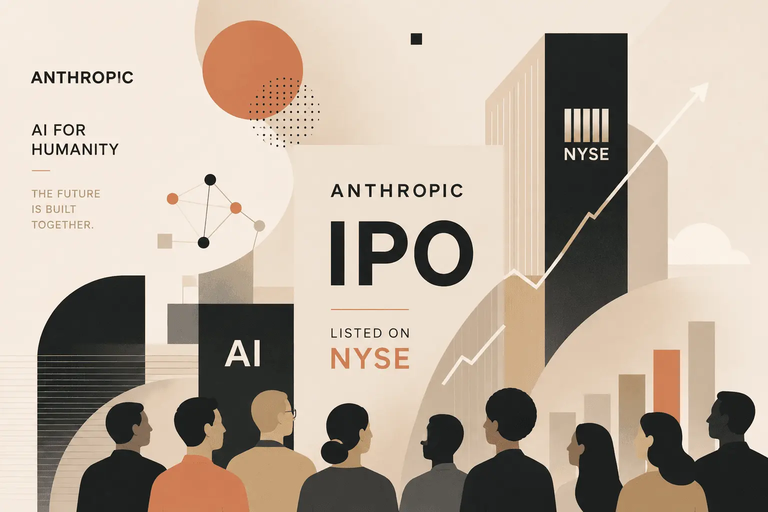
Anthropic hasn't even gone public yet, but on-chain contracts have already bet on a $2.1 trillion valuation.
Author: Cooper Duschang
Compiled by: TechFlow
TechFlow Digest: Anthropic’s IPO has become one of the most anticipated capital market events of 2026, but what’s truly interesting is that the on-chain perpetual contract market has already begun pricing it in advance. This article breaks down how Entropy established a synthetic trading market for Anthropic without spot assets, thereby rapidly rising within the Hyperliquid ecosystem. For professionals focusing on perpetual contract innovation and pre-listing asset pricing, this is a case that cannot be overlooked.
Key Takeaways
The market’s long-awaited Anthropic IPO has prompted traders to bet on its valuation through pre-listing perpetual contract markets. Aggregating data across multiple exchanges, traders expect the company’s post-listing valuation to be approximately $2.1 trillion.
Entropy is a HIP-3 builder. Over the past two weeks, its Anthropic pre-listing perpetual contract market averaged daily trading volume exceeding $10 million, with open interest reaching $30 million. Among all exchanges offering exposure to Anthropic’s pre-listing valuation, this represents the largest open interest position.
With no spot market for Anthropic, a unique phenomenon has emerged: some exchanges do not charge funding rates, while others charge based on deviations from oracle prices. This results in entirely different trading motivations for Anthropic perpetual contracts across various exchanges.
Introduction
Anthropic is one of the most anticipated IPOs of 2026, with traders betting on a valuation exceeding $2.1 trillion. Historically, exposure to private company performance and valuations has been limited to accredited investors and institutional capital. Most investors can only trade its shares after it goes public.
Perpetual futures do not settle against underlying assets, allowing exchanges to launch markets without holding Anthropic stock. The absence of settlement, delivery, or contract expiration has prompted exchanges to list Anthropic pre-listing perpetual contract markets, providing traders with synthetic exposure to Anthropic’s valuation. Currently, 12 exchanges offer Anthropic pre-listing futures. Six of them have open interest exceeding $1 million. In this network status report, we focus on the top five exchanges by open interest.
Although 12 exchanges provide an Anthropic pre-listing market, traders have recently shown a clear preference for one: Entropy. Entropy is a Hyperliquid HIP-3 exchange that launched its Anthropic perpetual contract market on August 19. Since then, Entropy’s Anthropic market average daily trading volume has risen into the top 15% of all markets on Hyperliquid, highlighting strong market interest in the Anthropic IPO.
In this network status report, we will analyze how Entropy’s Anthropic pre-listing perpetual contract market competes with other HIP-3 builders for first-mover advantage, enhances simulated aggregated order book depth, and contends with exchanges that charge low or even zero funding rates for pre-listing markets.
The Rise of Entropy as a HIP-3 Builder
Hyperliquid’s HIP-3 builder mechanism allows anyone who stakes 500,000 HYPE (approximately $40 million) to launch three perpetual contract markets at no additional cost. To create more markets, participants must enter a Dutch auction with a starting price of 500 HYPE (approximately $40,000). One of Entropy’s first three markets was the Anthropic pre-listing perpetual contract market.

Source: Talos CM Market Data Pro
Other HIP-3 builders have also deployed pre-listing markets to support price discovery before companies go public. These exchanges rely on internal order books to price pre-listing assets, whereas Entropy utilizes external market sources in addition to order book prices. The combination of multiple price inputs may be more accurate than competitors’, potentially granting Entropy greater market share among HIP-3 builders.

Source: Talos CM Market Data Pro
Price discrepancies between exchanges present arbitrage opportunities. While these pre-listing markets are inherently speculative due to a lack of public valuation benchmarks, traders can profit from cross-exchange spreads. Currently, there is a 2.47% price difference between centralized exchanges and Entropy.
The Timing Game Among HIP-3 Builders
Being first to cover a new pre-listing market on Hyperliquid offers a first-mover advantage, including capturing initial attention and generating fees to recoup market deployment costs. However, deploying too early with insufficient market interest can lead to low trading volume, increased slippage, and higher funding rates.

Source: Talos CM Market Data Pro
Like centralized exchanges such as Binance, Bitget, and Gate.io, Entropy prices Anthropic’s pre-listing market using implied company valuation. This pricing method temporarily deterred HIP-3 builders like Trade.xyz from entering the market, as they price pre-listing companies based on expected share prices. Until Anthropic releases a public S-1 filing or discloses more information regarding share sales, Trade.xyz remains on the sidelines. OKX faces a similar challenge, as its managed pre-listing market assumes the sale of 10 billion shares and uses a per-share price for valuation.

Source: Talos CM Market Data Pro
Currently, no other HIP-3 builders have listed an Anthropic perpetual contract market, avoiding liquidity fragmentation. Despite launching over 2.5 months later than Binance and Bitget, Entropy’s Anthropic perpetual market ranked second in average daily trading volume over the past two weeks ($10.22 million) and first in open interest ($30.63 million).
Entropy Order Book Depth and Slippage vs. CEXs
Routing orders to the optimal market based on tightest spreads, deepest order books, or lowest funding rates can enhance liquidity and reduce execution costs. Simulated aggregated order book data shows that Entropy possesses deep liquidity around the mid-price.

Source: Talos CM Market Data Pro
Comparing aggregated average order book depth over a 72-hour period, within a range of approximately 0.5% around the mid-price, Entropy’s liquidity accounts for roughly 17% of the combined total of Binance, Gate.io, and Bitget. The order book displayed on Hyperliquid highlights deep liquidity near the bid-ask spread within a price band of less than 1% around the mid-price. This reduces price impact for traders buying or selling pre-listing contracts.

Source: Talos CM Market Data Pro
Entropy’s spread rivals that of centralized exchanges, averaging 1.5 basis points over the past two weeks. This represents the tightest spread among all exchanges, further confirming Entropy’s high execution quality on Hyperliquid and reduced trading slippage.
How Funding Rates Influence Exchange Selection
Perpetual contract markets use funding rates to ensure perpetual prices do not deviate significantly from spot prices. How do exchanges charge funding rates when the company is not yet public? Pre-IPO markets created by HIP-3 builders do not require spot prices to calculate funding rates. On Entropy, funding rates are calculated based on the difference between the perpetual contract price and the oracle price. Oracle prices are derived from external or private market data sources, combined with internal order book prices.

Source: Talos CM Market Data Pro
Hyperliquid employs a floating funding rate that resets hourly, whereas Binance charges a fixed funding rate of 0.005% every 8 hours. Bitget and Gate.io charge extremely low or even zero rates. Recent discussions surrounding AI risks have caused funding rates on Entropy to spike. The existence of funding rates indicates genuine user positioning, and since fees are paid hourly, traders are incentivized to price Anthropic’s IPO fairly. However, when valuation expectations become highly volatile, holding costs rise sharply, prompting traders to shift to exchanges with lower funding rates.
Anthropic’s Pre-IPO market is the latest example of “perpetualizing everything.” Traders are beginning to speculate on the valuations of private companies. Entropy’s strong growth momentum and leap to the top spot for open interest indicate that traders prefer trading Pre-IPO perpetual contracts within the Hyperliquid ecosystem rather than limiting themselves to centralized exchange markets.
We anticipate that as Anthropic’s public listing documents continue to be released, other HIP-3 builders will join the competition to capture relevant trading volume. The emergence of more markets could challenge Entropy’s share and fragment liquidity. These markets will price Pre-IPO positions using implied company valuations or per-share prices.
Join TechFlow official community to stay tuned
Telegram:https://t.me/TechFlowDaily
X (Twitter):https://x.com/TechFlowPost
X (Twitter) EN:https://x.com/BlockFlow_News
 @coinmetrics