On-Chain RWA Trading Evolves: Variance Swaps Debue, Say Goodbye to Funding Rate Torment in Traditional Perpetual Contracts
Author: Castle Labs
Edited by: TechFlow
TechFlow Editor's Note: RWA perpetual contract volume surged 120x within a year, but uncertain funding rates and liquidity cold-starts have remained persistent flaws. Variational’s newly launched swap product directly integrates with TradFi market makers, transforming unpredictable funding rates into annualized holding costs. For institutions and market makers looking to enter on-chain RWA trading compliantly, this could be a watershed moment.
Perpetual contracts have become one of the most powerful tools in digital asset trading. They offer high capital efficiency, allowing users to gain price exposure without holding the underlying assets.
Initially, perpetual contracts competed in the same arena, focusing on crypto assets and liquidity.
As perpetual contracts expanded to more assets, particularly real-world assets, the competitive landscape broadened, spawning different strategies tailored to evolving markets.
This category has been expanding into stocks, commodities, indices, forex, Pre-IPO markets, and other assets that are not natively suited to crypto-native exchange models.
In fact, listing as perpetual contracts reveals significant differences between RWAs and crypto-native assets. Bringing these markets online through standard order books requires cold-starting liquidity venue by venue, typically relying on subsidies, incentives, and external market maker relationships.
Essentially, launching RWA perpetual contracts requires finding solutions that can provide 7×24-hour trading outside traditional market hours to ensure newly launched markets have sufficient liquidity.
Moreover, perpetual contracts are not ideal tools for RWA trading. The unpredictability of funding rates remains a major pain point for RWA perpetuals.
Among teams attempting to solve these issues, Variational has just released its swap product. This is their solution for supporting an ever-growing list of markets without rebuilding each market and liquidity pool from scratch, while providing traders with predictable costs.
Contrary to the literal meaning of the name, this is not about AMM swaps. Swaps have long existed in TradFi. For Variational users, swaps represent a new way to trade RWAs with predictable costs and liquidity sourced directly from traditional finance.
This report first highlights the growth of RWA perpetual contracts and their rising market share, then dives deep into swaps, comparing them with perpetuals and explaining their unique features.
Next, we translate this execution model into tangible user advantages by comparing order execution across different perpetual contract platforms.
RWA Perpetual Contracts: From a Niche Category to One-Eighth of On-Chain Perp Volume
RWA perpetual contracts grew from a niche category to a structurally significant share of crypto trading in less than a year. In October 2025, this category's volume was under $1 billion, but by August it exceeded $120 billion, growing 120-fold over a few quarters.
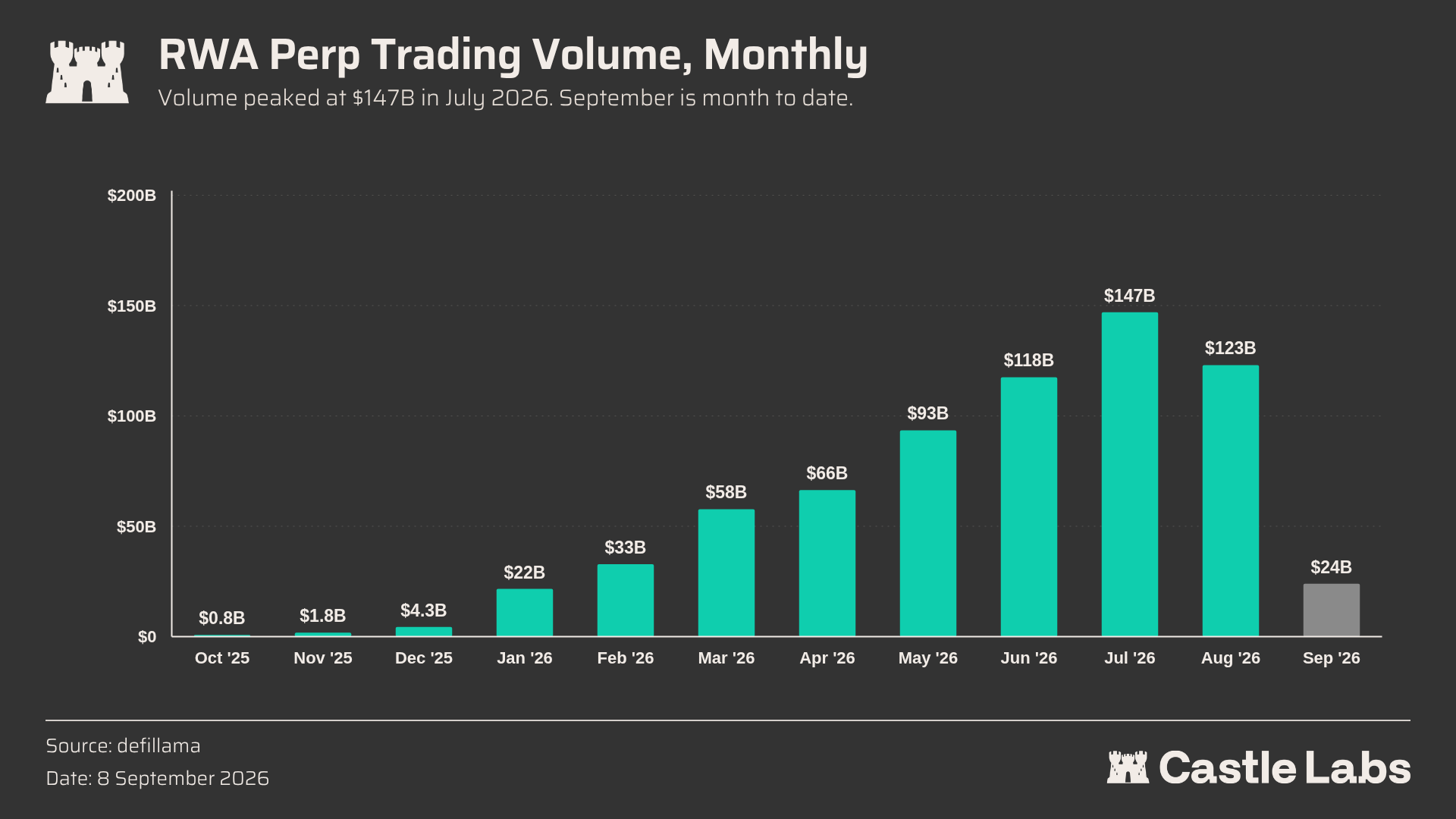
Chart: Monthly RWA perp trading volume (Oct 2025 – Sep 2026), peaking at $147B in Jul 2026. Source: DefiLlama; Date: Sep 8, 2026.
The category hit its first inflection point last October when TradeXYZ, deployed as an HIP-3 protocol on Hyperliquid, went live. Since then, it has continued to grow, peaking at 20% of on-chain perp volume in July, averaging around 12%-13% in most months, meaning nearly $1 out of every $8 traded on-chain comes from RWAs. Additionally, since June, it has established a baseline trading volume of $100 billion over the past several months.
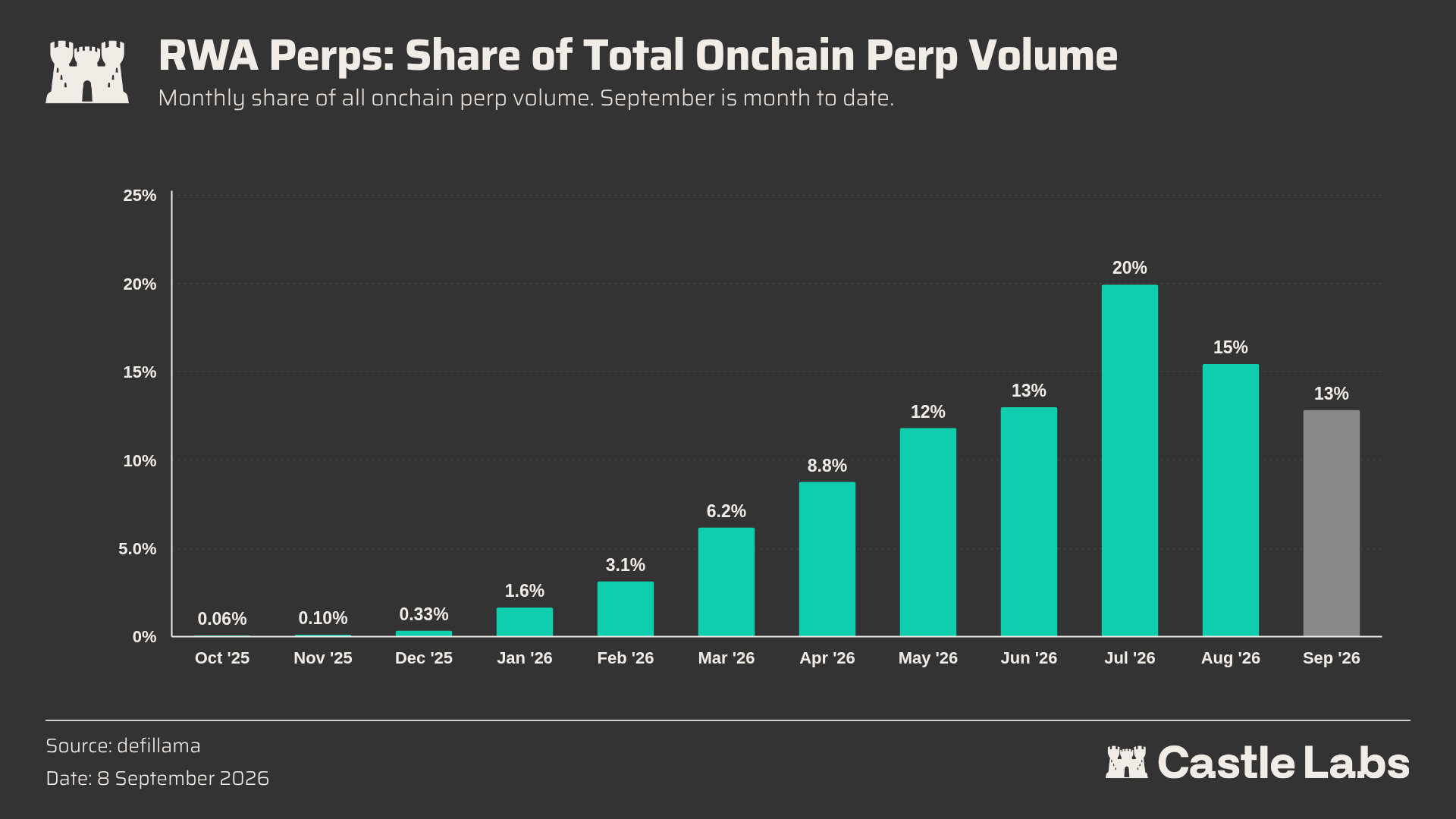
Chart: Monthly share of RWA perps in total on-chain perp volume (Oct 2025 – Sep 2026), peaking at 20% in Jul 2026. Source: DefiLlama; Date: Sep 8, 2026.
Despite rapid growth, this category is highly concentrated. As of now, total RWA perp open interest stands at $4.9 billion, with the top two protocols in the category, TradeXYZ and Variational, accounting for nearly 90% of it, followed by GMTrade, Lighter, Ondo, etc.
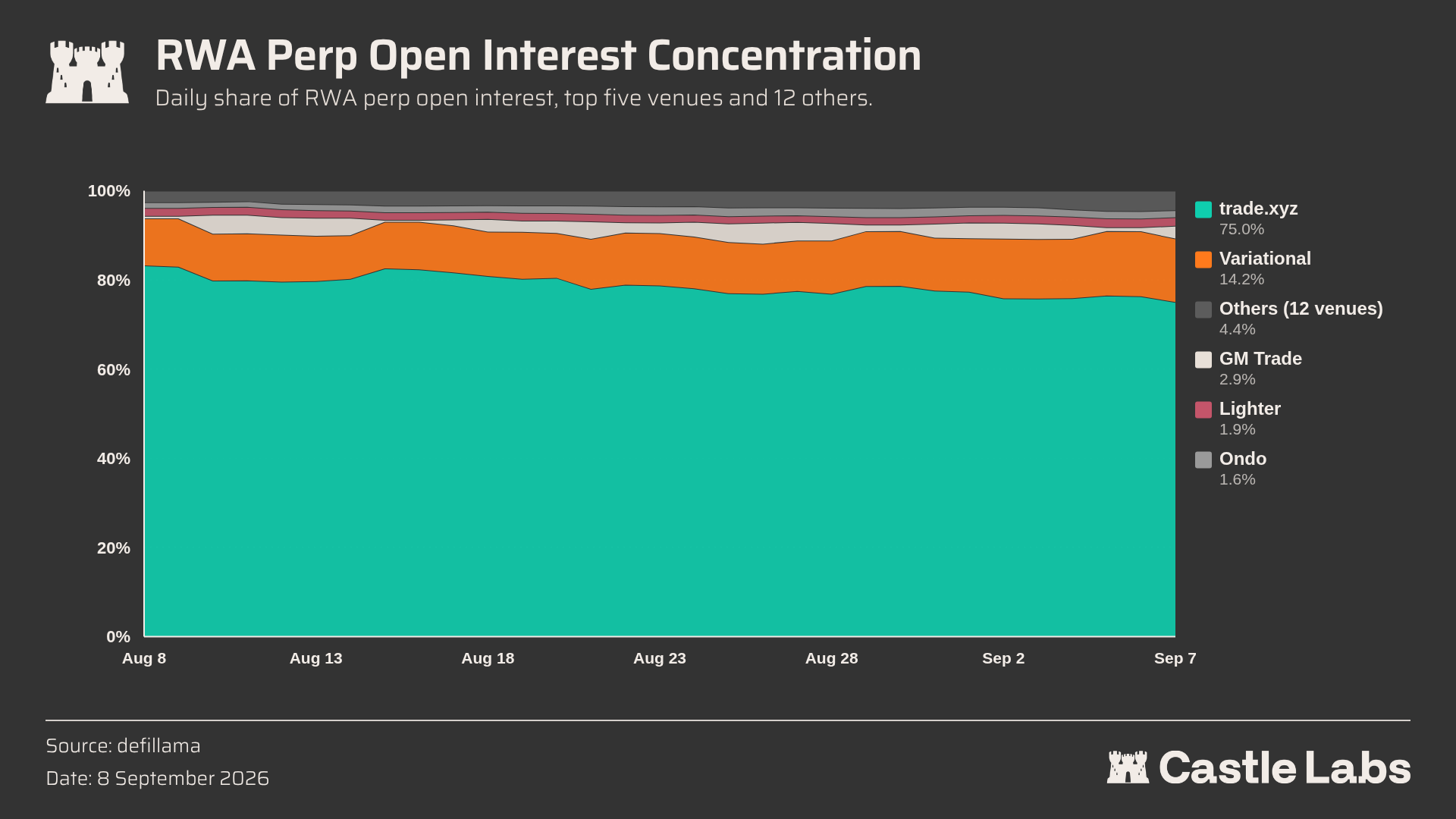
Chart: RWA perp open interest concentration (Top 5 platforms + Others), Trade.xyz accounts for ~75%, Variational ~14.2%. Source: DefiLlama; Date: Sep 8, 2026.
We expect this category to continue growing, with Variational swaps serving as a major contributor. In the next section, we differentiate swaps from perpetual contracts and explain why they are a superior method for trading RWAs on-chain.
Swaps or Perpetual Contracts?
This section defines swaps as a new primitive, highlighting the distinctions between them and perpetual contracts as trading tools.
At their core, both are "linear derivatives," meaning their payoffs are linear functions: price movements in the underlying asset translate directly into dollar value changes in the contract.
However, perpetual contracts and swaps differ fundamentally in what they track.
Perpetual contracts were born to closely track the index price of the underlying asset. Therefore, they use funding rates to incentivize rebalancing and closely follow the spot asset's index price.
Swaps, on the other hand, are designed to "track the total return of an asset over a period of time."
This difference is reflected in funding rates. Unlike traditional perpetuals, swaps only charge a fee once per day on held positions, collected at market close (5 PM ET).
Unlike perp funding rates driven by supply and demand, swap fees are better understood as a carrying cost, calculated based on "the actual cost of financing the underlying asset in traditional markets."
For equities, this means overnight interest rates in the index currency (e.g., USD's SOFR). For forex, it's the overnight interest rate differential between currencies, adjusted for spreads. For metals, it's the implicit cost of borrowing or lending overnight in USD.
These rates are strictly tied to TradFi, as they represent the real financing terms Variational secures from its TradFi liquidity partners, which are benchmarked on market interest rates.
Finally and equally importantly, swaps also allow users to earn dividends: long positions receive dividend amounts, while short positions pay them.
Initially, swap markets will use isolated margin and have set opening and closing times. Variational expects these markets to gradually transition to 7×24-hour operations and implement cross margin within the platform.
The first batch of launched swap markets are US100, US500, XAU, XAG, and USOIL. Since their launch earlier this month, these markets have already generated $3.8 billion in volume, with peak open interest reaching $245 million.
For Variational, evolving from perpetuals to swaps was a necessary step, given that within just two months of launch, TradFi perpetuals already accounted for over 50% of its volume and open interest.
Rather than relying on supply/demand dynamics and volatile funding fees, Variational focuses on direct access to TradFi liquidity, transforming unstable funding rates into annualized, easily predictable holding costs, making it easier for institutional investors to access RWAs.
In summary, both swaps and perpetual contracts provide exposure to the underlying asset.
Swaps source liquidity from a network of TradFi partners, replacing funding rates with daily fees that can be likened to a stable carrying fee, "primarily anchored to USD borrowing costs."
Typically, in currently launched swap markets, this results in longs paying 4%-6% annually, while shorts earn 2%-3% annually.
A crucial reminder before proceeding: swaps do not operate in isolation. To fully understand them, the next section delves into Omni Liquidity Providers and how they symbiotically function with swaps.
Omni and Swaps
Most perp exchanges need to boot liquidity within their own platforms. This works for mainstream assets, but problems arise when a platform attempts to list more assets. Every new market requires market makers, inventory, incentives, risk limits, and sufficient two-sided demand to support a deep order book.
A key differentiator for swaps lies in how they source liquidity, which is precisely why they can offer superior execution.
Variational avoids liquidity shortages through Request-for-Quote (RFQ) execution and vertically integrated liquidity provider Omni.
Omni Liquidity Provider (OLP) is Variational's proprietary integrated market maker.
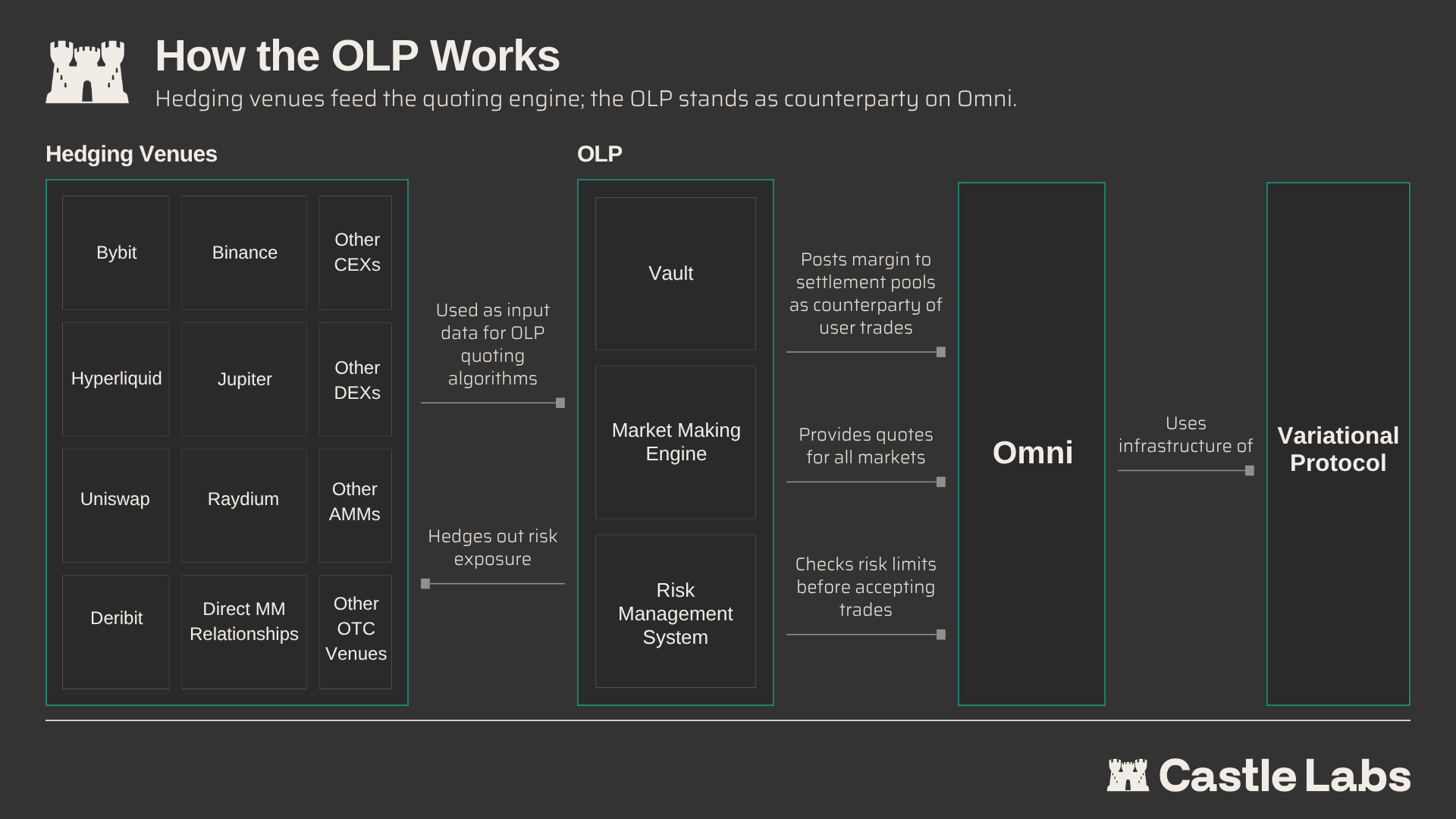
Chart: How OLP (Omni Liquidity Provider) operates: Hedging venues feed inputs to the quote engine, with OLP acting as the counterparty on Omni. Source: Variational / Castle Labs.
The OLP interfaces directly with liquidity providers in Variational's RFQ, bringing this liquidity on-chain. Because the OLP acts as the counterparty to all trades on Omni, the initial swap market's capped open interest is set at $10 million (to be quickly raised later), allowing the team time to test the OLP's hedging strategy. The OLP leverages external liquidity from CEXs, DEXs, and TradFi sources to manage and hedge risk.
Variational aggregates swap liquidity from TradFi venues, so these instruments will initially follow traditional market trading hours. As more liquidity venues are aggregated and TradFi continues to evolve toward round-the-clock trading, 24/7 trading is expected.
The benefit of this approach is clear: Variational can launch new markets without building an order book from scratch. Instead, they only need price feeds, reliable partners in the RFQ system, and the OLP's hedging strategy.
This design does not shun liquidity risk; rather, it makes trade-offs regarding pricing transparency and risk management.
In the next section, we will test whether this holds true in practice by comparing the order execution costs of Variational Swaps against other perpetual contract trading venues.
Swaps significantly reduce execution costs on Variational, with TradFi perpetual costs being 8 to 12 times lower than those on the most liquid on-chain venues.
If you've been following our research, you know this is the aspect everyone trading RWAs cares about most. While RWAs boast many advantages, including transparency, global accessibility, and execution efficiency, these on-chain assets ultimately must prove their execution rivals or even surpasses that of corresponding TradFi assets.
Comparative Analysis of Swap vs Perp Execution Costs
Perps are better suited for 24/7 crypto-style markets where funding rates are dictated by exchange-driven supply and demand. In contrast, Swaps are better suited for traditional assets, where financing costs, dividends, and external liquidity matter more.
The strongest case for Variational Swaps is not just that they offer more markets, but that they deliver better execution.
To measure this rigorously, we compare the execution costs of Variational Swaps against the primary on-chain venues listing TradFi perpetuals. Our platform sample includes major on-chain perp venues such as TradeXYZ, Lighter, and Ostium.
Methodology
Within our market sample, the analysis compares US100, US500, XAU, and XAG markets alongside their counterpart products on other exchanges. Because venues execute orders differently, execution costs are measured accordingly.
For order-book-based venues like TradeXYZ and Lighter, we pull live order books, sort them, and walk through the levels to simulate market orders on the book. For quote-based venues like Variational and Ostium, we analyze published quotes across varying trade sizes.
We measure execution cost by taking the average of the costs for opening both long and short positions. This provides a more comprehensive view of the actual state of quotes and order books.
Analysis
Some venues (like Lighter and Variational) charge no trading fees, so their execution costs are derived entirely from spreads. Other platforms do charge fees, which adds to the execution cost.
The first market we analyzed is US100.
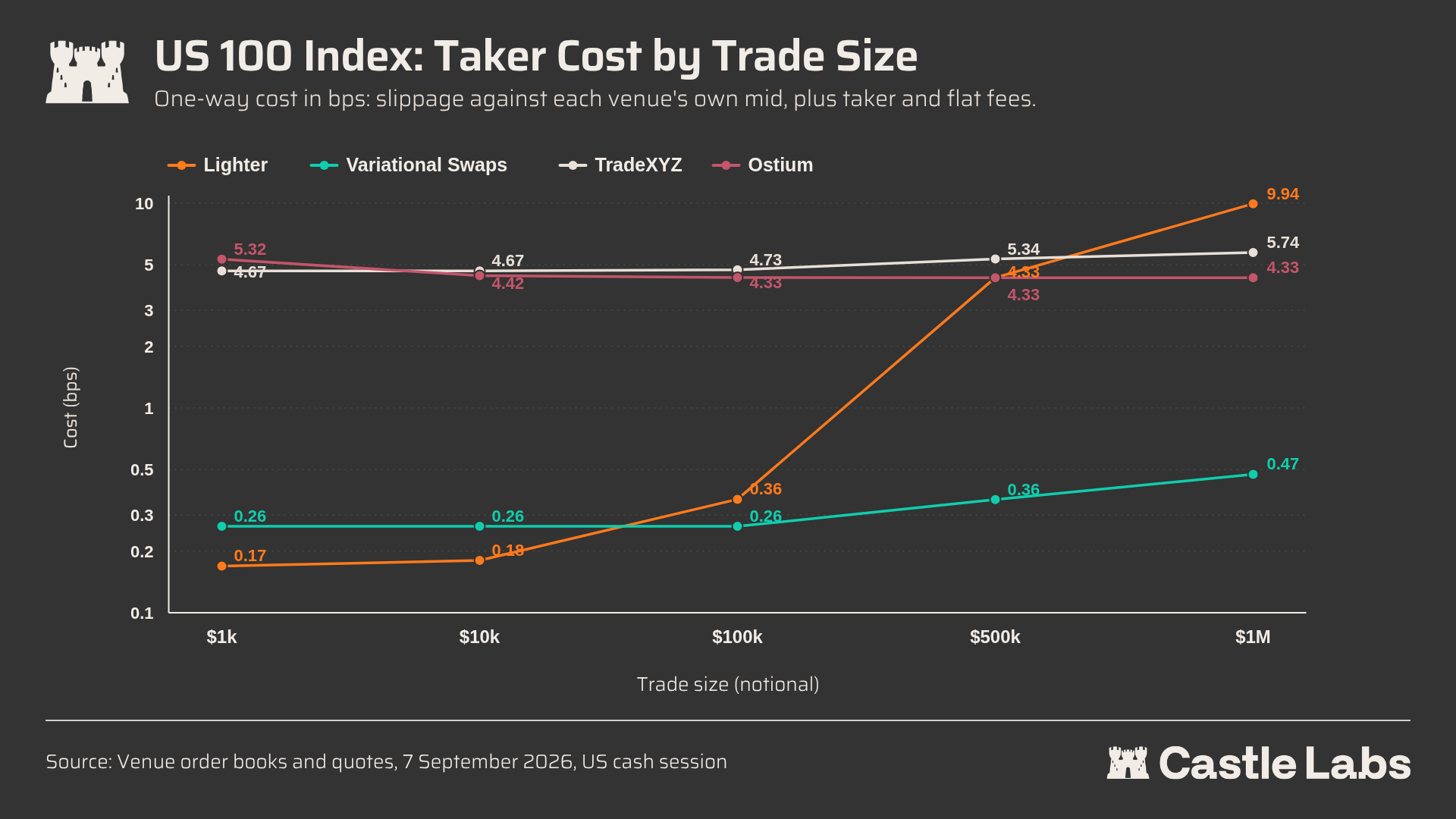
Chart: Taker cost for the US100 index across different trade sizes (basis points). Source: Venue order books & quotes, Sept 7, 2026 US equity session; Castle Labs.
For smaller sizes like $1,000 and $10,000, Lighter is the cheapest venue at 0.18 bps, but its execution costs scale quickly, rising from 0.36 bps at $100k to over 9.94 bps for $1M trades. Due to their fee structures, Ostium and TradeXYZ are the most expensive for small-sized trades, costing 5.32 bps and 4.67 bps respectively.
By contrast, Variational Swap's costs scale slowly, rising from 0.26 bps for a $1k trade to 0.47 bps for a $1M trade, making it 12 times cheaper than TradeXYZ (5.74 bps) and nearly 21 times cheaper than Lighter (9.94 bps).
Similar trends are observed in other markets, such as US500.
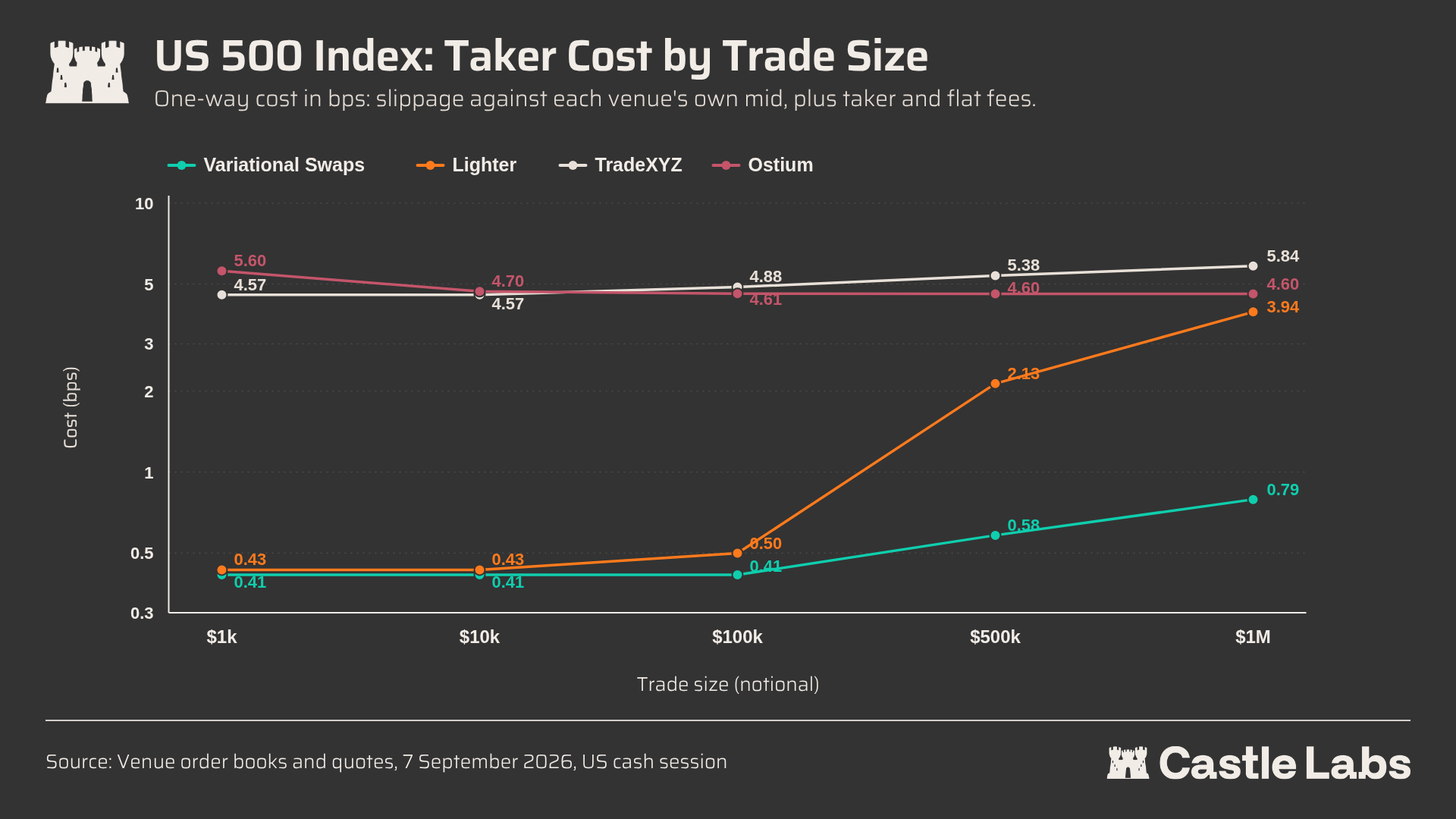
Chart: Taker cost for the US500 index across different trade sizes (basis points). Source: Venue order books & quotes, Sept 7, 2026 US equity session; Castle Labs.
In this specific case, Variational is the cheapest venue at every size, including $1,000 and $10,000 (0.415 bps vs. Lighter's 0.433 bps).
The gap between the two platforms is narrower at smaller sizes but widens to 5x at the $1M mark. This represents a significant cost difference: $79 vs $395 in execution costs. TradeXYZ and Ostium charge 5.84 bps and 4.60 bps respectively.
Next, we analyze silver (XAG) across the platforms.
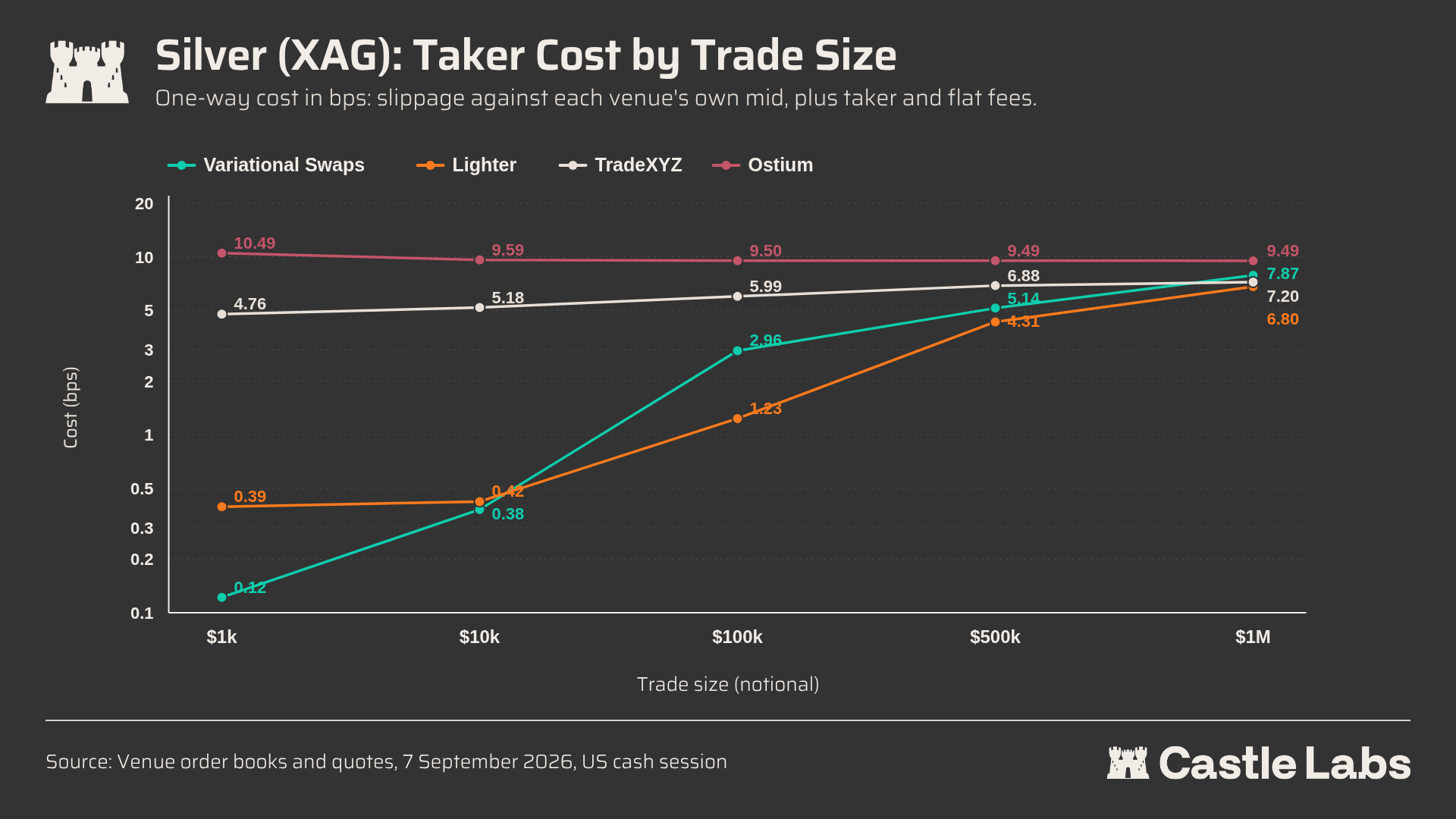
Chart: Taker cost for Silver (XAG) across different trade sizes (basis points). Source: Venue order books & quotes, Sept 7, 2026 US equity session; Castle Labs.
Variational is the cheapest at $1,000 (0.12 bps) and $10,000 (0.38 bps), but execution costs rise at the $100k scale, exceeding Lighter, and remain higher at larger sizes. A $500k order on Variational costs 5.14 bps versus Lighter's 4.31 bps, a difference of roughly 20%. XAG is currently the shallowest in depth among launched swap markets, lacking the stable quote shape seen in other markets. We expect these results to generalize to other markets as XAG grows.
Next is the gold (XAU) market, which behaves similarly to the US100 and US500 indices.
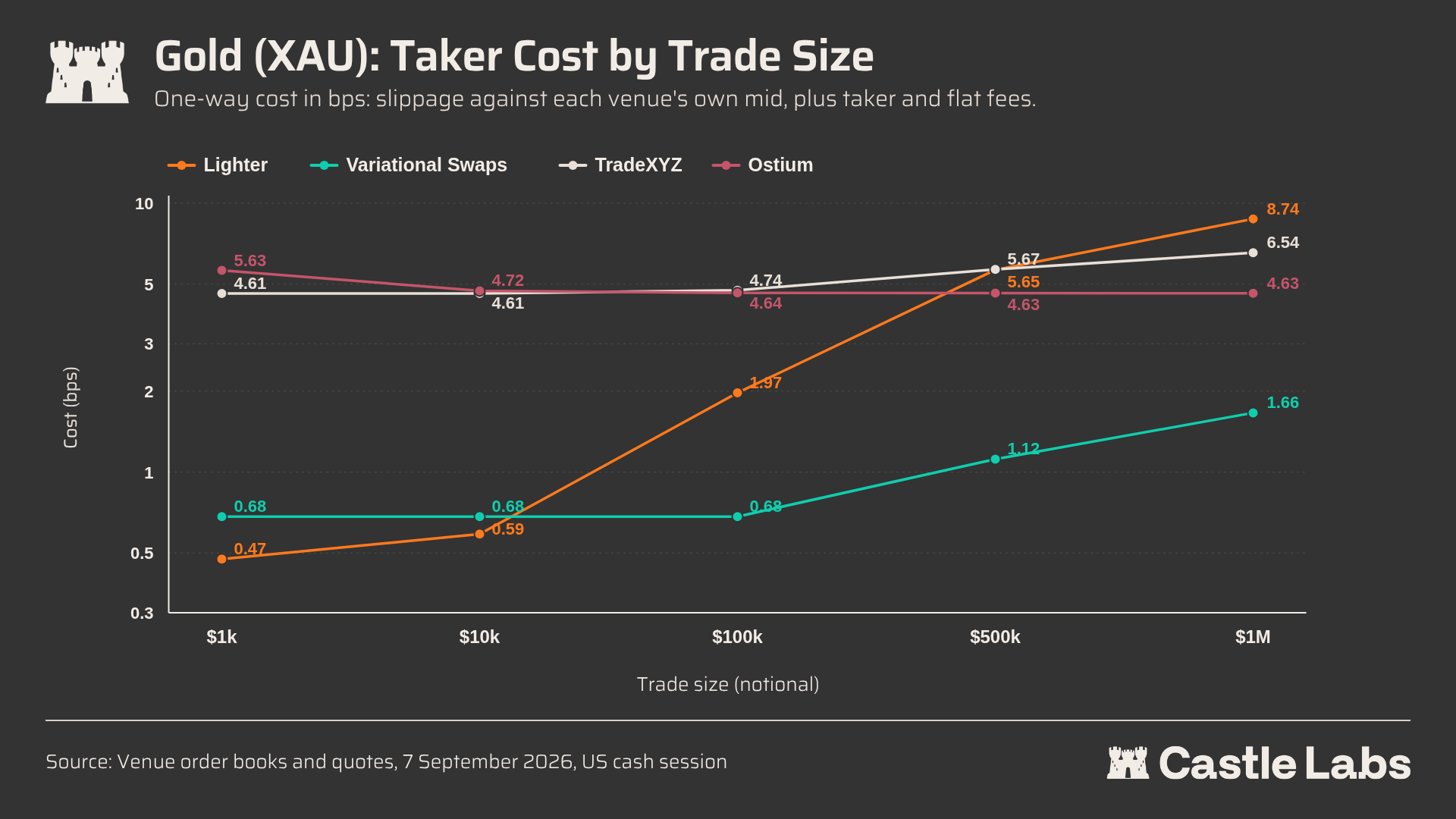
Chart: Taker cost for Gold (XAU) across different trade sizes (basis points). Source: Venue order books & quotes, Sept 7, 2026 US equity session; Castle Labs.
For smaller orders of $1,000 and $10,000, Lighter is the cheapest alternative, with opening costs of just 5 cents and 60 cents respectively. Meanwhile, Variational leads at larger sizes above $100k, costing only 0.68 bps, 65% cheaper than Lighter. Variational also maintains its lead on orders up to $1M, charging 1.66 bps, well below competitors: Ostium is closest at 4.63 bps, TradeXYZ charges 6.54 bps, and Lighter spikes to 8.74 bps. Across most markets, Variational is the cheapest venue for larger-sized orders, while Lighter leads on smaller-sized orders for assets like gold and US100 (e.g., $1k and $10k).
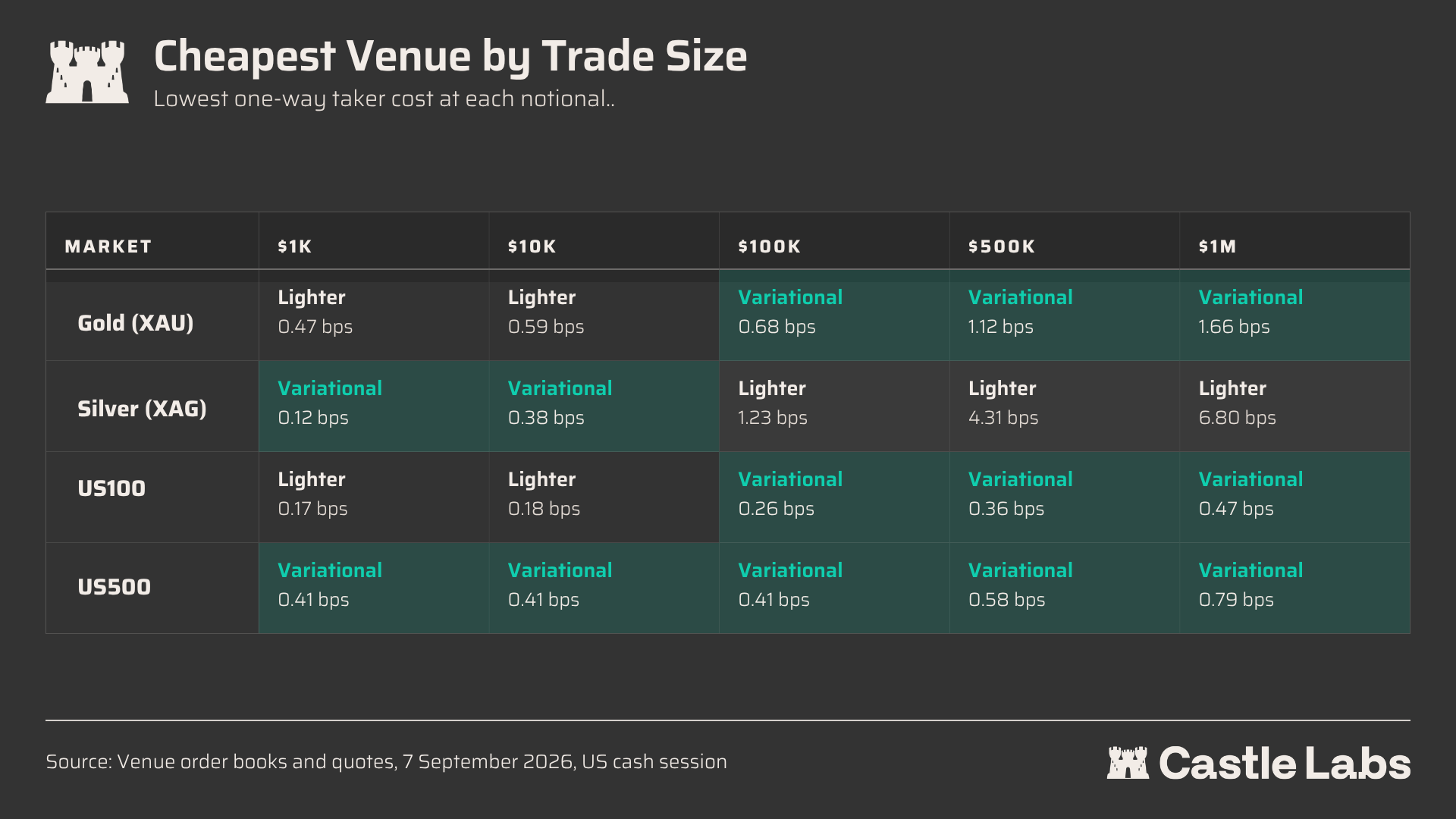
Chart: Comparison of cheapest venue for taker costs across different trade sizes (XAU, XAG, US100, US500). Source: Venue order books & quotes, Sept 7, 2026 US equity session; Castle Labs.
The on-chain trading landscape continues to evolve.
The share of RWA and TradFi assets in perp trading volume is steadily rising.
While demand from native on-chain users remains strong, the novelty of these assets and the accessibility advantages brought by going on-chain mean the market is far from reaching the efficiency levels needed to attract large-scale institutional traders.
Perp protocols must constantly carefully balance "launching attractive new assets" with "ensuring sufficient liquidity for efficient execution." Moreover, perps are unfriendly to RWA traders due to unpredictable funding rates, which can impact the final P&L of a trade.
Variational Swaps offer an interesting way to solve both problems simultaneously, benefiting both retail and institutional traders.
Retail traders can benefit from predictable funding costs and clear visibility into the true cost of holding exposure via swap positions. Institutions can rely on low execution costs, predictable funding rates, and tight correlation with the underlying markets.
The rapid growth of swaps proves this: they already account for over 50% of Variational's daily volume, with open interest exceeding $220 million.
This is primarily driven by the US100 market. As of September 7, this market accounted for over 50% of all swap volume and 30% of open interest.
In the first wave of launched markets, funding rates show annualized payments for longs ranging from 4.6% to 5.7%, while annualized returns for shorts hover around 2.4%.
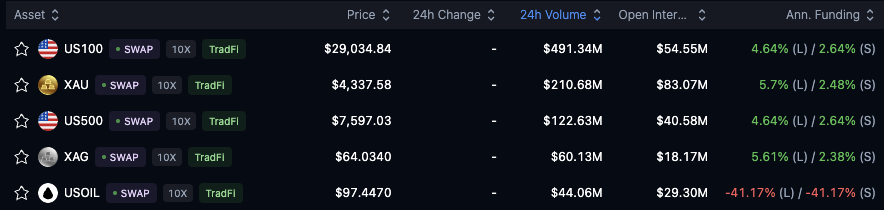
Chart: Price action, 24h volume, open interest, and annualized funding rates (long / short) for Variational Swap's first wave of listed markets (US100, XAU, US500, XAG, USOIL). Source: Variational.
So far, executing large-scale trades across most RWA markets and achieving favorable fills has been difficult. Swaps bypass the need for liquidity bootstrapping, delivering TradFi-level depth to any market, redefining perp venues as an on-chain derivatives protocol that aggregates liquidity where it already exists and transparently settles that exposure.
This model offers clear advantages. It supports more markets, sidesteps slow liquidity bootstrapping, and provides users with exposure to assets hard to list on-chain via order books, all at predictable costs.
By doing so, swaps also create a clearer structure for RWAs, where financing costs and trading hours reflect the underlying market rather than a supply-and-demand-driven perp template.
The trade-off is that this model demands more from the OLP. Users don't rely on a broad public order book but instead depend on Variational's pricing, hedging, risk management, and ability to maintain competitive quotes across hundreds of markets via its RFQ. All of this makes execution quality the core metric that needs to be proven.
Our analysis confirms that across most trade sizes, for currently listed assets, Variational is the cheapest venue. Taking US100 as an example, a $1M trade costs as low as $47. However, in certain cases like silver, insufficient trading volume leads to higher execution costs, with a $1M trade costing $787, 20% higher than Lighter.
Since the platform charges no fees, this further lowers execution costs, establishing it as one of the most cost-effective venues for trading TradFi markets on-chain.
Join TechFlow official community to stay tuned
Telegram:https://t.me/TechFlowDaily
X (Twitter):https://x.com/TechFlowPost
X (Twitter) EN:https://x.com/BlockFlow_News
 @castle_labs