The Short Squeeze Myth of Stock-Paired Meme Coins: Why It Is Doomed to Collapse?
Written by: David Christopher
Translated by: Saoirse, Foresight News
Unfortunately, the grand vision the market holds for stock-paired Meme coins will ultimately prove unattainable.
Some readers may not be familiar with the background. I am referring to a widely circulated narrative in the market: a short squeeze on the on-chain stock supply could ripple through to the traditional stock market. But unfortunately, the underlying mechanism is fundamentally incapable of doing so by design.
If you didn't follow the market over the weekend, you likely missed that absurd price dislocation. Liquidity pools are essentially an entry-exit trading mechanism. When users buy Meme coins like BONER, which are tied to tokenized stocks (TEQ), massive capital gets trapped, effectively monopolizing the circulating supply of the paired stock tokens. With the supply severely compressed, the token price experiences a violent pump.
AMC's stock token once spiked to $166.86, while its underlying real-world stock closed at just $2.59 last Friday. HIMS did not experience such extremes, but was equally baffling: the on-chain token peaked at $132.64, while the real-world stock closed at $28.84 on Friday, only returning to rational levels once traditional markets opened on Monday. Their on-chain prices reached approximately 64 times and 4.6 times their respective real-world stock prices.
Over the past few days, this phenomenon of "monopolizing token supply" has ignited market imagination. Everyone is particularly curious about the chain reaction this could trigger for heavily shorted stocks. Could a group of fervent Meme coin holders drive token prices astronomically high, rely on locked-up tokenized chips, not only execute a short squeeze on-chain but also transmit the squeeze effect to the real-world stock market?
Unfortunately, the answer is no.

BONER hoards Robinhood's on-chain HIMS tokens, causing the on-chain token price to spike to 4.5 times the real-world stock price over the weekend in an attempt to engineer a short squeeze. The attached image highlights the massive divergence in their price trajectories.
Why the Squeeze Strategy Fails
The first core issue is the disparity in scale. The circulating supply of most TEQ tokens is negligible compared to the volume of their corresponding underlying real-world stocks. Taking BONER as an example, it has cumulatively held 53% of HIMS stock tokens. While this percentage looks astonishing, when converted, it accounts for merely about 0.014% of HIMS' total real-world shares outstanding.
Even if the token supply scales up further, there remains a more fatal flaw: controlling stock tokens does not equate to controlling the actual stocks.
Stock tokens issued by Robinhood are backed 1:1 by real stocks held in custody accounts. Users only receive exposure to price gains; they do not own the underlying shares themselves. Therefore, when BONER deposits a large amount of HIMS stock tokens into a liquidity pool, it merely creates scarcity for the on-chain stock tokens without making the actual HIMS shares scarce in the real world.
Once token scarcity pushes the on-chain HIMS price significantly higher than the real-world stock price, Robinhood's authorized participants can mint new stock tokens to arbitrage the price difference. Minting new tokens does require purchasing additional real stocks as underlying backing, meaning issuance will bring a small amount of buying pressure to the target stock. However, hoarding existing tokens does not inherently force the purchase of an equivalent amount of HIMS common stock. Its primary outcome is prompting the platform to issue more stock tokens, expanding the token supply, and pulling the on-chain token price back in line with the real-world stock price.
Last week's market movement already proved this point: HIMS tokens broke past $100 on-chain, while the real-world HIMS stock price hovered around $29. Once traditional markets opened, approximately 4,000 brand-new HIMS tokens flooded the market, rapidly eliminating the massive price gap between on-chain and off-chain.
Of course, a legendary short squeeze is not entirely impossible. The premise is that we need a TEQ infrastructure that binds more tightly to real-world equity ownership.
What a More Mature TEQ (Tokenized Equity) Should Look Like
Ironically, the solution currently closest to this goal exists on the Solana public chain.
Last year, Galaxy partnered with Superstate to migrate GLXY on-chain. The distinction between the two is straightforward: Robinhood provides users with tokens that track stock prices, whereas under the Galaxy model, the token itself represents the actual stock.
Original Galaxy shareholders could convert their physical GLXY certificates into on-chain GLXY tokens. These on-chain tokens represent genuine Galaxy Class A common stock, carrying identical legal rights, economic benefits, and voting power as their traditional counterparts. When tokens are transferred and settled, Galaxy's official shareholder registry updates synchronously.
This makes the link between on-chain and off-chain markets far more direct. Transferring on-chain GLXY is equivalent to transferring equity ownership itself, rather than merely generating a mirrored certificate of the stock.
However, this Galaxy scheme is not yet fully mature. At present, its on-chain shares only permit transfers between whitelisted wallets, and Galaxy has not yet enabled permissionless automated market maker (AMM) trading.
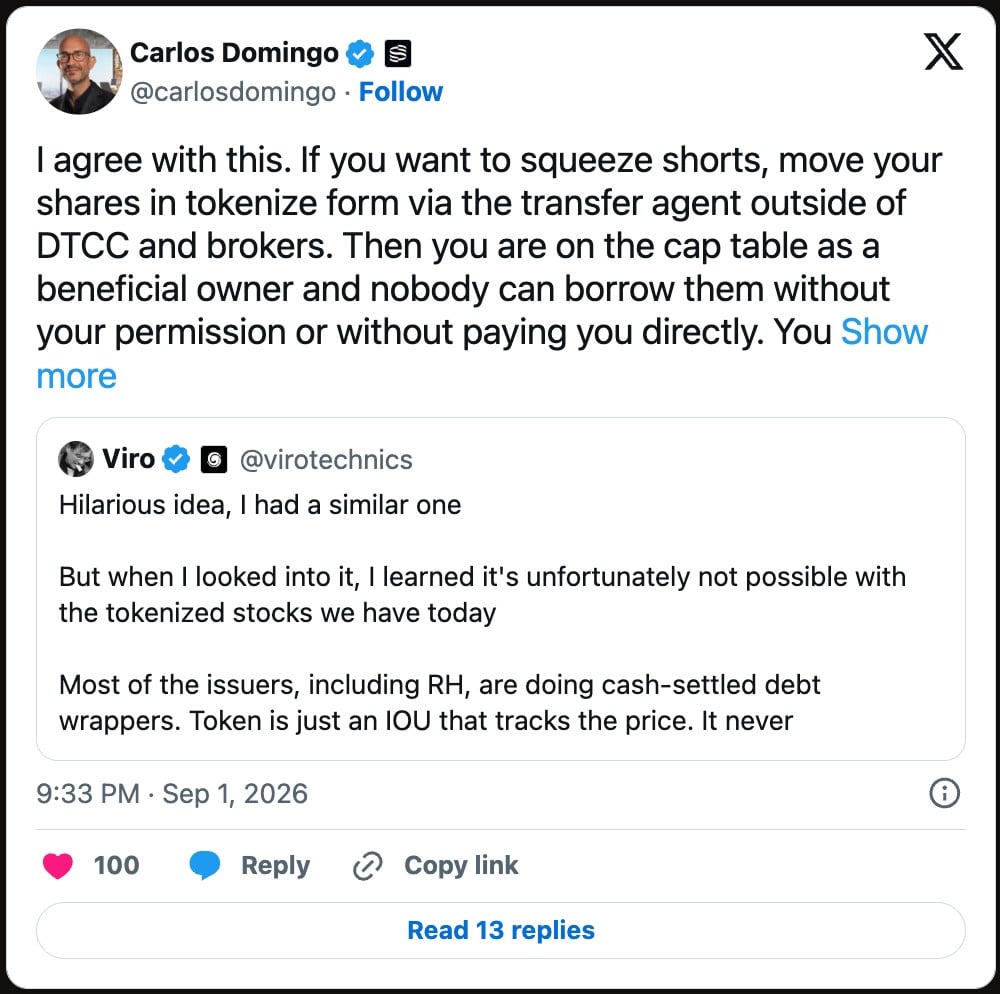
Discusses the conditions required for an on-chain short squeeze, pointing out that current tokenized stocks like those on Robinhood are merely price-tracking IOUs, not true equity, making a genuine short squeeze impossible.
Where Lies the True Value of Stock-Paired Meme Coins
So, is all of this merely a fresh gimmick fueled by speculators and hype capital?
I do not believe so.
The short squeeze effect is simply the narrative that the public latched onto first, the most thrilling storyline. Even if a squeeze cannot be realized, tying stocks to tokens still spawns entirely new market logic.
Eric Conner proposes a mainstream perspective: these Meme coins can serve as decentralized marketing tools for the corresponding listed companies. Token holders will organically track earnings reports, product updates, short interest, industry news, and any information related to the target stock, simultaneously producing a massive volume of memes and content.
But this model has obvious limitations. While the token name "BONER" might align well with Hims' product vibe, a medical company seeking credibility in the mainstream market would struggle to publicly embrace a token with such a name.

Posits that every stock will eventually spawn a corresponding Meme coin community, claiming such communities can deliver viral growth for listed companies, while sharing relevant podcast content regarding the HIMS on-chain token surge.
However, reality occupies a middle ground. Today, excellent companies understand guerrilla marketing. Token communities naturally form distribution channels. Companies do not need to acknowledge them, let alone control them.
A second, perhaps even more interesting development path lies in transforming TEQ into entirely new financial and gamified foundational components.
NetNet Capital introduced the "RW-Play" concept, whose core idea is using tokenized stocks as programmable modules within games and DeFi products. COINflip uses tokenized Coinbase stock as winner rewards; SpaceX Invaders distributes tokenized SpaceX stock as prizes; and MSFT Flight Simulator rewards users with tokenized Microsoft stock.
Tokenized stocks are no longer limited to simple buy-and-hold strategies. They can function as trading pairs, collateral, reward prizes, and liquidity sources, embedded across a variety of novel applications.
The current market largely consists of taking new assets and replicating the old tricks of 2020's DeFi. But what deserves deeper reflection is how the market will evolve once TEQ develops its own native foundational components.
Setting aside Robinhood's explosive on-chain candles, the combination of stocks and tokens represents one of the most highly original innovations in the on-chain space recently. Currently, Robinhood's stock tokens have made this chain the primary battleground for this track, but this status quo will not remain uncontested indefinitely.
Galaxy has already proven that Solana can host TEQs deeply bound to real-world equity. In the future, the Base public chain will very likely launch its own similar solution. The core of track competition lies not in who puts more stocks on-chain, but in who builds a more valuable bridge between on-chain assets and real-world equity. Ultimately, whoever uncovers more intriguing use cases for tokenized stocks will prevail.
It is fascinating to witness the birth of an entirely new narrative. While opportunities for speculative profit certainly exist here, more importantly, it heralds the emergence of unprecedented financial mechanism designs.

Robinhood's co-founder stated that Robinhood Chain positions itself as a premier chain for real-world assets (RWA), while also being compatible with meme-style speculative gameplay.
Join TechFlow official community to stay tuned
Telegram:https://t.me/TechFlowDaily
X (Twitter):https://x.com/TechFlowPost
X (Twitter) EN:https://x.com/BlockFlow_News
 Bankless