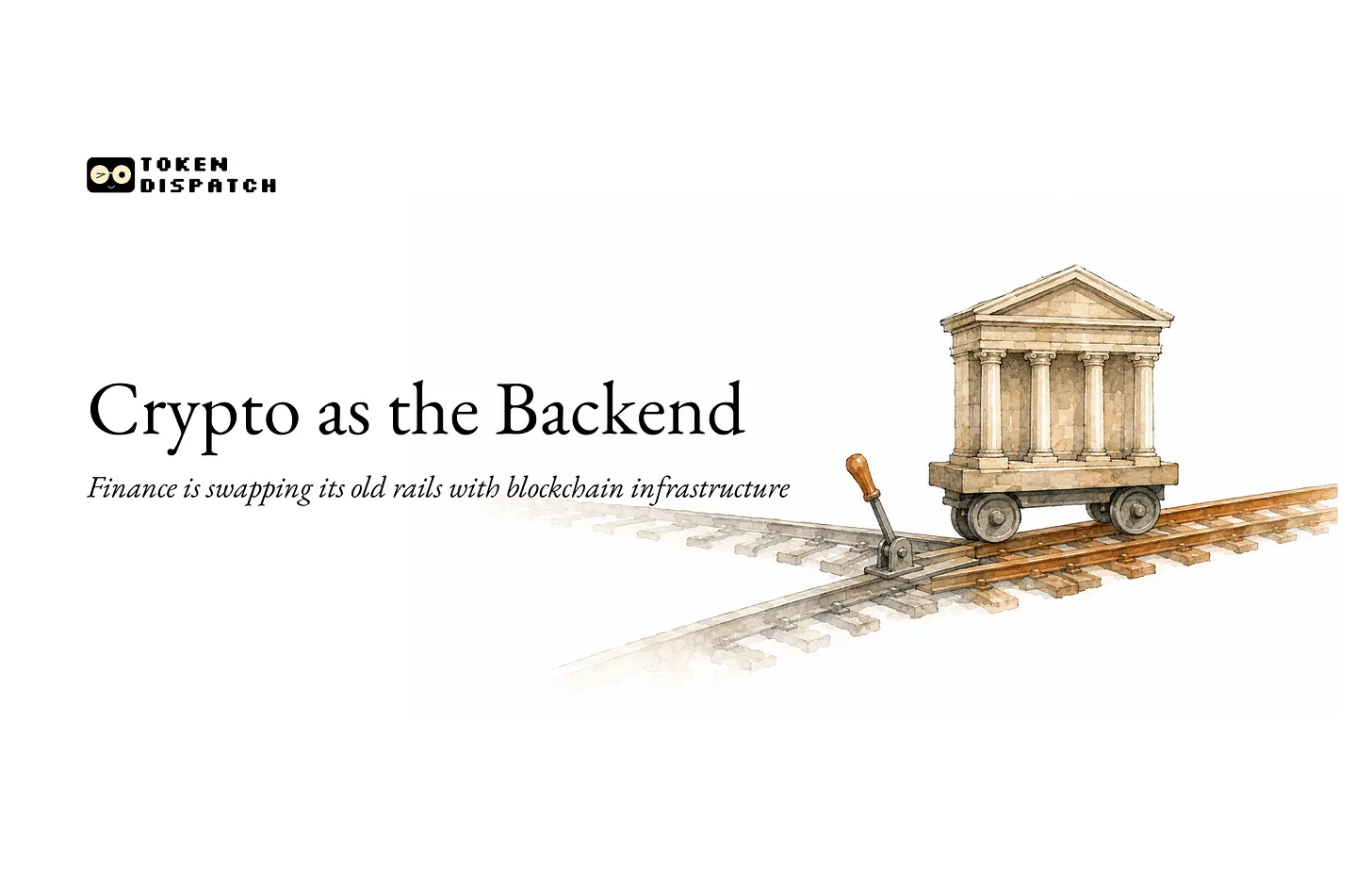
When throughput is no longer the bottleneck, what kind of blockchain does finance truly need?
Written by: a16z Crypto
Translated by: Luffy, Foresight News
Finance is the most intuitive use case for blockchain, and also one of the most demanding. In the context of financial applications, one of the frequently cited advantages of blockchain is that it integrates assets, ownership records, and execution rules into a shared system not controlled by a single counterparty. However, this does not mean that blockchain is inherently capable of adapting to the operational scale and constraints of global financial markets.
For years, discussions surrounding blockchain implementation have consistently focused on cost and throughput, namely the number of transactions a single public chain can process per second — without sufficient performance ceilings, financial applications cannot achieve scaled deployment. However, as the throughput gap between various commercial systems continues to narrow, the focus of industry discussion is shifting.
As financial institutions begin executing transactions, issuing stablecoins, and tokenizing assets on-chain, they need to verify whether these networks can truly meet the operational demands and expectations of real financial markets. This includes stable and reliable access capabilities, predictable transaction execution rules, and controlled permissions regarding when sensitive information is disclosed publicly. These guarantee mechanisms must remain effective even under extreme conditions such as network congestion, service outages, or attacks.
Blockchain developers have been tackling these challenges for years. This article will outline the technical hurdles already overcome, unresolved legacy issues, and why today's blockchain is closer than ever to supporting financial markets.
Predictability: Certainty Guarantees for Transaction Inclusion and Ordering
For a long time, performance ceilings have been the most obvious bottleneck to development. Fundamental issues such as insufficient transaction processing capacity, frequent network congestion, and persistently high fees have made it difficult for many real-world financial scenarios to be truly implemented. Once market activity picks up, routine operations like order placement and cancellation become either prohibitively expensive or unreliable.
In recent years, particularly during the last infrastructure upgrade cycle, this constraint has been alleviated. Across the industry, overall blockchain throughput has seen substantial growth over the past five years, with some commercial networks now capable of processing tens of thousands of transactions per second. Yet this is merely the beginning; current stress tests and entirely new architectural designs will push performance metrics even higher.
But new problems follow: relying solely on throughput cannot determine exactly when a transaction will finally be finalized on-chain. The predictability of transaction execution has become the new core proposition.
Transactions must be confirmed and take effect within a predetermined time window, following rules that are known in advance by market participants. The value of numerous operations in financial contexts exists only within extremely narrow time intervals. For everyday payments, a one-second execution delay might be negligible; but for trading markets, a difference of milliseconds can determine whether participants trust this trading infrastructure. Take an on-chain order book as an example: if a trader's cancellation instruction is confirmed too late, other market participants can execute trades based on stale prices. Market makers will factor this risk into their pricing, widening bid-ask spreads, ultimately resulting in worse execution prices for all traders.
Simply put, predictability requires two layers of guarantees: the first is transaction inclusion assurance, meaning censorship resistance; the second is transaction ordering assurance.
Resilience: Stable and Reliable Transaction Execution Channels
Even with perfect ordering rules, risks persist if a single entity still controls the authority to execute transactions. Imagine if a randomly selected staking node determined transaction inclusion for the NYSE every second. Obviously, such nodes would wield immense power to manipulate markets for traders within the exchange.
The ordering mechanism determines the sequence of a transaction relative to others once on-chain; while interference resistance requires addressing the preceding stage: whether participants can successfully submit orders without relying on a single gatekeeper or operator — whose decisions could influence pricing, trading risk, and ultimately the final execution outcome.
Therefore, blockchain developers are striving to build stronger deterministic guarantees, pursuing immediate transaction confirmation rather than mere "finality." The goal is that if a compliant transaction arrives at the network on time, it can be immediately packaged and included on-chain. This standard is far stricter than "your transaction will eventually be confirmed," and it is precisely the capability that financial markets require.
Our researchers have proposed and defined the concept and metric of "Strong Chain Quality," ensuring that the next round of transaction execution authority will not be monopolized by a single operator's queue. Its underlying logic is that a blockchain can reserve a portion of space in each block to accept transactions submitted by other nodes in the network, providing multiple pathways for compliant transactions to get on-chain. This ultimately reduces a single operator's control over the transaction packaging sequence.
Our goal is to make blockspace a public infrastructure with multiple access channels, rather than a single queuing line. Achieving this requires more complex underlying logic than current commercial protocols, but the benefits justify the R&D investment. Even under network stress, market participants can be assured that their transactions will execute smoothly.
Ordering: Explicit Rules Understandable to Market Participants
Predictability likewise depends on how trading venues determine the sequence of transactions. When multiple transactions are ready for execution, the market needs a clear set of ordering rules.
Most blockchains do not finalize transactions one by one; instead, they package transactions into "blocks" written to the ledger by block builders or proposers. In many current systems, this entity holds significant discretionary power over which transactions are included and their arrangement order. The original intent of this design was to simplify protocol logic, which remains acceptable for certain application scenarios. But in financial markets, transaction ordering directly determines execution priority, final prices, and the fairness of the entire trading process.
Furthermore, if a single entity controls the packaging rights for the next block, it may gain early visibility into transaction information, seizing market opportunities. In the crypto industry, this phenomenon is commonly known as Maximal Extractable Value (MEV): operators extract additional profits beyond basic block rewards by selecting, dropping, or reordering transactions within a block. Sandwich attacks are the most typical case: traders monitor pending transactions, place preemptive orders to move prices, then execute reverse trades to profit. The logic becomes even more straightforward in institutional trading contexts: the party controlling transaction flow may make trading decisions based on order information earlier than anyone else.
This mechanistic flaw closely mirrors existing problems in traditional financial markets, where centralized intermediaries profit from privileged information on order flow and trading intent. If on-chain markets fail to provide robust guarantees regarding transaction ordering and execution rules, they will ultimately reproduce the same information asymmetry issues.
Blockchain protocol designers are developing more explicit ordering mechanisms, primarily including deterministic rules based on priority fees, as well as business rules customized by trading venues. Exact implementation solutions are currently still in the academic research phase, but their core logic aligns seamlessly with traditional finance: market participants have clear expectations for transaction ordering and execution, mirroring the price-time priority matching mechanism adopted by traditional exchanges.
Transaction inclusion guarantees and ordering mechanisms must work synergistically. If bidding orders and liquidation/closing instructions can be artificially delayed before ordering rules take effect, then no matter how fair the ordering logic, it will be meaningless. Similarly, if users cannot predict the post-inclusion processing rules, the value of immediate confirmation will be significantly diminished.
High throughput is merely the foundational condition for on-chain finance implementation; only when paired with predictable transaction inclusion mechanisms and clear ordering rules can on-chain finance be deployed in environments characterized by high time sensitivity and real-market pressure.
Privacy: Locking Trading Intent Prior to Transaction Execution
A trader's order submission information exposes their trading judgment and operational intent. For example, order size and direction can reveal whether a fund is establishing or closing positions. If orders are made public before being fully filled, other traders have the opportunity to manipulate prices ahead of time for profit.
This is particularly pronounced in on-chain scenarios. Many blockchains directly publish data from the pending transaction pool before a transaction is finally confirmed. For financial businesses, even if privacy protection cannot be achieved after trade completion, pre-trade privacy defense is a mandatory requirement.
Markets can remain transparent and open, without requiring all participants to view others' unexecuted orders in real time.
Current protocol designers are focusing on protecting data privacy during the window period when trade information is still vulnerable to arbitrage exploitation, while simultaneously supporting diverse privacy disclosure models post-execution. After trade completion, disclosure rules can be flexibly adjusted: public markets display complete trade records externally, while interbank transactions restrict access permissions only to counterparties and regulators. Third parties unable to view all details can still verify that the entire transaction complies with business rules.
To this end, protocol designers are exploring various cryptographic solutions, such as fully homomorphic encryption and encrypted transaction pools. These schemes can hide transaction contents until a deadline arrives, or a committee confirms the final ordering position of the transaction within the block. By the time the market can see the transaction, the front-running arbitrage window will have closed.
Markets can balance transparency without exposing unexecuted orders to everyone in real time. On-chain finance also needs to implement this differentiated logic: supporting audit verification post-execution, and strictly protecting trade secrets pre-execution.
If blockchain aims to become the core infrastructure of financial markets, it must establish a trading system that market participants trust sufficiently.
Throughput is merely the first test. Without adequate performance, on-chain financial applications will forever be limited to niche scenarios. Now that trading speed has become an industry baseline, harsher tests loom: how can blockchain meet the maturity standards financial institutions demand for trading infrastructure? This standard includes predictable execution mechanisms, unambiguous execution priority rules, interference-resistant transaction access channels, and pre-trade privacy protection, while retaining auditable transparency post-execution.
Join TechFlow official community to stay tuned
Telegram:https://t.me/TechFlowDaily
X (Twitter):https://x.com/TechFlowPost
X (Twitter) EN:https://x.com/BlockFlow_News
 a16z