Agentic Payment Research Report: From Payment Paths to the Ecosystem Landscape
Author: Will Awang
On August 27, at the 15th China Payment and Clearing Forum, Lu Lei, Member of the Party Committee and Vice Governor of the People’s Bank of China, addressed the hottest topic today: agentic payment.
Three sentences from the vice governor have essentially framed the battles the agentic payment industry will fight over the next two years.
The first concerns the essence of payment. The essence of payment is the transfer of fund ownership, which objectively requires transaction outcomes to be predictable, liabilities to be defined, and trails to be traceable; while large models and autonomous agents exhibit characteristics such as output randomness and insufficient logical transparency. Blindly or excessively granting agents decision-making authority over transactions will undermine the trust foundation of fund transfers.
The second concerns commercial rules. Current payment industry governance rules and dispute resolution mechanisms are all built around the premise of "the human being the ultimate decision-maker"; the new model of agents autonomously initiating and assisting in transactions easily blurs the boundary of liability among consumers, participating institutions, and algorithmic systems.
The third concerns multi-party competition. The battle over protocols is fundamentally a battle over business rules and technical standards, and ultimately a battle for dominance in the age of artificial intelligence.
Read together, these three sentences point to the same thing.
Payment has been a business for sixty years, selling certainty. You can walk out of a store with your purchase immediately after checking out because there is a guarantee behind it: you can enter your card number on a website you've never heard of because someone will cover you if things go wrong. And every link in the entire system—authorization, clearing, chargeback, liability shift—is designed on the premise:
The person making the decision is present, and they take responsibility for their decision.
And now, the entity initiating the transaction itself is uncertain. It can misunderstand, be misled, buy the wrong thing within budget, and every step it takes is cryptographically flawless. When the ultimate decision-maker in a transaction is no longer a human, on what grounds can this system built on certainty continue to operate?
Against this backdrop, internet giants, AI giants, card networks, and payment companies have each given their answers across every dimension, and those answers differ. Some are modifying the existing stock, some are building new rails, and some are buying time.
This research report is based on our continuous tracking of this field in recent years and some practical experience, hoping to clarify the non-trivial logic hidden behind the simple phrase "Agentic Payment."
I. The Premise That Hasn't Changed in Fifty Years

1.1 Six Generations of Authorization: Only the Means Have Changed
Over fifty years, the payment industry has upgraded six generations of authorization technology, yet it has never changed one premise: when authorization occurs, the human is present.
From signature imprinting, to magnetic stripe plus real-time authorization networks, to EMV chip ciphertext, to NFC, to tokenization, all the way to today's agentic tokens—the six generations of upgrades have completely changed verification methods, yet they always verify the same thing: is the person at the point of transaction the actual cardholder? Signatures, PINs, fingerprints, Face ID—the methods grow increasingly sophisticated, but the premise remains unchanged.
Similarly, the decades-old dispute framework of card networks is built on a binary question—either the cardholder authorized it, or they didn't.
Agents dismantle the three pillars of this premise at once:
- Authorization and transaction are separated in time; a sentence you spoke three days ago might be executed by an agent at 2 a.m.;
- Intent is expressed in natural language, and "help me book a cheaper flight" cannot fit into any risk control engine field;
- Finally, for the first time, the initiator of the transaction is not the cardholder themselves.
In the world of agents, a third scenario emerges: the card wasn't stolen, the merchant made no error, the agent did exactly what it was asked, yet the consumer still says, "I don't want this."
1.2 Three "Can"s: Point-by-Point Comparison
Back to Vice Governor Lu's three words. Aligning them with traditional payment implementations one by one makes it clear where failures occur.
- Predictability relies on a human pressing the confirm button. That press fixes a vague intention into a transaction with a certain amount and target. But an agent doesn't do that.
- Liability definition previously relied on merchant of record and card network rules. Who is the seller under contract, and who to hold accountable when issues arise—this rule set has been written for decades, and its validity depends on fixed, limited roles along the transaction chain that have been explicitly named by regulations. Along the agent chain, no single segment has ever been explicitly named by existing rules.
- Traceability relies on account systems and transaction records. Agents actually do this better—complete signature chains, complete audit trails, every step nailed down to the cryptographic level.
Of these three, only the last one can be delivered by AI large models, and ironically, the last one is the least difficult.
1.3 Four Questions Raised by One Airline Ticket
Wednesday morning, 7 a.m., you wake up in Hong Kong to a deduction notification on your phone: HKD 2,600, Cathay Pacific, Hong Kong to Singapore, Thursday.
But you wanted Wednesday. Last night before bed, you asked your agent to book a Wednesday economy ticket, under a budget of 3,000. After you fell asleep, direct flights on Wednesday jumped to 3,800. The agent searched until 3 a.m. until it found a Thursday morning ticket for 2,600—within budget, correct destination, wrong day. And you booked this ticket to catch a meeting at 9 a.m. in Singapore on Thursday—the morning flight lands after the meeting has already ended.
Did you authorize this transaction? Literally, yes; in intent, no. Both answers are correct, and that is precisely the trouble.
You want to recover this 2,600. Do you contact the agent's developer, Cathay Pacific, or the issuing bank? This line of questioning breaks down into four unavoidable questions in agency law regarding delegated payments:
- Whether authorization is established,
- Where the boundaries lie,
- Who is responsible if boundaries are exceeded,
- Ultimately, who bears the loss.
These four questions form the skeleton of agency law over two millennia. And they naturally split in two: the first two belong to the domain of "proof," which cryptography can answer; the latter two belong to the domain of "adjudication," which only rules can answer. Today, almost all players are crowded into the first two questions.

These four questions are precisely the expansion of Vice Governor Lu's second sentence.
The reason current governance rules are "built around humans as the ultimate decision-makers" is concretely tied to the answers to these four questions as they apply to humans: the person authorizes themselves, sets their own boundaries, exceeding boundaries can only mean unauthorized access, and there is a ready-made system for sharing losses.
Four answers, sharing one premise. Once the premise is gone, all four answers hang in mid-air simultaneously.
Today, none of the four questions have answers. But the industry isn't waiting.
II. Ecological Landscape of Agentic Commerce
Over the past year, domestic and international card networks, payment institutions, and tech companies have densely released over ten agreements related to agentic payment; giants are acquiring companies, building new rails, and fighting for standards. Rules haven't even been finished writing, but the industry has already filled every position.
At the same forum, Han Xinyi, CEO of Ant Group and Chairman of Alipay, outlined four exploration paths for global AI payments: The first category includes payment tech and infrastructure platforms like Stripe; the second includes cryptocurrency companies like Circle and Coinbase, leveraging stablecoins and their wallet systems to directly support automated machine-to-machine payment scenarios using crypto as a medium; the third includes traditional payment networks represented by the two major card networks, Visa and Mastercard; the fourth includes AI platform enterprises like Google and OpenAI.
This list is highly informative. Viewed together, it shows four types of entities; viewed separately, it reveals five steps.
Cutting by entity clarifies who is present, but obscures who stands where. To see the latter, we must switch axes—cut according to the value capture chain of a single agentic transaction.
2.1 Five Steps on the Value Capture Chain
From intent generation to funds landing, a single agentic transaction passes through five steps sequentially. Each step holds different leverage, collects money differently, and carries entirely different levels of value attribution.
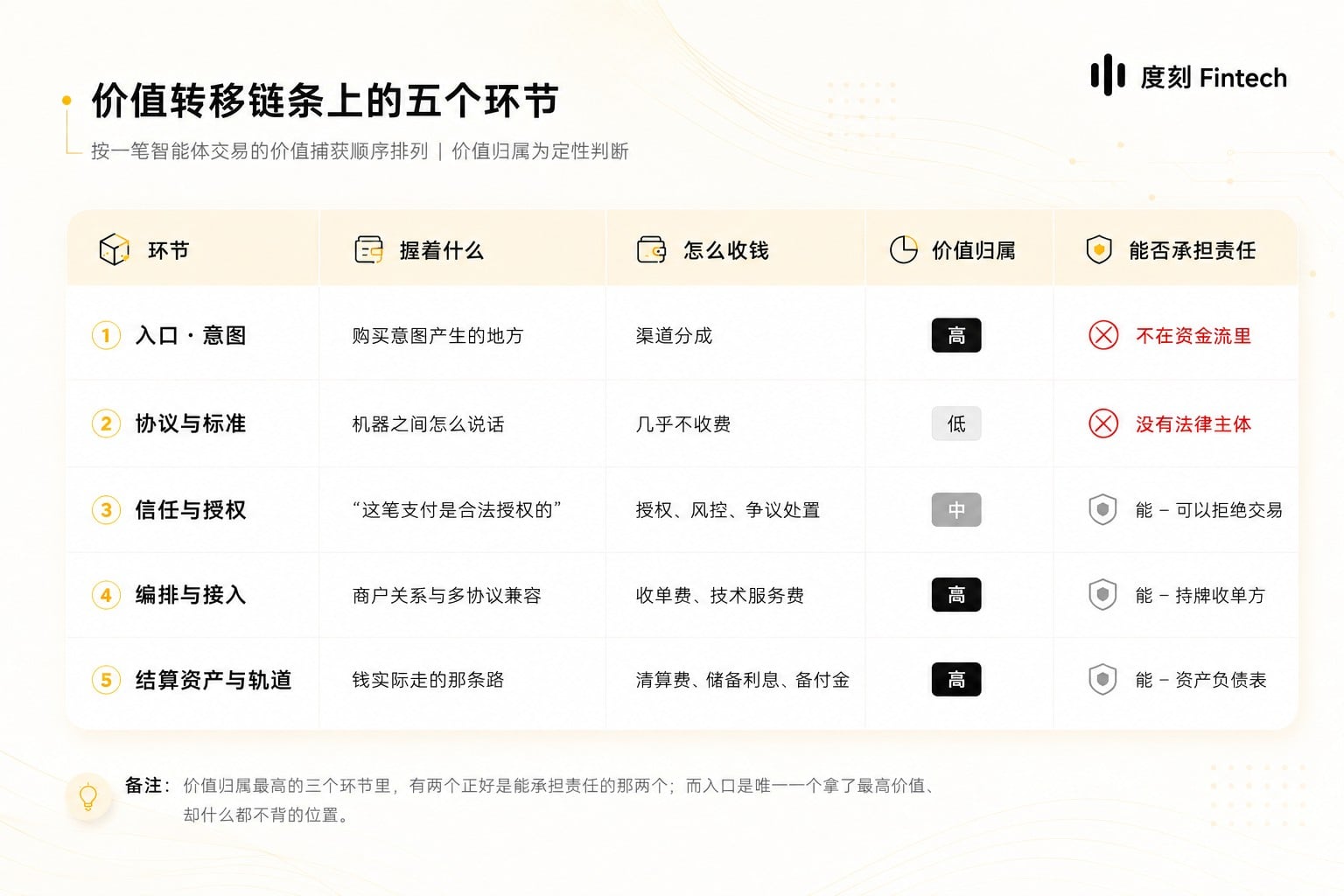
There are three points in this table that need elaboration.
First, the low-value cell happens to be the fully open-source cell. MCP, A2A, AP2, UCP, x402—all donated to foundations—and their positions are marked as low-value attribution on virtually every public map. This is no coincidence. Donating protocols is inherently to ensure no one rents off that layer; open source here is a mechanism for non-attribution of value, not the cause.
Second, card networks occupy two cells simultaneously. They charge fees via rules at ③ and own their own clearing network at ⑤. They are the only entity spanning two steps across the entire table, and these two steps happen to be the hardest to replace.
Third, and most crucially: two of the five steps cannot bear responsibility.
The entry layer holds the most valuable asset but sits outside the fund flow; the protocol layer has no legal entity whatsoever—code cannot be served, sued, or compensated. ③④⑤, however, all can. Trust layer enforcement doesn't come from courts but from "I can reject this transaction"; the PSP in the orchestration layer is itself a licensed acquirer and must backstop merchant chargebacks; the settlement layer relies on balance sheets and reserve funds.
Thus arises a mismatch: of the three steps with the highest value attribution, two are exactly the ones capable of bearing responsibility, while the third—the entry—is the only one taking the highest value while carrying zero liability.
2.2 Humans Let AI Choose, Dare Not Let AI Pay
Positions are filled, but demand-side temperature splits into two diametrically opposed halves.
The first half has already flipped.
Based on data from over 1 trillion US retail site visits, Adobe reports that in May 2026, retail visitor conversion rates from AI were 54% higher than non-AI channels, whereas a year ago, this group's conversion rate was less than half that of non-AI. In March 2025, it trailed by 38%; by March 2026, it led by 42%—an 80-percentage-point swing in 12 months.
Shopify's platform data explains why: over half of AI-referred sessions land directly on product detail pages, compared to only ~20% for organic search; AI-referred visitors convert nearly 50% higher than organic search, with average order value 14% higher.
It's not more people coming; it's different people. They know what they want, head straight for specific products, and mostly buy long-tail items unranked on search engines. The conversion reversal doesn't rely on consumers becoming bolder, but on the fact that the ones arriving are actually buyers.
The second half has barely moved.
Research from Checkout.com in June this year gives the number: only 3% of transactions today involve AI agents. More telling than that figure is the nature of the "fear"—24% of consumers say they would never delegate purchases to AI, and 27% distrust any institution to operate AI shopping agents. This is no longer wait-and-see, but active refusal.
Why the fear? An event in the crypto circle this February explains it best. An AI agent named Lobstar Wilde saw a plea post on social media, independently judged intervention was needed, and autonomously transferred $450,000. The post was fabricated, while the user originally only intended to give 4 SOL.
Budget caps can contain the scale of losses, but cannot contain violations of intent within the budget.
They pass the test of "trusting AI recommendations," but fail the test of "daring to let it pay on my behalf."
2.3 This Channel Itself Has Yet to Grow Up
Beyond heat, we must look at the base, and right now, this industry lacks even a unified ruler.
Contentsquare's benchmark, based on nearly 100 billion sessions, shows AI-driven traffic accounts for only 0.2% of total sessions.
This is Q4 2025 data, reported in January 2026—comparing it to Adobe's May figures means a two-quarter gap, yet this curve grew sixfold in a year. In the same benchmark, the absolute conversion rate for AI-driven traffic is 1.3%, still lower than email's 1.9%; while Adobe reports relative premium, the two are incomparable.
The growth side is more telling. On May 11, Shopify said in an enterprise blog that Q1 AI-referred orders grew nearly thirteen times year-on-year; during an Aug 5 earnings call, they said AI-driven traffic and orders each grew three times YoY.
These two numbers cannot be subtracted. The former only measures referred orders, while the latter combines traffic and orders into a wider bucket; moreover, the "three times" figure doesn't exist in Q2 press releases or 10-Q filings.
And this "incomparability" is itself the problem. Two numbers from the same company, on the same topic, twelve weeks apart, differ even in overall scope, and this is already the most transparent company industry-wide.
The same trap exists on the liability side: that often-cited dispute growth forecast covers all online chargebacks, with zero attributed specifically to agents.
2.4 And the Merchant Side Isn't Connected
One step further down the chain is the merchants meant to absorb all this.
Compliance risk firm Ballerine's assessment is most direct: 73% of merchants are not yet prepared for agency, most payment service providers haven't adopted these protocols, and no party along the payment chain has agreed on liability attribution. Checkout.com's concurrent figures seem conflicting but actually ask another question: 89% of merchants say they are actively preparing.
73% unprepared, 89% preparing—the numbers don't clash; one asks if the system is integrated, the other asks if work is underway.
Everyone is working on it for a year, yet integration remains stuck at 3%.
2.5 And on the Machine-to-Machine Side, Already Hundreds of Millions
Shifting focus from humans to machines yields a completely different picture.
Raw on-chain data for x402 shows cumulative $135.7 million in volume, 178.3 million transactions. Filtering out wash trading and test transactions still leaves $15 million adjusted volume, 109.6 million valid transactions, and ~5,300 valid merchants. The real market is smaller by an order of magnitude than the surface on-chain data, yet even after this cleansing, the volume remains at the hundred-million level.
Opposite these transactions are no hesitant consumers, no merchants needing register modifications, and no one waiting for someone else's authorization.
What are they buying? By current on-chain categories, roughly five types:
- Pay-per-call interfaces: search, maps, weather, corporate registry queries, any metered endpoint; agents discover and pay on-demand without pre-approving keys;
- Data and feeds: financial reports, on-chain data, regulatory info, social signals billed per query or volume;
- Inference and compute: pay-per-model call, GPU/sandbox environments rented per request, exit upon task completion;
- Content and assets: images, music, fonts, papers, datasets, used per instance rather than pre-purchased quotas;
- Agent-to-agent procurement: one agent outsources subtasks to another, buys outputs, settles in USDC.
By transaction count, this is currently the largest category.
These five share a common trait: delivery equals consumption, with no room for regret. None require returns, none generate disputes, and none need a human afterward saying "I don't want this."
But hundreds of millions doesn't equal a mature market. Deconstruct the structure, and you see a very young shape: the top 1% of buyers contribute ~90% of volume, with just 0.02% contributing ~48%—less a mass market, more dozens of institutional automation backends running batch jobs; chain distribution is similarly concentrated, with Base handling ~90% of valid transactions, while supply hasn't grown yet.
The curve's shape is even more intriguing. Transaction volume peaked in Nov 2025 at ~38 million monthly; by Mar 2026, it dropped to ~2.1 million, yet volume remained $1.64 million, pushing the average ticket size to a new high since launch.
Count collapsed 77%, but average price rose. This curve isn't dying; it's swapping categories.
Industry positions are filled, consumers trust recommendations but refuse to hand over payment rights, merchants are preparing but not connected—on the human chain, the three parties won't move first; on the machine side, hundreds of millions have already run.
Agentic payment, one word, cannot contain these two realities.
III. Two Denominators Under One Word
The mismatch in the previous chapter's two pictures exists because they measure completely different things.
The term "Agentic Commerce" masks a fundamental fracture—it actually describes two completely different transactions sharing a name.
- AI proxy shopping: humans delegate agents to buy ("buy me a pair of size 42 running shoes"), agent searches, compares, checks out, but the purchasing decision is human-made, spending human money.
- AI autonomous trading: machines autonomously purchase digital services to complete their tasks, calling an LLM API, paying $0.003, receiving results to continue working, with no human clicking "confirm purchase."
The former is substitutional, carving share from existing human shopping behavior; the latter is generative, creating transaction volume from thin air.
Their ceilings are determined by completely different factors, and all forecasts circulating in the market measure almost exclusively the first half.
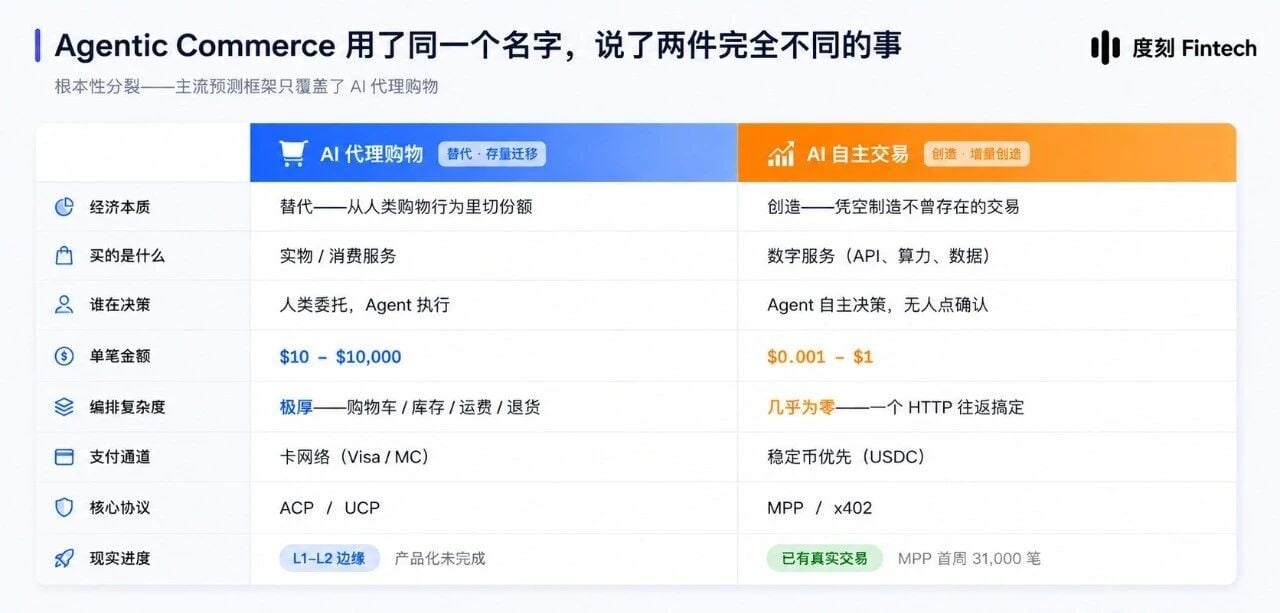
(Everyone talks about Agentic Commerce, but no one clarifies it's actually two things: two paths, three-layer architecture)
3.1 AI Proxy Shopping: The Ceiling Is Money Humans Would Spend Anyway
Let's look at the most measured half.
Morgan Stanley's figures project $190B to $385B by 2030, and their metric is honest: representing 10% to 20% of US e-commerce. eMarketer's metric puts US AI platform retail e-commerce at ~$20.6B this year. McKinsey projects global agentic commerce between $3T and $5T by 2030.
From $20B to $5T, the gap is over 200x. This gap reflects less disagreement on growth speed and more on "what exactly is being counted"—some only count checkouts completed within AI interfaces, some count all AI-influenced orders, some even include machine-to-machine calls.
But regardless of methodology, the substitutional half shares a common ceiling: its denominator is the money humans would spend anyway.
Mastercard CEO Michael Miebach explained it vividly with a scenario. You plan to camp, ask AI what to bring, it lists fifteen items, and omits tents knowing you already have one. After getting the list, you still hunt site by site, wasting hours; if checkout could happen instantly at that moment, it flows smoothly.
Then he added a judgment: basically, "people won't inherently buy five extra tents just because they have an agent; this is more replacement of existing traffic."
Agents change how this money is spent, where it's spent, and who earns it, not how much.
It's a battle over channels, entrances, and attribution—a migration of existing stock; and the flip side of stock migration is that incumbents at every step have reasons to delay—merchants won't cede checkout, platforms won't cede entry points, and card networks lose nothing along this path.
3.2 AI Autonomous Trading: The Half No Forecast Covers
The other half appears in no forecast.
Joe wakes up to a message from his personal agent. Overnight, it liquidated his Walmart position—satellite imagery showed declining foot traffic in store parking lots, combined with bearish sentiment in prediction markets; it sent meeting invites to three prospective clients' scheduling agents, each attaching a one-page briefing; it also scanned pricing from six cloud providers, finding equivalent performance alternatives 65% cheaper annually.
Total spend: $0.67.
This $0.67 isn't saved; it's created. These transactions didn't previously exist, not due to lack of demand, but because human decision costs exceeded transaction value—no one spends a penny to check satellite lot data to decide whether to sell a position. Just deciding "is it worth checking?" inherently costs several cents.
Such micro-payments aren't absent in human economics because poorly executed, but mathematically unviable. Flip the payer, and the inequality reverses.
Once reversed, the consumption shape of agents immediately diverges from humans. AMP PBC analyzed 100 trillion tokens flowing through OpenRouter, concluding contrary to popular imagination: the median request isn't a human prompting a large model, but a machine looping mid-process. One agent loops all night, repeating similar calls thousands of times, unattended, continuously.
This isn't a single purchase; it's a continuous consumption stream.
Another number at the watershed: on-chain AI agents completed ~176 million transactions cumulatively last year, with an average ticket of only $0.31 to $0.48, ~76% below Visa's $0.30 flat fee threshold.
Card networks aren't failing here; humans simply wouldn't make these transactions.
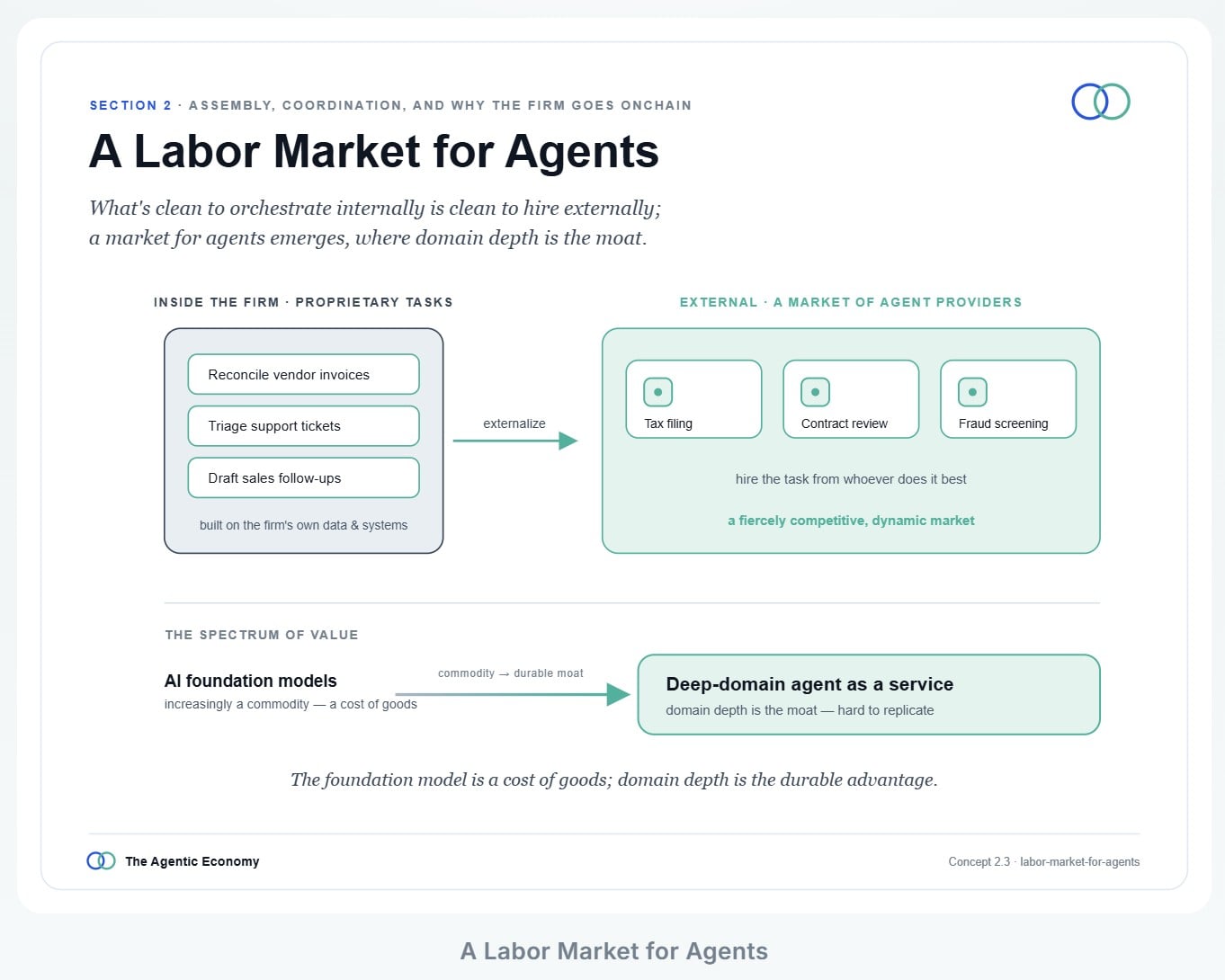
(Agentic Economy: Why the Smart Economy Grows On-Chain)
So what's the denominator for this generative half?
Circle CEO Jeremy Allaire offered a coordinate: companies are essentially "organized cognition with logos slapped on," with labor costs comprising 25% to 50% of revenue, nearly all for knowledge firms. When every function is honed into a clearly defined skill, a clean enough skill to be orchestrated internally becomes clean enough to be discovered and hired externally; an open agent labor market needs no creation—it's the overflow of millions of companies optimizing themselves.
The denominator for substitution is human shopping expenditure; for generation, it's labor costs.
Generation doesn't measure shopping; it measures token settlement and hiring machine labor. Different denominators—that's the hardest proof of "two different transactions."
3.3 The Two Pictures Align
Looking back at the mismatch from the previous chapter now.
Whether 3% or 73%, they measure substitution—which desperately needs complete consumer protection: returns, chargebacks, dispute resolution, KYC, none optional; it also requires every incumbent to agree ceding some territory.
The generative type requires no user relinquishment, no merchant register modification, and no one yielding ground, so it's already at 100 million transactions.
Rollout sequence is thus determined, driven not by technical maturity but by risk-bearing parties. Protocol-backed scenarios run fastest—APIs, data, compute, instant delivery, clear billing, no refund disputes. Enterprise-backed scenarios follow second—budget pools and approval chains existed pre-agent as manual processes, translating authorization, not inventing it. Human-backed consumer retail is slowest.
A strong corroborating factor highlights the supply-demand mismatch: consumers most willing to delegate purchases are grocery/produce (41%) and daily necessities (31%), least willing for financial services (15%); merchants expect agentic commerce to land first in complex-decision products like financial instruments.
One side wants to start where least thinking is needed; the other wants to start where delegation adds most value.
The scenario with strongest visual appeal rolls out last.
IV. Seven Gates a Single Agentic Payment Must Pass
The true difference between the two transaction types lies not in amount or frequency, but in where liability resides. Substitution is slow because every transaction drags a complete liability chain; generation is fast because that chain is inherently empty.
Chapter II's table tells you who holds what, but not where liability falls—positions divide by "what they hold," liability divides by "who money passes through."
To map this line, simply walk a transaction end-to-end, watching where it changes hands.
4.1 Agentic Payment Stack

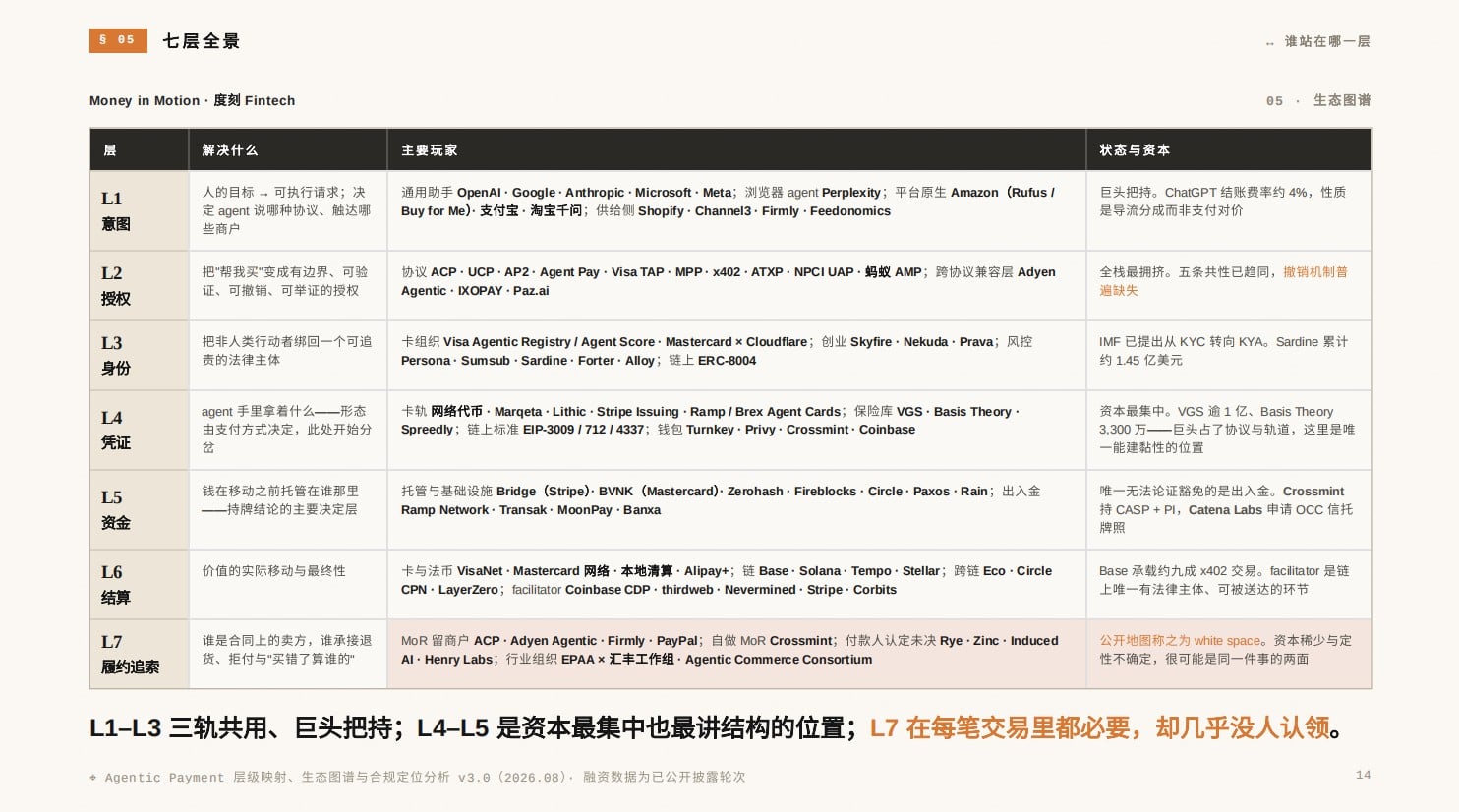
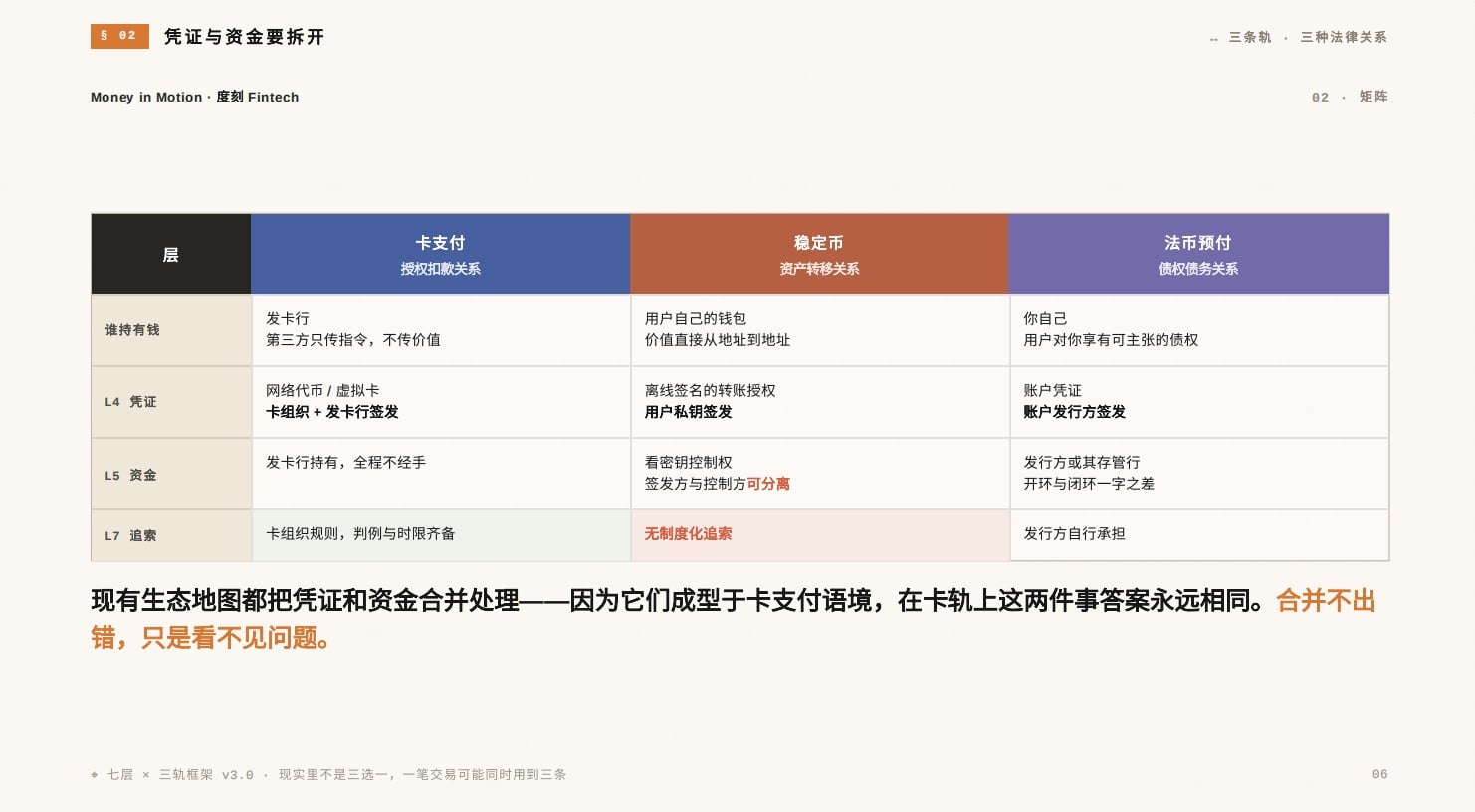
Multiple architectural diagrams circulate publicly, each useful, sharing one structural gap: almost all merge "credentials" and "funds." This isn't an oversight, but a product of perspective. All these frameworks took shape within the card payment context, where on card rails, the answers to both are perpetually identical—credentials issued by card networks and issuers, funds residing at issuers. Merging causes no errors. Switch to either of the other two paths, and they immediately separate. Stablecoin rail credentials are offline-signed transfer authorizations, funds reside in on-chain wallets; issuers and fund controllers can be entirely different entities; fiat prepaid rail credentials are account credentials, funds sit on issuer or custodian books, same product form could constitute stored value or pre-paid services. L1 to L3: Three Paths Fully Shared The first three layers handle "human" and "agency relationship" questions—understanding intent, obtaining authorization, proving identity, unrelated to how money moves. The fiercest battle occurs in the authorization layer; initiators aren't card networks, but Google and Stripe—they're fighting not for payment share, but to define the language of authorization. Google's AP2 uses two authorization documents to separate presence and absence, donated to FIDO Alliance; Stripe's Shared Payment Token abstracts cards, agent tokens, BNPL into a single interface; Mastercard's Verifiable Intent co-developed with Google, losslessly translatable with AP2; Visa's TAP claims compatibility, but translation loses information. Whichever authorization format becomes the lingua franca holds power to define "authorization." Vice Governor Lu's talk of dominance struggle manifests in industry as authorization document formats. Identity layer deserves mention: industry consensus holds agents may execute actions, but authorization and liability forever belong to a real human. IMF's April Note explicitly proposed regulators consider shifting from KYC to KYA—Know Your Agent. L4 Diverges, L5 Is the Article's Hub At the credential layer, the three paths first produce radically different outputs:
- Card rail: network tokens or virtual card numbers, issued by card networks and issuers;
- Stablecoin rail: offline-signed transfer authorization, signed by user private key;
- Fiat prepaid rail: account credentials, issued by account issuer.
4.2 All Protocols Only Answer First Two of Four Questions
Deconstruct primitives of dozen+ protocols, find high convergence, four consistencies: authorization must layer; boundaries defined by merchant scope, amount cap, time window, usage count; signatures as undeniable evidence; agents never touch raw credentials.
Fifth is common blank: detailed grant definitions, almost none specify clean withdrawal post-issuance pre-execution.
Blank glaring, because precisely top market demand.
Back to ticket. "Within 3000" fits field, amount cap, machine verifiable; "economy class" fits, enum type; "next Wed" fits, time window. Specs beautifully crafted.
Unspoken half—"must arrive Wed, Thu morning meeting"—fits no field.
Not amount, enum, time window, it's reason behind utterance.
Intent integrity lives only in human minds, authorization doc mere projection. Not unfinished engineering, structural.
Execution phase flawless: amount passes, cabin passes, time window hinges on whether "Wed" was hardcoded—without it, the transaction is structurally flawless under the agreement. Precision of authorization boundaries is the sole defense here.
Whole protocol stack invests energy in one thing: proof. Silent on "who owns what happened."
Proof built, adjudication remains blank.
V. Three Paths to Agentic Payment
Chapter IV's decisive fifth layer translates to three real-world paths. Differences never tech selection—fund custody dictates who pays when problems hit.
(Missing Liability Layer in AI Payment: Who Pays for Agent Errors?)
5.1 Wallets & Credits: Liability Prepaid
Funds in own ledger, recharge = authorization, balance = boundary, depletion = finale.
First to land among three. Alipay disclosed 300M agentic payments cumulatively by May; closely scrutinized, most internal ecosystem shopping assistants—AI compares/combines/orders Taobao, payments closed-loop, disputes platform rules.
Lands first not solving authorization, but shrinking problem to bypass resolution: single merchant, single wallet, single rule, consumer/merchant/provider same platform.
Cost: confinement—how does Alibaba's Tongyi order milk tea on Meituan?
Also loudest noise.
Labeling internal AI assistants "Agentic Payment" falsely implies solved.
5.2 Card Rails: Liability Absorbed by Network Rules
Funds at issuer, card networks hold two unique assets: globally accepting network, fifty-year polished dispute infrastructure—chargebacks to liability shift to 3DS, full precedent/timelines/evidentiary/appeal mechanism.
TAP, Verifiable Intent, AP2, ACP, UCP all build here, doing same: retrofit stock into agent-usable form.
Advantage: liability assigned, dispute channel; flaw: all rules rewriting, until done, submitting that ticket dispute, no tribunal knows adjudication.
5.3 On-Chain Direct Pay: Liability Either Floating or Code-Replaced
Funds in user's own wallet, receipt = finale.
x402 on-chain volume down 77% from Nov 2025 peak, mainly focuses on $0.10-$1 range share collapsed 46% to 4%.
Survivors: buying tokens, calling APIs, renting compute—delivery-equals-consumption, irrevocable goods.
Reason lies in the protocol's nature. x402 is barebones: no authorization documents, no recourse, no dispute channel. For immediate-use goods, barebones is an advantage, saving dispute costs entirely; for any potentially errant goods, a bare protocol simply cannot gain traction.
Three paths competing not same cake, drawing boundaries by dispute density: zero-dispute goes to chain/stablecoin, complex-dispute to cards, avoided-dispute to wallets.
Three paths settle liability positions, none answers fourth question: ultimately who bears loss.

5.4 Law Offers No Answers
Law should answer this. Instead of silence, it offers three contradictory answers: unwritten, rewritten, partially retracted.
First, unwritten. US lacks dedicated agent transaction regulation to date. Reg E says consumers may authorize payments "by card, code, or other manner," ignores AI agent disobeying instructions; generally interpreted applies to financial institutions consumer deposit accounts, protection extends not to crypto-native rails. Contracting itself not issue—ESIGN Act 2000 recognized electronic agents contracting—vacuum post-contracting: agent excess authority liability allocation, no dedicated rules, no precedent.
Second, written then rewrote. Amazon sued Perplexity Nov 2025, alleging Comet AI assistant logged into Amazon accounts using user credentials to buy, failed identifying as AI agent. Mar this year, district court granted injunction, found access unauthorized by Amazon, user authorization irrelevant to ruling; Aug 4, Ninth Circuit reversed injunction, found when user directs agent to act, accessing Amazon computers is user, not Perplexity—agent not independent accessor, extension of user hand.
Federal appellate court first handling this, gave two opposite answers in half-year. Both tiers evaded: arguing solely entrance qualification, neither judgment mentions buying wrong after entry.
Third, partially written then withdrew. EU AI Liability Directive formally retracted Oct 2025 eve of mass commercial agent use, citing unforeseen consensus among 27 members; PSD3 leaves seam, strong customer auth designed for phone-holding humans, agents lack fingerprints.
Above three answers presses cross-border layer, nature often inverted: trouble not jurisdiction vacuum, jurisdiction oversaturation.
Model runs US servers, user sits Hong Kong, merchant Singapore, settles USDC—single act drops into consumer domicile/data subject location/market location simultaneously, no "occurrence site" decides winner.
Thus closest to global consensus, directly enforceable in payment chain, remains card network rules.
Enforcement derives not courts, from "I can reject transaction."
5.5 Three Methods to Fill Void
Post-law void, filled with private order. To date, three fill methods emerged.
First: pricing. Amex skips protocols, commits directly, registered agent-caused errors protected eligible cardholders; card networks shift chargeback liability compliant transactions, replicating 3DS script; Munich Re etc. sold AI liability insurance, payouts exceed threshold.
Three things price same variable: authorization document boundary precision. Boundary precision equals liability price.
Pricing path natural boundary: each party prices only calculable portion. Amex protects registered agents only, insurance covers above-threshold only, card networks cover protocol-compliant only. Beyond boundaries, still blank.
Second: collective rulemaking. Aug 18, Rain launches Agentic Payments Alliance, 26 founding members including Visa, Mastercard, Fiserv, Circle, Solana. Co-run by founders, owned by none, early work joint research/frameworks, testing agent identity/authorization standards, advocating regulatory issues.
Industry treats federal guidance absence as blank check to write own standards.
Third: direct designation of responsible party. Aug 24, China Payment and Clearing Association guides by PBOC publishes "Self-Discipline Convention for Agentic Payment Applications," effective same day; three days later Lu Lei demands market implement. Basic principles seven characters: provider of payment service assumes responsibility. Members providing account management/transaction processing/acquiring/routing/clearing bear principal liability—not merchants, not agent developers, not model vendors, not insurers.
Same question, three fill methods, the final differs from the first two by a single point: the first two require no one to step forward initially, while the third requires one to do so.
VI. Market Participants' Agentic Strategies
Rules unfinished, money already bet. Quantifying five key players reveals doing same question—will I stand there—each algorithm different, one answer diametrically opposed to rest.
6.1 Visa: Agentic Payment Won't Hit Its Income Statement
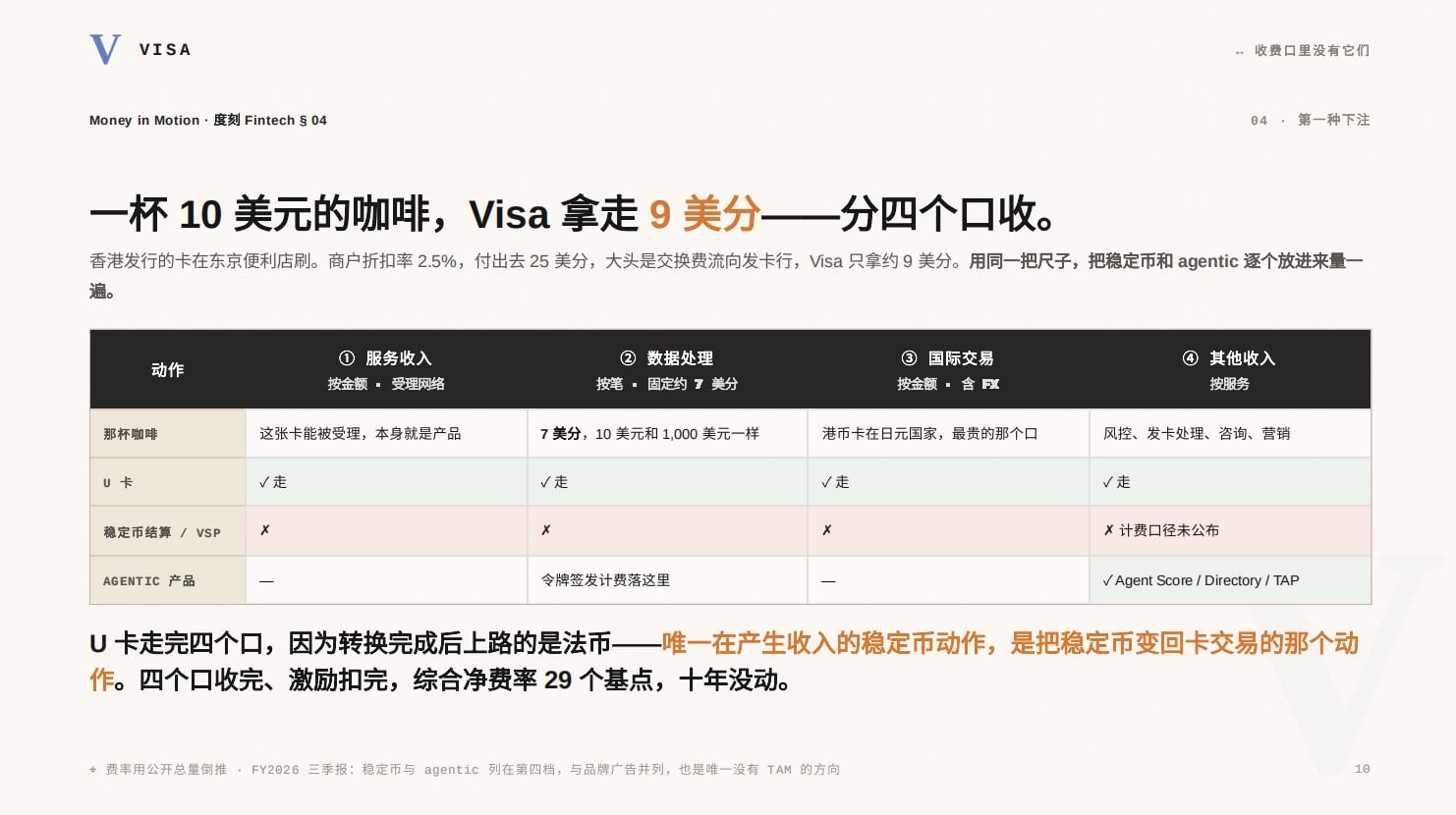
Look priority rank: fourth tier, alongside brand advertising. CEO improvised capital allocation ranking, finishes consumer payments/value-add/business/fund flow, only then "above these, stablecoin, agentic." Only directions lacking addressable market denominator—other legs paired with $T/$B TAMs, these two lack digits entirely.
Company surviving decades on 29bps net interchange, won't alter equilibrium itself for new thing. Thus agentic product list short—Agent Score, Agent Directory, Token Assurance Framework—uses same token infra, extends phones to agents.
Not building new roads for agentic, replacing drivers on old road.
(Stablecoins and Agentic: Too Small for Visa's Income Statement)
But stopping here misses what truly doing.
Visa Intelligent Commerce goal: one-integrate-compatible with TAP, x402, MPP, ACP, UCP; Chief Product/Strategy Officer Jack Forestell positions whole thing one sentence: AI transforms commerce frontend, stablecoins reshape funds backend, Visa role ensures two ends run safely/reliably/globally.
Tokenization manages credentials, TAP identity, verifiable records audit, MPP specs multi-rail access—four lines cover all stages of the authorization chain, none are racing to capture settlement. It is not competing with stablecoins, but quietly repositioning itself from a settlement network into an authorization infrastructure.
Card networks may not win machine economy settlement, but might win authorization.
Investment records more honest than protocols. Visa Ventures invested in Nekuda (auth doc generation) and Payman (bank-side approval breakpoints)—former birth during user-agent dialogue, outside VisaNet; latter funds never touch card rails. Buys upstream, buys off-rail, clearly understands protocol covers only "money passing through me" segment.
6.2 Mastercard: Multi-Rail Settlement Compatible, Trust Interop Not
Same question, totally different answer sheet.
Boundary drawn precise: buyers still human, personal/corporate, cards win; buyers become machines, acknowledges multiple rails.
For AI shopping on behalf of humans, the answer leverages existing card network assets: tokenization, zero-liability guarantees, and dispute resolution. For machine-to-machine procurement, the architecture boils down to eight words—on-chain authorization, off-chain settlement. Authorization lives on-chain because machines require instant transaction recognition; settlement occurs off-chain because routing funds is a separate matter. As stated by the company itself: settlement will occur across diverse tracks, potentially involving stablecoins or other methods, remaining highly open.
Settlement multi-rail allowed, trust/interop must secure.
"Multi-rail settlement" is backed by spending. On August 3, it completed the acquisition of stablecoin payment infrastructure company BVNK for up to $1.8 billion, closing nearly five months ahead of schedule.
Why buy? Answer hides in four-party model.
In the traditional fiat system, fund movement rests with member banks, and card networks never control settlement. When it states settlement may occur on stablecoins, the alternative track lacks a corresponding member bank network to perform that function.
No member banks on stablecoin track, becomes member bank itself.
6.3 Stripe: Swapping Initiation, Not Goods
Stripe position easiest misread "balancing."
ACP co-created with OpenAI, MPP co-issued with Tempo, founding member of x402 Foundation; merchants integrating its Agentic Commerce Suite auto-compatible with all protocols. M&A: acquired Bridge, Privy, Metronome, co-founded Tempo with Paradigm, purchased AI model gateway OpenRouter this year for over $7 billion.
Others buy blanks on own answer sheets, buys entire exam hall.
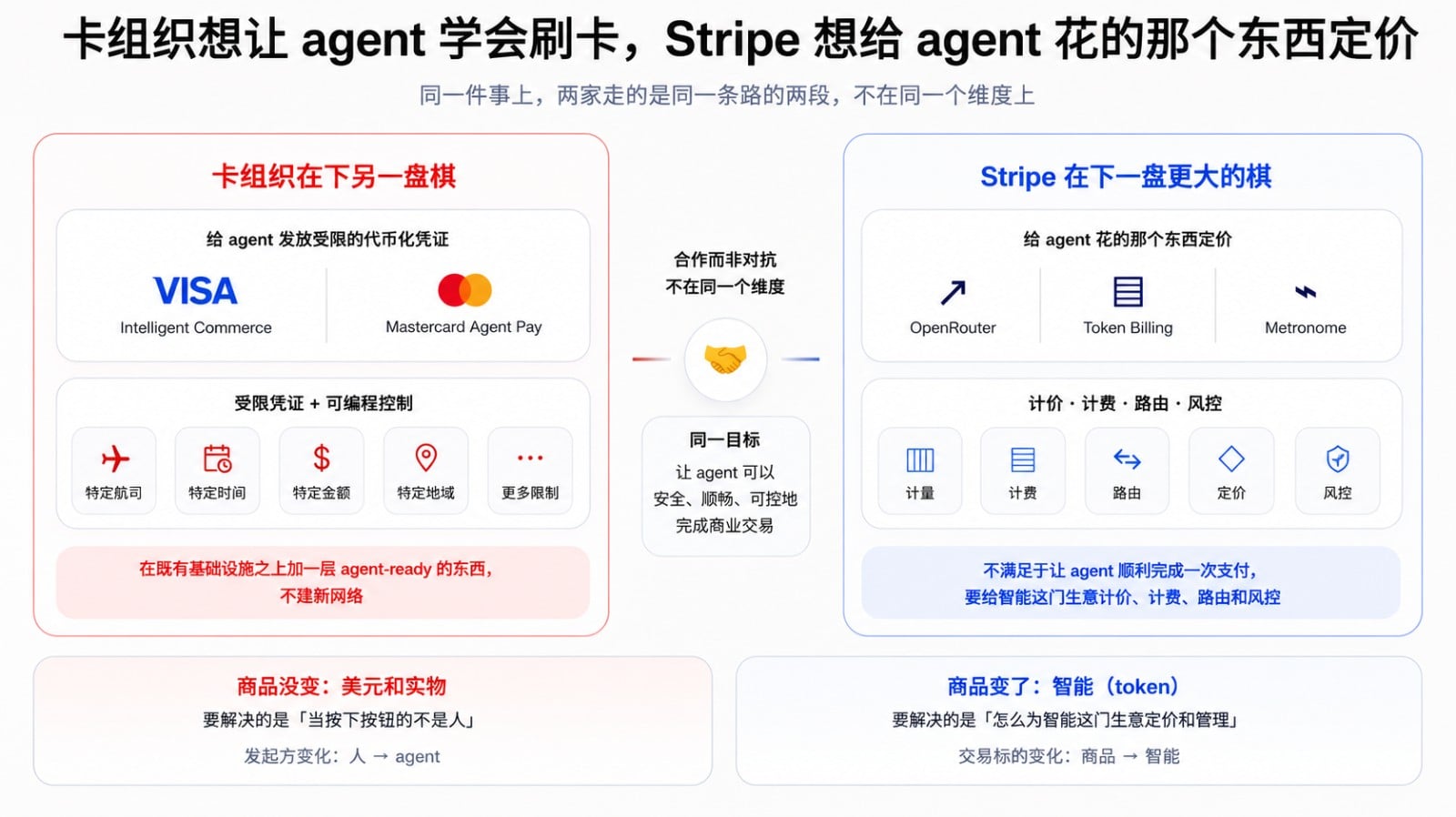
Balancing not whole. True difference here: card networks want agents learn swipe cards, Stripe wants price goods agents spend.
Former swaps initiator, goods unchanged, still USD/physical; solves "button not pressed by human" issue, solved once before—offline to online, magstripe to online verify, each time same method: restricted credentials to new initiators.
Latter swaps goods themselves. network token completes swiping, stablecoin token settles, AI token generates invoices—three tokens now same company.
With moving costs compressed near zero, value concentrates on the pricing side, and it acquired the sole vantage point capable of observing the full view of cross-model behavior.
Google fights for definitional power, Stripe fights for execution power. Whoever legislates, execution routes through its channels.
(Tokens: Stripe's New Dollar?)
6.4 OpenAI: Not Payment Company, Grabbing Upstream
OpenAI answer guessless, wrote specs.
The agency payment specification for ACP explicitly states: OpenAI is not the merchant of record; settlement, refunds, chargebacks, and compliance remain the responsibility of merchants and their PSPs. This is the clearest publicly available answer to date, and it points toward the seller side.
Resulting tripartite division clean: OpenAI handles user intent/product discovery/comparison/decision/purchase interface/merchant protocol integration; Stripe handles payment credentials/tokenized auth/risk signals/exec infra; merchants handle inventory/orders/fulfillment/post-sales/major real trade liability.
Eats upstream, carries downstream liability.
Instant Checkout backtracks to the discovery stage—not due to inability, but calculation. Its own primary rationale aligns precisely with the core thesis of this article: payment cannot be solved by UI alone; it is a convergence of licenses, compliance, anti-fraud, dispute resolution, network rules, and fund liability.
Merchants truly care about more than just the ability to tap a pay button: they care about brand experience control, payment method decisions, member system integration, attribution and data routing, merchant of record status, and liability allocation.
Collecting payment within the conversation makes it difficult to still claim not being the seller.
Thus it retreats to a lighter, yet more leveraged layer within the transaction chain: capturing the point where users initially submit requests. With a fee of ~4%, structured as channel revenue-sharing rather than payment service consideration—precisely the commercial justification AI platforms use to claim they do not constitute payment services.
6.5 Alipay: The Only One Saying "I Am That Person"
Front four highly aligned on one thing—pushing liability beyond own cell. Fifth answer opposite.
Alipay follows the path least taken seriously by others: wallets and preloaded credits. At this year's May AI Payment Ecosystem Conference, it unveiled a complete suite—AI Pay, AI Collect, Token Pay, and AI Wallet—covering authorization, payments, settlement, management, and security.
The standout feature is the AI Wallet. It manages not only funds but agent authorization: pre-payment intent management and boundary setting, mid-payment 24-hour task execution monitoring and risk alerts, and post-payment bill inquiries. Officially described as an upgrade from "capable of paying and receiving" to "capable of managing and controlling."
This is precisely the product manifestation of the common void discussed in Chapter IV. While competing protocols debate authorization mechanics, the limits, cancellations, and revocations consumers demand are realized here as a user-visible interface. It isn't elegant—because it bypasses the protocol layer to execute directly within a closed loop—but it got done first.
What truly separates it from the others comes down to six characters. When facing accountability for AI errors, Alipay reiterates a commitment from twenty years ago: "If you dare to pay, we dare to compensate."
The preceding players all argue they are not that person; only Alipay claims it is.
It dares to say this not out of boldness. Return to Chapter II's table—it is the only entity occupying four stages simultaneously: entry, trust, orchestration, and settlement. Card networks spanning two already represent the hardest-to-replace position, but spanning four is unprecedented: it controls the entry point, risk and dispute handling constitutes trust, acquiring powers orchestration, and reserves plus clearing govern settlement. A transaction traverses its own ecosystem from start to finish, making compensation a tangible reality rather than mere public relations rhetoric.
The cost is embedded in the same statement. The closed loop can underwrite risks precisely because it is closed. How does Alibaba's Tongyi buy a cup of milk tea on Meituan? That question had no answer in May, nor does it in August.
August response: a full-stack agentic commerce infrastructure and the AHA multi-agent cross-device interoperability protocol, partnering smartphone makers, automakers, and large model developers. Objective clear: expand the closed loop sufficiently until it resembles openness.
Han Xinyi left candid remarks at the same event: the true bottleneck in building an agentic commerce infrastructure likely lies not in technology, but in establishing new benefit-sharing mechanisms; without a fair distribution model, even capable and willing parties will struggle to unite everyone.
Those who take on liability ultimately face revenue-sharing challenges.
6.6 Commonality Among Five Answer Sheets
Five together, structure neat.
Front four each reinforce standing layer, reinforcement method precisely liability cutting.
Visa acknowledges via investment it only covers the segment "when money passes through it"; Mastercard uses rules to confine the third question within its token's coverage; Stripe accepts no liability yet routes everyone's transactions through its pipes; OpenAI explicitly states in writing it is not the merchant of record.
Four forms of severance, one underlying action.
The fifth does the opposite, at the cost of operating only within its own fenced yard.
Today's complete shape of this problem: either sever liability and expand business globally, or assume liability and restrict business to a closed ecosystem. No one has yet proven a third path exists.
Conclusion · Who Stands Where
That $2,600 airline ticket is unrecoverable.
You call the card issuer, and the agent replies: Was this transaction authorized by you? Yes, your cryptographic key signed it, therefore it does not constitute fraud, and the chargeback channel is closed. You contact Cathay Pacific, and the ticket was issued legitimately, the agent passed identity verification, and the airline has no obligation to process a refund. You seek out the agent's developer—if reachable—they state the agent rigorously executed your exact instructions, staying within the budget and time window, performing correctly.
No party at fault, and you miss the morning meeting in Singapore.
Failure to assign accountability for this sum stems not from technological blind spots. Signature chains are intact, audit trails are complete, every step cryptographically sealed.
The problem lies in every link on the chain having preemptively drafted an explanation to demonstrate it is not the responsible party.
These are not deflections; each statement holds true. In card payments, funds definitively reside at issuers; in stablecoins, they sit securely in users' own wallets; protocol providers genuinely only relay instructions. ACP's specifications explicitly declare non-status as merchant of record in black and white, and Visa's dual investments acknowledge coverage is strictly limited to the segment "when money passes through us."
Stacked together, they yield a paradox: a marketplace where everyone claims funds do not touch their hands, rendering a "provider bears responsibility" principle impossible to draft—because no one admits to providing payment services.
Rules emerging first in China stems not from superior foresight, but from having identifiable subjects for accountability. Of the five stages in the value capture chain, only those controlling rules and balance sheets can step forward, and in China, those positions are held by licensed institutions.
High overlap between revenue collectors and liability bearers is no coincidence; it is simply two expressions of the same reality.
What card networks truly sell over sixty years is neither clearing nor routing, but dispute liability assignment. Every corporation arguing funds do not pass through it simultaneously proves it cannot collect revenue from it.
This precisely anchors Vice Governor Lu's three words: predictability, definability, and traceability. The greatest challenge has never been technological tracing, but institutional definition.
Join TechFlow official community to stay tuned
Telegram:https://t.me/TechFlowDaily
X (Twitter):https://x.com/TechFlowPost
X (Twitter) EN:https://x.com/BlockFlow_News
 0xWillmfer