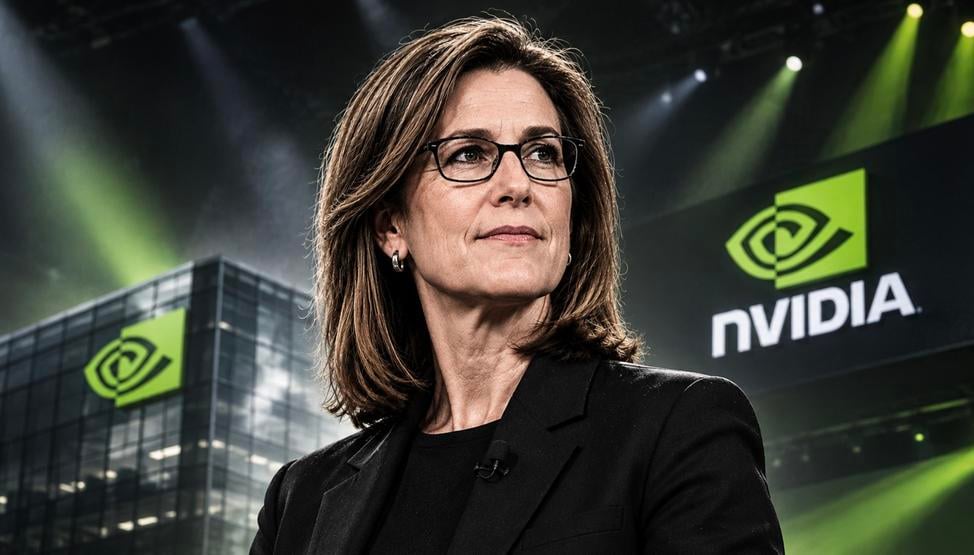
Is NVIDIA Becoming the Fannie Mae of Compute? Understanding the Financialization Risks of AI Infrastructure in One Article
Author: Simon Taylor
Edited by: TechFlow
TechFlow Editor's Note: AI demand is indeed real, and GPUs are truly running at full capacity, but the financing structures built around these assets increasingly resemble the mortgage machines of the pre-2008 era. Compute contracts from Nvidia and hyperscaler cloud vendors have already piled up commitments exceeding two trillion dollars. The core question is: when demand growth slows, who gets caught first? For tech and crypto investors, understanding this layer of financial leverage is more valuable than debating whether AI is a bubble.

Nvidia has become Fannie Mae of the compute world: even if GPUs are fully loaded, your pension fund might end up holding the bag.
AI can be real, GPUs can be fully utilized, and yet your 401(k) retirement account could still end up left holding the paper.
In 2006, the hottest product on the US financial market was the 2/28 adjustable-rate mortgage. Borrowers enjoyed extremely low, attractive rates for the first two years, after which they faced interest rates for the remaining 28 years that they could barely afford to repay.
This sounds utterly insane until you realize no one ever intended to make it to year three. The plan was to refinance using a house worth more than the purchase price before the rate reset, and repeat endlessly. Loans were never designed to be paid off; they were designed to be replaced.
Housing prices don’t need to rise forever. They just need to rise fast enough. When the 2008 crisis hit, the first crack wasn't a sudden collapse in prices. Annual growth slowed from roughly 15% to 8%, breaking the refinancing math. Borrowers began sinking into third-year rates they couldn’t afford. Foreclosures followed, forced sell-offs ensued, and bankers walked out of Lehman Brothers carrying cardboard boxes.
Now look at frontier AI labs. OpenAI loses billions annually, funding higher valuations to cover compute bills, then repeats the cycle. Equity financing isn't obviously a mortgage, but the underlying logic is similar: today’s economics only work because better terms arrive tomorrow. Jay Martin’s video drawing this analogy is well worth watching; I’ve borrowed his framework.
A GPU version of the 2/28 mortgage.
So my most direct counterargument is: this is not 2000.
Infrastructure isn't sitting idle. AI revenue is exploding, and connected GPUs are nearly running at full capacity. This is true, and that’s precisely why 2008 is a far more revealing comparison.
The housing crisis didn’t happen because houses became useless. It happened because a financial machine was built around the assumed future value of these highly useful assets.
An asset can be real, yet its financing can still go mad.
Wall Street is now rebuilding this machine for compute. Publicly traded companies at the center of this construction make up roughly 40% of the S&P 500 index—an index held across millions of pensions and 401(k) accounts.
The real question to ask isn’t whether AI demand is fabricated.
It’s how many financial notes are already built on the assumption that demand must keep climbing. And what happens when the demand curve flattens?
1. AI Has Never Looked Better
The second-quarter earnings season was a parade of 「beat estimates and raised guidance」. Companies genuinely selling AI infrastructure haven’t shown the typical signs of a demand illusion.
Google Cloud revenue hit $24.8 billion, up 82%, with a backlog of $514 billion, increasing by over $50 billion in a single quarter.
Microsoft Azure annualized revenue crossed $100 billion for the first time, growing 43%.
AWS grew 37% to $42.2 billion, its fastest pace in 18 quarters.
Nvidia holds approximately $500 billion in procurement commitments for Blackwell and Rubin chips through 2026, with the CFO noting the number continues to rise.
So, revenue is real, demand is real, and utilization is real.
Returns have been excellent thus far.
What’s spooking the market is that the spending required to sustain this growth has become enormous.
Alphabet delivered a monster cloud quarter, yet its stock still fell 5% after capex guidance hit $205 billion and free cash flow turned negative. Infrastructure businesses can generate beautiful revenue, but they can still be crushed by 「promises made to earn the next dollar」.
2. There Are No Idle GPUs
For the past few years, four words have been bulls’ best argument against another internet bubble: 「No idle GPUs」. This argument is far stronger than most discussions acknowledge.
In 2002, after the music stopped, 97% of the fiber optic cable laid across the US for the internet age sat unused. Cisco, the darling of that boom, plummeted 90% in the crash, not returning to its 2000 March price until December last year.
I started my career at BT Group in September 2000, and I still vividly remember veteran staff worrying about share prices and early retirement packages.
Today, there’s a familiar anxiety in the air.
And the bulls are right.
If a GPU is plugged in, it isn’t idle. It’s running near full capacity. But the 「if」 in that sentence carries too much weight. Enterprises simply can’t secure power, grid connections, and zoning permits fast enough. Satya Nadella has quietly voiced the unspoken concern: 「You might actually have a pile of chips sitting in inventory, and I can’t get them powered on.」
Why can’t we just power them on? Because data centers take time.
Grid constraints, slow permitting, and local opposition have grown politically potent. Sightline Climate estimates that 30% to 50% of the large data centers committed to this year will face delays. When Zuckerberg starts handing out $50,000 bonuses to Louisiana teachers funded by data center tax revenues, you know the polling data reflects reality.
So the critical distinction isn’t used versus unused, but purchased versus deployed.
We may not see idle GPUs in the internet bubble sense. Instead, we might see financed chips unable to convert to revenue due to delayed racks, power, or grid interconnection. This gap between spending and earning is where the financial narrative begins.
3. Two Trillion Dollars in Commitments
Within three years, US inflation-adjusted spending on data center capacity has already surpassed the total expenditure of the entire interstate highway system, which took 40 years to build. Despite the massive spending, actual live compute falls far short of purchased compute, meaning a large chunk of this boom now consists merely of contracts for future delivery.
There are three pieces of market infrastructure worth understanding here.
「Backlog orders」 are commitments signed by hyperscalers with clients to use future compute capacity. Backlog is not revenue.
A significant portion takes the form of 「take-or-pay」 contracts, meaning clients pay regardless of whether they take the capacity. Hyperscalers now hold approximately $2.1 trillion in alleged guaranteed take-or-pay backlog.
The third piece involves special purpose vehicles (SPVs). Over $1.09 trillion in future payments sits beneath lease agreements financed by equity investors or SPVs.
An SPV is an independent entity created to hold projects and construction debt. It keeps assets, along with the majority of the leverage, off the client’s own balance sheet.

None of this means the contracts are fake. But it certainly makes timing critically important.
If data centers are delayed, hyperscalers cannot recognize revenue as planned. If the lab on the other end of the contract slows spending, the lease doesn’t vanish. Someone, somewhere, is still carrying the debt.
No one embodies this risk better than Oracle. It has bet the entire company on a $300 billion deal with OpenAI. Leverage is stacked at 4.4x trailing twelve-month EBITDA to finance it. What do investors do when they perceive rising bond risk? They buy insurance. In the bond market, that insurance is a credit default swap. Read backward to understand: if credit defaults, the swap pays you cash. You pay a premium for this protection, just like an insurance policy.
The more expensive this insurance gets, the tighter the bond market becomes.
Oracle’s insurance is flashing warning signs. Insuring $10 million of Oracle debt now costs about $215,000 annually, setting records. Barclays notes Oracle CDS has become the most popular hedge across the entire AI trade. When traders want to short this construction wave, they aren’t necessarily shorting Nvidia.
They buy protection against Larry Ellison betting the whole company on compute.
The solid bullish case is that demand remains exceptionally strong, albeit concentrated. Anthropic’s annualized recurring revenue climbed from $9 billion in December to roughly $74 billion by late July. At the same time, monthly growth decelerated from roughly 51% in May to about 8%. To be clear, this isn’t a toxic asset. It might be the fastest-growing private company in history. The warning is that a financing machine built for an exponential curve doesn’t need to fail to run into trouble. It just needs the exponent to flatten.

Housing price growth slowing from 15% to 8% wasn’t a crisis at the time. It became one once financing built around 15% broke down.
I’m asking the same questions here: How much infrastructure is already contracted based on future demand? Who is providing the financing? And what happens if the curve ceases to be exponential?
4. Wall Street Finances the Gap
The hyperscalers' free cash flow engines used to pay for all of this.
These companies had ample cash to build directly. That is long gone. Microsoft's free cash flow is expected to turn negative for the first time since at least 2001. Oracle's capital expenditures will reach 86% of revenue this year.
When internal cash runs dry, Wall Street has an answer. It always does.
On August 10, Jensen Huang sat down with CNBC alongside heads of Apollo, BlackRock, Blackstone, Brookfield, Goldman Sachs, and KKR. They announced related platforms aimed at mobilizing $500 billion from Wall Street’s deepest pockets. This allows Nvidia customers to buy GPUs and build data centers without putting every dollar on their own balance sheets. The basic financial problem is simple: chips are bought today, construction takes time, and cash flows later.
Private credit exists precisely to finance this gap.
Blue Owl is one of the largest private credit managers funding the infrastructure boom. It serves as a reminder that this money ultimately belongs to investors, who sometimes want it back. Over the weekend of July 4, several of its flagship funds restricted redemptions, trapping roughly $14 billion. Redemption gates are a mechanism to slow withdrawals, preventing forced fire sales of illiquid assets into a bad market. This doesn’t mean the fund is insolvent. But it does signal that liquidity has become part of the problem.
This is also where the mortgage analogy stops being mere decoration. Ed Zitron calls it the 「subprime data center crisis」, because SPVs with active loans but no power generation produce zero revenue. It’s like a homeowner whose teaser rate resets while still owing on the mortgage. The analogy isn’t perfect, but the cash flow dynamic is painfully familiar: debt exists ahead of the economic benefits required to service it.
Then the head of KKR Digital Infrastructure dropped a line that will unlock further financing downstream: When you can treat compute as a cash flow stream, you can 「securitize it, tranche the risk, and sell it off」.
Securitization turns a collection of individual cash flows into standardized notes that institutions can buy.
Once that’s achieved, compute becomes financial collateral.
5. Nvidia Steps Into Fannie Mae’s Old Role
Once compute becomes collateral, lenders must agree on what qualifies as financeable compute and what it will be worth later. Nvidia enters the frame here.
Marc Rubinstein’s excellent piece explains how Nvidia became the 「ultimate guarantor」.
Just as the MBS market requires Fannie Mae and Freddie Mac to act as arbiters, liquidity providers, and ultimate guarantors, Nvidia plays this exact role in the compute market. As an arbiter, its architecture and CUDA ecosystem define what constitutes 「financeable」 compute. Just as conforming loan standards dictate which mortgages lenders will touch. As a liquidity provider, its residual value guarantee makes Nvidia the buyer of last resort when secondary markets stall. As a guarantor, that same backstop allows private credit funds to underwrite GPU-backed debt as investment grade. Much like the implicit government backing of GSEs renders mortgage debt near-risk-free.
Nvidia has its reasoning.
Renowned investor Michael Burry (the man who predicted the 2008 financial crisis featured in The Big Short) once noted that a 6-year depreciation schedule for chips is far too long. Nvidia launched the A100 chip in 2020, yet CoreWeave's demand contracts for these chips are signed through 2029. (Do the math yourself.)
Nvidia’s argument is that compute, especially Nvidia compute, is infrastructure. The chips, the surrounding CUDA software, and long-term demand make the asset resemble a toll road or power plant rather than disposable hardware.
Curiously, regulators seem to partially agree with Nvidia’s infrastructure thesis.
On the very same day the CEOs appeared on CNBC, reports emerged that the SEC has decided a large portion of data center bonds do not qualify as asset-backed securities. That sounds positive. But it’s also a warning, because post-2008 rules like risk retention, which require issuers to hold a stake in their own deals, do not apply here.
Even hyperscalers lack sufficient internal capex to fund this building spree. The shortfall is this large:
Between 2028 and 2030, hyperscalers are projected to need an additional $1.3 trillion in financing. The entire Bloomberg US Investment Grade Corporate Bond Index is only $8 trillion in size.
Nvidia’s program provides up to 25% residual value support for each transaction. This means Nvidia commits to covering a portion of a used GPU’s future value.
Today, this looks like a good deal for Nvidia. Because the hourly price per chip is rising.
Silicon Data shows H100 rental rates at $2.71 per hour. That exceeds $1.96 in November. Gavin Baker notes that neither bulls nor bears anticipated old GPU prices would rocket upward. Collateral appreciation is both good news and a warning sign. Housing prices were also rising in 2005.
There is a major distinction here. Fannie Mae does not build houses.
Nvidia manufactures chips, sets standards, and provides guarantees. It also controls the release cadence, deciding when today’s collateral becomes yesterday’s obsolete hardware.
6. Compute Is Now an Asset Class
Wall Street is willing to lend against almost anything. But to scale lending, it needs identifiable standards, predictable cash flows, collateral valuation methods. It also needs markets where buyers and sellers can transfer risk.
Compute now possesses all these elements.
Nvidia’s CUDA hardware and software provide the standards. Take-or-pay contracts deliver cash flows. The GPU leasing market offers price signals. Securitization transforms all of this into tradable notes.
Nvidia remains the ultimate guarantor. By underwriting up to 25% of residual value per deal, it cushions private credit against scenarios where chip values fall short of projections.
Demand is real, but narrow, and extraordinarily correlated.
Labs, hyperscalers, chipmakers, and capital providers are increasingly acting as each other’s customers, investors, and guarantors.
This does not mean AI is on the verge of collapse.
In fact, the bullish case is exactly why this machine can grow so massive. GPUs are fully loaded, AI revenue is accelerating, and even older chips are retaining value. A useful asset with rising cash flows is precisely the kind of thing finance loves to standardize, leverage, and distribute.
The danger isn’t that the technology is fake. The danger lies in the growth eventually required by the financial structure outpacing what technology can deliver on time. What happens if demand stops growing at today’s pace?
That brings us back to your 401(k).
The public companies funding this construction already represent roughly 40% of the S&P 500.
They are already inside the index.
If compute is truly becoming the defining asset class of our era, finance will constantly find ways to pack more compute exposure into indices.
AI can be real, GPUs can be fully utilized, but the notes can still cause damage.
The mortgage machine collapsed not because Americans stopped needing homes. It collapsed because financing required curves to rise faster than reality allowed.
Compute is now an asset class.
And each of us holds a small slice.
Join TechFlow official community to stay tuned
Telegram:https://t.me/TechFlowDaily
X (Twitter):https://x.com/TechFlowPost
X (Twitter) EN:https://x.com/BlockFlow_News
 @sytaylor