Gold held in hand yields no interest; what do 856 holding addresses indicate?
Author: Unitas Labs
We pulled all holding addresses since XGLD went live, resulting in 856 valid addresses and nearly $15 million TVL. Before the data came out, we didn't have a definite answer to "who is using this product." After the data came out, the picture became much clearer than expected.
Who is Buying?
The sample started from 920 XGLD holding addresses. After excluding non-individual addresses such as exchange hot wallets, LP addresses, and contract addresses, and further excluding addresses with holdings below $100, we obtained 856 valid analysis addresses, with total holdings of $14,096,488.57. On-chain identifiable gold assets include all gold tokens such as XGLD, XAUt, and PAXG. Based on this, holding addresses were divided into ten categories according to the proportion of gold assets in the portfolio, on-chain interaction frequency, and pairing methods with stablecoins or mainstream crypto assets:
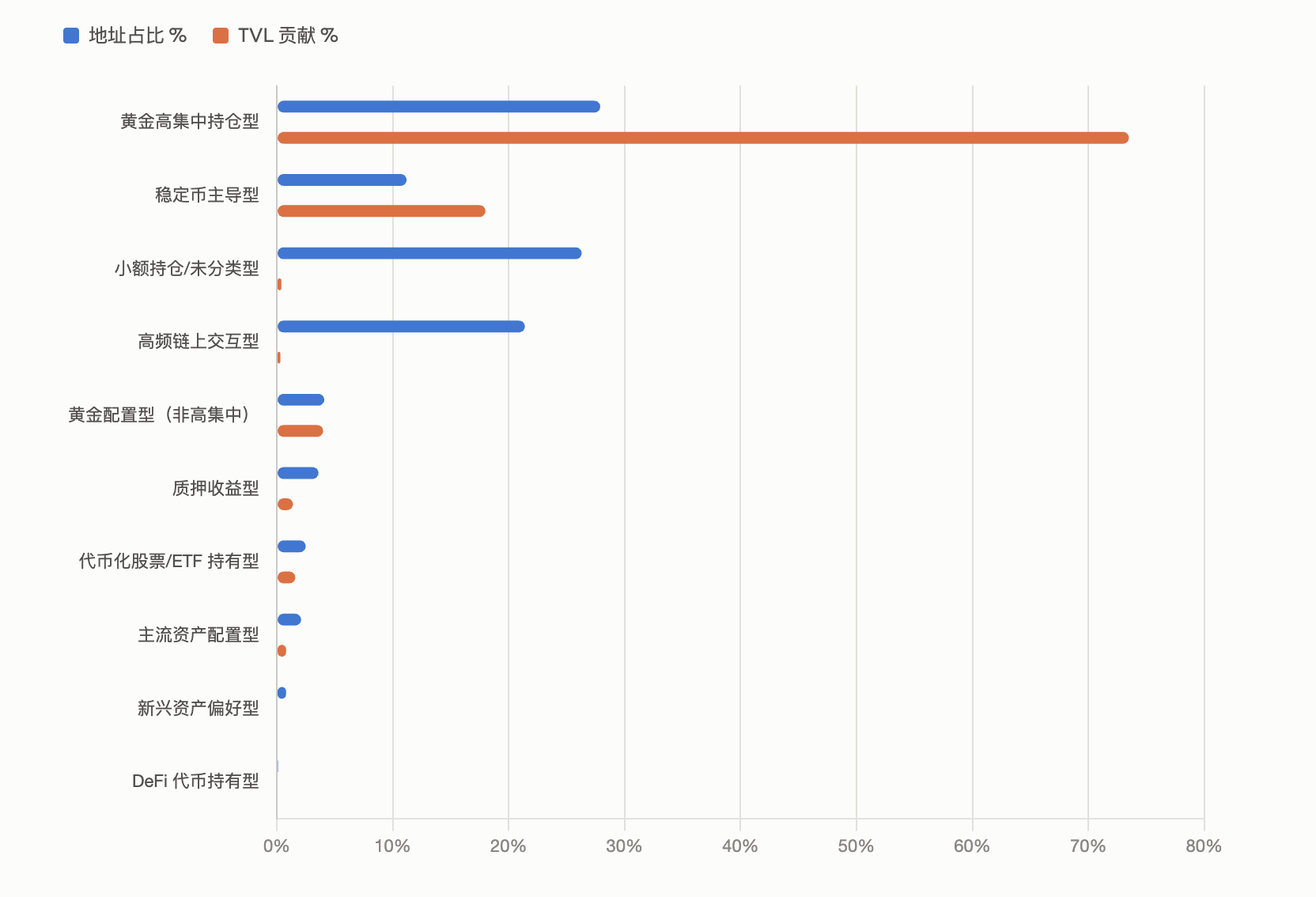
The conclusion is clear: the 239 addresses with high-concentration gold holdings contributed 73.5% of the total TVL. Although the high-frequency on-chain interaction type accounted for 21.4% of the addresses, they actually contributed only 0.3% of the TVL. Those who put up the money are not people chasing APY across various protocols, but those who originally intended to allocate gold.
What Are These People Thinking?
The logic of the high-concentration gold holding type is straightforward: they intended to hold gold anyway. For them, XGLD is not a "new opportunity," but a "better execution method for the same decision"—holding gold while earning extra yield, with unchanged gold exposure. It is worth noting that stablecoin-dominant users contributed 18% of the TVL—they use XGLD for portfolio rebalancing or hedging configuration, making it the second largest source of TVL. This shows that XGLD's appeal is not limited to die-hard gold holders; there is also room for users holding large amounts of stablecoins and looking for yield outlets.
Bigger Context: What Is Happening in the XAUt Holder Ecosystem
We also analyzed 654 valid XAUt holding addresses (after excluding exchange hot wallets). Compared with the XGLD group, the profile structure is overall similar but differentiated locally:
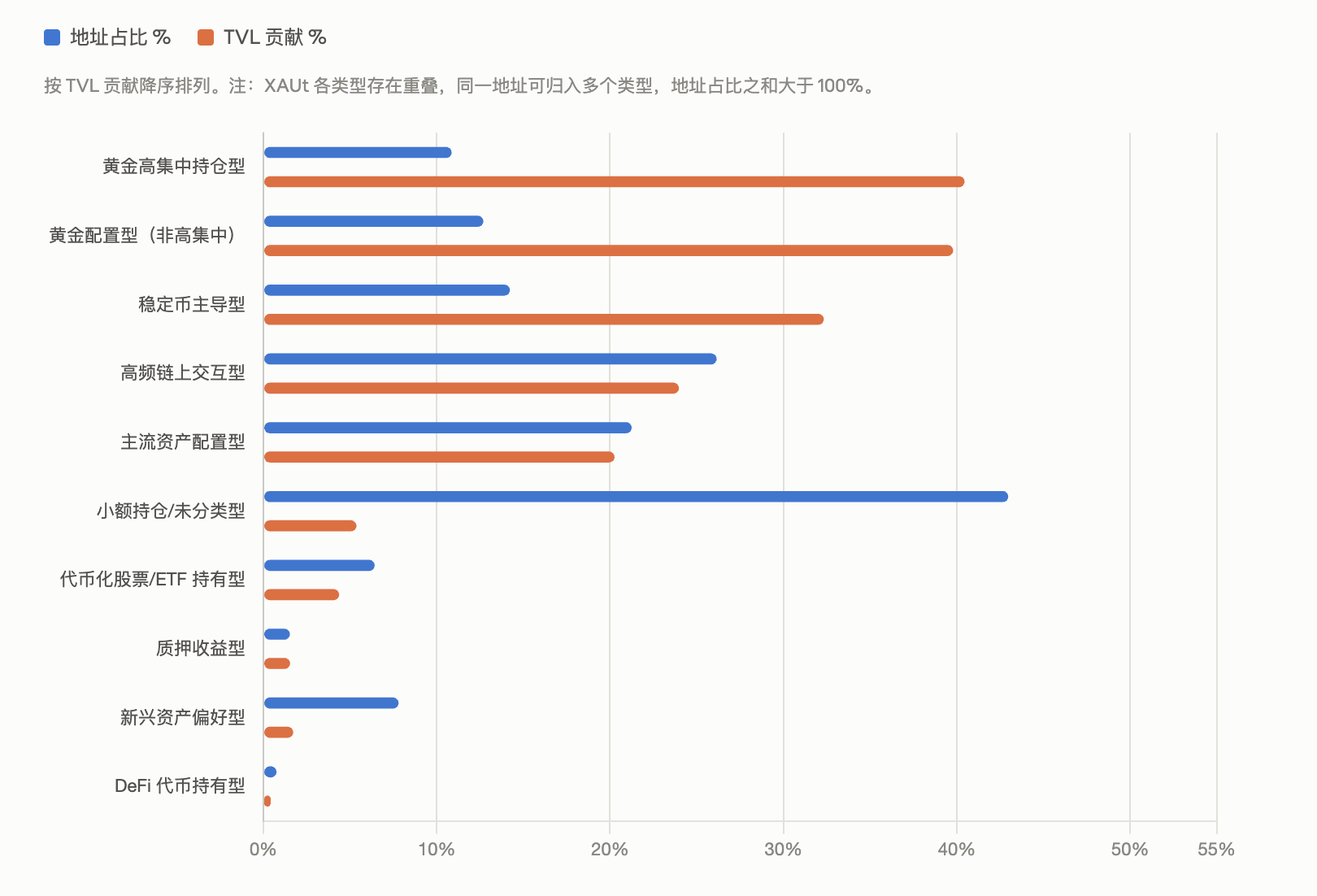
Note: There is overlap between the various XAUt profile types; the same address can simultaneously meet the identification criteria of multiple types, so the sum of addresses is greater than the total sample size.
Among the XAUt group, there are 42 addresses of the tokenized stock/ETF holding type—these users hold both on-chain stock-like assets and gold, representing a group seriously engaging in multi-asset portfolio allocation. Their emergence represents a direction: on-chain asset allocation logic is moving closer to traditional multi-asset portfolios. Additionally, 90% of XAUt's existing supply is concentrated in three exchange hot wallets on Binance. Users who truly hold XAUt directly on-chain are a relatively precise group in scale, with a clear conversion path.
What Is XGLD and How It Works
The background is that Tether Gold officially confirmed the completion of integration with Unitas Labs, and XGLD was formally integrated into the XAUt ecosystem. XAUt is tokenized gold issued by Tether; each token corresponds to one ounce of physical gold in a Swiss vault. Over the past few years, it has succeeded in "putting gold on-chain": verifiable, transferable, and redeemable. But gold itself does not yield interest; this is an old problem.
XGLD solves this problem without moving the gold allocation: users deposit XAUt to mint XGLD 1:1; the protocol uses XAUt as collateral to borrow stablecoins through top centralized exchanges or qualified compliant lenders; stablecoins are invested in Delta-neutral strategies to capture funding rate yields. Your gold allocation remains the same gold, just with an added layer of continuous yield-generating attributes; upon exit, destroy XGLD via the redemption contract to retrieve XAUt, with no mandatory lock-up period.
The strategy's historical performance is in the double-digit annualized range, but funding rates fluctuate with the market, and returns are not principal-protected. Reserve verification is provided by Primus Labs via real-time Proof of Reserves, with on-chain data available for inspection. Users holding XAUt can deposit and mint directly at unitas.so/xgld.
The Next Question for Tokenized Gold
Over the past few years, the industry has succeeded in "moving gold on-chain." The next question to answer is "what can be done after moving it on-chain." 856 addresses and nearly $15 million TVL is an answer currently supported by real users and real data. It shows that when on-chain gold can truly yield interest, the first to enter are those who originally intended to hold gold; they came not to chase APY, but to make allocation more efficient. This is the starting point for tokenized gold moving from "on-chain holding" to "on-chain financial applications." XGLD is one of them, and will not be the last.
Risk Warning: Returns are not principal-protected and fluctuate with the market; the strategy involves counterparty and execution risks; historical performance does not represent future returns.
Join TechFlow official community to stay tuned
Telegram:https://t.me/TechFlowDaily
X (Twitter):https://x.com/TechFlowPost
X (Twitter) EN:https://x.com/BlockFlow_News
 @UnitasLabs