2026 Global Crypto Asset Tax Overview
By: FinTax
Summary
As crypto assets gradually enter the mainstream financial system, tax treatment across various jurisdictions has shifted from early regulatory gaps to institutionalization. The OECD released Taxing Virtual Currencies in 2020, one of the earlier studies systematically comparing crypto asset tax treatments across multiple global jurisdictions. Since then, with the development of the crypto asset market, an increasing number of jurisdictions have begun to clarify relevant tax treatments through existing tax laws, special provisions, or tax guidelines, while the procedural nature and complexity of crypto asset taxation continue to rise.
From the perspective of existing systems, crypto asset taxation is still primarily built upon traditional tax regimes. Various regions typically incorporate them into existing income tax, capital gains tax, corporate income tax, and indirect tax systems based on asset nature and trading activities, further clarifying specific treatments through special provisions or tax guidelines. The maturity of rules for different businesses is inconsistent; ordinary trading, mining, etc., entered the tax system earlier, while on-chain native businesses such as DeFi and NFTs involve more complex asset exchanges, revenue recognition, and transaction structures, where relevant tax rules remain relatively lagging.
At the same time, there are significant differences in tax treatment and actual tax burdens among jurisdictions. Crypto assets may involve direct taxes, indirect taxes, and property-related taxes simultaneously. Different holding periods, trading methods, income nature, and taxpayer identities will also alter tax outcomes. Consequently, the global crypto asset tax system is gradually shifting from whether to tax towards more refined classification and treatment of different assets, transactions, and economic activities.
Crypto Tax Rules Continue to Expand
Crypto assets entered tax systems relatively late. The OECD released Taxing Virtual Currencies: An Overview of Tax Treatments and Emerging Tax Policy Issues in 2020. Based on the participation of over 50 jurisdictions, it systematically compared income tax, consumption tax, and property tax involving crypto assets, representing the first comprehensive study targeting such a wide range of jurisdictions at the time. The OECD pointed out that research on the tax implications of crypto assets in various regions is still at an early stage, and consistent treatment has not yet been formed on basic issues such as asset nature, taxable events, income classification, and valuation.
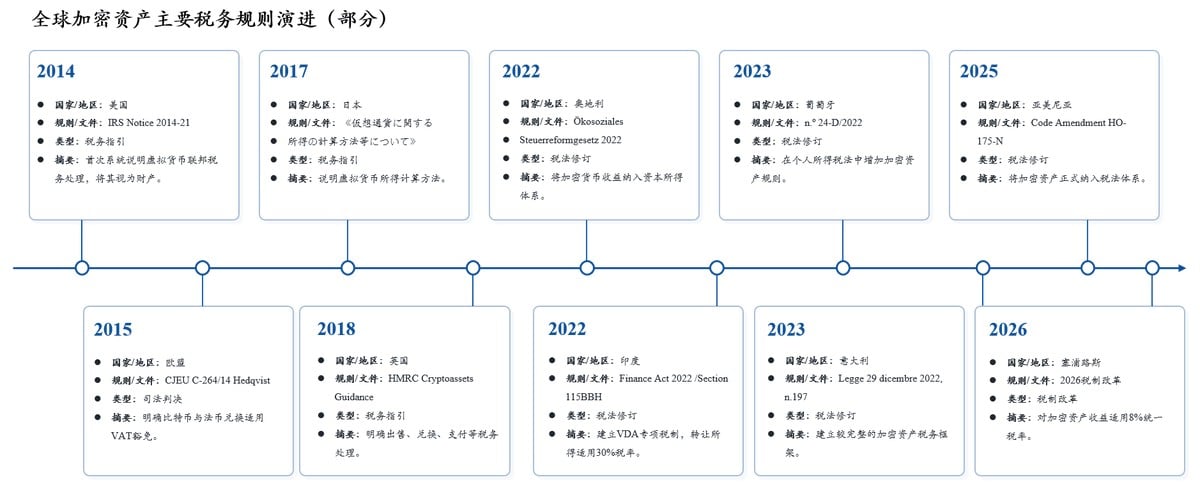
Since then, the coverage of crypto asset tax rules has continued to expand. Data published by PwC in 2021 showed that the number of jurisdictions with crypto asset tax guidelines increased from 7 in 2014 to 29 in 2021, more than quadrupling in seven years. As of 2025, this number has further increased to 43. While coverage continues to expand, existing systems are also accelerating refinement and extension.

Existing Tax Systems Still Dominate, Rule Maturity Diverges
Currently, crypto asset taxation still primarily relies on existing tax systems. The United States continues to apply general tax rules to digital assets as property, and Australia's 2025 tax review concluded that current tax laws are capable of covering digital asset transactions. A comparison by the European Commission across 27 member states shows that most member states primarily handle crypto assets within existing tax frameworks, and corporate crypto business revenues are all included in corporate income tax.
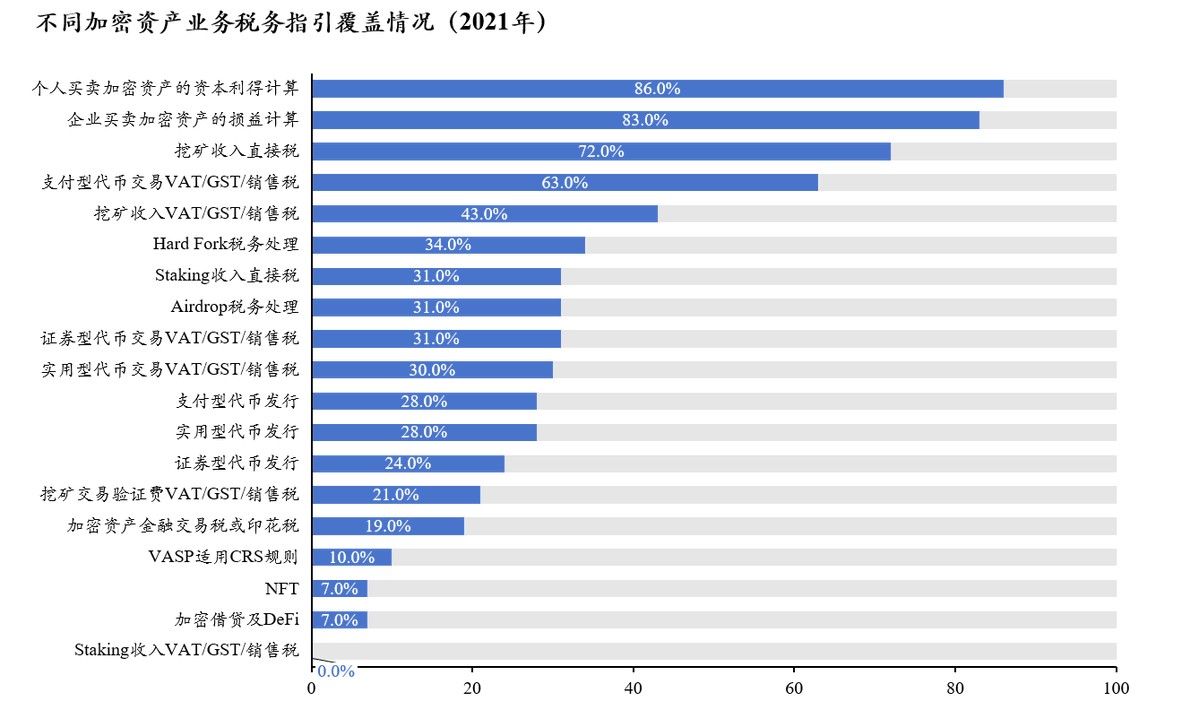
Coverage of tax rules for different crypto businesses is uneven. Among over 40 jurisdictions surveyed by PwC in 2021, the proportion with existing tax guidelines for individual and corporate crypto asset trading was 86% and 83% respectively, mining was 72%, while staking was only 31%, and both DeFi and NFTs were 7%. By 2025, this disparity still exists: Germany's latest crypto asset income tax guidelines cover many common transactions, but NFTs and liquidity mining remain excluded; Australia also lists DAOs, DeFi, GameFi, and NFTs as areas requiring further research. Overall, businesses that correspond more easily to traditional assets, income, and financial transactions are more likely to be directly accommodated by existing tax laws; the more complex the on-chain structure, the more lagging the tax rules tend to be.
Significant Differences in Tax Burdens Across Jurisdictions
Crypto asset taxation involves high complexity. The tax burden is not determined by a single tax rate but may involve multiple tax types such as individual income tax, capital gains tax, corporate income tax, value-added tax or consumption tax, property tax, and inheritance tax. Specific application depends on the nature of the transaction; for example, trading, payment, mining, staking, and business activities may form asset disposals, investment income, or business income respectively, and apply different tax calculation rules.
The so-called "crypto tax-friendly" status is therefore a comprehensive judgment combining individual needs with jurisdictional rules. In addition to nominal tax rates, factors such as tax residency status, individual or corporate entity, income classification, holding period, tax-free thresholds, and long-term holding incentives must also be considered. The same jurisdiction may be friendly to individual long-term investments but apply completely different tax burdens to high-frequency trading, mining, or business operations.
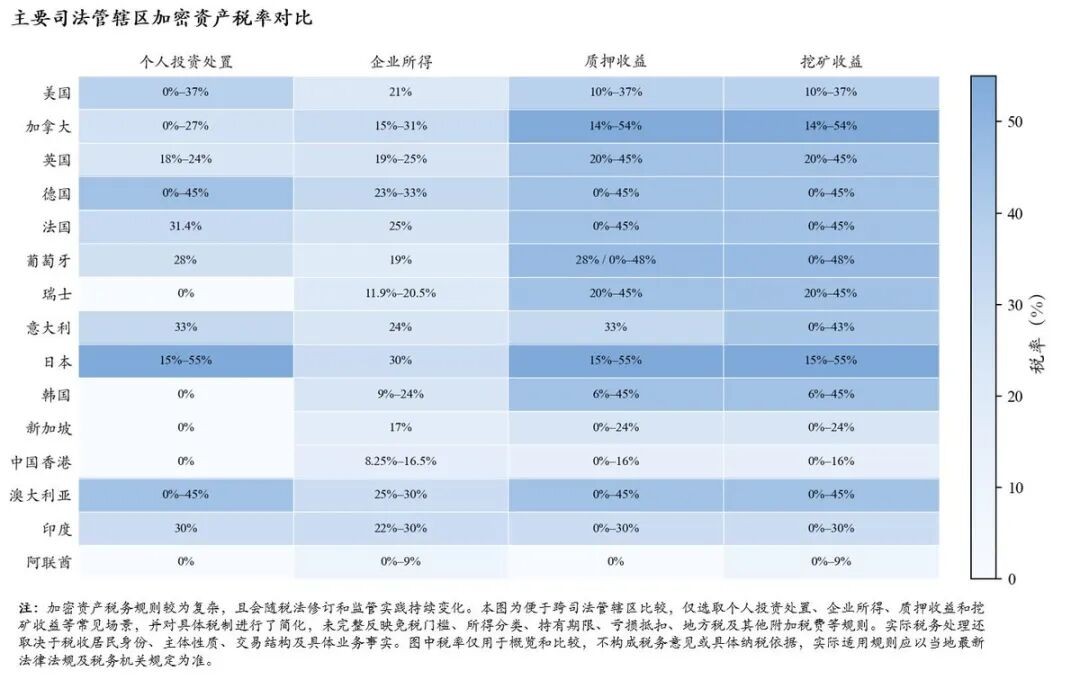
The chart below starts from common scenarios such as individual investment disposals, corporate income, staking rewards, and mining rewards, and comprehensively considers economic size, crypto asset market activity, and regional representativeness to compare representative tax rates of major jurisdictions, showing significant differences in actual tax burdens across jurisdictions. Considering that crypto asset tax rules in various regions are relatively complex and continuously changing, for ease of intuitive comparison, some applicable conditions and special rules in the chart have been simplified; if you need to understand the complete tax rules of a specific jurisdiction, please refer to our Crypto Tax Basic Research Series.
Join TechFlow official community to stay tuned
Telegram:https://t.me/TechFlowDaily
X (Twitter):https://x.com/TechFlowPost
X (Twitter) EN:https://x.com/BlockFlow_News
 TaxDAO