Gas Up 10x, Rewards Halved: Has Aptos Become a Positive-Yield General-Purpose L1?
Authors: Sam, Schubert, Blockworks
Compiled by: AididiaoJP, Foresight News
Today we focus on a core question: How did Aptos transform from a public chain that "continuously made holders lose money" into one of the few mainstream general-purpose L1s where the overall net income of holders exceeds operator costs.
The core metric is Token Holder Net Income (THNI). Meanwhile, a quick scan of the current market: The crypto equity group is leading the way driven by Circle's surge, while BTC and most token sectors are under pressure ahead of the July CPI release.
Market Overview: Circle's Solo Show
Yesterday's market was overall flat. Crypto equities (+2.9%) were the only highlight, BTC dipped slightly by 0.4%, and the S&P 500 fell 0.2%.

Sector divergence was obvious: Oracle (+5.8%) led the gains, followed closely by Meme coins (+3.0%), exchange tokens (+2.5%), and RWA (+2.4%); DEX (-4.1%), privacy sector (-3.7%), and Solana ecosystem (-3.1%) significantly underperformed.

Extending to the weekly chart, the pattern is clearer. The crypto equity group crushed all assets with +12.0%, surpassing Oracle (+7.6%) and gold (+7.1%). BTC fell 0.7% for the week, the S&P 500 fell 0.4%, and the vast majority of token sectors closed lower. The Solana ecosystem (-10.0%) and crypto miners (-11.2%) were at the bottom.

The rise in gold was driven by macroeconomics: July non-farm payrolls actually decreased by 23,000, far below the expected increase of 80,000, directly weakening the probability of a Fed rate hike in September.
Crypto Equities, Basically Circle's Solo Show
CRCL surged 16.0% this week, BLSH (+4.4%) and GLXY (+2.3%) contributed small gains, while FIGR (-4.0%) and GEMI (-3.2%) completely lagged behind. The broader crypto equity index rose only slightly by 0.1%.
Circle released its Q2 2026 earnings report on August 5: Revenue and reserve income totaled $701 million (YoY +7%), adjusted EBITDA $143 million, USDC circulating supply $73.3 billion (YoY +19%), total on-chain transfer volume $14.8 trillion (YoY surge of 151%).
Interestingly, the market reaction was not a surge on the earnings day, but a slow warming up. CRCL rose only 3.2% on the earnings release day, cumulative gains expanded to 8.7% by last Friday, closing at about $71 yesterday, accumulating a 16.0% rise compared to before the earnings report.
Behind this are two long-term catalysts continuing to ferment:
- Arc Mainnet: Officially launches on September 16, with heavyweight institutions such as BlackRock, Visa, DTCC, etc. participating as founding validators
- Federal Bank License: Circle National Trust has been approved by federal regulators, becoming one of the first stablecoin issuers to obtain a federal bank license
Once these two matters are implemented, Circle's narrative space and business ceiling will both be significantly opened up.
Aptos Value Capture: A Complete Flip from Huge Losses to Net Profits
Aptos is now one of the few mainstream general-purpose L1s that allows holders as a whole to earn more than what is paid to operators.
Core Metric: THNI
Token Holder Net Income (THNI) measures the real net income of "holders as a whole"—total network revenue minus fees paid to validators. Staking rewards are considered internal redistribution among holders and are not included in expenses.
By this metric, Aptos officially turned positive in May 2026 and has remained positive since. During the same period, Ethereum, Solana, and Sui remained in negative territory.
The real turning point appeared after the protocol-level reforms from February to March this year.
Rankings Completely Flipped
Data from January 2025 (annualized contribution per $10,000 FDV):

July 2026:


Aptos went from the bottom to the top, with a flip magnitude of over $110.
Comparison scope explanation: Only true general-purpose platform public chains. Hyperliquid is essentially an app chain, BNB is deeply bound with Binance, TRON is more like a stablecoin-specific chain, Avalanche is a multi-subnet architecture rather than a single execution environment—excluding these allows for a clean comparison of Aptos with similar projects like Ethereum, Solana, and Sui.
Four Reforms, One Turning Point
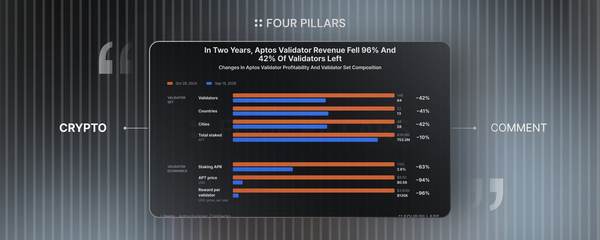
From February 19 to March 19, Aptos intensively implemented four core changes:
- Gas prices directly increased 10 times
- Staking rewards halved, fixed at 2.6%
- Total supply hard cap locked at 2.1 billion tokens
- Permanently locked 210 million tokens

The results were very direct:
- Network revenue surged approximately 16 times
- Operator commissions halved simultaneously
- Both revenue and expenditure sides improved simultaneously
Even more rarely, demand did not shrink due to the price increase—instead, it continued to grow. Daily transaction volume climbed from about 4.5 million to over 12 million, and transaction fees are now 10 times the original.

The Real Burning Engine: Decibel
Decibel—a fully on-chain perpetual contract order book—contributed the vast majority of transaction counts on the Aptos chain.
Key mechanism: Executing $1 via the fully on-chain order book burns an average amount of APT approximately 50 times that of swapping $1 in a standard liquidity pool. The reason is simple—every quote, cancellation, and execution is an independent transaction requiring Gas payment.
Because of this, although Decibel contributed only over half of Aptos' transaction volume, it accounted for 97% of the transaction count. A fully on-chain CLOB (Central Limit Order Book) is only economically feasible under Aptos' current fee levels and throughput.
Next Metric: Burn/Issuance Ratio
Besides THNI turning positive, what is more worth tracking long-term is the "ratio of burn to issuance".
- January this year: 0.2%
- Now: Close to 10%
This number is key because token issuance itself brings continuous selling pressure—validators may sell rewards to cover operating costs, and the foundation may also sell rewards to realize gains.
Now the reward rate is fixed, large-scale unlocking pressure will significantly decrease after October, and Decibel's product roadmap continues to expand. On-chain activity is expected to continue amplifying, and value capture will be further strengthened.
Join TechFlow official community to stay tuned
Telegram:https://t.me/TechFlowDaily
X (Twitter):https://x.com/TechFlowPost
X (Twitter) EN:https://x.com/BlockFlow_News
 Blockworks