a16z Latest Interview with YC CEO: Chasing Trends Is Chronic Suicide, What Question Should Entrepreneurs Really Ask?
Source: Deep Thinking Circle
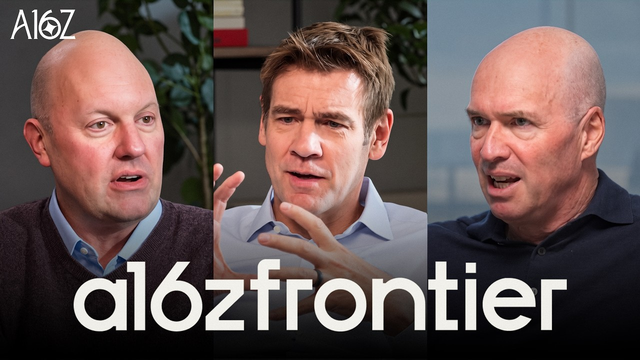
Have you ever seriously considered that those who made the wrongest judgments at the wrongest times often became the wisest people later? Recently I watched an a16z conversation, YC (Y Combinator) President Garry Tan and Anish Acharya talked for two hours, about his career starting point, about the opportunities he missed, about how AI is rewriting the rules of the startup game. After listening, I pondered it repeatedly for a long time, because many things he said aligned highly with the trends I've observed myself over the past few years, but he explained them in a sharper way. I feel this content is very worth sharing seriously.
He Rejected Palantir and Missed the Chance to Stay in Web, But These Two Mistakes Taught Him the Most Important Thing
Garry Tan said the biggest mistake he made in his career was not a misjudgment on a certain product, but chasing what looked "hot" at the time over and over again, instead of sticking to the fields he truly understood and was truly interested in. When he graduated from Stanford in 2003, he had clearly accumulated solid experience in web programming, but because web 1.0 had just crashed and Nasdaq plummeted, everyone said web was dead, and he really believed it, turning to chase Windows Mobile. He said at that time Mark Zuckerberg was probably working on Facemash, Facebook hadn't been born yet, and he happened to leave web programming at this exact moment, "went in the wrong direction, got the timing right, that's how ironic it is".
There was an even more expensive time. His Stanford fraternity brothers Joe Lonsdale and Stephen Cohen were interns at Peter Thiel's hedge fund at the time. When Palantir was founded, Peter Thiel specifically flew to Seattle to have dinner with him, directly wrote him a check for $70,000, saying this is your annual salary now, come work with us. Garry Tan said thanks, but he might get promoted to level 60 that year, so he politely declined. He calculated in the interview that refusing that time is now roughly a $2 billion to $4 billion mistake. But he said the root cause of both mistakes was exactly the same: he was looking at the map, not the terrain itself. He cared about what looked cool, what would make good investors approve, instead of opening his eyes to see what the smartest people around him were doing.
I feel this thing is easy to say, but truly doing it is extremely difficult. Because chasing "hot spots" gives you instant, positive feedback, people around you will say you are smart, media will tell you this is the trend. But the harder thing Garry Tan talked about is believing your own direct experience, instead of being carried away by some article on Twitter or Wall Street Journal. He used the word "courage", I think the word choice is very accurate. Earnestness in his view is not childishness, but a kind of courage that can only be possessed after maturity—you have to be clear-headed enough to still believe in those realities you touched with your own hands when everyone is telling you the opposite.
What Is the Real Magic of Silicon Valley: fringe Is the Treasure
Garry Tan mentioned a point that impressed me deeply. He said that the truly great things in Silicon Valley over these past few decades almost all started as things that looked strange, fringe, and non-mainstream at the time. The idea that "every family has a computer on their desk" was at that time a thorough weirdo dream, the group from Homebrew Computer Club looked like a group of fringe weirdo punks in the eyes of outsiders. But it was exactly this group of people that defined the computer era for the next few decades.
He also mentioned something that resonated with me particularly, which is that good ideas have a marker: you cannot find their boundaries. The deeper you go, the more you discover the intellectual boundaries of this topic are open, infinite, rather than something clearly countable. My own observations are also like this, truly potential things are often hard to define in the early stages because it is itself creating a new category. Instead, those opportunities that can be clearly defined at a glance are often places where competition is already sufficiently full.
Garry Tan mentioned that what YC does is essentially turning this Silicon Valley that originally required connections and circles to enter, into a place where anyone with a good idea and execution ability can come in. He called YC's Startup School "birthright for tech", seven thousand people flock to San Francisco every year, most are coming for the first time, where you come from doesn't matter, what matters is your idea and execution. I think this positioning is correct, because what YC truly gives entrepreneurs, besides funding and brand endorsement, is a community where you can speak truly—not that kind of social performance where people say "killing it" to each other at TechCrunch events, but people you can truly call and confide in during the hardest times.
One Person Can Be 400 People, But This Doesn't Mean Everything Becomes Simpler
This is the part of the entire conversation I feel is most concrete and most worth pondering repeatedly. Garry Tan said, now through vibe coding and agentic coding (AI agent-driven programming), a founder can be 400 selves from two years ago. This is not exaggeration, but literal. You can alone build things that previously required a whole engineering team to push forward.
He said very directly: the golden age of pure SaaS (Software as a Service) model is ending soon. He made an analysis, a pure per seat SaaS without any data moat or network effects, might not hold within five to ten years. Because AI is pressing the cost of "making software" down to near zero, software itself is no longer a moat, data, user relationships, network effects are. He said if you are still doing a pure SaaS in 2026, you better ensure it is a springboard towards some deeper moat, not the endpoint.
Then he said a sentence that I feel is particularly important: code is no longer precious. I understand the meaning behind this sentence—previously writing code was expensive, so before you write you must think clearly, must initiate project, must review, must write spec, must do QA, every link is to reduce the cost of "doing it wrong". Now writing code costs almost nothing, so the underlying assumption of this whole process has changed fundamentally. What truly became expensive became taste and agency. Knowing what to do, where it is worth investing effort, this thing is instead harder and more critical than before.
markdown file Is an Employee, skill file Is Reusable Muscle Memory
This is a metaphor Garry Tan said in the interview, I feel is very precise. He said inside YC, the logic they use AI agent to handle various business processes is: you first do a thing once, do it perfectly, then turn it into a markdown file plus code plus test, can be called repeatedly, put into cron job to run automatically. He said: "a markdown file is an employee", and it is the kind of employee that will never make the same mistake a second time, you tell it where it was wrong, it fixes there into a bug fix, then this fix stays forever.
This work method he described is essentially turning every repeatable business process into a skill file. Engineering has engineering skill, sales has sales skill, customer service has customer service skill. First time running definitely not right, you give it feedback, it adjusts, slowly this skill becomes precise. Then this thing afterwards doesn't need people to do, or rather, people only need to be responsible for setting direction and handling edge case.
He also mentioned the concept of token maxing. He said if you really want to feel what 2028 looks like, you can do it now, the cost is using tools like Open Claw (open-source version of Claude) or Hermes Agent, pull context window to 800,000 to 1,000,000 token, let agent think with complete context in every task. He said this now roughly requires spending $50,000 to $100,000 a year, too expensive for most people, but for a CEO or founder, this investment is worth it, because you equal to living into the world three years later using today's cost.
I myself agree with this logic. The skill file framework solves a very real problem: when your AI agents are more and more, how do you guarantee the "knowledge" and "processes" they accumulate won't disappear as each conversation ends? Solidifying it into markdown file and code is essentially building long-term memory and transferable muscle memory for the agent. This is the same logic as cultivating a real employee, except this employee's marginal cost tends towards zero.
Pedro and His Meeting Notes agent: This Is Where Management Should Truly Be Reimagined
There is a part in the interview that impressed me extremely deeply, Garry Tan talked about how Brex's co-founder Pedro uses AI agent to manage the company. Pedro let agent read all his direct subordinates' meeting notes, then this agent can see information two levels down. That is to say, he doesn't need to personally attend a certain compliance team's meeting, agent will help him sort out what this team discussed in the past three weeks, where there are disagreements, who has friction with whom. Then he can suddenly appear in a meeting, with complete context, directly say "You are right, we will do according to your plan", then leave.
Garry Tan said this is the deepest management problem AI solves: a company grows large beyond one person's cognitive boundaries, many problems start to disappear in the middle layer, because no one has enough bandwidth to truly understand what is happening in every corner. The amount of information human brain can process at once, in psychology there is a saying called 7 plus or minus 2, which is our working memory limit is roughly around seven units. But one person plus a configured agent can hold context as much as three Harry Potter books in the brain. This is not just efficiency improvement, but an expansion of cognitive paradigm.
I feel this example reveals a more fundamental thing. Traditional management layer exists, largely because information flow in the organization has friction, everyone can only process limited information amount, so need layer-by-layer reporting, layer-by-layer coordination. But if a founder can through agent directly perceive the real state two levels below the organization, then the reason for management layer's existence needs to be redefined. Garry Tan said very directly: those organizational coordination works previously completed by middle managers, essentially should be done by agent, doesn't need to be people.
Those Things Thought to Disappear Soon Will Actually Be Much Slower. This Is Good
This is the part in the interview I feel is most clear-headed and also most easily misunderstood. Garry Tan said he believes AI's impact will be much slower than most people expect, but he calls this judgment white pill (optimistic antidote), not disappointment.
His logic is this: the infrastructure of the whole world, all companies, all institutions, governments, are all built on a premise that "humans can only hold seven plus or minus two things in the brain at a time". This premise has been right for the past few thousand years, so all organizational structures, all process designs, are essentially designed to cope with human cognitive limitations. But now this premise is being broken by AI. The problem is, this breaking won't happen overnight, because humans are creatures of habit, institutions are inertial systems. He estimates this transition roughly needs 20 years.
But he said these 20 years are not bad, for entrepreneurs, these 20 years are opportunity window. Because big companies can't change, or change very slowly, and Garry Tan said a sentence I feel is very powerful: "an org like Microsoft can't. But a startup can. And every startup must." When he worked at Microsoft, needed to communicate with another department about a P3 level bug fix, spent four hours, ran to opposite building with baseball bat, the other side didn't even reply email, didn't mark won't fix, just directly ignored. This kind of bureaucratic hell, in big companies is almost structural, not some person's problem, but the inevitable result of whole organization design.
My own feeling is, Garry Tan's 20 years judgment, is both a comfort to those too anxious, and a warning to those who think they can lie flat and wait for the trend. It is slow, but it will definitely come, and before it comes it will continue to create uneven opportunity distribution—between people who know how to use agent and those who don't, the gap will become larger and larger, just this gap won't be clearly visible within one quarter.
What the Next Computer Looks Like: voice, memory, harness wars (Hardware Wars)
Garry Tan's judgment on the next generation computer form, I feel is the most forward-looking part of the entire conversation. He said short term interface might still keep current look, but voice interaction is almost certain direction. More important is memory dimension. He said he hopes future computer is not just a tool responding to questions, but a benevolent existence that understands your hopes, fears, and desires, and continuously helps you realize them.
He called 2027 the start of "harness wars (AI Assistant Wars)", meaning current cutting-edge model's computation cost, will drop to a fraction of today's within two to three years, at that time consumer grade AI products will have a real big war. Today you spend 50 to 100 dollars can use model capability, might be now the top level intelligence. By then, user experience, memory design, multi-modal interaction methods, will become the real competition points. He compared this to the return of browser wars.
My own judgment is, this harness wars core is not just whose model is smarter, but who can better integrate user's historical memory, behavior preferences, work context into daily interaction. Now everyone uses ChatGPT or Claude, every conversation basically starts from zero, model doesn't know what decision you made last week, what long term goals you have, what communication method you hate. Once this problem is truly solved, AI assistant changes from "tool" to "partner", user migration cost will rise sharply, this is the real moat.
My Own Biggest Feeling: agency and taste Are the Truly Scarce Things in the AI Era
After listening to this entire interview, what spins most in my brain are still the two words Garry Tan mentioned repeatedly: taste and agency. He said these two things now become off the charts important (importance has exceeded the chart's scale), but many people haven't realized yet.
My understanding is, AI's appearance lowered the threshold of "making things" to near zero, but it didn't lower the difficulty of "knowing what to do", even made this thing harder, because the possibilities you face became more. Previously you were constrained by resources, so choices would be automatically filtered out by half. Now constraints disappeared, you face countless almost equally "feasible" directions, at this time what is truly scarce is judgment.
Garry Tan said he himself is a late bloomer, made many mistakes, rejected Palantir, left web, but he said his life is a proof: you can make mistakes, then seriously reflect, then make different choices. I feel this sentence is more real than many inspirational speeches, because it didn't say you will definitely succeed, it only said one thing: introspect and iterate ability, is the truly valuable thing in rapidly changing environment.
From chasing Windows Mobile in 2003 to missing Palantir, to later leading YC, the road Garry Tan walked, in a sense is the microcosm of Silicon Valley these twenty years: full of misjudgments on timing, full of confusion between "hot" and "right", but also full of those willing to admit mistakes, willing to adjust, willing to still do it when everyone says no. I feel in the AI era, this trait is more important than any time, because never has any era like now, gave these people such large leverage.