TokenInsight Q2 Crypto Market Review: Spot Rebound, Derivatives Retreat, TradFi Perpetuals Become the Largest Growth Battlefield
TechFlow Selected TechFlow Selected
TokenInsight Q2 Crypto Market Review: Spot Rebound, Derivatives Retreat, TradFi Perpetuals Become the Largest Growth Battlefield
As leverage recedes and the spot market warms up, the real growth lies not on the crypto-native gambling table, but in bringing Wall Street products on-chain.
 Navigating Web3 tides with focused insights
Author: TokenInsight
Translation: TechFlow
TechFlow Editor's Note: Q2 2026 pushed the crypto exchange industry from broad deleveraging to a cautious stabilization phase. Total trading volume fell further 8% to $16.5 trillion, but underlying structure improved—spot volume rebounded from $3.3 trillion to $4.5 trillion, while derivatives activity dropped from $14.6 trillion to $12.0 trillion. Meanwhile, market share continued to concentrate among the largest exchanges, while TradFi perpetual contracts became the clearest incremental growth segment. In this switch of "spot participation rebound, leverage restraint, product diversification acceleration," this report covers 20 mainstream exchanges, revealing how Binance expanded its leading advantage against the trend, and how equity perpetuals evolved from an experimental product to a strategic ground for exchange differentiation.
Executive Summary
Q2 2026 pushed the crypto exchange industry from broad deleveraging to a cautious stabilization phase. Total trading volume fell further 8% to $16.5 trillion, but underlying structure improved—spot volume rebounded from $3.3 trillion to $4.5 trillion, while derivatives activity dropped from $14.6 trillion to $12.0 trillion. Meanwhile, market share continued to concentrate among the largest venues, while TradFi perpetual contracts became the clearest incremental growth segment this quarter. Against this backdrop, this report examines the performance of 20 mainstream exchanges in trading volume, open interest, and the expanding equity and commodity perpetual markets.
In June, Bitcoin tested the $60,000 support zone multiple times, once intraday dipping near $58,000 before recovering, sparking heightened spot and derivatives trading activity despite continued macro uncertainty. Average futures open interest fell further to $0.08 trillion, indicating leverage preference remained low even as trading activity stabilized.
Market leadership continued to consolidate among the largest exchanges. Binance increased its total market share from 32.77% to 35.34% (+2.57 percentage points), recording the largest quarterly increase—despite already being the industry's largest share holder. Market structure also shifted within the quarter: derivatives remained the dominant trading product, accounting for 73% of total volume, but fell from 82% in Q1, reflecting a substantial recovery in spot participation.
Beyond crypto-native markets, TradFi perpetual contracts became the industry's fastest-growing product segment in Q2. Monthly trading volume expanded from $52 billion in January to $268 billion in June, with equity perpetuals surpassing commodities as the main growth driver. TradFi perpetuals also increasingly became an important component of exchange activity, exceeding 15% of total derivatives volume on several peak trading days. Binance, Bitget, Bybit, MEXC, and Gate all launched tokenized equity, US stock trading, or IPO/Pre-IPO products within the quarter.
Data Coverage
This report examines the Q2 2026 crypto exchange industry, based on trading volume, open interest, and other analytical data from 20 exchanges: Binance, OKX, Bybit, Bitget, Hyperliquid (futures only), MEXC, Gate, KuCoin, Coinbase (spot only), BingX, Crypto.com, HTX, Kraken, Bullish (spot only), Upbit (spot only), Deribit (futures only), Bitfinex, Bitstamp (spot only), Hashkey Exchange (spot only), and Gemini (spot only). Based on market share, trading volume, and open interest, 11 exchanges—Binance, OKX, Bybit, Bitget, Hyperliquid (futures), MEXC, Gate, KuCoin, Coinbase (spot), Crypto.com, and HTX—were selected as primary analysis subjects, with the remaining exchanges grouped into "Others."
Total Trading Volume Stabilizes, Spot Rebound Offsets Derivatives Decline
Q2 2026 crypto exchange trading volume continued to soften, falling to $16.5 trillion, a quarter-over-quarter decrease of about 8% from Q1's $17.9 trillion, still far below the $31.0 trillion peak set in Q3 2025. Notably, BTC tested the $60,000 support zone multiple times in June, with intraday lows approaching $58,000, but each breakdown attempt was quickly absorbed, with prices recovering near $60,000 before daily close. Both spot and derivatives activity surged significantly that month.
Although Q2 derivatives trading volume fell from $14.6 trillion to $12.0 trillion, spot volume rebounded from $3.3 trillion to $4.5 trillion, suggesting weakened leverage preference following the previous liquidation cycle, and continued uncertainty regarding interest rates, geopolitics, and risk assets. The rebound in spot volume indicates users were still actively adjusting exposure and responding to BTC pullbacks.
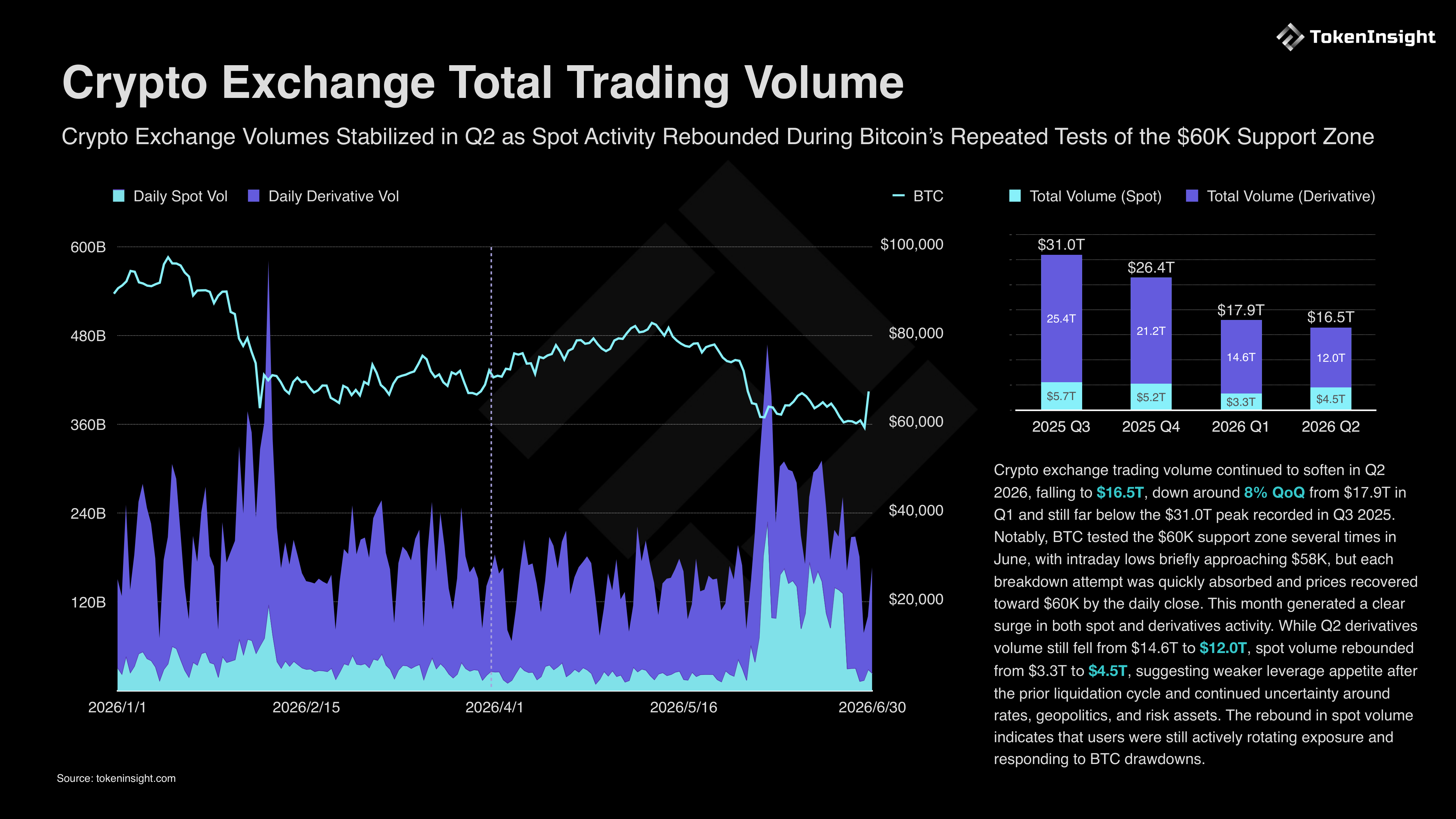
Chart: Total Crypto Exchange Trading Volume and BTC Price Trend. Source: TokenInsight
Binance Expands Leading Advantage Against the Trend
Q2 2026, Binance further consolidated its dominance, with total trading volume reaching approximately $5.85 trillion, market share rising from 32.77% to 35.34%, the largest quarter-over-quarter increase among all tracked exchanges. This is particularly noteworthy as Binance built upon the highest market share base yet captured the largest incremental share growth. Meanwhile, OKX (13.88%), MEXC (8.53%), Bybit (9.81%), KuCoin (2.96%), and Coinbase (1.62%) also expanded their shares during the period.
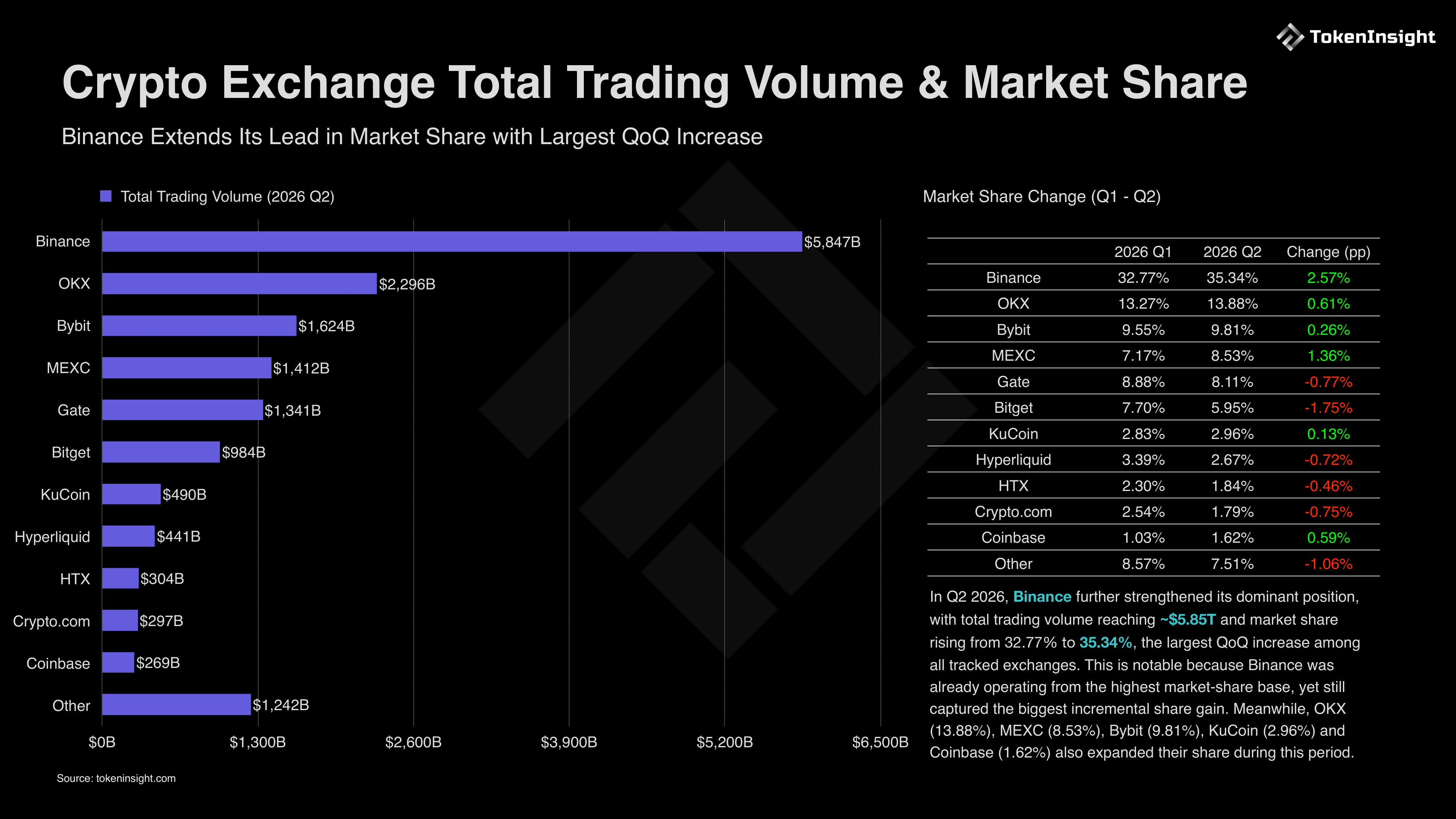
Chart: Total Crypto Exchange Trading Volume and Market Share Changes. Source: TokenInsight
Derivatives Dominance Weakens, Spot Participation Recovers
Q2 2026, derivatives remained the main source of exchange trading volume, accounting for 73% of total volume. However, this declined significantly from 82% in Q1, indicating a broad recovery in spot trading activity. This shift was particularly evident among several major exchanges: Binance derivatives share fell from 83% to 75%, Bybit from 88% to 75%, Gate from 87% to 73%, Bitget from 90% to 79%. OKX and MEXC remained the platforms with the highest derivatives proportion among major platforms, with derivatives accounting for 86% and 81% of their Q2 trading volume respectively. Meanwhile, KuCoin, HTX, and Crypto.com showed a more spot-driven structure, indicating market participation in Q2 was less concentrated on leverage trading than Q1, with spot capital flows regaining importance during the quarter.
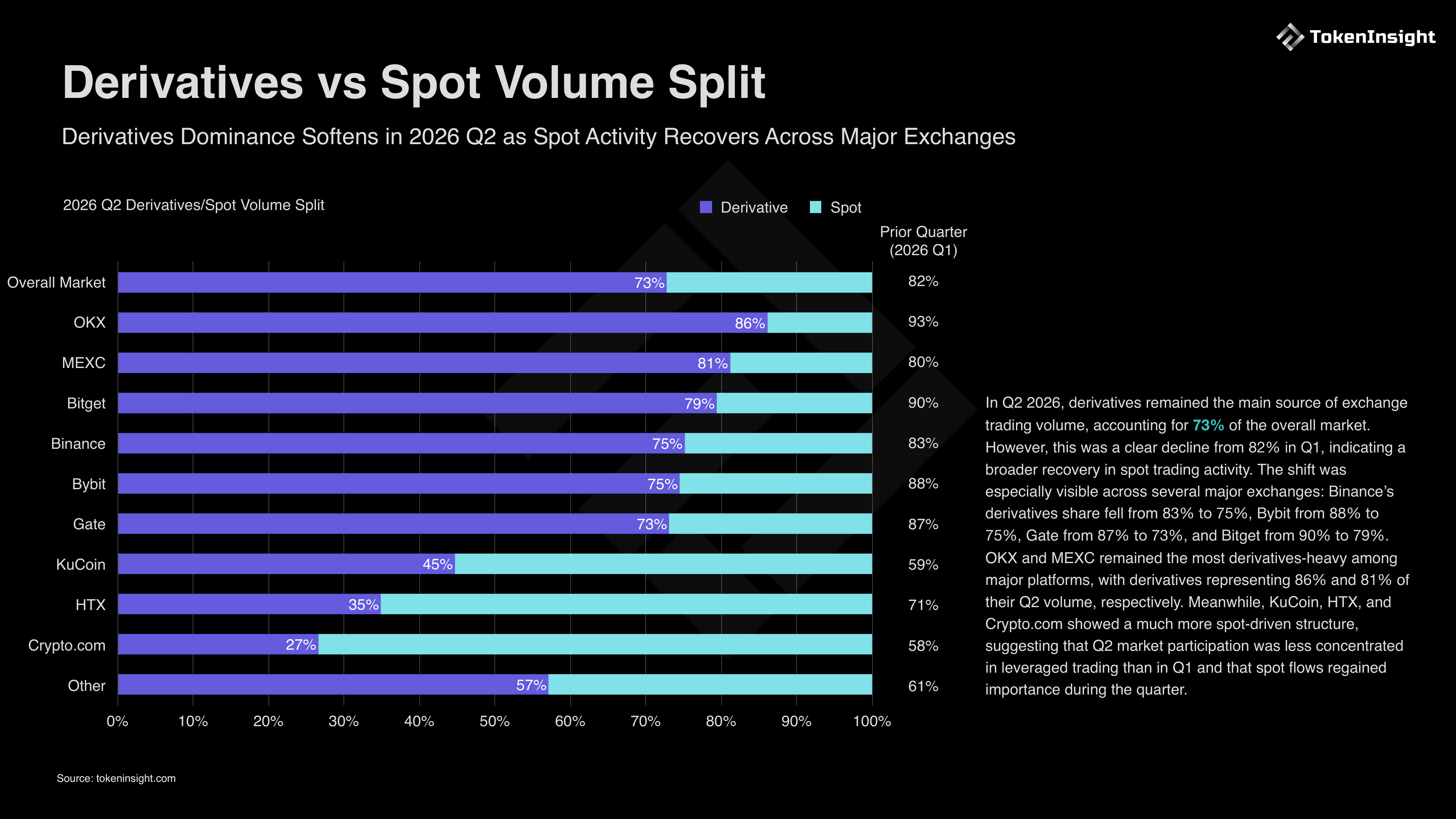
Chart: Comparison of Derivatives and Spot Trading Volume Proportion for Major Exchanges. Source: TokenInsight
Spot Market Share: Binance Leads, Second Tier Relatively Dispersed
Q2 2026, Binance remained the clear leader in spot trading, with an average market share of 32.26%, steadily holding about one-third of monthly spot trading volume. Outside Binance, the spot market was relatively more diversified: Bybit ranked second with 9.19%, followed by Gate at 8.01% and OKX at 7.08%. KuCoin, Coinbase, MEXC, Crypto.com, Bitget, and HTX each held about 4% to 6%, while "Others" still accounted for 12% of Q2 spot trading volume. Monthly breakdown also showed most major exchanges gained spot share during the quarter, conversely, the "Others" category was significantly compressed, falling from a larger share in Q1 to a much smaller contribution in Q2.
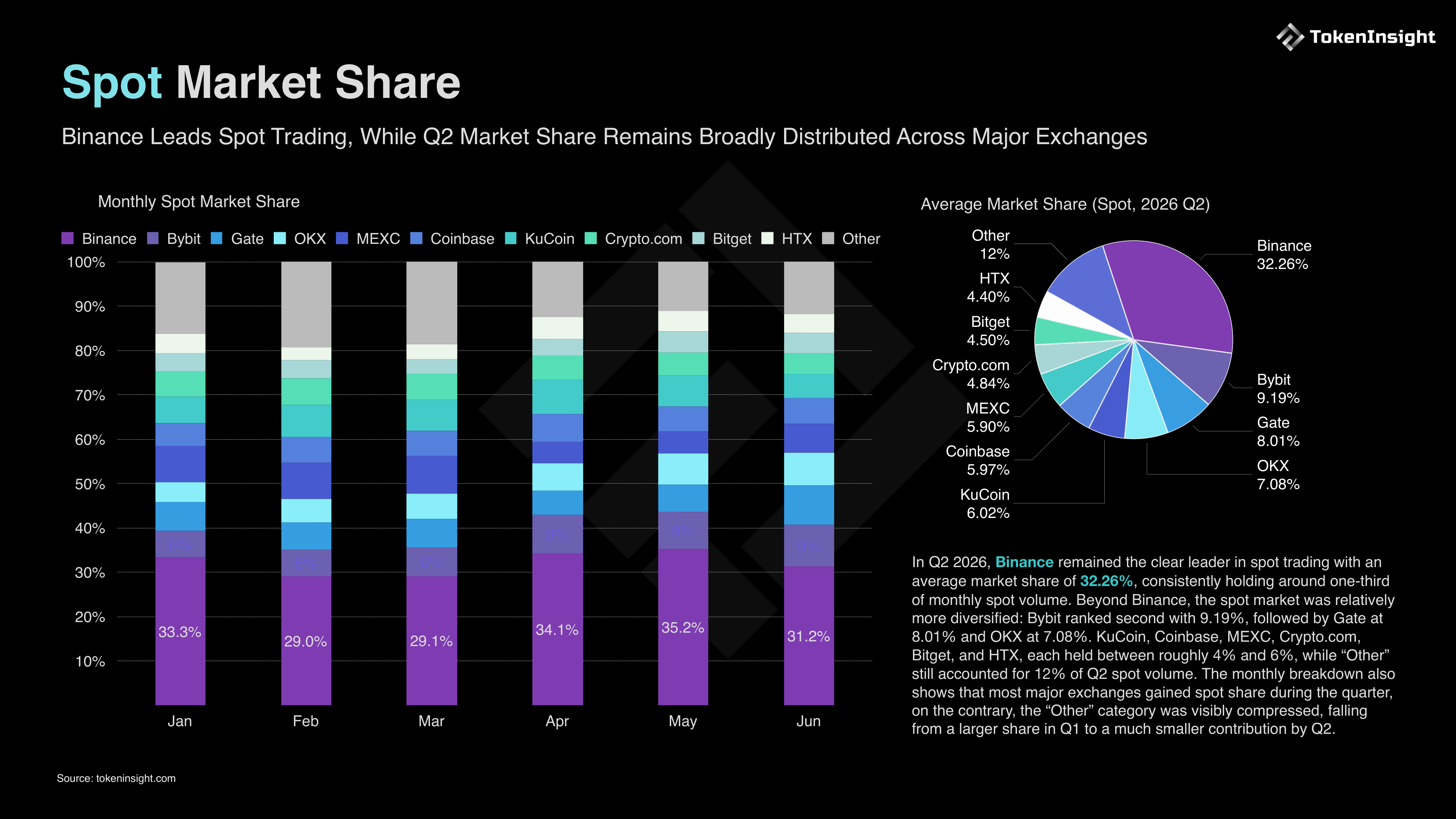
Chart: Q2 Spot Market Share Monthly Changes and Average Proportion. Source: TokenInsight
Derivatives Market Share: Highly Concentrated, Top Four Account for 72%
Q2 2026, Binance reinforced its dominance in the derivatives market with a share of 36.48%. OKX maintained its position as the second largest derivatives venue with 16.42%, followed by Bybit (10.05%) and MEXC (9.51%). The top four exchanges combined accounted for over 72% of the market. Monthly breakdown showed most leading exchanges maintained or expanded derivatives share throughout the quarter, while the "Others" category continued to shrink, average market share falling to just 6%. This trend indicates increasing concentration of derivatives liquidity.
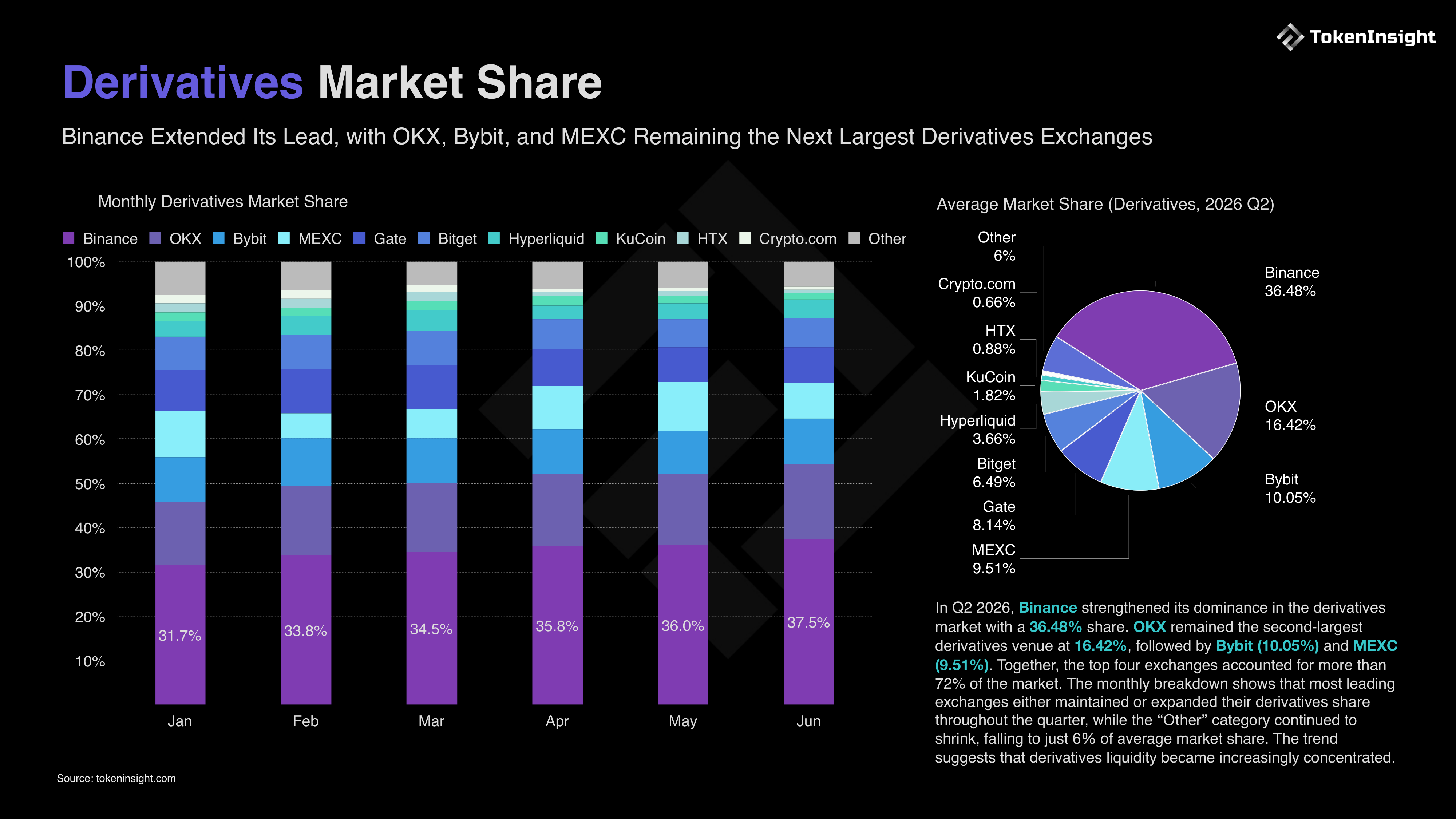
Chart: Q2 Derivatives Market Share Monthly Changes and Average Proportion. Source: TokenInsight
Open Interest (OI) Stabilizes, Leverage Continues to Normalize
Q2 2026 crypto futures average open interest fell to approximately $0.08 trillion, lower than Q1's $0.09 trillion, and far below the 0.17 trillion peak set in Q3 2025. Despite Bitcoin recovering to the $80,000 level, daily OI remained relatively stable for most of April and May, indicating price increases were not accompanied by comparable leverage position accumulation. By end of June, both Bitcoin price and aggregated open interest declined, OI falling to approximately $60 billion, suggesting deleveraging continued amidst rising market uncertainty. Overall, the quarter reflected a more conservative derivatives market—leverage remained low despite occasional increases in spot trading activity and price volatility.
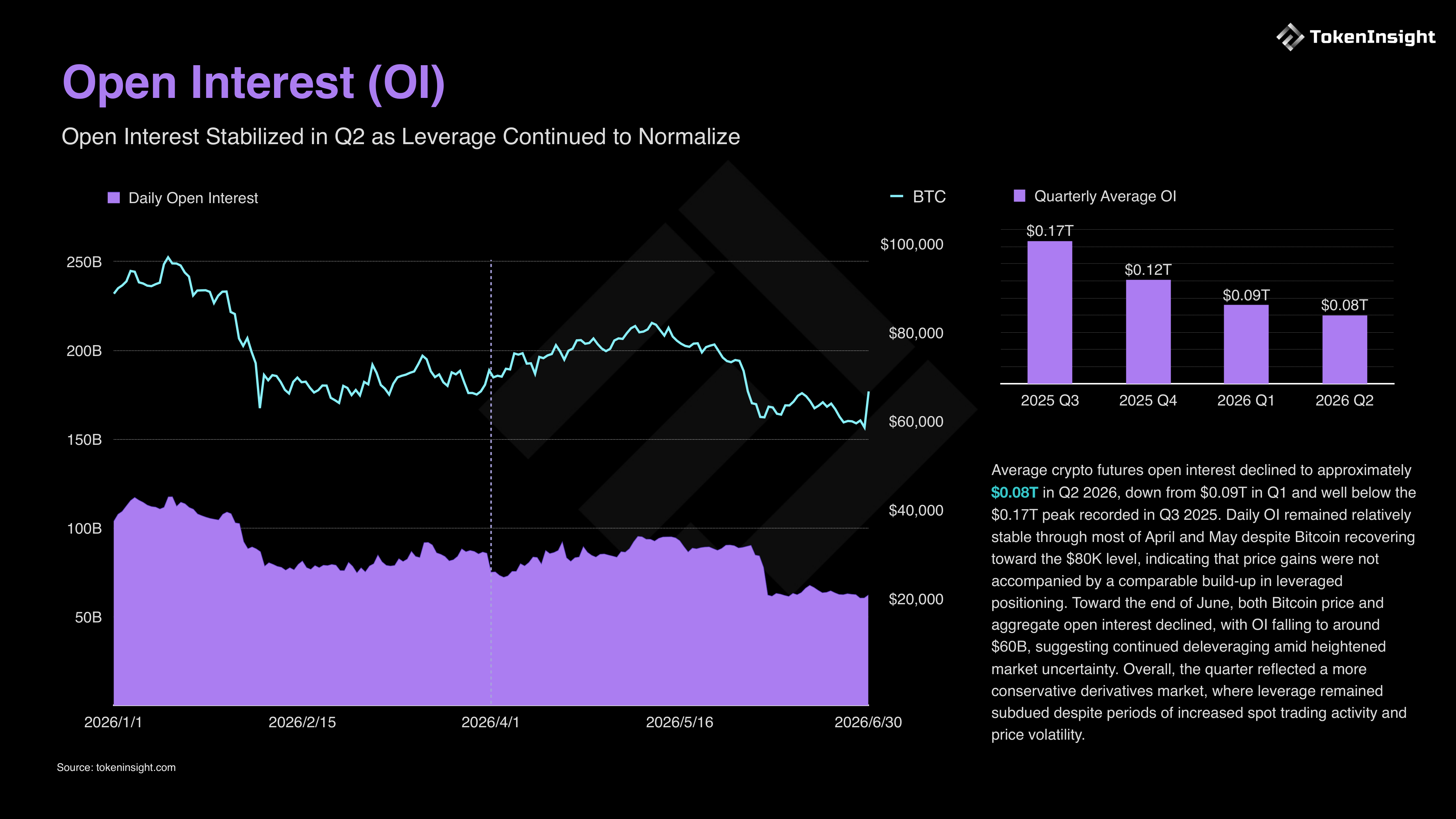
Chart: Crypto Futures Open Interest and BTC Price Trend. Source: TokenInsight
OI Market Share: Binance Leads, KuCoin Largest Increase
The open interest market remained firmly dominated by leading derivatives exchanges in Q2 2026. Binance expanded its leadership with an average market share of 26.35% (+0.40 percentage points). Among the top five exchanges, Bitget recorded one of the strongest increases, share rising from 7.81% to 8.58% (+0.77 percentage points), while MEXC also expanded to 9.21% (+0.59 percentage points). KuCoin was the biggest winner this quarter, market share surging from 2.23% to 6.20% (+3.97 percentage points), the largest increase among all tracked exchanges. In contrast, Gate recorded the sharpest decline (-3.58 percentage points), Hyperliquid and Bybit also saw mild share losses. Despite these changes, the overall competitive landscape remained stable, with leading exchanges continuing to capture the majority of futures open interest.
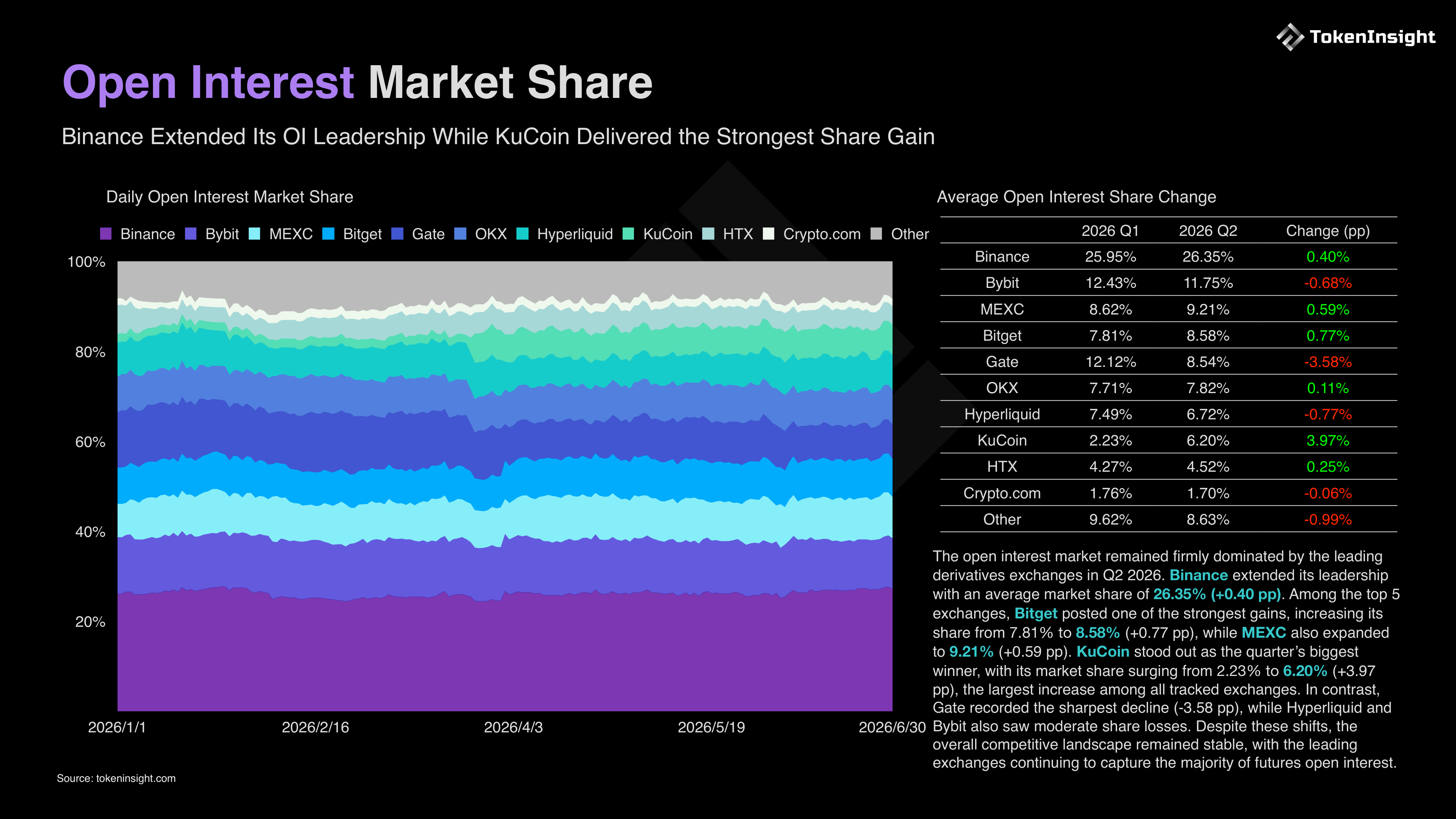
Chart: Open Interest Market Share and Quarterly Share Changes. Source: TokenInsight
TradFi Perpetual Contracts: Largest Incremental Battlefield
Trading Volume Explosion, Equity Contracts Drive June Surge
First half of 2026, crypto exchanges' expansion into TradFi perpetuals gained clear traction, total monthly trading volume rising from $52 billion in January to $268 billion in June. Commodity perpetuals remained the core trading volume base throughout the period, but equity perpetuals became the main growth driver, expanding sharply from $45 billion in May to $141 billion in June. Trading activity also showed obvious weekly patterns: weekend average trading volume was only about 23% of weekday levels, indicating most trading activity remained concentrated on traditional business days. Meanwhile, as the Nasdaq Composite recovered from early year weakness and rose in May and June, crypto exchanges were increasingly capturing demand for continued exposure to traditional markets. June's breakthrough indicates TradFi perpetuals are evolving from a niche product to a meaningful growth segment for exchanges, with equity-linked perpetuals showing the strongest user adoption and market scalability signals.
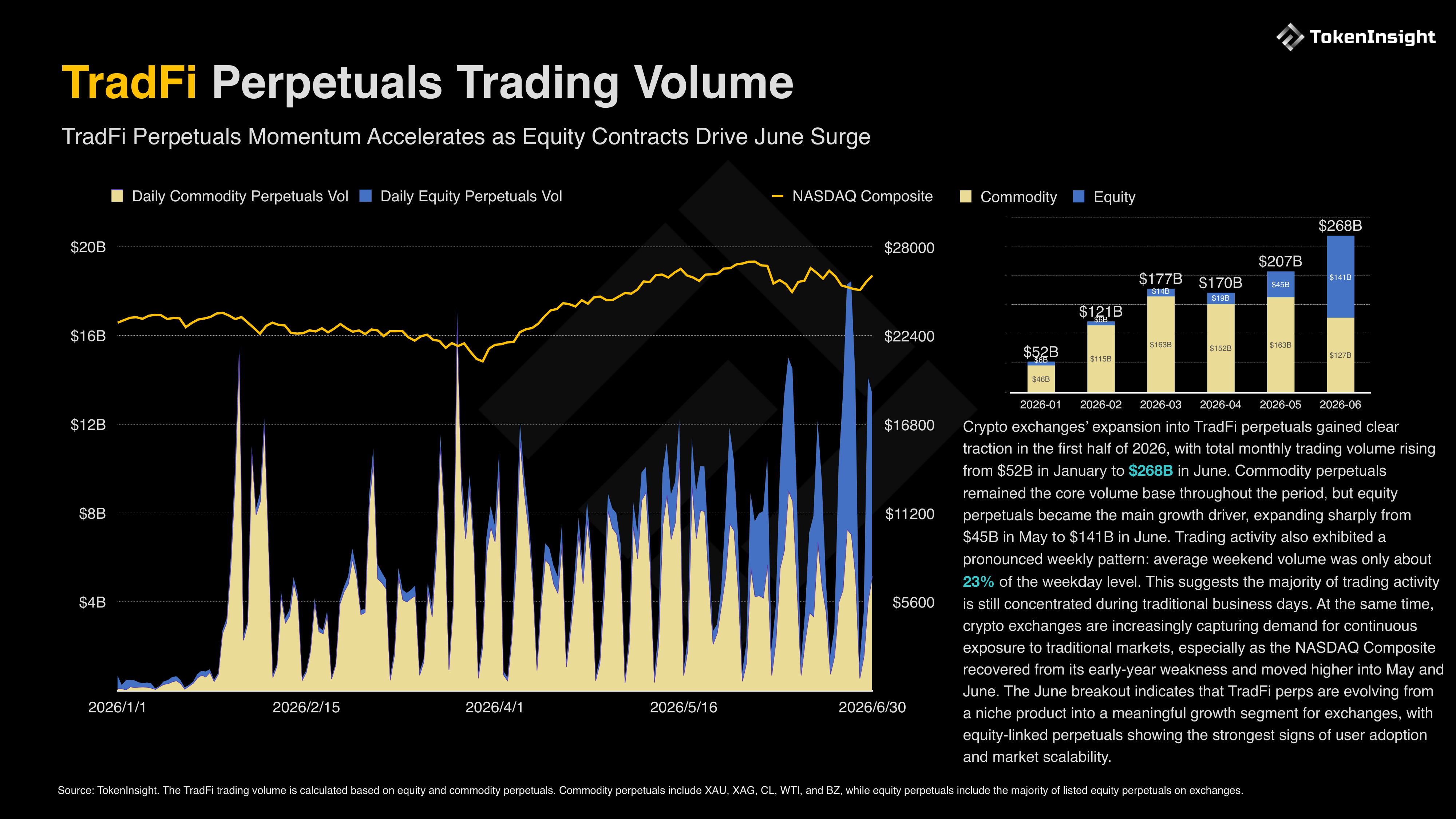
Chart: TradFi Perpetual Contracts Monthly Trading Volume (Commodities vs Equity). Source: TokenInsight
Penetration Rate: Binance, Bitget Highest
Q2 2026, TradFi perpetuals continued to gain traction among crypto exchanges, but their penetration into exchange derivatives activity remained uneven. Among centralized exchanges, Binance (8.65%), Bitget (8.61%), and MEXC (7.22%) recorded the highest proportion of TradFi perpetuals in their derivatives trading volume, benefiting from the launch of various stock and commodity perpetuals during the quarter. In contrast, OKX (3.52%), Gate (2.66%), Crypto.com (2.00%), Bybit (1.23%), KuCoin (1.13%), and HTX (0.57%) had smaller shares of TradFi perpetuals in their derivatives activity.
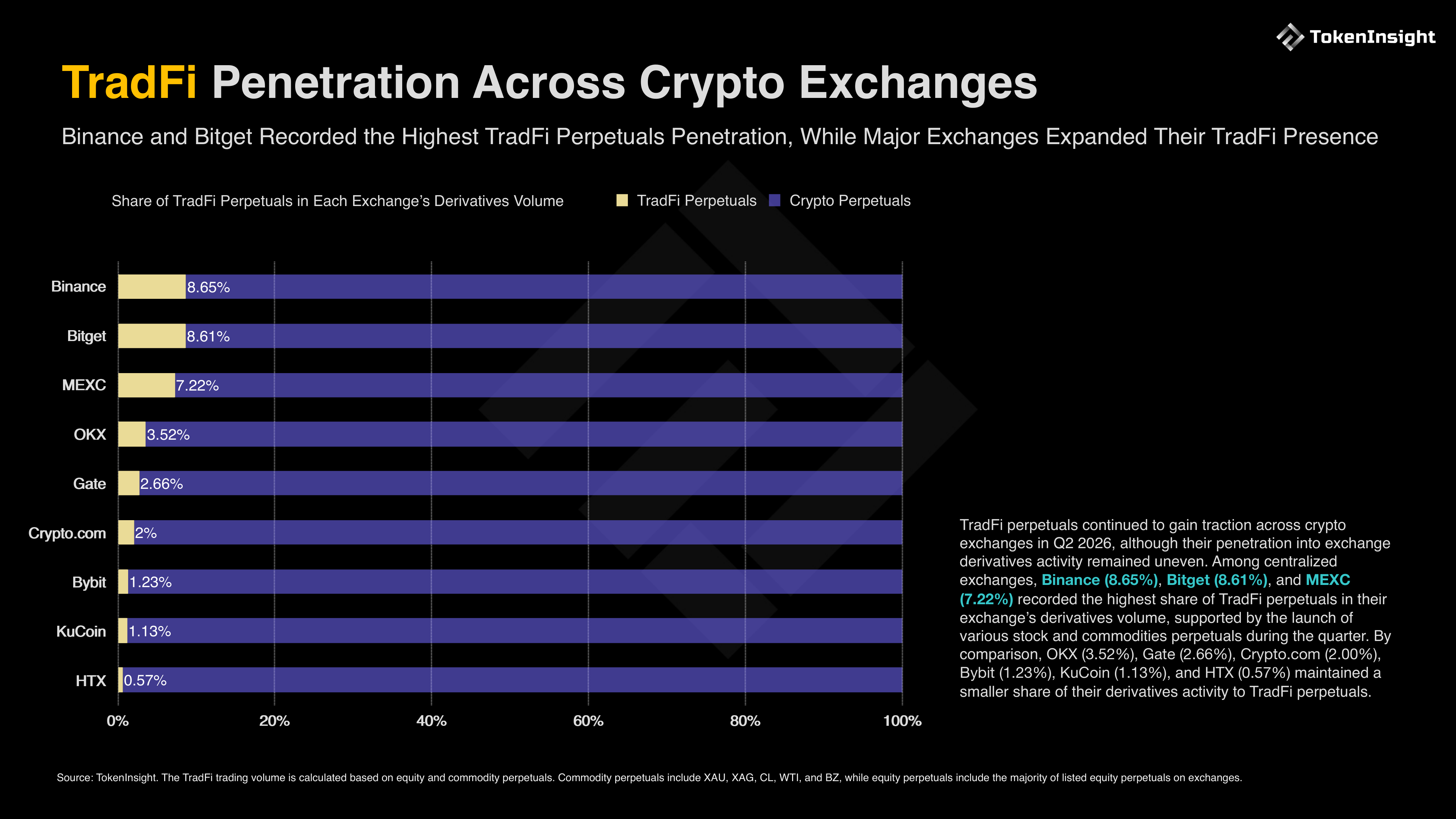
Chart: Penetration Rate of TradFi Perpetual Contracts in Derivatives of Each Exchange. Source: TokenInsight
Market Share: Binance Leads, Bitget/OKX Follow Closely
The TradFi perpetual market was highly concentrated in Q2 2026, Binance generated $380 billion trading volume and captured about 60% market share, far exceeding the rest of the industry. Bitget (11.01%), OKX (10.97%), and MEXC (10.85%) formed a competitive second-tier cluster, each around $69 billion. For most exchanges, commodity perpetuals still accounted for the majority of activity, but from a macro perspective, equity perpetuals are becoming an increasingly important battlefield.
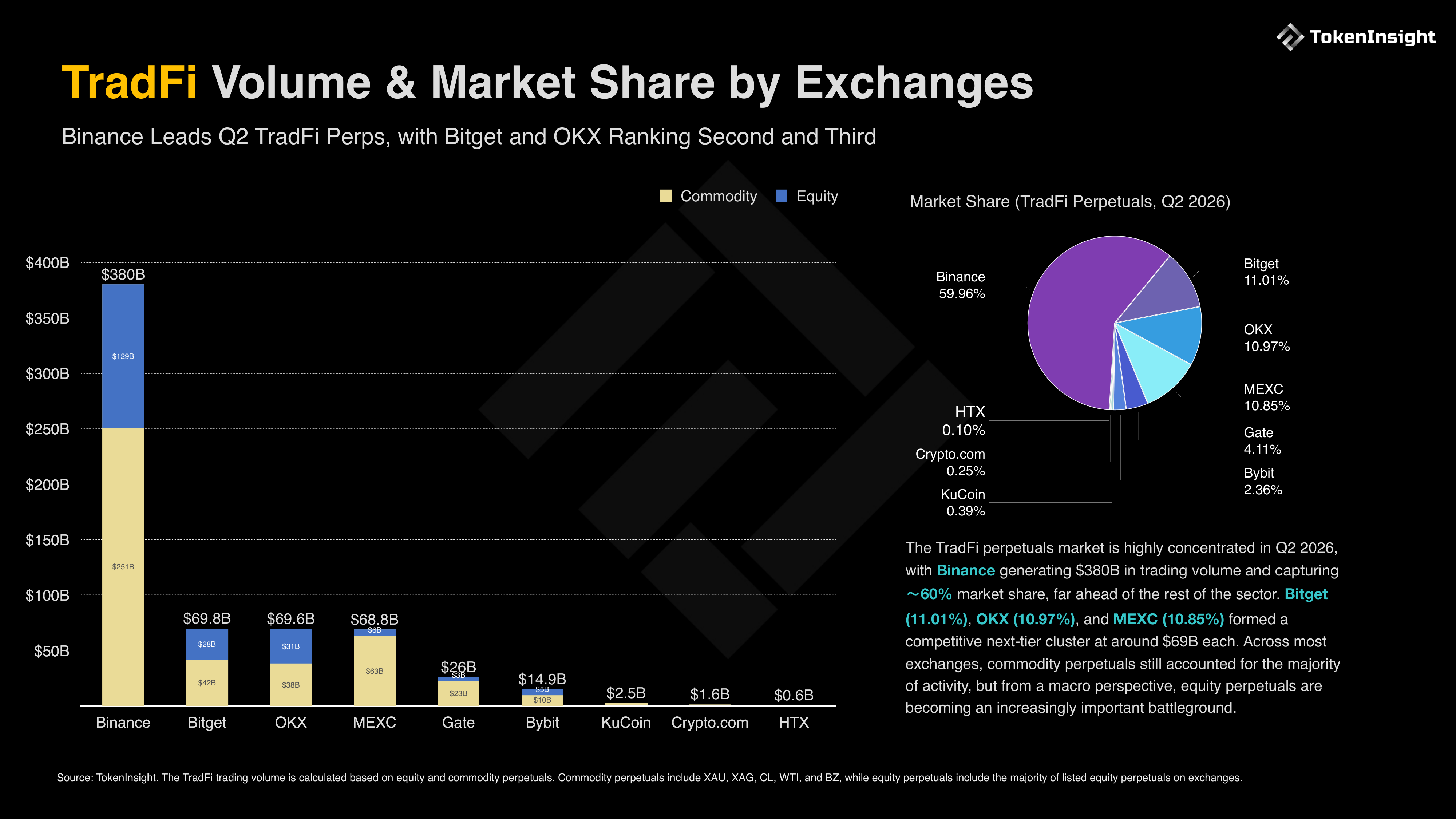
Chart: TradFi Perpetual Trading Volume and Market Share (by Exchange). Source: TokenInsight
Landscape Changes: Equity Concentrates Towards Binance/OKX, Commodities MEXC/Bitget Catching Up
During 2026 Q2, commodity perpetual trading remained firmly led by Binance, although its market share fell quarter-over-quarter by 7.5 percentage points to 58.5%. The strongest increases came from MEXC (+4.1 percentage points) and Bitget (+1.9 percentage points), consolidating their status as the second and third largest commodity perpetual venues. OKX, despite a mild market share decrease of 1.0 percentage points, maintained its position as the fourth largest exchange, Bybit also expanded its presence (+1.8 percentage points). Overall, the commodity market remained relatively concentrated, but competitive dynamics gradually widened as several exchanges continued to gain share from market leaders.
Equity perpetuals experienced more drastic market share redistribution in Q2. Binance recorded the quarter's largest increase (+21.5 percentage points), share rising to 63.0%, while OKX (+10.8 percentage points) also expanded significantly to become the clear second largest venue. Although Bitget gave up 17.5 percentage points market share this quarter, it maintained its status as the third largest equity perpetual venue. In Q2, the market became significantly more concentrated, with Binance, OKX, and Bitget combined accounting for over 90% of total equity perpetual trading volume.
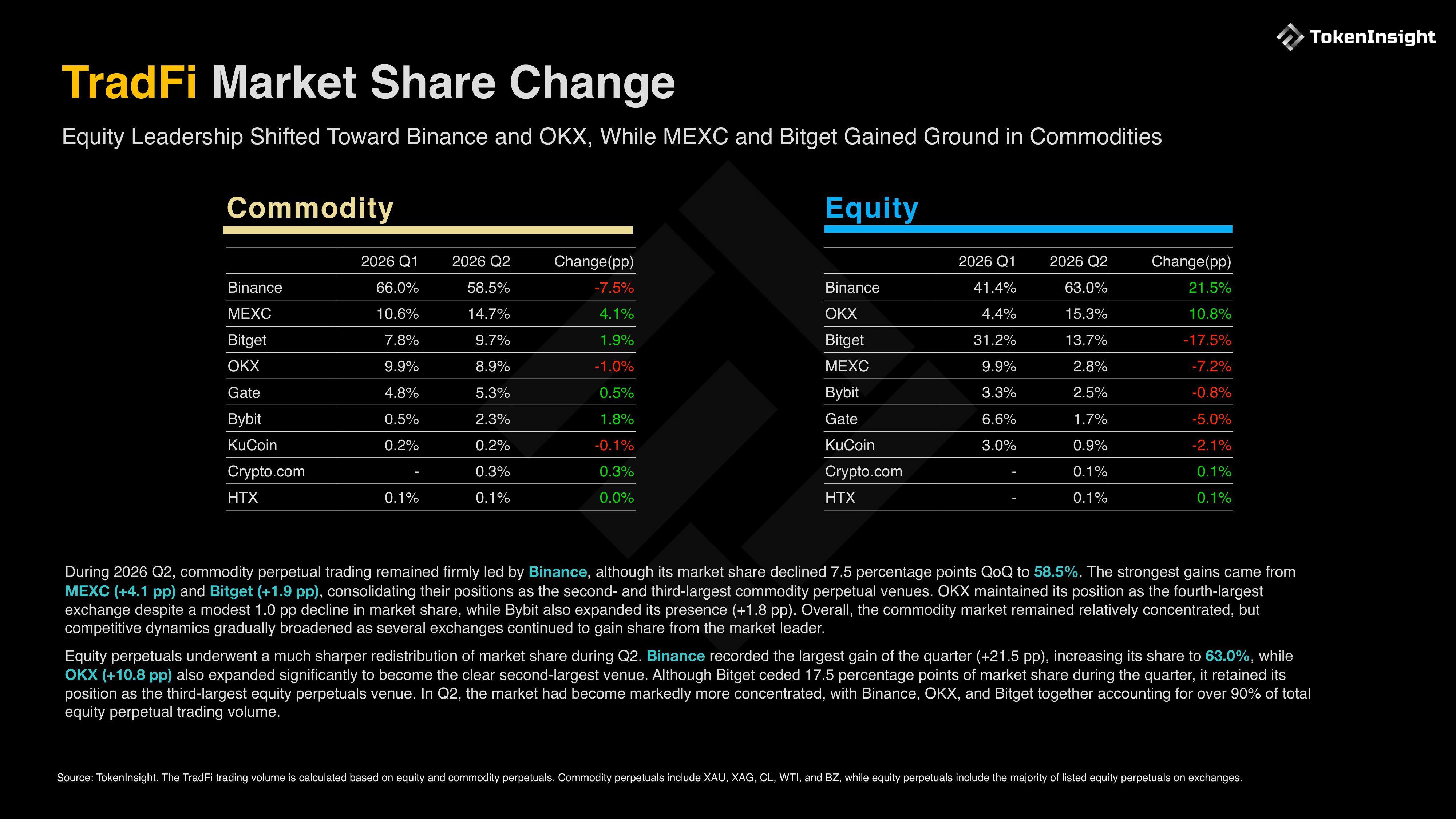
Chart: Commodity and Equity Perpetual Contracts Market Share Changes. Source: TokenInsight
Q2 Key Events: Strategic Focus Shifts to RWA, TradFi Integration and Pre-IPO Market Access
During Q2, exchanges shifted strategic focus to RWA (Real World Assets), TradFi integration and IPO/Pre-IPO market access. Binance, Bitget, Bybit, MEXC, and Gate all launched tokenized equity, US stock trading, or IPO/Pre-IPO products within the quarter, marking a key step for the industry extending from pure crypto-native trading to traditional financial market infrastructure.
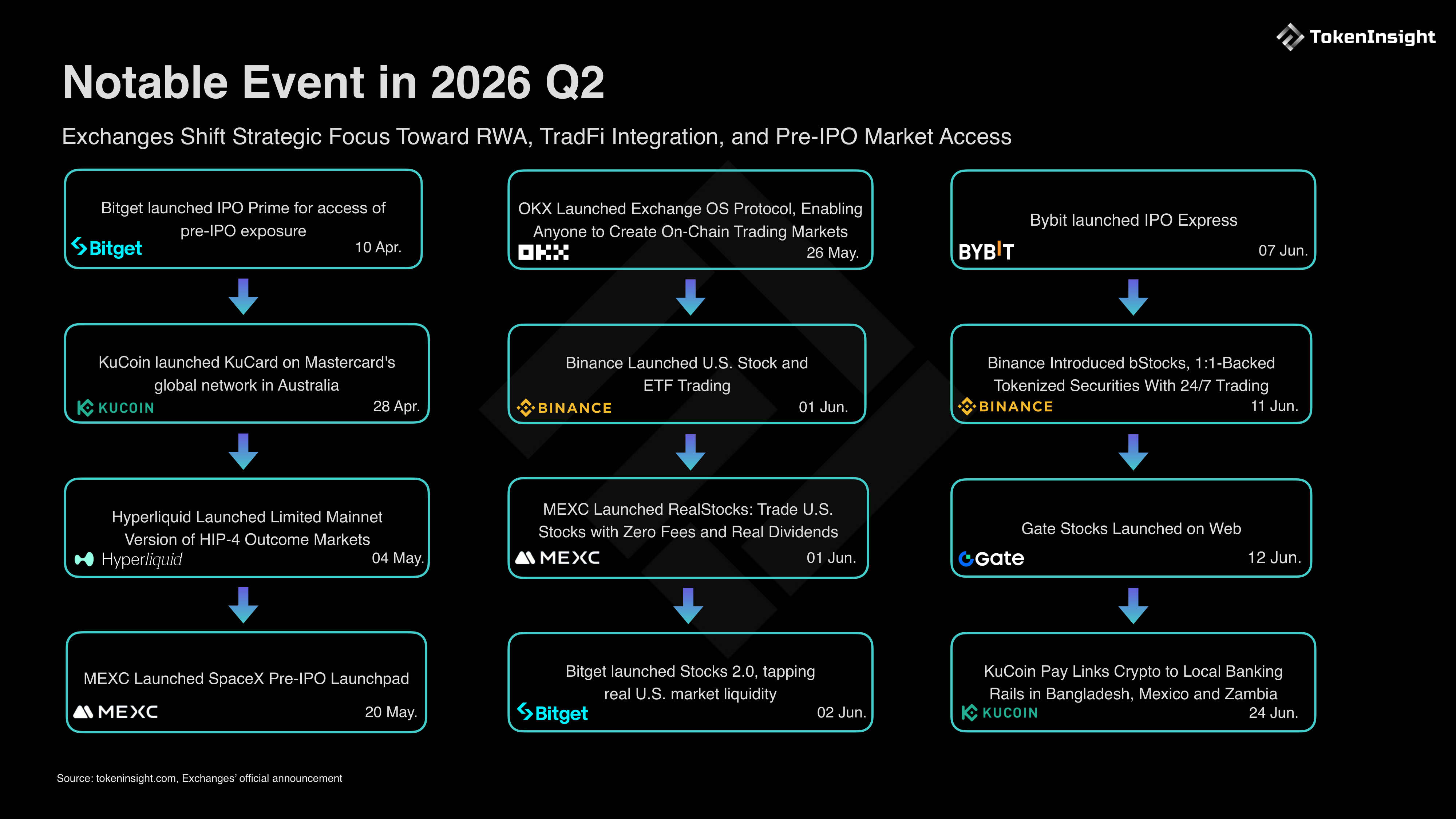
Chart: 2026 Q2 Exchange Major Events Timeline. Source: TokenInsight
Conclusion and Outlook
2026 Q2 marked a transition from post-liquidation repair to a more normalized, spot-supported market structure, rather than a full-cycle recovery. Trading activity stabilized, spot participation rebounded, while open interest remained low, indicating risk preference returned selectively, rather than through new leverage. This environment continued to favor large exchanges with deeper liquidity, broader product coverage, and stronger distribution capabilities, reinforcing market share concentration.
Meanwhile, TradFi perpetuals are emerging as the clearest incremental growth vector, led by the rapid expansion of equity-linked perpetuals. Looking ahead, exchange growth will increasingly rely on product execution, liquidity depth, regulatory clarity, and the ability to convert traditional market exposure demand into recurring trading activity. Therefore, competition around equity and commodity-linked products may intensify, while broader recovery in derivatives leverage may remain gradual unless macro conditions and Bitcoin market structure become decisively more favorable.
For exchanges, Q2 data outlines a clear main thread: when leverage recedes and spot warms up, the true increment is not on the crypto-native gambling table, but in moving Wall Street products on-chain—the explosion of equity perpetuals is the sharpest cut of this narrative.
Join TechFlow official community to stay tuned
Telegram:https://t.me/TechFlowDaily
X (Twitter):https://x.com/TechFlowPost
X (Twitter) EN:https://x.com/BlockFlow_News
 @TokenInsight