
ARK Aggressively Buys Crypto Concept Stocks: Lower Risk or Dual Pressure?
TechFlow Selected TechFlow Selected
ARK Aggressively Buys Crypto Concept Stocks: Lower Risk or Dual Pressure?
Crypto concept stocks are far more volatile than Bitcoin.
 Navigating Web3 tides with focused insights
Written by: Andjela Radmilac
Compiled by: Luffy, Foresight News
ARK Invest, led by Cathie Wood, cumulatively purchased $77 million worth of crypto-related public company stocks in June. According to ARK's daily trade disclosure data, during Bitcoin's worst monthly performance in four years, the fund added $44 million worth of Coinbase, $25.25 million worth of Circle, and $8.2 million worth of Bullish.
Wood and several institutions have adhered to the same investment logic for years: crypto-related public companies provide investors with a compliant channel to share in the crypto industry cycle benefits without directly holding Bitcoin. However, market data analysis by CryptoSlate as of July 2 reveals the huge hidden costs of this stock investment path.
The annualized 30-day realized volatility range for 9 US-listed crypto companies was 68%–90%, nearly double Bitcoin's volatility of 37.6%. Extending to a 90-day dimension, Circle's volatility reached as high as 103.6%, while Bitcoin was only 37.8%. The gap in stock price drawdowns is also significant: Circle drew down 51.4% from its high, MSTR drew down 48.6%, and Bullish drew down 43.6%; whereas Bitcoin fell 36.4% from its January high of nearly $97,000, with all declines smaller than the aforementioned individual stocks.
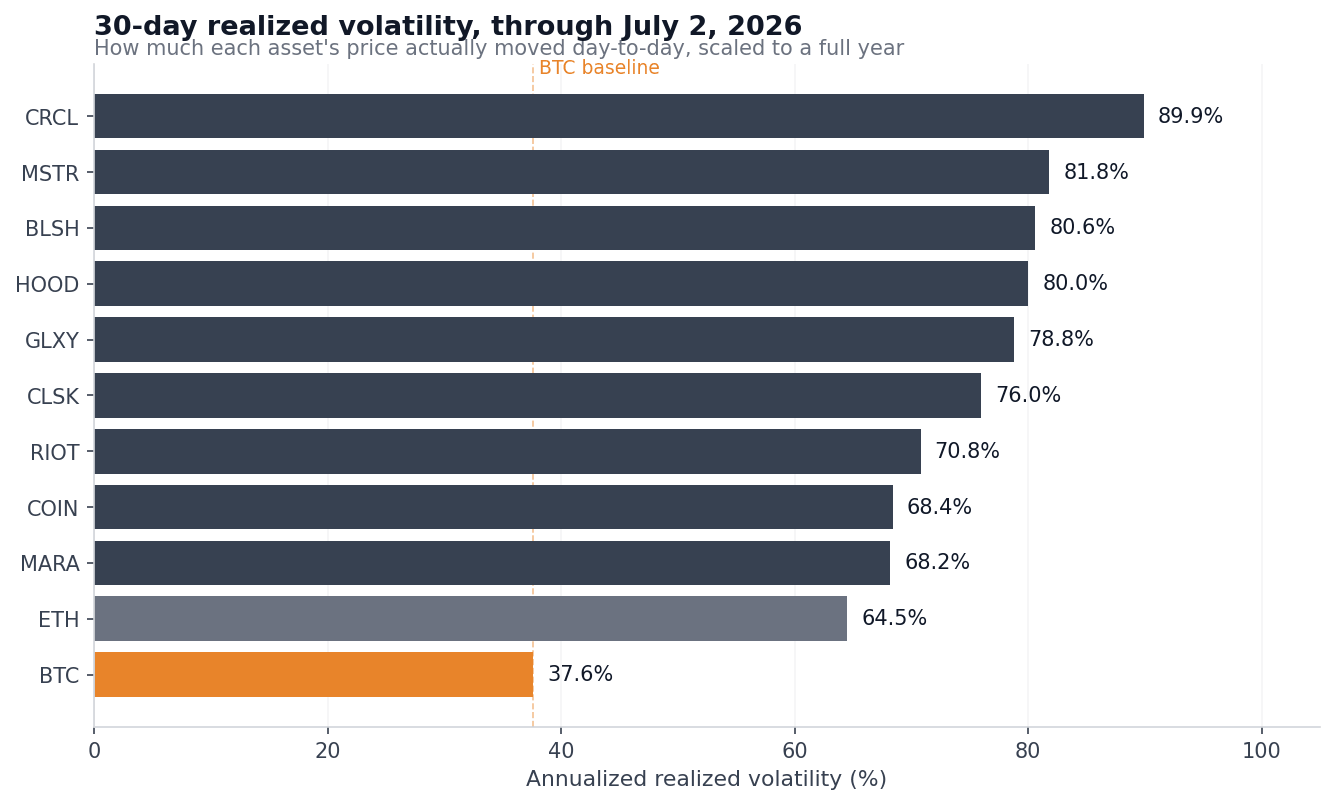
30-day annualized realized volatility of BTC, ETH, and nine crypto company stocks listed in the US from January 1, 2026 to July 2
Looking at volatility alone, crypto stocks seem like leveraged Bitcoin, but correlation data reveals a completely different truth. Over the past 90 trading days, the correlation coefficients between Circle, Robinhood, Bullish and Bitcoin were only 0.55–0.58 (correlation range is 0 to 1, where 1 represents completely synchronized movement, and 0 represents no association), meaning price fluctuations explain only about one-third of the volatility of crypto company stocks, with the remaining volatility coming entirely from company-specific risks: quarterly earnings, industry competition, financing activities, share dilution, etc. Investors intended to use stocks to position in the crypto industry, but ended up with only partial crypto price exposure, while additionally bearing a whole set of operating risks unique to the stock market.
Only One Stock Truly Tracks Bitcoin
The table below statistics the correlation between crypto company stocks and Bitcoin from the end of 2025 to present. The beta coefficient represents the percentage change of the corresponding stock for every 1% fluctuation of Bitcoin.
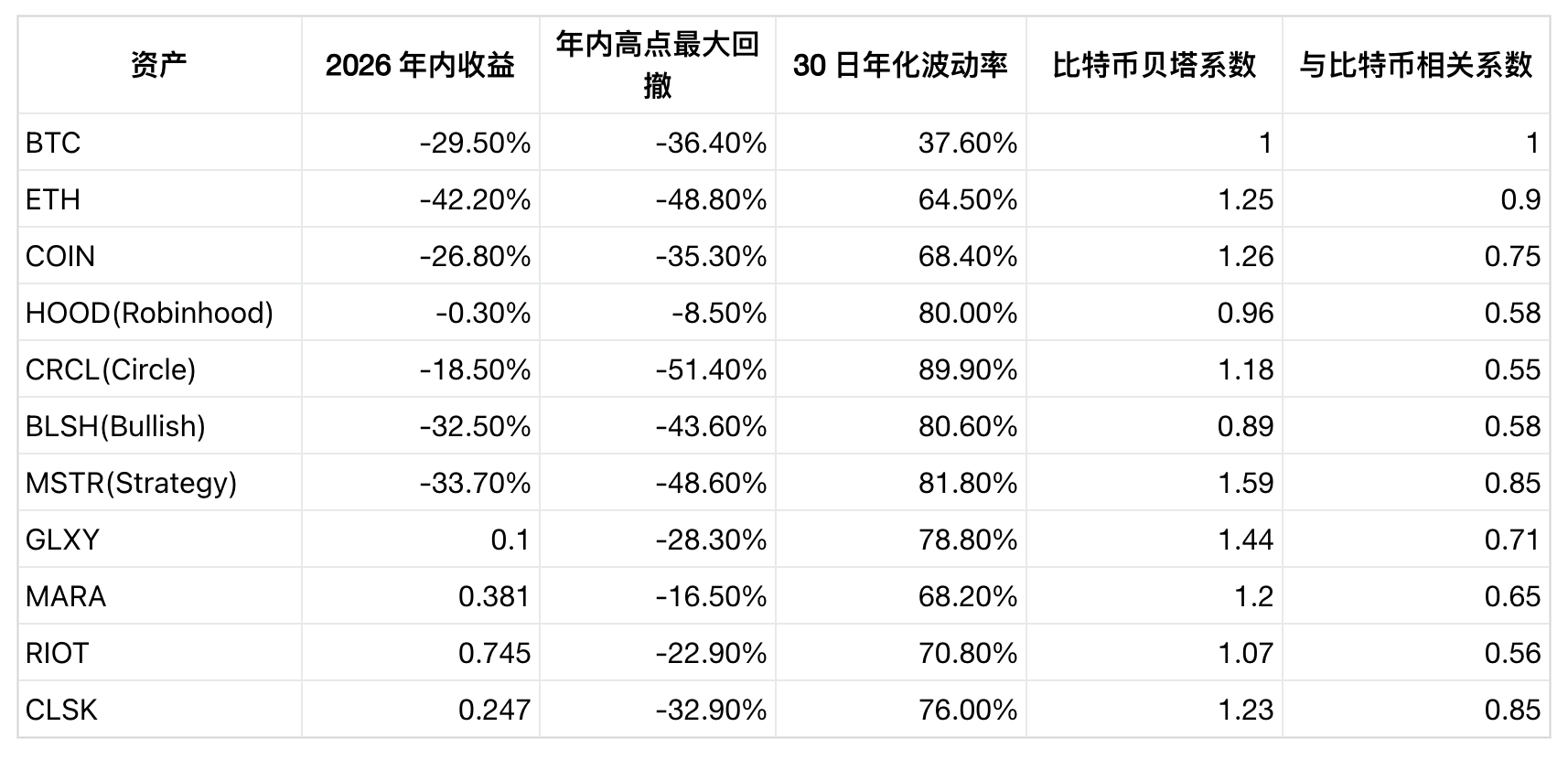
Only MSTR in the entire market can be called a Bitcoin substitute target. With a beta of 1.59 and correlation of 0.85, it is essentially a leveraged equity instrument for holding Bitcoin. In this downturn, its year-to-date decline and drawdown from highs both far exceeded Bitcoin.
Coinbase is a relatively balanced choice, with a year-to-date decline of -26.8%, slightly less than BTC, a beta coefficient of 1.26, and a correlation coefficient of 0.75, making it the second strongest in linkage with Bitcoin within the sector. However, its volatility remains nearly double that of Bitcoin, and its stock price fell 60.6% from the historical high of $419.78 in July 2025; investors buying at that high lost far more than holders entering at Bitcoin's historical high in October 2025.
Circle perfectly interprets "corporate risk under a crypto wrapper." It has the lowest correlation with Bitcoin in the entire sector and the highest 90-day volatility. The trigger occurred on June 30: the Open USD stablecoin, jointly endorsed by over 140 companies including Coinbase, Stripe, Visa, Mastercard, BlackRock, etc., was officially launched, causing CRCL to plummet 17.5% in a single day. This sharp decline had almost no connection with Bitcoin market conditions; it was purely company-specific negative news brought by share competition in the stablecoin track.
Robinhood is a counter-example, also confirming that individual stock business is independent of crypto market conditions. The stock fell only slightly by 0.3% year-to-date, with a maximum drawdown of only 8.5% within the year. Crypto business is just a small part of its large portfolio of stock, options, and derivatives brokerage; diversified business buffered the decline; but conversely, during a crypto bull market, it is also difficult for it to bring sufficient crypto price returns to investors.
Mining company trends are the most abnormal. Bitcoin fell 29.5% year-to-date, while RIOT surged 74.5%, MARA rose 38.1%, and CleanSpark rose 24.7%. The core logic is that mining companies are transforming into AI high-performance computing service providers, signing hundreds of billions of dollars in computing power leasing contracts and continuously reducing their Bitcoin inventory. Although their daily market conditions still follow Bitcoin fluctuations (beta coefficients are all greater than 1), full-year returns are entirely driven by AI hosting business, decoupled from coin prices.
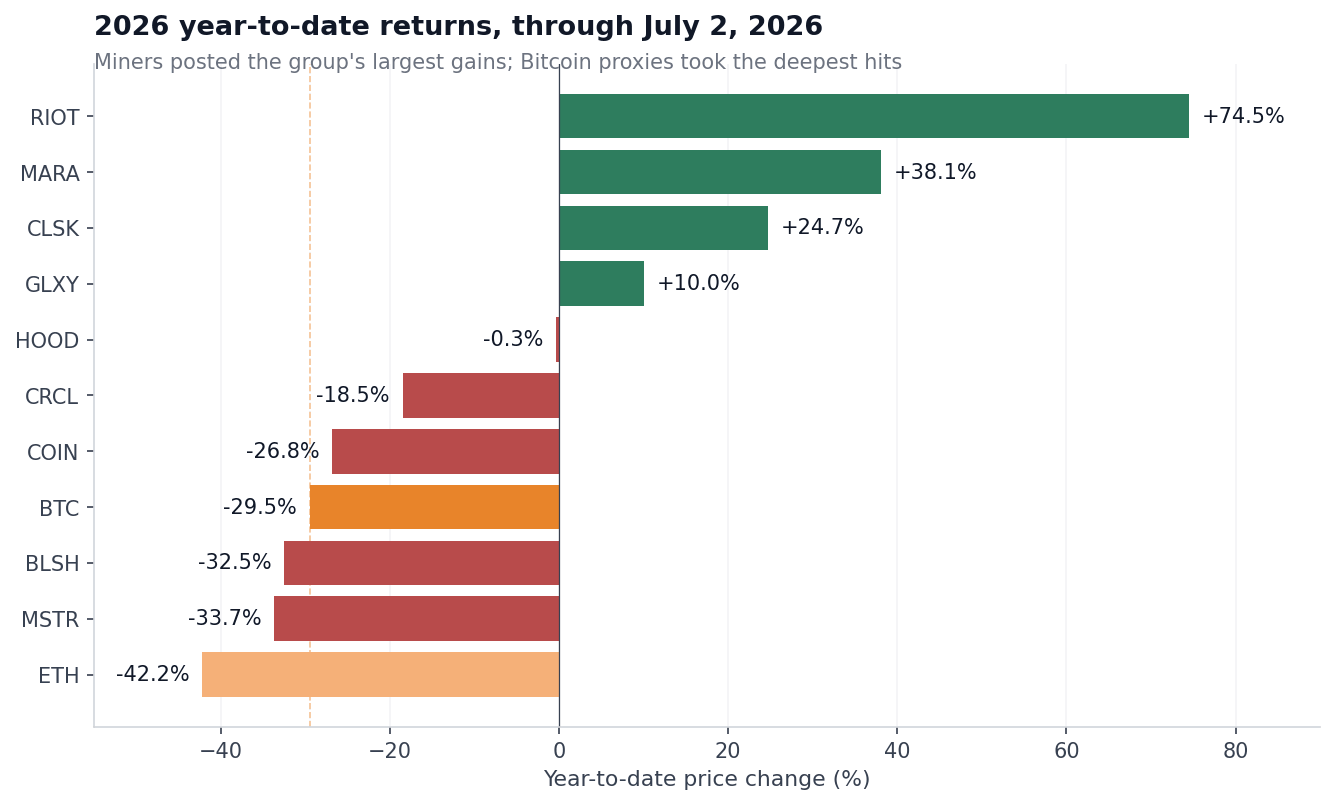
Year-to-date price changes of BTC, ETH, and nine cryptocurrency stocks listed in the US
Bitcoin itself is not without volatility. Volmex's Bitcoin 30-day volatility index hit a low of 24.5 in late May, a peak of 68.7 in early February, and rebounded to 41.6 in early July. Even so, the volatility of the vast majority of crypto stocks remains doubled.
Strategy Case: Equity Structure Brings Additional Risks
Holding Bitcoin only requires bearing the risk of price fluctuations; buying crypto-related public company stocks also adds multiple variables such as corporate operations, equity dilution, disappearance of valuation premiums, financing pressure, and capital structure changes.
Strategy recently exposed all hidden dangers within a month. At the end of June, its market-to-net asset value multiple (mNAV) fell below 1 for the first time; this indicator measures the company's total valuation against its net assets. A multiple below 1 means the market's valuation of the entire company is less than the value of the cash and Bitcoin it holds. As disclosed by June 22, Strategy held 847,363 Bitcoins; on the day mNAV fell below 1, this batch of Bitcoins was worth about $50 billion.
mNAV greater than 1 is the foundation of Strategy's entire growth flywheel. In the past, the company could issue common stock and preferred stock at a premium, raise funds, and continue to increase Bitcoin holdings, increasing holdings per share. Once mNAV falls below 1, this cycle will erode shareholder value in reverse — issuing shares in exchange for funds to buy coins is equivalent to selling existing Bitcoin assets at a discount.
CryptoSlate reported as early as January that Bitcoin holding companies are divided into valuation premium types and discount types. At the end of June, Strategy's total market value was $29.54 billion, less than half of the peak of over $71 billion in 2024, and all four types of preferred stock fell to historical lows.
Strategy introduced a response plan, announcing a stock buyback plan of up to $1.25 billion on June 29, while authorizing the sale of Bitcoin to supplement liquidity, covering preferred stock dividends and interest on debt. A few weeks prior, the company conducted its first Bitcoin sale since 2022 on June 1, selling only 32 Bitcoins. After the news was released, the stock surged 12.6% in a single day, ending an eight-day losing streak. The world's largest Bitcoin holding enterprise actually needed to sell chips for cash flow in a bear market; this is a constraint not encountered when directly holding Bitcoin, and is also a risk unique to stocks.
This is precisely the background for ARK's counter-trend addition. On June 25, amidst a collective sharp decline in crypto stocks, Wood's fund bought $3.27 million worth of Robinhood in a single day, simultaneously adding to Coinbase, Circle, and Bullish. Wood believes Bitcoin's long-term target price is at the million-dollar level, and is currently positioning heavily discounted crypto-related public companies that have deeply corrected since the 2025 highs.
Data reveals the true face of these companies.
- Strategy = Leveraged Bitcoin + Equity Dilution Risk;
- Circle = Stablecoin Track Payment Enterprise, Deeply Embroiled in Share Competition;
- Robinhood = Comprehensive Brokerage, Crypto is Just a Side Business.
Wood buying a basket of these company stocks is essentially betting on different business model combinations; the strength of crypto exposure varies greatly among them.
Each individual stock has an independent investment logic; Coinbase outperformed Bitcoin year-to-date, Robinhood held the beginning-of-year price, and the mining company sector led overall returns. But the core question remains: is buying crypto stocks really less risky than directly holding coins?
Data from nine listed companies shows that stocks either amplify Bitcoin volatility or add corporate operating risks unrelated to coin prices.
The truly strong cryptocurrency stocks this year rely on independent growth businesses such as AI computing power, brokerage traffic, and payment products; Bitcoin is only a secondary influencing factor.
Join TechFlow official community to stay tuned
Telegram:https://t.me/TechFlowDaily
X (Twitter):https://x.com/TechFlowPost
X (Twitter) EN:https://x.com/BlockFlow_News
 @CryptoSlate