Michael Saylor: The path of Bitcoin's evolution lies in remaining unchanged.
TechFlow Selected TechFlow Selected
Michael Saylor: The path of Bitcoin's evolution lies in remaining unchanged.
Interpreting the Development Logic of Bitcoin Over the Next Ten Years.
 Navigating Web3 tides with focused insights
Author: Michael Saylor, Founder of MicroStrategy
Compiled by: Saoirse, Foresight News
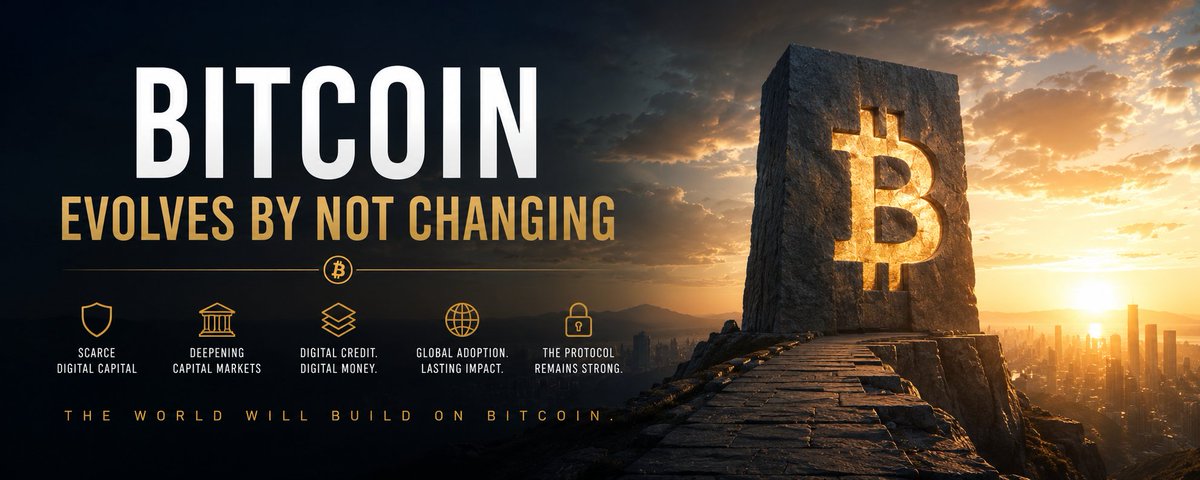
In the next decade, the most significant development and transformation of Bitcoin will not come from frequent changes at the underlying protocol layer, but from its increasingly important position across various industries globally. The underlying base layer will tend towards stability, capital markets will continue to deepen, various application scenarios will expand, various institutional investors will enter the market successively, and the entire world will build various systems based on Bitcoin.
Bitcoin is not a tech stock, not a payment company, nor a software platform that competes by stacking new features. Bitcoin is a monetary network. Its purpose is not rapid iteration or starting over, but steady operation and never collapsing. This essential difference will define Bitcoin's development path over the next decade.
Bitcoin is Digital Capital
Bitcoin has already won the first key battle. More and more people globally realize that Bitcoin is digital capital: scarce, durable, portable, divisible, programmable, and capable of global transfers.
Bitcoin's core value proposition is not 'to replace all payment channels,' but 'to become a neutral, global, scarce standard of value, around which capital, credit, and commercial activities are conducted'.
The original design intention of the underlying base layer is not for small daily payments like buying coffee, but for final clearing and settlement. Block space resources are scarce, secured jointly by energy, cryptography, economic incentive mechanisms, and network-wide consensus.
Large-scale asset clearing, corporate reserve funds, collateral settlement, and final delivery of asset ownership should all be completed on the underlying base layer. And personal consumer payments, digital banking services, lending, credit products, stable value tools, and various interest-bearing financial products will be built around Bitcoin, on top of Bitcoin, derived from Bitcoin, or implemented through institutional channels connecting to Bitcoin.
Bitcoin always maintains its original form, while the world builds myriad applications on top of it.
The Influence of the Four-Year Halving Cycle Will Continue to Weaken
The Bitcoin block halving mechanism will always be significant; it is a core component of the entire monetary system. Each halving reduces new circulating supply, further solidifying the credibility of the rule that Bitcoin's total supply is 21 million coins.
But the four-year halving cycle can no longer dominate Bitcoin's overall trend.
Nowadays, Bitcoin's institutionalization and globalization are extremely high, liquidity is sufficient, and it is deeply integrated into global capital markets. Narratives relying simply on retail cycles can no longer explain its market changes. The total supply on the supply side continues to shrink, while the structure on the demand side undergoes a fundamental shift.
In the next decade, Bitcoin's price trend will be less affected by miners' new output and more determined by various capital flows: ETF fund inflows and outflows, corporate treasury allocations, national sovereign reserve adjustments, bank credit funds, derivatives trading funds, insurance funds, collateral funds, structured credit funds, and global savings funds.
Halving tightens supply; capital flows determine long-term growth trends.
The next stage of Bitcoin adoption is no longer just more retail buying, but balance sheets across various industries starting to allocate Bitcoin.
Digital Credit Accelerates Bitcoin Adoption
Bitcoin is digital capital, and digital credit is the bridge connecting this digital capital to the global broad financial system.
Capital markets need maturity matching, yield products, credit tools, collateral assets, maturity transformation, risk management, and various yield-based financial products. Bitcoin itself provides the world with a better capital carrier; financial products secured by Bitcoin allow this digital capital to circulate in the global economy.
Digital capital converts into digital credit, digital credit derives digital currency, and digital currency becomes the interaction interface between Bitcoin and the global economy.
This system will not weaken Bitcoin, but rather strengthen Bitcoin's value.
In the past, when banks, capital markets, credit tools, and settlement systems developed around gold, the practical value of gold increased significantly; when mortgage loans, real estate investment trusts, asset securitization, insurance, and credit markets emerged around real estate, the financial attributes of property were fully amplified; when stocks were paired with exchanges, index funds, derivatives, margin trading, and custody networks, liquidity and usage scenarios expanded exponentially.
Bitcoin will replicate this development path, and relying on the global digital network, the development speed will be far faster than the former.
The next wave of Bitcoin adoption will no longer be limited to individual investors buying. Individuals, enterprises, banks, funds, insurance companies, pensions, sovereign entities, and credit markets will all use Bitcoin as a capital asset.
Various Interaction Interfaces Will Become the Main Battlefield of Industry Competition
Everyone recognizes Bitcoin's unique value attributes, but everyone's way of interacting with Bitcoin differs.
Some people custody private keys themselves, some hold Bitcoin ETFs, some hold Bitcoin through banks, some corporate entities hold Bitcoin directly, some use Bitcoin as collateral, some hold credit products secured by Bitcoin, and some use digital currency issued based on the Bitcoin credit system.
All the above interaction channels have value, but there are essential differences between them. Self-custody of private keys protects asset sovereignty; institutional custody lowers the threshold for ordinary people to participate; ETFs simplify the asset allocation process; banks create credit products based on Bitcoin; enterprises issue related securities; miners are responsible for ensuring network security; network-wide nodes execute underlying rules; holders complete capital allocation.
The core contradiction of the industry in the next decade does not lie in whether Bitcoin can survive — Bitcoin has already established itself. The real core contradiction is: whether all financial exposures linked to Bitcoin in the market correspond to real Bitcoin assets; or whether the global financial system will create a large amount of 'paper Bitcoin' without physical support out of thin air.
Custody mechanisms, asset transparency, proof of reserves, risk management, capital structure, counterparty risk, each item is crucial.
Even if the peripheral financial system breeds large amounts of leverage and information opacity, thereby triggering periodic crises, the Bitcoin underlying protocol itself remains robust. Bitcoin cannot eliminate human operational errors, but it will clearly expose various risks to the market.
The Threshold for Underlying Protocol Modifications Will Continue to Rise
Bitcoin's 'immune system' is the strict network-wide consensus mechanism. This is not its shortcoming, but precisely the core source of Bitcoin's value.
Transaction fees determine the cost of using block space; network-wide nodes set network rules; miners are responsible for packaging blocks; holders allocate capital resources; any changes to the underlying protocol require unified consensus from the vast majority of network participants.
The most important characteristic of Bitcoin is not that it can be easily upgraded and iterated, but that it cannot be tampered with at will.
In the next decade, Bitcoin's underlying base layer will become more conservative, and protocol modifications will require stronger evidence. Any modification proposal that brings systemic risk, weakens decentralization attributes, destroys the integrity of monetary rules, expands the policy attack surface, or triggers unpredictable negative consequences will be resisted by the entire network.
This conservative trend is a benign development for the entire network. Improvement ideas with defects should be rejected before becoming protocol changes.
Innovation will not stop, but will all shift to the peripheral ecosystem: wallets, custody services, Lightning Network, sidechains, layered protocols, institutional clearing systems, collateral systems, digital credit, and digital currency fields will continue to iterate and innovate.
The underlying base layer will become the ultimate carrier for final clearing of global assets.
The future of Bitcoin depends on whether the global market can carry out various innovations around it without damaging the underlying protocol itself.
The Mining Industry Will Transform into Global Energy Infrastructure
The Bitcoin mining industry will become increasingly specialized and institutionalized, deeply bound with the global energy market.
Mining is the link between digital security and physical energy; it converts electricity into network monetary security guarantees, creating a global energy consumption market that can be flexibly located, shut down on demand, and constrained by economic laws.
The core competitiveness of top mining enterprises is no longer just owning high-performance mining machines, but holding high-quality power contracts, healthy capital structures, mature fund reserve strategies, stable power grid cooperation relationships, and the ability to monetize power resources during violent energy price fluctuations.
As block mining subsidies continue to decrease, the importance of transaction fees will continue to rise, and the value of block space will rise with the tide. The mining industry will depart from the niche geek technology track and transform into an energy infrastructure and capital market supporting industry with strategic significance.
Bitcoin mining on one hand ensures network security, on the other hand stabilizes energy demand, digests idle and abandoned power resources, and simultaneously promotes global discussions on the deep connection between currency and energy.
Existing Risks Are Real and Cannot Be Ignored
The biggest risk for Bitcoin is not disappearing completely.
There are five types of real core risks: improvement plans with vulnerabilities destroying the underlying protocol, custody institutions blurring real asset reserves, high leverage distorting Bitcoin pricing, and national regulatory bodies controlling various Bitcoin interaction channels:
First, the underlying protocol is destroyed. The integrity of the Bitcoin monetary system is maintained by strict consensus; underlying modifications must be extremely rare, undergo comprehensive and rigorous review, and achieve overwhelming network support to be implemented.
Second, proliferation of paper Bitcoin. If the total amount of Bitcoin claims issued by intermediary institutions far exceeds the actual circulating Bitcoin quantity, the market will erupt in periodic credit crises. The underlying protocol itself will not collapse, but investors will suffer huge losses due to high leverage, information opacity, and re-pledging.
Third, custody business moves towards centralization. If the vast majority of users hold Bitcoin through a few banks, exchanges, funds, or applications, Bitcoin itself remains scarce, but user participation channels will continue to be limited, facing permission controls everywhere.
Fourth, regulatory capture risk. National governments cannot modify Bitcoin underlying code, but can regulate exchanges, brokers, custody institutions, miners, banks, tax declarations, energy access, and other upstream and downstream supporting links.
Fifth, uncertainty exists in the development of the fee market. After block subsidies continue to decline, Bitcoin needs a long-term stable, high-value fee market to support network longevity security. I believe that when Bitcoin becomes a global mainstream clearing collateral, this fee market will take shape, but the development process will not be smooth.
All the above risks will not render Bitcoin completely invalid, but merely point out the core problems the industry needs to solve in the future.
Outlook for the Next Decade
By 2036, I expect Bitcoin holders will have a wider range, institutional participation will be deeper, influence at the global political level will increase, deeply integrated into the global financial system, and at the same time network participants will more actively defend Bitcoin underlying rules.
It will become a globalized digital capital standard; become reserve assets for individuals, enterprises, funds, banks, and national sovereign entities; become the core collateral asset in the digital credit market; complete final delivery and clearing of large-scale assets relying on the underlying layer; become the value anchor for various new digital currencies; support a complete ecosystem of continuously expanding credit, yield products, derivatives, insurance, custody, and structured financial products.
And the underlying base protocol, the magnitude of changes will be far smaller than all applications and financial systems built on its periphery. This is Bitcoin's paradox.
The world needs digital capital, needs digital credit, and will also generate massive demand for digital currency in the future; the global market will build a new financial system around Bitcoin.
But Bitcoin's own mission is not to encompass all financial functions. Bitcoin's core mission is to become that immutable value cornerstone.
Join TechFlow official community to stay tuned
Telegram:https://t.me/TechFlowDaily
X (Twitter):https://x.com/TechFlowPost
X (Twitter) EN:https://x.com/BlockFlow_News
 @saylor