
Research Report Analysis: MRVL’s Optical AI Is Taking Off—Why Does Morgan Stanley’s Star Analyst Choose to Hold Despite High Valuation?
TechFlow Selected TechFlow Selected
Research Report Analysis: MRVL’s Optical AI Is Taking Off—Why Does Morgan Stanley’s Star Analyst Choose to Hold Despite High Valuation?
Those holding MRVL stock—or searching for investment targets along the AI chip and optical interconnect value chain—should consider the logic behind this contrarian viewpoint.
 Navigating Web3 tides with focused insights
Author: Rita
TideResearch Introduction
On May 28, Morgan Stanley analyst Joseph Moore updated his research report on Marvell (MRVL). Marvell had just delivered a record-breaking quarterly report, and management significantly raised its full-year outlook—prompting near-unanimous bullish sentiment on Wall Street. Moore is among the few who did not follow suit, maintaining a “Peer Weight” (neutral) rating while raising his price target from $172 to $195—both adjustments remaining below the then-current stock price. He acknowledges that the AI opportunity is real—but argues the current valuation already fully prices it in. Investors holding MRVL or searching for exposure along the AI chip and optical interconnect value chain would do well to understand the logic behind this contrarian view. Below is our concise summary and analysis.
Three Key Takeaways
① Record quarterly results and a sharply upgraded full-year outlook. For the quarter ended April 2026 (Marvell’s fiscal year 2027 Q1), revenue totaled $2.418 billion, up ~28% year-on-year and slightly above consensus expectations of $2.406 billion. EPS came in at $0.80, matching expectations. More importantly, forward guidance was substantially strengthened: Management raised its FY27 full-year revenue outlook to ~$11.5 billion (~40% growth), and further lifted FY28 revenue to ~$16.5 billion (~45% growth). Next-quarter revenue guidance has a midpoint of $2.7 billion, representing ~35% YoY growth and ~$100 million above consensus.
② Moore maintains neutral because the stock price already reflects growth. His $195 price target implies a ~40x multiple on calendar-year 2027 estimated EPS (including share-based compensation expenses). Moore compares Marvell directly with his top pick, NVIDIA: both stocks trade near similar levels (~$198 vs. ~$212), yet NVIDIA’s next fiscal-year EPS is expected to be ~$13—more than double Marvell’s ~$6. Moore contends that for Marvell to sustain this valuation, investors must see continued EPS upgrades, concrete evidence of market share gains in networking, or clear confirmation of large-scale custom chip shipments—none of which have materialized yet.
③ Two AI growth engines: one sprinting, one climbing. The sprinter is optical interconnects. Moore raised his FY27 growth forecast for this segment from ~50% to over 70%, with the optical module product line expected to reach an annualized run rate of $1 billion in the coming quarters. The climber is custom AI chips (ASICs designed specifically for cloud providers). Moore’s confidence in FY28 is rising—but a major new customer won’t begin volume production until FY28, meaning no related revenue will appear this year.
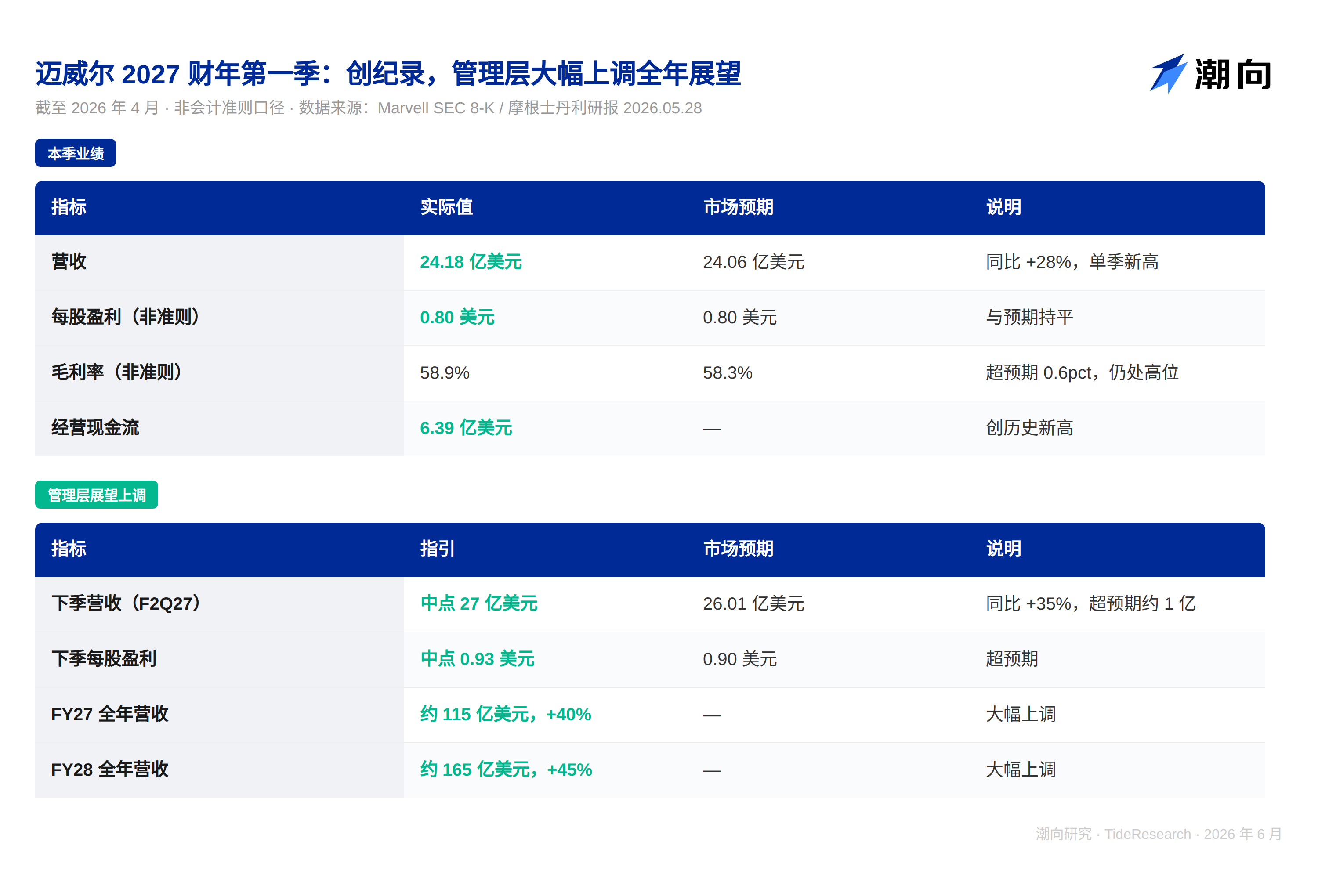
The Logic Behind “Peer Weight”: Opportunity Is Real—So Is the Price
Moore does not dispute Marvell’s AI opportunity—he has upgraded all three growth drivers. His concern lies solely in the stock having already raced ahead of fundamentals.
This 40x forward EPS multiple rests on several simultaneous assumptions needing validation: sustained ramp-up in optical interconnects, transition of custom chips from early ramp to mass-volume shipment, and stabilization of storage and enterprise business. If any one of these falters, the valuation becomes unsustainable.
In his report, Moore explicitly benchmarks Marvell against NVIDIA. Though their stock prices are comparable, NVIDIA’s next fiscal-year EPS is more than twice Marvell’s—meaning investors pay roughly the same price for markedly less earnings power. This disparity forms one of Moore’s core rationales for neutrality.
Where Marvell Fits in the AI Stack
Marvell does not build GPUs. Instead, it builds the infrastructure that moves data between GPUs and across server racks. As AI training clusters scale, the volume of data exchanged between chips grows exponentially—making high-speed optical interconnects increasingly critical. This is Marvell’s strongest and most visible segment today: Moore expects the optical module product line (acquired via Inphi) to hit a $1 billion annualized run rate within the next few quarters. Another growth vector is intra-cluster “scale-up” optics, projected to expand from ~$150 million to over $300 million.
The second growth pillar is custom chips. Cloud providers seeking reduced reliance on single GPU vendors engage Marvell to design proprietary AI ASICs. Moore’s confidence in FY28 is increasing, driven by three factors: existing custom chip business, associated sales of complementary products, and a new major customer scheduled to enter volume production in FY28—though this revenue remains invisible this year.
Conversely, storage, enterprise data centers, and legacy networking remain under inventory correction pressure—with no near-term catalysts for recovery.
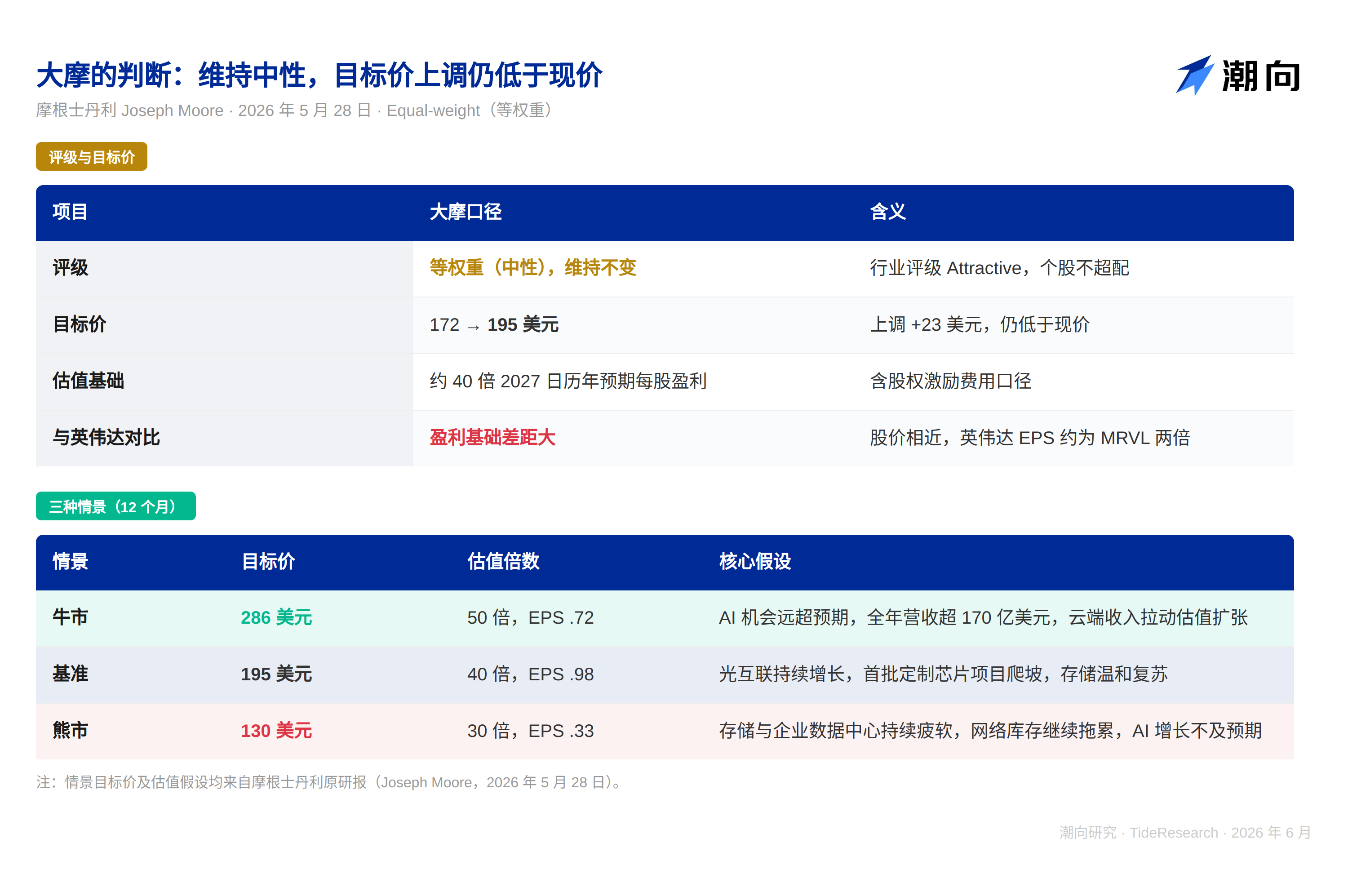
What Morgan Stanley Is Betting On—and What It’s Not
Morgan Stanley is betting that Marvell’s optical interconnect thesis holds—and that AI data center demand remains robust. Its upward revision to the price target and long-term outlook reflects this conviction. What it is *not* betting on is additional upside in the current stock price—hence Moore’s choice of “Peer Weight” rather than “Overweight.”
Three key signals warrant close monitoring: (1) whether the optical module product line hits its $1 billion annualized run rate within the next few quarters; (2) whether the new major customer’s custom chip program achieves smooth volume ramp in FY28; and (3) when signs of recovery emerge in storage and enterprise businesses. A shortfall in any one of these would necessitate a reassessment of the 40x valuation.

This article is TideResearch’s summary and interpretation of a third-party brokerage research report. All referenced ratings, price targets, earnings forecasts, and related judgments reflect the views of the cited analyst and represent only the stance of their affiliated institution—not TideResearch’s position—and do not constitute investment advice.
Please note three points when reading: First, price targets reflect analysts’ expectations over approximately the next 12 months—they are forecasts, not guarantees—and subject to repeated adjustment based on performance and market conditions. Second, sell-side research reports are inherently biased toward optimism, and some covered companies may have investment banking relationships with the issuing firm. Third, the true value of a research report lies in its core thesis and underlying assumptions—not in any single price target. Focus on the logic—not just the number.
Markets carry risk; decisions must be made independently. This article should not serve as the basis for buying or selling any security.
Data sources: Marvell FY27 Q1 Earnings Report (SEC Form 8-K) · Morgan Stanley Research Report (Joseph Moore, May 28, 2026) · Public Analyst Ratings Aggregators (MarketBeat, GuruFocus, Benzinga)
TideResearch · 2026 June
Join TechFlow official community to stay tuned
Telegram:https://t.me/TechFlowDaily
X (Twitter):https://x.com/TechFlowPost
X (Twitter) EN:https://x.com/BlockFlow_News
 @BlockFlow_News