Day 2 after its IPO, SpaceX surged nearly 20%, with its valuation reaching $2.5 trillion
TechFlow Selected TechFlow Selected
Day 2 after its IPO, SpaceX surged nearly 20%, with its valuation reaching $2.5 trillion
The next two days require close attention.
 Navigating Web3 tides with focused insights
By Ye Zhen
Source: WallStreetCN
On its second trading day, SpaceX’s stock continued its strong debut performance, pushing its market capitalization past the $2.5 trillion mark and officially placing it among the world’s top six most valuable publicly listed companies. This unprecedented mega-IPO—combined with an extremely low initial free float—is triggering a rare “chip博弈” (chip博弈 refers to a battle for limited tradable shares) across global capital markets.
SpaceX closed Monday at $192.46—a nearly 20% surge—and rose over 42% above its $135 IPO price, adding $412 billion to its market value in a single day.
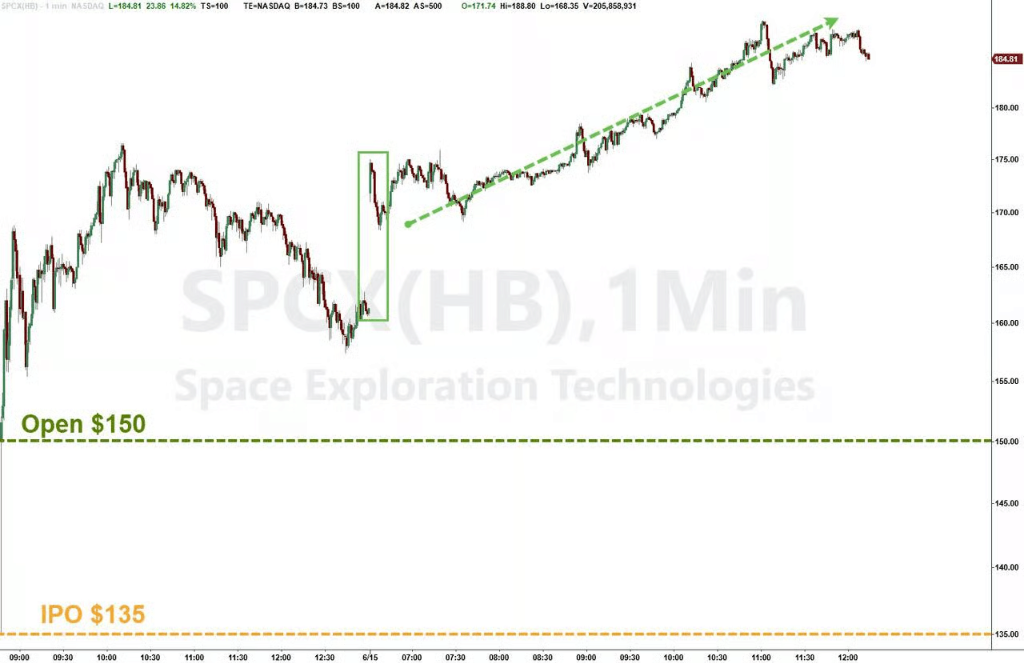
After underwriters fully exercised their overallotment option (“green shoe”), the company raised a total of $86.2 billion, netting $85.7 billion after underwriting fees. This robust market performance not only directly bolsters investor confidence in the AI sector—which has driven this year’s market rally—but also sets the tone for a broader revaluation of tech giants.
Frenzied market demand has made founder Elon Musk the world’s first trillionaire, with his net worth now exceeding that of Larry Page—the world’s second-richest person and co-founder of Google—by more than threefold. This successful listing significantly alleviates Wall Street’s concerns about the market’s capacity to absorb mega-IPOs and paves the way for potential listings later this year by major AI competitors such as Anthropic and OpenAI.
However, despite the strong start and anticipated passive buying pressure, market observers warn that volatility is set to spike sharply over the coming months. Within this meticulously engineered Wall Street capital feast, investors must closely monitor two critical upcoming dates in July—not only because they represent a collision between massive passive inflows and a “share vacuum,” but also because they may catalyze a far larger consolidation strategy within Musk’s business empire.
Retail Buying Frenzy Resonates With Macro Environment
During the first two trading days post-listing, retail investor enthusiasm was exceptionally high.
According to Vanda Research, the volume of SpaceX shares purchased by retail investors over those first two days matched the entire U.S. retail buying volume for the prior week. Max Gokhman, Senior Vice President of Investment Solutions at Franklin Templeton, noted that significant pent-up demand had accumulated outside the market from investors previously unable to access SpaceX shares—making this initial surge unsurprising.
Beyond micro-level capital inflows, macro-level geopolitical and liquidity conditions have also supported the stock’s sharp rise.
With the U.S. and Iran announcing an agreement to reopen the Strait of Hormuz—and growing market expectations that the Federal Reserve, under new Chair Kevin Warsh, may adopt a moderately dovish stance—the S&P 500 and Nasdaq-100 indices both posted substantial gains. Angelo Kourkafas, Senior Global Investment Strategist at Edward Jones, stated that the macro backdrop is becoming increasingly favorable, and falling yields could encourage investors to continue moving further out along the risk curve.
July 7: Nasdaq Inclusion Meets Extremely Low Float
As the initial listing euphoria begins to cool, the market approaches its first highly trade-sensitive milestone: July 7.
Former Wall Street analyst Alexandra Mertz pointed out that SpaceX’s newly issued Class A shares account for just 4.3% of its total market capitalization—meaning its initial free float is extraordinarily tight.
July 7—the first trading day after Independence Day—and the 15th trading day since listing, marks the official inclusion of SpaceX into the Nasdaq-100 Index. According to Bloomberg, index rebalancing forecaster Intropic estimates that, given major indices’ plans for rapid inclusion, passive investors’ share of the free float will jump to roughly 30% after 15 trading days.
At that point, large index funds—including Vanguard CRSP and FTSE Russell—will be obligated to passively build positions in the open market, per their free-float adjustment mechanisms. Market estimates suggest this passive buying could range from $8 billion to $18 billion. Meanwhile, early insiders remain subject to lockup restrictions and cannot sell, driving the free float to its lowest possible level.
Analysts warn that the direct collision between nationwide passive buying and historically minimal free float—amplified by AI-driven forecasts—could trigger extreme upside price action during this period.
Late July: Real Selling Pressure From Earnings Unlock & Institutional Floor
The second critical date falls two business days after SpaceX’s Q2 earnings call—expected in late July. While conventional IPO lockups follow simple fixed-term schedules, SpaceX’s unlock timetable is precisely tied to its Q2 earnings conference.
Market rumors suggest up to 30% of early insider shares could be unlocked following the earnings call. But Alexandra Mertz clarified that roughly half of those early insider shares belong to Musk himself—who remains subject to an absolute 366-day lockup as founder. Thus, only 10%–15% of shares are realistically poised to enter the public market.
More critically, early major shareholders exhibit very low selling intent.
Noted investor Ron Baron has explicitly stated he will not sell—and plans to add $1 billion in open-market purchases. BlackRock has likewise publicly signaled its intent to buy $5–10 billion. As Matt Kennedy, Senior Strategy Analyst at Renaissance Capital, observed, the stock has been “priced to near-perfection.” When the retail-demand rocket booster detaches, and price action becomes subject to institutional and employee unlock-related selling gravity, marginal buyers will become exceptionally important.
Capital Chessboard: $7B Tax Event & “Parity Merger” Speculation
Behind SpaceX’s precise listing architecture, Wall Street is closely tracking Musk’s personal financial calendar.
Musk must exercise stock options granted under Tesla’s 2018 compensation plan by August 15—triggering a massive $7 billion personal tax liability. Ahead of that critical deadline, higher share prices for assets under his name improve his ability to settle option exercises on a net-share basis—or secure favorable margin loans.
Market analysts have sketched out a “Goldilocks scenario”: Between the July 7 index-driven price peak and the fresh supply of unlocked shares expected at month-end, SpaceX and Tesla could announce a parity merger conducted via a “stock-for-stock” exchange. Such a public-market arbitrage mechanism would perfectly alleviate Musk’s tax liquidity pressure.
This speculation appears subtly echoed in SpaceX’s underwriter lineup. Unusually, Charles Schwab, Morgan Stanley, and JPMorgan Chase were named core underwriters for this IPO. Market observers believe awarding these institutions—historically vocal opponents of Tesla’s executive compensation plan—exceptionally generous underwriting allocations may be intended to secure their “yes” votes at Tesla’s November shareholder meeting, should a merger proposal surface.
Moreover, SpaceX’s governance structure outlined in its prospectus provides logical scaffolding for such a potential merger.
SpaceX’s Class B shares carry 10x super-voting rights, and all shareholder litigation must proceed through mandatory private arbitration—creating an ideal “founder defense fortress.” Analysts contend that legally subsuming Tesla under SpaceX’s corporate structure represents the ultimate capital solution to shield Musk’s business empire from activist investors and state-court interference.
Join TechFlow official community to stay tuned
Telegram:https://t.me/TechFlowDaily
X (Twitter):https://x.com/TechFlowPost
X (Twitter) EN:https://x.com/BlockFlow_News