Caught in domestic and external crises, is Ethereum’s adherence to a neutral path viable?
TechFlow Selected TechFlow Selected
Caught in domestic and external crises, is Ethereum’s adherence to a neutral path viable?
Ethereum’s price decline has evolved into a comprehensive test of market confidence.
 Navigating Web3 tides with focused insights
By Oluwapelumi Adejumo
Translated by Saoirse, Foresight News
As Ethereum’s native token ETH enters a mid-term downtrend, overall market sentiment has sharply deteriorated. According to blockchain analytics platform Santiment, discussion volume around ETH surged across the network in May—but the prevailing tone was overwhelmingly negative, with investors increasingly concerned about further price declines.
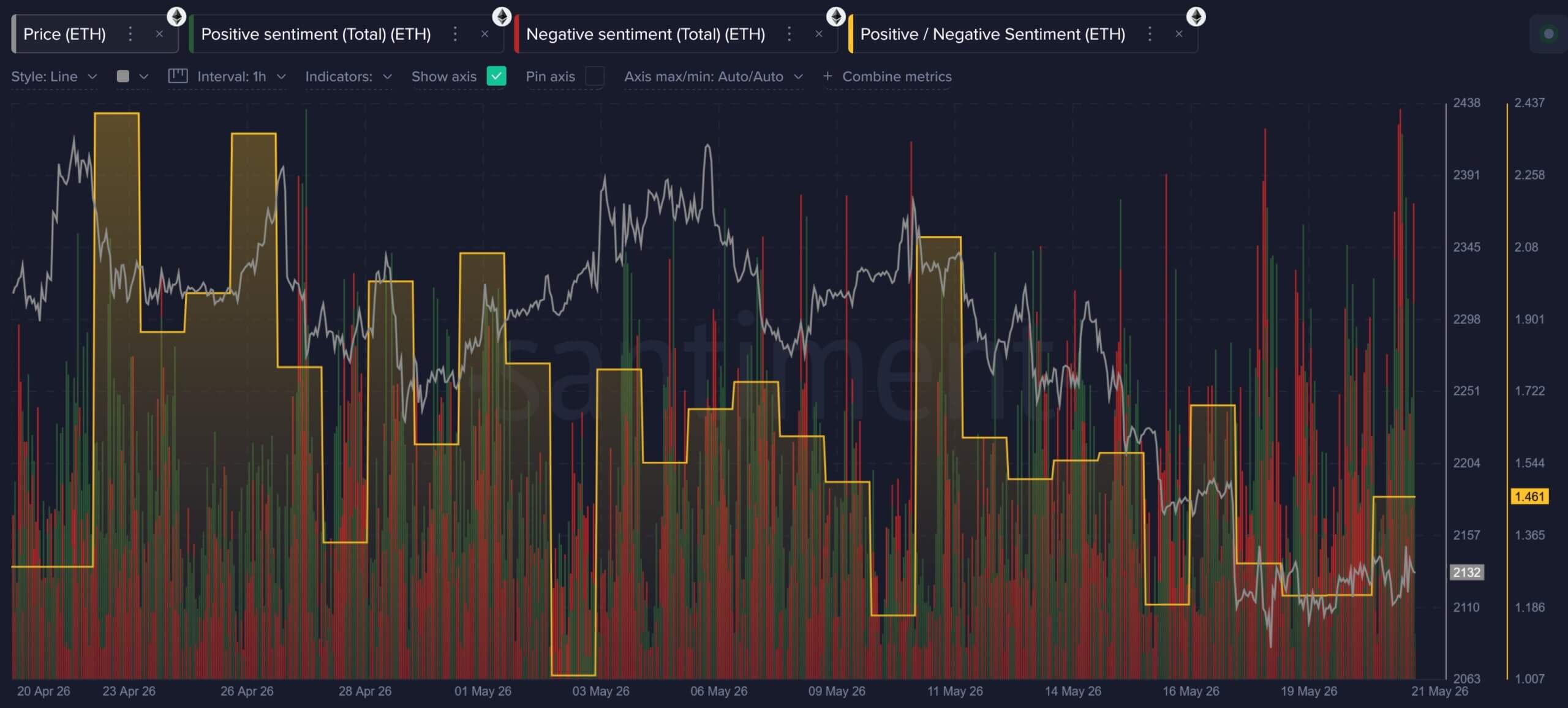
Ethereum Market Sentiment (Source: Santiment)
Analysts point to a confluence of bearish catalysts intensifying downward pressure: weak spot price action, continuous outflows from ETH ETFs, departures of core personnel from the Ethereum Foundation, public skepticism voiced by long-standing community supporters, and growing competitive strength from peer layer-1 blockchains—including Hyperliquid, Zcash, and Solana.
CryptoQuant’s broader market data further confirms a marked cooling in institutional investment enthusiasm. ETH’s current price is approaching the critical $2,000 support level, while both spot market dynamics and fundamental indicators signal pronounced weakness.
Ethereum’s underperformance relative to the broader crypto market is stark: its ETH/BTC exchange rate has fallen to approximately 0.02758—the lowest in ten months—indicating ETH has significantly lagged behind Bitcoin in this cycle. Spot investors continue reducing holdings, market liquidity is contracting, and major institutions have largely halted new purchases.
Persistent Spot Selling, Absence of Effective Buying Support
Institutional ETH holdings have declined steadily over the past two quarters. Institutional holdings peaked above 7 million ETH in October 2025 but have since retreated to roughly 5.5 million ETH. Major investment firms have been trimming core positions amid prolonged price weakness.
The regulated ETF market faces similar headwinds. Total assets under management (AUM) for ETH ETFs currently stand at approximately $12.14 billion—down 23% from their January peak. Per SoSoValue data, May’s market conditions were particularly severe: ETFs recorded net outflows for two consecutive weeks, totaling roughly $470 million—the most intense capital flight phase of the year so far.
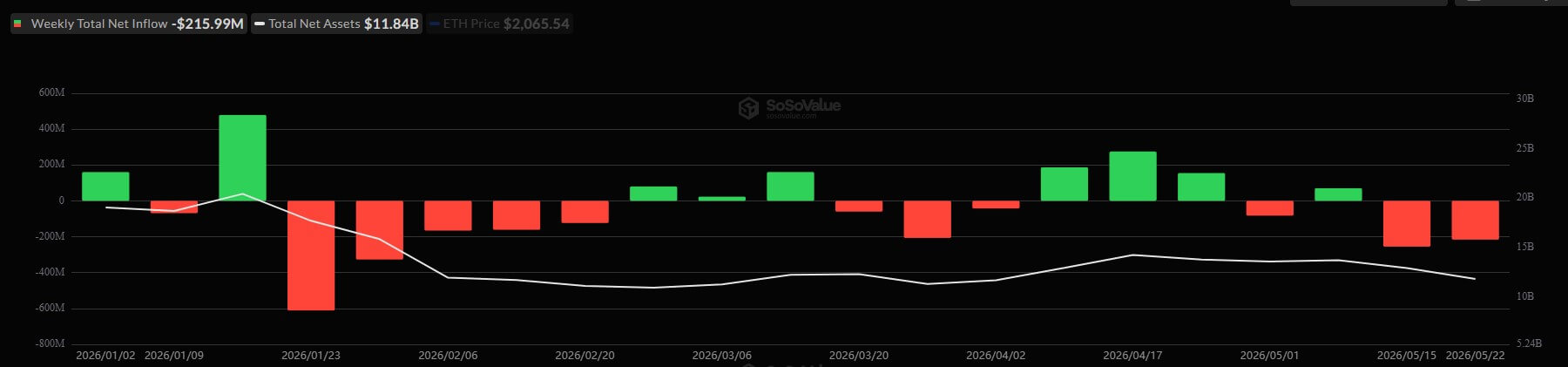
Weekly ETH ETF Net Flows (Source: SoSoValue)
The Coinbase Premium Index remains persistently negative, signaling that U.S. institutional investors have lost appetite for spot ETH purchases. As institutional holdings shrink, ETH market liquidity tightens in tandem. Since February 2026, average daily institutional trading volume has trended lower—well below its one-year average—with recent daily volumes hovering between $17 million and $42 million.
Market willingness to “buy the dip” has waned, and spot trading activity remains subdued. In this environment, negative news triggers heightened price volatility.
Rising Hedging Activity in Options Markets, Yet Futures Longs Hold Firm
While spot selling intensifies, derivatives markets show deep divergence on ETH’s outlook—experts remain divided on whether ETH has entered a sustained bear market or is nearing a bottom.
Professional traders are aggressively purchasing put options as hedges, yet perpetual futures markets retain substantial long positions—revealing a stark contrast between risk-averse and bullish sentiment. Block Scholes data shows ETH’s 7-day 25-delta risk reversal skew sits near -7%, indicating traders are willing to pay a premium for downside protection.
Deribit data reveals total open interest in $2,000 and $2,100 strike put options has surpassed $380 million—making these two levels focal points for short-term institutional positioning.
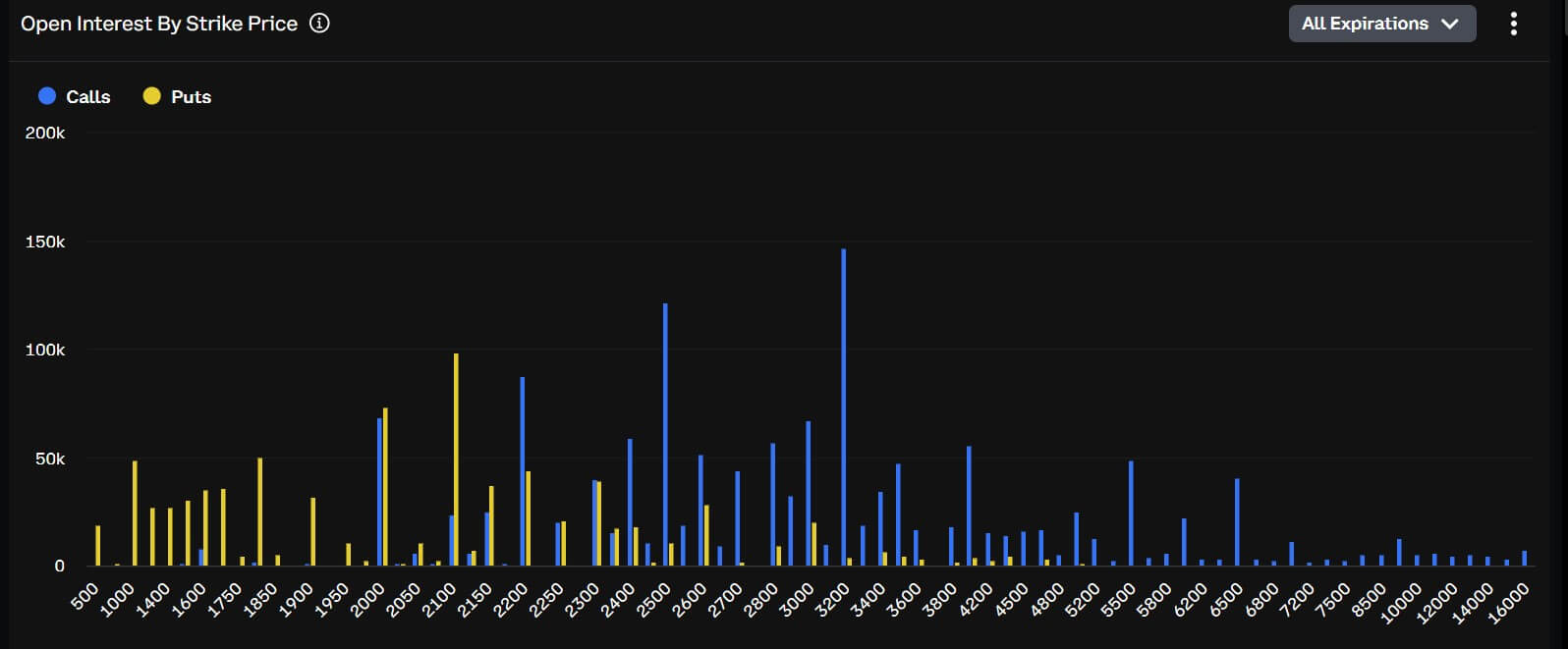
ETH Options Open Interest Distribution (Source: Deribit)
Interpretation: Heavy put option positioning suggests broad consensus expects continued weakness. With price already breaking below the $2,100 support level, risk appetite continues eroding—and absent spot buying demand, market participants rely heavily on hedging to manage exposure.
Perpetual futures signals are more complex. CryptoQuant reports ETH’s funding rate has remained stably positive, reaching 0.0082 on May 21. Despite declining market cap, reduced institutional holdings, and shrinking spot volume, speculative long sentiment hasn’t fully dissipated.
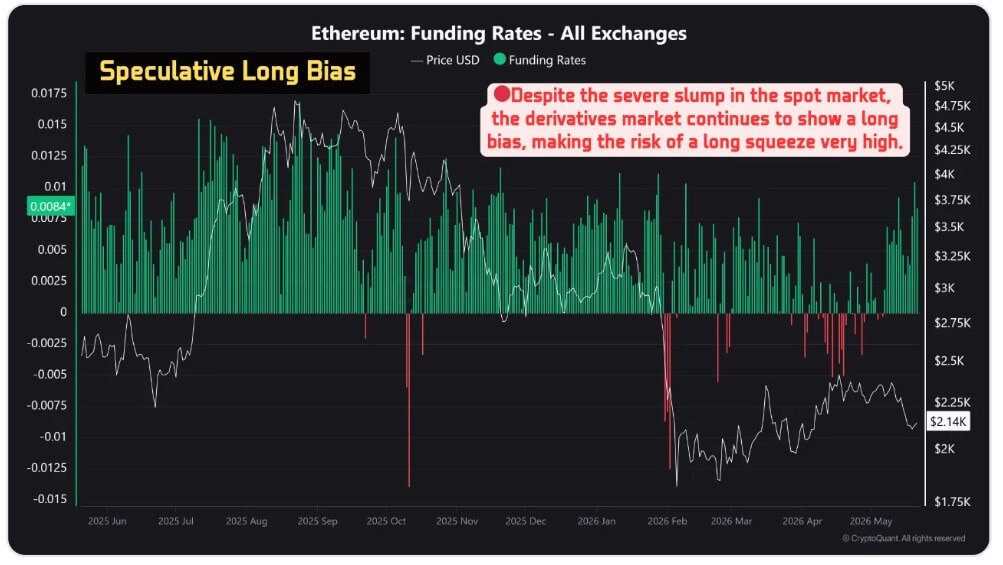
ETH Funding Rate (Source: CryptoQuant)
This polarity between bulls and bears injects significant uncertainty into price action. A sudden resurgence in spot buying could trigger a short squeeze rally; conversely, a break below the critical $2,000 support level risks cascading liquidations, amplifying volatility.
Core Talent Exodus Intensifies Debate Over Ethereum’s Value Proposition
Amid weakening price performance, the Ethereum Foundation—the Swiss nonprofit overseeing Ethereum’s underlying development—is undergoing sweeping senior leadership changes.
Senior researchers Carl Beek and Julian Ma have officially departed, sparking internal organizational turbulence. Beek, who spent seven years at the Foundation, led Beacon Chain design; Ma developed the lab’s oversight incentive framework.
Since February, at least nine senior staff members have either resigned or stepped back from core roles—including five departures just in May: former Co-Executive Director Tomasz Stańczak, Board Co-Chair Josh Stark, protocol contributor Trent Van Epps, Protocol Lead Barnabé Monnot, and Tim Beiko. Senior researcher Alex Stokes has also taken a three-month sabbatical. During this market downturn, reductions in core technical staff have created gaps in technical leadership.
Industry analysts attribute this exodus to the Foundation’s 38-page strategic manifesto released in mid-March. The document codifies four foundational principles—Censorship Resistance, Open-Source Deployment, Privacy Preservation, and Base-Layer Network Security (collectively termed CROPS).
It explicitly defines the Foundation’s role as an ecosystem steward—not a commercial operator—with core responsibilities focused on preserving network neutrality, rather than boosting token price, maximizing investor returns, or driving business expansion.
As rival blockchains aggressively capture market share, the Foundation’s steadfast neutrality is becoming increasingly difficult to reconcile with market expectations. Tommy Shaughnessy, Co-Founder of venture firm Delphi Ventures, notes the negative impact of talent loss runs deeper than surface appearances: with reform-minded members departing, internal challenges to the current strategic direction have effectively vanished.
Mounting Calls for Reform, Neutrality Model Faces Existential Test
Many departing core contributors criticize the Foundation’s insufficient commercialization efforts and advocate governance restructuring. Dankrad Feist—a prominent researcher who left the Foundation last year to join an emerging L1 project—has publicly proposed establishing a new, independent entity to bolster Ethereum’s economic competitiveness.
He recommends seeding the new institution with at least $1 billion in initial capital—partially sourced from network staking yields. This body would report directly to token holders, with its primary mandate being to expand ETH’s real-world commercial use cases and drive token value appreciation.
Feist highlights that the Ethereum Foundation holds less than 0.1% of circulating ETH, disqualifying it from capturing base-layer staking rewards or on-chain transaction fees. Consequently, the entire ecosystem lacks a professional, well-resourced organization actively promoting ETH in capital markets.
Ryan Sean Adams, Co-Founder of media outlet Bankless, concurs. He argues Ethereum’s growth cannot rest solely on the Foundation. The ecosystem requires a well-capitalized, highly competitive institution dedicated to optimizing capital efficiency, articulating value propositions externally, and executing commercial projects—functions squarely outside the Foundation’s mandate.
Proposals for reform do not call for abolishing the existing Foundation. Instead, they advocate a dual-institution model: one upholding the original mission—preserving base-layer neutrality and building public infrastructure—and another laser-focused on token promotion and institutional capital acquisition.
Bullish investors contend the market is overreacting to short-term volatility and misinterpreting personnel turnover as instability. Ryan Berckmans, an investor, observes that talent rotation is a natural part of healthy team evolution. Ethereum has previously navigated regulatory scrutiny and leadership transitions smoothly—while delivering landmark technical upgrades including The Merge and blob transactions—and retains top-tier on-chain application asset volume. Global enterprises continue deploying stablecoins and tokenized assets, providing enduring long-term tailwinds.
Major institutional holders remain optimistic. Thomas Lee, Chairman of BitMine—the publicly traded company holding the largest ETH position—views current market panic as a normal cyclical correction. BitMine holds 5.2 million ETH, with over $10 billion in assets staked.
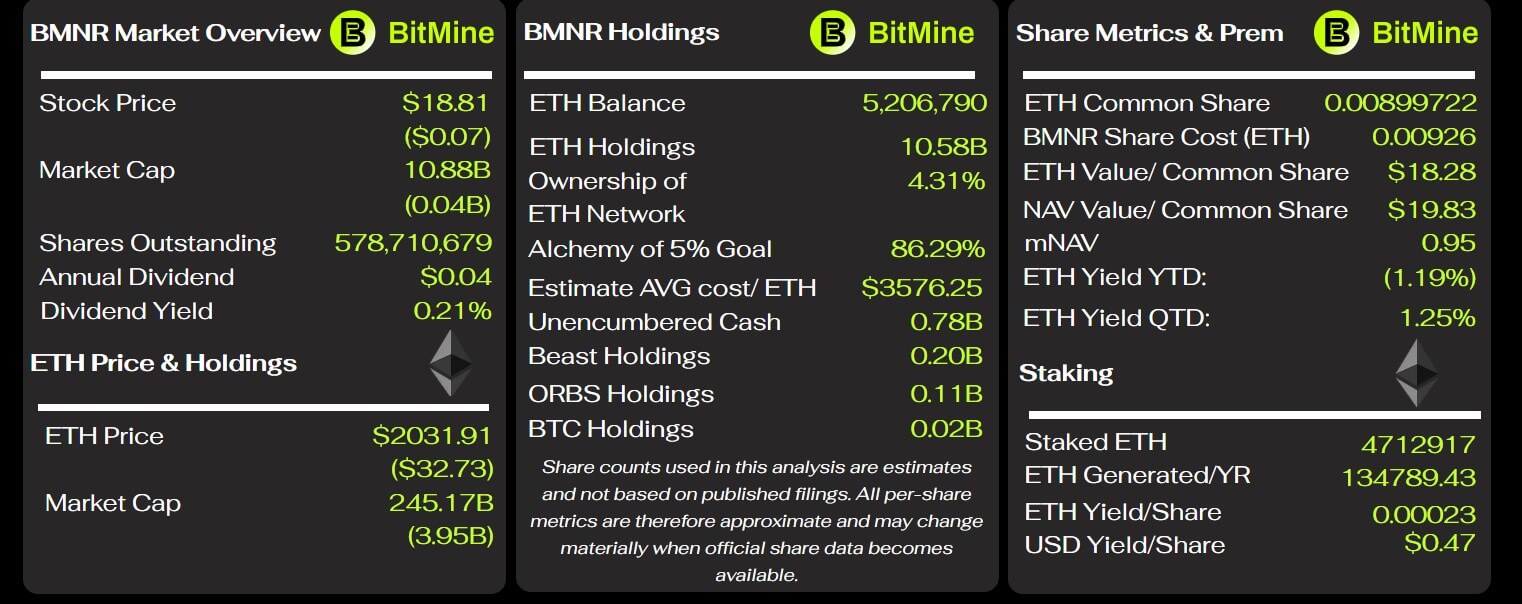
BitMine Key Metrics (Source: BitMine Tracker)
Lee emphasizes that blockchains serve as foundational infrastructure for AI-driven commercial systems and institutional financial settlement. Ethereum’s mature security architecture, abundant market liquidity, and broad institutional recognition continue to deliver irreplaceable competitive advantages.
Rebuilding Momentum: How Ethereum Can Regain Its Uptrend
Industry insiders stress that Ethereum’s future trajectory hinges on translating its technical roadmap and competitive moats into a compelling investment thesis. Galaxy Digital analysts note that halting capital outflows requires disciplined execution of operational plans.
Near-term priorities include successfully launching the Glamsterdam upgrade, advancing the subsequent Hegotá version, clarifying internal governance responsibilities, and concentrating resources on high-potential commercial verticals—particularly high-value DeFi, institutional asset issuance, real-world asset tokenization, stablecoin settlement, and privacy-preserving financial infrastructure. Ethereum’s neutrality and security will remain central advantages in these domains.
Simultaneously, Ethereum must accelerate development in next-generation thematic areas—including L1 scalability, on-chain privacy, post-quantum security, and AI-native economic frameworks. Related technical frameworks are already documented in the open-source R&D roadmap; the key challenge now lies in coordinating commercial entities and institutional stakeholders toward shared goals.
While the Foundation’s charter clearly defines base-layer R&D principles, it offers no explicit roadmap for token value creation—and lacks a dedicated operational body to counter competitive threats.
This price decline transcends mere cyclical correction—it represents a profound test: Can decentralized systems rationally allocate commercial functions while maintaining stability and adjusting institutional roles?
If the ecosystem leverages leadership transitions to clarify accountability and convert technical vision into tangible investment value, this trough may catalyze governance optimization. Conversely, failure to adapt—amid persistent spot weakness, recurring talent attrition, and shifting competitive dynamics—risks eroding market confidence in Ethereum’s ability to sustain its token’s fundamental value.
Join TechFlow official community to stay tuned
Telegram:https://t.me/TechFlowDaily
X (Twitter):https://x.com/TechFlowPost
X (Twitter) EN:https://x.com/BlockFlow_News
 @CryptoSlate