a16z: The Next Target for AI-Native Software Is HR Systems That U.S. Enterprises Can’t Replace
TechFlow Selected TechFlow Selected
a16z: The Next Target for AI-Native Software Is HR Systems That U.S. Enterprises Can’t Replace
HR software that is both expensive and difficult to use represents AI’s final gold mine.
 Navigating Web3 tides with focused insights
Author: Joe Schmidt IV
Translated by TechFlow
TechFlow Intro: Joe Schmidt IV, a partner at a16z, directly calls out Workday—the HR software giant with nearly $10 billion in annual revenue—arguing that its moat looks deep but its underlying architecture is stuck in 2005, and AI “band-aids” won’t save it. The article dissects why Workday’s four-layer defense system (integration lock-in, proprietary configuration, consulting ecosystem, multi-year contracts) is simultaneously eroding—and outlines six defining product characteristics and implementation pathways for an AI-native HCM system. This is a classic a16z investment thesis made public, explicitly signaling to founders: build the next-generation Workday.
Workday is arguably the most important—and least loved—enterprise software product. Over 10,000 companies use it; tens of millions of employees are trapped inside it daily; its annual revenue approaches $10 billion; its market cap sits around $30 billion.
These numbers have nothing to do with usability. An HR administrator’s typical day looks like this: running reports across three separate pages because the system is too complex to handle payroll cycles natively—so they do them in Excel instead; keeping Zoom open while a business partner walks them step-by-step through a promotion workflow; waiting for IT to explain which integration broke this week.
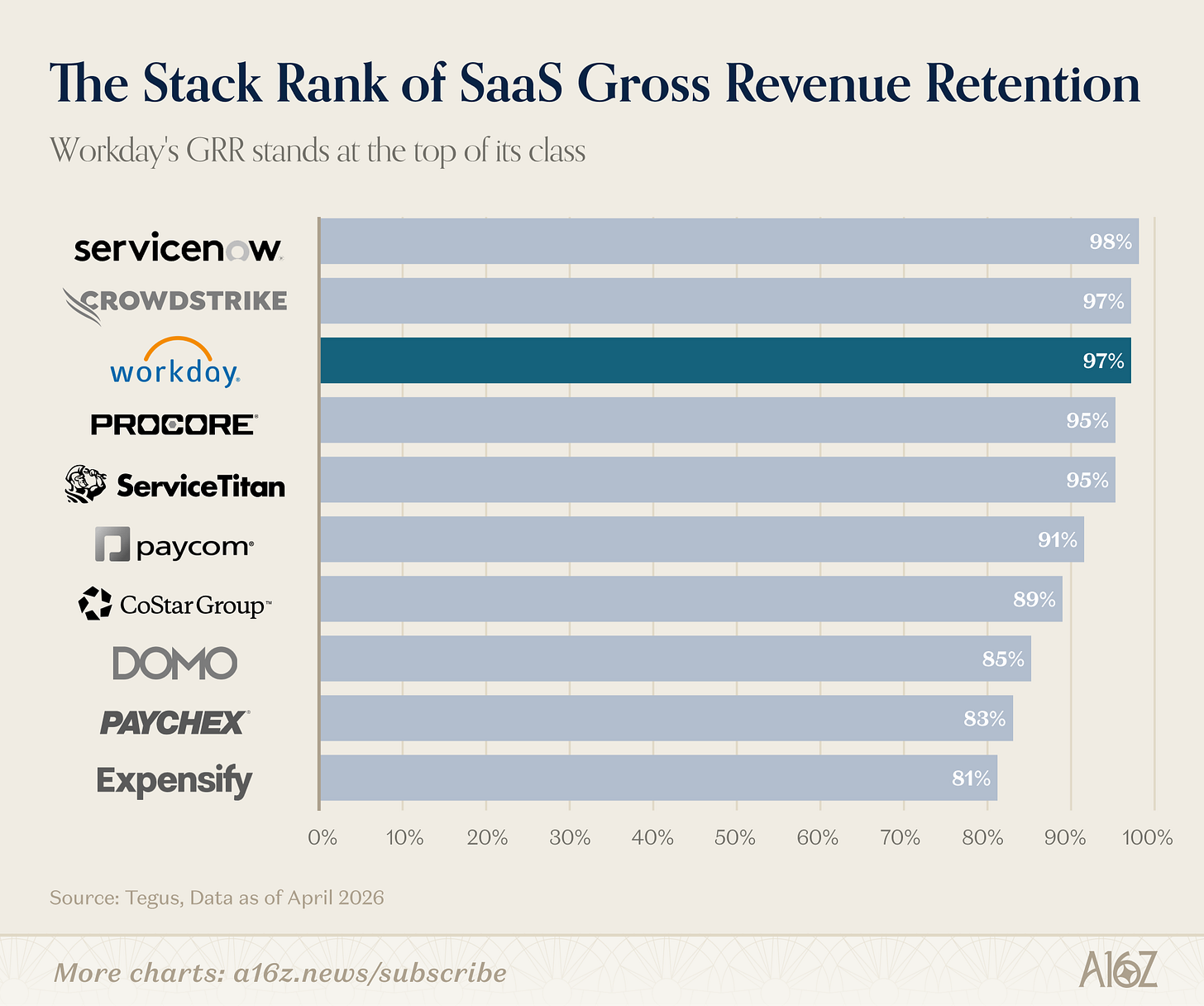
Customer renewal rates hover near 100%, which most would interpret as evidence of strong product-market fit. But Workday is different—its high renewal rate reflects inability to leave, not willingness to stay.
HCM (Human Capital Management) is the last major enterprise software category without a native-AI challenger. That status quo is about to change. A transformation larger than the platform migration that birthed Workday itself is now underway—and Workday’s end is near.
The Cloud Migration Built Workday
Workday itself is a product of platform disruption. In 2005, after Oracle’s hostile acquisition of PeopleSoft—the then-dominant HRIS vendor—PeopleSoft co-founders Dave Duffield and Aneel Bhusri bet that the shift from client-server to multi-tenant cloud architectures would reset the entire HRIS category. They believed Oracle and SAP couldn’t catch up architecturally—and that within a decade, all legacy client-server HRIS systems would become maintenance-only relics. Simultaneously, they observed large enterprises shifting from large upfront capital expenditures to predictable annual operating expenses—from perpetual licenses and on-prem data centers to subscription-based models.
Workday won on both fronts: it was the only mainstream HRIS built from day one on a true multi-tenant cloud architecture—and its pricing model perfectly aligned with enterprises’ transition to subscription procurement. Within ten years, it became the default choice.
Why Workday Is So Hard to Dislodge
Over the past two decades, every serious attempt to attack Workday in the enterprise market has failed—for the same reason: Workday’s moat isn’t in the product itself, but in everything surrounding it.
Deep technical and human entanglement. Workday sits at the center of hundreds of integrations—payroll, benefits, ATS (Applicant Tracking Systems), expense reimbursement, identity management, finance, state tax filing—none of which can be cleanly migrated. Each tenant carries thousands of hours of muscle memory: an administrator running the exact same performance cycle for four consecutive years; a compensation manager who has memorized a 17-step payout process. Adding a new cost center ripples across reporting, integrations, job architecture, compensation bands, and benchmarking—and nothing works unless every system and every person updates in strict sequence.
A proprietary configuration layer. Workday configures differently from most enterprise systems. Integrations are built using Workday Studio—a proprietary tool with typical implementation timelines of 6–18 months, requiring certified consultants to operate. Reports run on Workday’s own BIRT implementation; calculated fields use Workday’s custom expression syntax; tenant configuration relies on Workday’s unique business process and security frameworks. These skills have zero portability outside the Workday ecosystem: no open-source community, no Stack Overflow, no transferable developer resumes—both developers and their employers are locked in.
A consulting cartel. More than 10,500 certified consultants globally—across Accenture, Deloitte, Kainos, PwC, KPMG, and over 150 smaller firms—deliver Workday implementations. Projects take 6–18 months and cost $300,000–$1M+; implementation fees often equal 100% of annual software spend. This services economy may be worth more than the product itself—it lobbies on Workday’s behalf, absorbs customer complaints, and gives the world’s largest companies a direct financial stake in maintaining Workday.
Multi-year contract lock-in. Workday locks customers into long-term contracts. Even if a customer wanted to switch tomorrow, structural constraints force them to wait until their contract expires.
Layered together, these four defenses give Workday one of the highest net revenue retention rates in enterprise software—and for most large enterprises, it remains among the hardest products to rip out.
Why Now Is the Window
Some will say: “For twenty years, challengers have come and gone—Workday just can’t be moved.” That’s true. New entrants either target startups (Rippling and Gusto’s path) or niche, hard-to-solve markets (Deel for cross-border employment).
Workday hasn’t been idle either. In 2025, under its Illuminate brand, it launched over 25 AI features, rolled out dozens of intelligent agents, acquired Sana Labs and Pipedream, introduced Flex Credits—a usage-based pricing model—and signed deals with Accenture, Nike, and Merck. Its AI ARR has surpassed $400 million, growing at triple-digit year-over-year rates.
But Flex Credits and “AI ARR” are procurement innovations—not product innovations. Signing Flex Credits is not the same as running core HR workflows in production using intelligent agents. Flex Credits exist for a very practical reason: every enterprise CIO and CFO’s 2026 KPI includes a line item for “AI spend,” requiring real dollars to demonstrate progress; and on every traditional software vendor’s earnings call, “AI revenue” is the first number analysts ask about. Flex Credits serve as a mutually convenient procurement construct—customers commit to a credit pool, booking AI spend against budget; Workday records that commitment as AI ARR; and decisions about which agent runs which workflow get deferred until Illuminate delivers something actually useful. Both sides hit their KPIs—and celebrate the signing, without committing to specific deployments.
You don’t need to take our word for it. A major Workday services partner recently wrote, “Most organizations don’t even know these capabilities exist—let alone how to activate them.” Customers are already resisting incremental token fees layered atop already-renewed subscriptions. Longtime Workday administrators we’ve spoken with describe Illuminate as: “the same manual work, wrapped in a chat interface.” Every Illuminate feature is an add-on layer stacked atop the same form-approval engine—AI ARR can grow triple digits, while the underlying product remains completely unchanged.
But this time is different. Three variables have shifted simultaneously—exposing Workday’s soft underbelly.
First, enterprise IT is finally re-evaluating core systems. Large enterprises are conducting AI-readiness assessments on systems they once assumed would be locked in for a decade—ITSM, ERP, HCM. The pace of AI stack evolution has turned legacy architecture into a liability. A company aiming to lead in AI cannot rely on an HRIS designed in 2005. When the CHRO and CIO ask, “What does the AI-native version of this look like?” and Workday answers by selling consumption credits on the same engine—that’s the opening.
Second, the tools needed to rebuild are now in place. The same shift is happening one layer up in the enterprise tech stack: companies like Tessera are already executing AI-native SAP migrations at Fortune 500 scale—ERP complexity exceeds HCM by an order of magnitude, and a single ECC-to-S/4HANA upgrade can cost $700M and take three years. HCM is the same problem—but with a smaller surface area. Add vendor-owned pre-deployment services teams (not Accenture), and the implementation layer ceases to be the formidable moat it once was.
Third, Workday can’t seal the gap from within. The company has placed bets on three parallel initiatives: Illuminate (customer-facing intelligent agents), Sana (a new “work entry point”), and the upcoming Agent System of Record (an enterprise-wide governance layer for intelligent agents). All three sit atop the same form-approval engine—a powerful but two-decade-old infrastructure, difficult to configure or modify, and increasingly misaligned with modern HR organizations’ actual needs. Slapping AI on top changes nothing underneath.
Workday’s real foundational asset—its multi-trillion-dollar transaction dataset—sounds robust, but what matters operationally is how data connects to workflows, permissions, and integrations—and every layer of that tech stack is now a liability. Workday can layer AI on top, but it cannot become AI-native without rebuilding—and rebuilding is precisely what a public, installed-base-driven company cannot do.
As we’ve discussed before, the Fortune 500’s system replacement cycle is opening for the first time in twenty years—driven by the enterprise AI re-platforming wave. No next-generation HR solution today is architected at the scale of a Fortune 500 HRIS system. This is a unique opportunity—to enter precisely the enterprise market where Workday makes the most money—and where every prior challenger has failed.
What an AI-Native Workday Should Look Like
We believe the opportunity lies in building a direct HCM competitor to Workday—an enterprise-grade, AI-native HR system built for the next two decades.
We’re looking to invest in products with six defining characteristics:
- One-month deployment. Implementation is Workday’s biggest weakness—and the primary reason enterprises won’t switch. A true enterprise Workday implementation must cover U.S. payroll taxes across all 50 states, cross-border payroll across 60+ countries, ACA and SOX compliance controls, pitfalls of dozens of benefits carriers, union agreements, Workday Studio, BIRT reporting, Extend configuration. No single person understands it all—and most projects take 12–18 months because fragmented expertise across a dozen specialists must be sequentially scheduled and coordinated. Coding agents flatten this fragmentation. One agent can ingest an entire tenant—business process definitions, integration definitions, audit logs, payroll batch runs—reconstruct rules in natural language, validate against live integrations, preserve edge cases, and generate draft configurations in days. Today’s Workday is configurable only within its pre-defined boundaries; an AI-native HRIS should be customizable to a company’s actual policies—and coding agents should deliver what used to command six-figure consulting fees.
- Built-in HR workspace. The best HR administrators are de facto product managers—they know what cross-system reports the CHRO truly needs, what a compensation planning tool should look like, and what onboarding should feel like. Today, those things can’t be done in one role. Pulling cross-system data requires data warehouse and analytics teams; building a real workflow or application requires developers—or a Workday Extend contract. The workspace compresses all of this into a single, agent-native interface: ask a cross-system question and get an answer; describe an app in natural language and get a working version; propose a process change and see an impact preview. HR teams we’ve spoken with are already building such apps themselves—for example, a manager onboarding flow that auto-drafts JDs, assembles 30-60-90-day plans, and coordinates IT for account and device provisioning.
- Agent-first. Beyond portals, employees should interact with HR inside their everyday tools. An employee traveling to Milwaukee should be able to ask in Slack who else is within 50 miles—and get the answer in the same thread. Managers approving time off should see full contextual awareness—balance, recent leaves, upcoming requests, team coverage—right in the approval interface, without jumping to another dashboard. Consider a more complex scenario: launching a new business unit. Today in Workday, this takes weeks: new cost center, job architecture, headcount planning, benefits setup, payroll integration, approval workflows. In an AI-native system, an HR operations leader should be able to describe it in natural language (“500 people in Austin and Dublin, reporting to this EVP, these job families, this comp band”)—and the system should automatically map all dependencies, flag downstream changes, and generate configuration and go-live plans in one pass. And data must flow bidirectionally: HR data should power organization-wide agent workflows—not sit siloed inside the HRIS.
- Open. Connecting a new payroll provider requires 6–12 months of custom integration via Workday Studio; adding a benefits carrier takes similar effort; pulling data into BI tools requires hiring consultants. Frontline teams we’ve spoken with aren’t waiting—they’re building Claude MCPs to pull data from Workday into their actual tools, routing approvals via Slack, treating Workday as read-only. What these teams really want is an HRIS that’s open by design: customers’ own agents can directly read the HR data model; APIs aren’t gated behind credit pools; and the connectivity layer treats integrations as a first-class product. Ecosystem appeal comes from building the best agent development platform on top of the data—that’s where work gets done fastest.
- Agent-layer security and permissions. HR data is the most sensitive in the company—compensation, performance, sick leave, PII—and agents operating on that data require system-native, fine-grained access controls. A manager’s agent should see team compensation; an individual contributor’s should not. An external recruiter agent should see open roles—but not severance history. Getting permissions right per agent is the dividing line between AI being allowed to touch production HR data—and being blocked by security policy entirely. Retrofitting this on non-native architecture is nearly impossible.
- Always-on compliance. Regulatory scope around HR data (EU AI Act, GDPR, data residency) is expanding faster than any single administrator can track. Inside Workday, staying compliant means a senior HR leader reading newsletters and hoping nothing was missed. An AI-native stack flips this logic: a continuously running agent monitors regulatory changes across jurisdictions, flags what needs updating in the tenant, and drafts configuration updates. This is extremely difficult to retrofit onto 2005-era architecture—but native to 2026-era stacks.
How to Get Started
Building all six characteristics takes time. The launch path looks like this.
Partner with several Fortune 500 companies currently conducting AI-readiness assessments of their HR tech stack. Start by using mapping and migration tools to extract enterprise-specific, region-specific rules and edge cases from their tenants—then begin automating the manual work piled up around Workday (payroll spreadsheets, performance handoffs, ticket queues)—and move into full-system replacement when the timing is right.
Commercial architecture is critical here. Workday’s multi-year contracts lock down the HRIS budget line—but Fortune 500 HR organizations have adjacent, unlocked budgets: HR Operations, HR Technology, Transformation, Innovation, Consulting. A well-scoped implementation project or automation subscription can cleanly land in these budgets—with real SOWs and procurement processes—without forcing a head-on confrontation with Workday’s renewal cycle. By the time the renewal window truly opens, your company is already embedded in the tenant—and already delivering measurable value the CHRO can point to. At that point, the question isn’t “Try an unknown vendor?”—it’s “Extend our trusted vendor into budgets we’re already spending anyway.”
One more factor: Workday will leverage its product portfolio to suppress startup competitors. Most Fortune 500 Workday tenants are full-platform (HR, Finance, Payroll, Adaptive Planning). A CIO won’t dismantle their entire tech stack for an HR-only challenger. The optimal strategy mirrors Workday’s original playbook against PeopleSoft: enter at the highest-leverage point; integrate cooperatively with existing systems in adjacent domains; build natively in strategic directions. New entrants can treat customers’ existing Finance and Payroll instances as stable, day-one integrations—and replace only the parts of Workday HR that customers truly hate: performance, compensation planning, org restructuring, natural-language reporting. Let the platform mature organically into remaining areas. Sales should open with continuity: payroll continues uninterrupted, integrations remain live, and renewal cycles won’t create operational vacuums.
Each step dissolves one layer of defense: agent-native workflows replace two-decade-old muscle memory; natural-language configuration retires XpressO; pre-deployment teams bypass the consulting cartel; adjacent-budget wedges neutralize multi-year lock-in.
Don’t Expect Workday to Go Quietly
Workday is already mobilizing. Over the past fourteen months, the company cut over 2,100 employees, and co-founder Aneel Bhusri returned as CEO with an explicit AI transformation mandate. A $30 billion company with 10,000+ customers—and a services ecosystem potentially larger than its product business—won’t stand still.
Expect the full playbook: aggressive bundling of Adaptive Planning, Payroll, and Finance clouds to make HRIS renewal look like a CFO-unbreakable package; rolling out deeply discounted multi-year renewals mid-evaluation cycle; enlisting consulting partners with nine-figure Workday practices to spread FUD. Introduce contractual friction during tenant data export attempts; accelerate M&A when challengers gain real traction. None of these tactics solve the underlying architectural problem—but any one of them can delay a design partner’s project by a quarter. Challengers who fail to bake that cost into their runway will burn cash fast. Our thesis holds—not because Workday won’t fight back—but because the architecture it uses to fight back cannot be rebuilt into what the Fortune 500 actually needs.
The Opportunity
HR software is one of the few remaining enterprise software categories where the incumbent has clear vulnerabilities, the architecture demands rewriting, and buyers actively seek alternatives. The global HCM software market exceeds $40 billion—and is growing. Workday alone peaked near $80 billion in market cap two years ago. We believe the AI transition will spawn an even larger company.
And the stakes exceed the business itself. As enterprises move toward hybrid human-agent work—running on a single system—the HRIS becomes the company’s operational substrate: who reports to whom, who has what permissions, who earns what, who owns what, who operates within compliance. Building that on 2005-era architecture caps how much AI the entire company can deploy.
Right now, somewhere, an HR administrator is manually typing 17 salary adjustments—one field at a time—into Workday’s performance cycle from Excel, while a business partner watches over Zoom to ensure she selects the right job code. This happens today at every Fortune 500 company—using a product that costs the company millions annually. Someone will build the next Workday—a system designed for agents, not form approvals. Once built, no one will look back.
Join TechFlow official community to stay tuned
Telegram:https://t.me/TechFlowDaily
X (Twitter):https://x.com/TechFlowPost
X (Twitter) EN:https://x.com/BlockFlow_News
 a16z
a16z