A 15,000-person Caribbean island generates half its government budget by selling .ai domain names.
TechFlow Selected TechFlow Selected
A 15,000-person Caribbean island generates half its government budget by selling .ai domain names.
More than 2,000 new domains enter the registration system daily, with each domain representing revenue flowing into Anguilla’s treasury.
 Navigating Web3 tides with focused insights
Author: Jia Yang
In February 2026, bot.ai sold for $1.2 million on the domain marketplace Sedo—the first publicly recorded seven-figure transaction for a .ai domain. The buyer’s identity was not disclosed; the seller was reportedly Philipp Michel, a domain investor. Prior to the sale, the domain’s landing page displayed only one line: “Want to buy bot.ai?”
.ai is the country-code top-level domain (ccTLD) assigned to Anguilla, a 15,000-person island in the Caribbean Sea. A British Overseas Territory, Anguilla relies primarily on high-end tourism and contends annually with hurricane season each fall. In 2025, revenue from .ai domain registrations and renewals totaled $93 million—47% of the government’s budget.
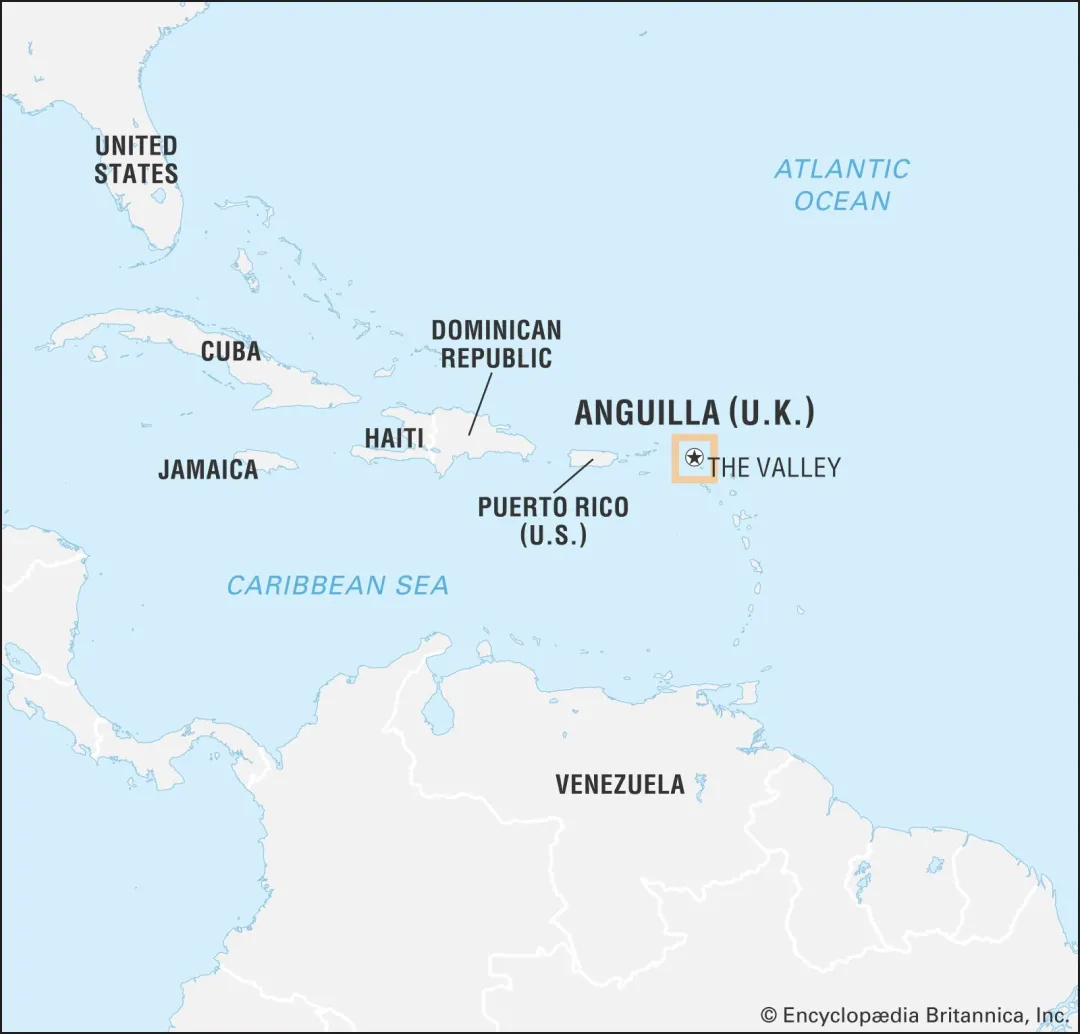
Figure | Anguilla’s location (Source: Britannica)
This January, an average of 2,008 new .ai domains were registered globally each day—one every 43 seconds.
From Under 1% to 47%
In 1995, the Internet Assigned Numbers Authority (IANA), following the International Organization for Standardization’s list of country codes, assigned two-letter ccTLDs to each country and territory. Anguilla received .ai; its neighboring island Antigua received .ag. At the time, no one foresaw how valuable those two letters would become. Former Anguillian Premier Ellis Webster later repeatedly called it “pure luck.”
In 2018, .ai registration revenue stood at $2.9 million—4% of Anguilla’s national budget. By 2022, it had risen to $7.7 million, or 6%. That figure remained relatively flat until November 2022—when OpenAI launched ChatGPT.
In 2023, .ai revenue jumped to $32 million—21% of the budget. In 2024, it reached $39 million (23%), and in 2025, $93 million (47%). Within three years, .ai evolved from a marginal revenue stream into a fiscal pillar on par with tourism—which contributes 37% of GDP.
“Prior to AI’s true explosion, .ai revenue accounted for less than 1% of national income. It rose to 25–27% in 2023, and reached approximately 47% by 2025,” said Jose Vanterpool, Anguilla’s Minister of Infrastructure and Communications, in his annual fiscal statement.
The 2025 surge also reflected a compounding effect: .ai domains require a minimum two-year registration period. Registrants who flooded in after ChatGPT’s November 2022 launch largely faced their first renewal in 2025. Fabian Ledl, founder of Domaintechnik, explained that .ai’s renewal rate stands at roughly 90%, meaning the 2023 registration boom entered the government’s fiscal ledger a second time in 2025. Based on prior trends, Anguilla’s government had projected .ai revenue for 2025 at EC$132 million (~$48.84 million), rising to EC$138.6 million in 2026 and EC$145.53 million in 2027. Yet actual 2025 revenue hit EC$250 million—nearly double its own forecast.
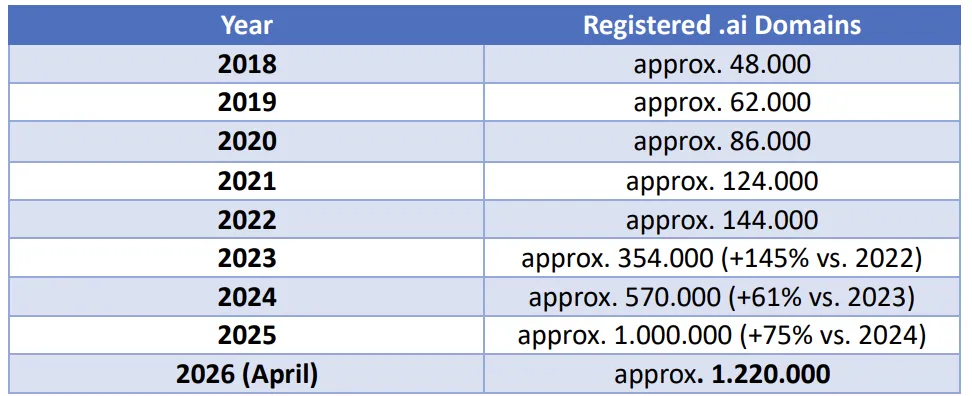
Figure | .ai domain registrations (Source: Domaintechnik)
Secondary-market sale prices rose in tandem. Before bot.ai, the record was wisdom.ai, which sold for $750,000 in October 2025. Earlier, you.ai fetched $700,000—the buyer was Dharmesh Shah, co-founder of U.S. software company HubSpot. He told media he’d had “a product idea enabling users to create digital avatars to perform tasks on their behalf.”
Next came cloud.ai ($600,000), blockchain.ai ($405,000), and law.ai ($350,000). Matt Barrie, CEO of Escrow.com, revealed an even more dramatic case: a certain .ai domain sold for $300,000, then resold months later for $1.5 million—the name remains undisclosed.
Still, comparatively speaking, .ai’s valuation isn’t exceptionally high. In February 2026, AI.com sold publicly for $70 million—the highest known price for any .ai domain to date is less than 2% of that. Dharmesh Shah himself acknowledged that, long-term, .com domains will retain value better and longer than .ai. He bought .ai primarily because suitable .com options weren’t available—and .ai remained a credible second-best choice conveying AI relevance.
The entire .ai ecosystem rests on this “second-best” positioning. .com remains the default consensus for internet naming; .ai serves as AI companies’ fallback when preferred .coms are unavailable. This relationship tightly couples .ai’s premium pricing to the AI cycle itself.
Tuvalu’s Tuition Fee
The Pacific island nation of Tuvalu walked a similar path back in 1998.
It received the .tv domain—coincidentally short for “television.” Even before video streaming surged, those two letters held marketing value. Tuvalu’s government signed an exclusive agreement with a Canadian firm promising a one-time $50 million payment—a sum never delivered. Later, the contract passed through Idealab and Verisign, finally landing with GoDaddy in 2021.
Under Verisign, Tuvalu received fixed fees plus sales royalties: $2.2 million annually, plus 5% of revenues exceeding $20 million. The structure was stable—but capped low. Around 2010, Tuvalu’s Finance Minister Lotoala Metia publicly derided Verisign’s payments as “peanuts.” Only after switching to GoDaddy in 2021 did Tuvalu’s annual revenue approach $10 million.
Anguilla’s contract structure flips Tuvalu’s model. In October 2024, it signed a five-year agreement with U.S.-based domain registrar Identity Digital, explicitly prioritizing revenue sharing over a lump-sum buyout. According to BBC reporting, Identity Digital retains ~10% of revenue; the rest flows to Anguilla’s treasury. In January 2025, Identity Digital officially assumed control of .ai registration operations, migrating all .ai domain servers from Anguilla’s island infrastructure to its global network—to mitigate hurricane risk. Hurricane Irma in 2017 inflicted $320 million in damage on Anguilla, nearly crippling power and communications.
This structure secured Anguilla the lion’s share during the AI boom. Identity Digital’s newly launched auction service generated over $600,000 in additional revenue for Anguilla’s government in its first year alone; even its daily-auction mechanism lifted weekly .ai revenue by 20%. How the money is spent has been partially disclosed.
The 2025 fiscal statement specifies allocations toward: sovereign debt repayment (approximately $292 million as of end-2025—about 19.9% of GDP, well below the Caribbean region’s 60% red line); airport and road network expansion; renewable energy investment; and free healthcare for children under five and seniors over seventy. The airport is critical: Anguilla’s tourism industry has long been constrained by limited flight capacity.
Cora Richardson-Hodge inherited precisely this fiscal landscape upon assuming office as Premier in February 2025. She is Anguilla’s first female Premier; her Anguilla United Front won 8 of 11 parliamentary seats in the general election, relegating Webster’s Progressive Movement to opposition. Vanterpool, also of the United Front, joined the new cabinet.

Figure | Cora Richardson-Hodge (Source: Anguilla Focus)
Betting on Two Letters
Before stepping down, former Premier Webster repeatedly issued the same warning across multiple forums: “You cannot predict how long this will last. Our economy and projects must not rely entirely on it—otherwise, if the winds shift, we’ll face drastic cuts in very short order.”
That caution may sound discouraging against the backdrop of 2025’s budget surplus—but it points to a concrete possibility.
.ai’s high premium rests on one premise: AI remains a label worth prominently displaying on tech companies’ digital “business cards.” When a technology transitions from frontier innovation to foundational infrastructure—like electricity or cloud computing—it shifts from brand asset to default attribute. No company today brands itself an “electric company” or “cloud company,” because those concepts have become baseline expectations. If AI follows the same trajectory over the next five to ten years, .ai’s marketing value will gradually erode—new registrations will slow, renewal rates drop, and the secondary market cool.
Identity Digital itself noted in external communications that the sustained premium of AI-themed domains hinges on the capital cycle of the AI industry. They, too, recognize its fragility.
Conversely, .ai could chart a different course. As AI companies collectively occupy the .ai namespace—e.g., claude.ai, x.ai, perplexity.ai, meta.ai—this mass adoption may reinforce the suffix’s semantic weight. .com didn’t gain value because of the United States per se, but because early entrants established it as the industry default. Whether .ai can replicate .com’s stability remains uncertain—and requires observation across at least two to three full AI cycles.
Moreover, if these revenues truly fund debt repayment, infrastructure, education, and healthcare—as current spending patterns suggest—then even if the .ai boom recedes, those investments endure. Expanded airport capacity enables new flight routes; lowering sovereign debt to under 15% of GDP creates lasting fiscal resilience—neither vanishes with the AI cycle. But if funds flow instead into recurring expenditures—civil service salary hikes, expanded welfare benefits—the year the .ai windfall fades will be extremely difficult.
As of April 2026, total .ai registrations stand at approximately 1.1 million. Domaintechnik forecasts reaching 1.7 million by year-end 2026. Over 2,000 new domains enter the registration system daily—each representing a direct inflow into Anguilla’s treasury.
Yet every such transaction implicitly affirms one shared assumption: somewhere in the world, a product manager still believes adding .ai to their English-language domain name will earn one extra glance from users.
How long that belief endures—no one truly knows.
Join TechFlow official community to stay tuned
Telegram:https://t.me/TechFlowDaily
X (Twitter):https://x.com/TechFlowPost
X (Twitter) EN:https://x.com/BlockFlow_News