DeFi Security Guide: How to Effectively Defend Against Hacker Attacks in the AI Era?
TechFlow Selected TechFlow Selected
DeFi Security Guide: How to Effectively Defend Against Hacker Attacks in the AI Era?
Cyberattacks will not cease; as AI becomes smarter, attacks will only increase.
 Navigating Web3 tides with focused insights
By: sysls
Translated by: AididiaoJP, Foresight News
Introduction
After reviewing numerous DeFi protocol hacks, I’ve developed a deep apprehension toward “state actors.” They are highly skilled, well-resourced, and play an extremely long game. These super-villains meticulously scrutinize every corner of your protocol and infrastructure for vulnerabilities—while typical protocol teams split their attention across six or seven different business priorities.
I don’t claim to be a security expert—but I have led teams in high-risk environments (including the military and high-value financial domains), and I bring extensive experience in strategic thinking and emergency planning.
I genuinely believe only the paranoid survive. No team sets out thinking, “I’ll treat security with negligence and indifference”—and yet hacks still happen. We must do better.
AI Means This Time Is Truly Different
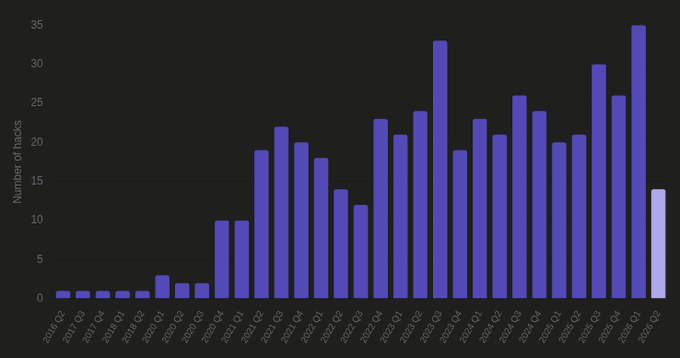
(Source: https://defillama.com/hacks)
Hacks are not rare—but their frequency is clearly accelerating. Q1 2026 was the most hack-heavy quarter on record for DeFi—and Q2 has only just begun, already threatening to surpass the prior quarter’s record.
My core hypothesis: AI dramatically lowers the cost of vulnerability discovery and vastly expands the attack surface. A human would need several weeks to audit misconfigurations across one hundred protocols; today’s foundational models can accomplish the same in hours.
This should fundamentally reshape how we think about—and respond to—hacks. Legacy protocols accustomed to pre-AI-era security practices face increasingly acute “one-shot” risks.
Thinking in Surfaces and Layers
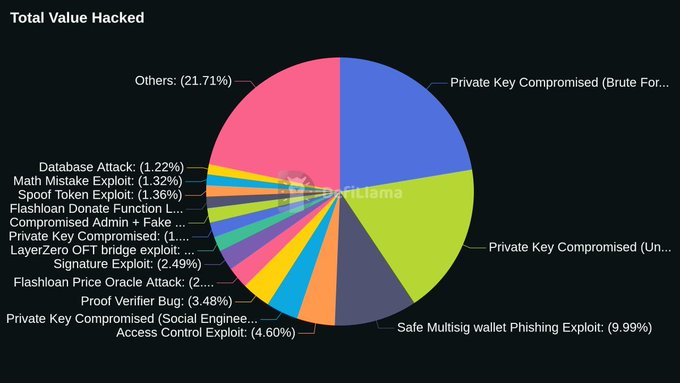
(Source: https://defillama.com/hacks)
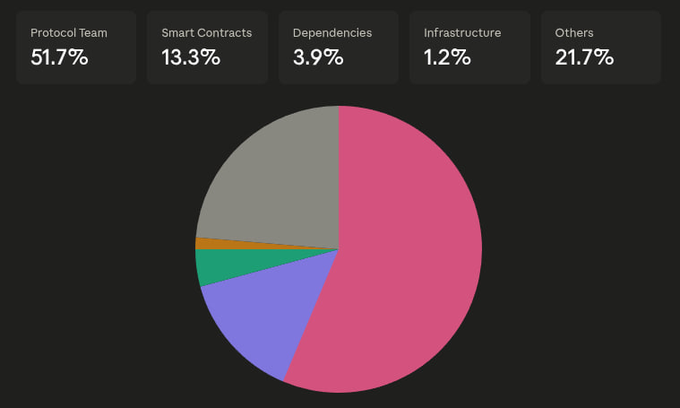
The attack surface of hacks effectively reduces to three domains: the protocol team, smart contracts and infrastructure, and user trust boundaries (DSN, social media, etc.).
Once these surfaces are identified, defensive layers are overlaid:
- Prevention: Processes that, if rigorously enforced, minimize the probability of exploitation.
- Mitigation: Limits damage when prevention fails.
- Pause: No one makes optimal decisions under extreme pressure. Upon confirming an attack, immediately trigger the master kill switch. Freezing halts further losses and buys critical thinking time…
- Reclaim: If you lose control over a toxic or compromised component, discard and replace it.
- Recovery: Reclaim what you’ve lost. Pre-plan partnerships with institutions capable of freezing funds, reversing transactions, and assisting investigations.
Principles
These principles guide concrete actions across all defensive layers.
Leverage Cutting-Edge AI Aggressively
Use state-of-the-art foundation models to scan your codebase and configurations for vulnerabilities—and conduct red-team testing across broad surfaces: probe frontend flaws to see whether they reach the backend. Attackers will do this. Anything your defensive scans uncover, their offensive scans likely found first.
Use tools like pashov and nemesis, and AI platforms such as Cantina (Apex) and Zellic (V12), to rapidly scan codebases before full audits are complete.
Time and Friction Are Good Defenses
Introduce multi-step workflows and time locks for any operation that could cause harm. You need sufficient time to intervene and freeze upon detecting anomalies.
Historically, objections to time locks and multi-step setups centered on friction for protocol teams. Today, that concern is diminished: AI can effortlessly handle such friction in the background.
Invariants
Smart contracts can be defensively constructed by codifying immutable “truths”: if any of these truths breaks, the entire protocol logic collapses.
You typically have only a few invariants. Elevate them carefully into code; enforcing multiple invariants in every function quickly becomes unmanageable.
Power Balance
Many hacks originate from compromised wallets. Your configuration must ensure that even if a multisig is breached, damage can be rapidly contained—and the protocol restored to a governable state.
This requires balancing Governance (decides everything) and Rescue (restores governable stability but cannot replace or override governance itself).
Something Will Always Go Wrong
Assume from day one: no matter how brilliant you are, you will be hacked. Your smart contracts—or dependencies—may fail. You may fall victim to social engineering. A new upgrade may introduce unforeseen vulnerabilities.
Once you adopt this mindset, rate limits and circuit breakers become your best friends. Cap losses at 5–10%, freeze, then plan your response. No one makes optimal decisions under fire.
The Best Time to Plan Is Now
Design your response plan before being hacked. Codify processes as much as possible—and rehearse them with your team—so you won’t panic when shock hits. In the AI era, this means possessing skills and algorithms that rapidly synthesize large volumes of information—and share concise summaries and long-form analyses with your inner circle.
Perfection isn’t required—you just need to survive. No system is bulletproof from day one; through iterative learning, you become antifragile.
Absence of evidence of being hacked is not evidence of being unhackable. The point of maximum comfort is often the point of maximum danger.
Preventive Measures
Smart Contract Design
Once invariants are defined, elevate them to runtime checks. Carefully assess which invariants truly warrant enforcement.
This is the FREI-PI (Function Requirements, Effects, Interactions, Protocol Invariants) pattern: re-validate the “crown invariants” a function promises to uphold at the end of each value-touching function. Many drain attacks that pass CEI (Checks-Effects-Interactions)—such as flash-loan sandwich attacks, oracle-assisted liquidation grief, and cross-function solvency drains—are caught by invariant checks at function termination.
Robust Testing
Stateful fuzzing generates random call sequences against the protocol’s full public interface—and asserts invariants at every step. Most production bugs manifest across multiple transactions; stateful fuzzing is nearly the only reliable method to discover such paths ahead of attackers.
Use invariant-based tests to assert that properties hold across all call sequences generated by the fuzzer. Augment with formal verification, which proves properties hold across all reachable states. Your crown invariants absolutely merit this treatment.
Oracles and Dependencies
Complexity is security’s enemy. Every external dependency expands the attack surface. If designing primitives, give users control over who and what they trust. If dependencies can’t be removed, diversify them—ensuring no single point of failure can destroy your protocol.
Extend audits to simulate how oracles and dependencies might fail—and apply rate limiting to the potential severity of disaster if they do.
The recent KelpDAO exploit illustrates this: they inherited LayerZero’s default requiredDVNCount=1 configuration—an element outside their audit scope. Ultimately, off-chain infrastructure beyond the audit perimeter was compromised.
Surface Attacks
Most surface attacks in DeFi have already been cataloged. Walk through each category, ask whether it applies to your protocol, and implement controls specific to that vector. Cultivate red-team capabilities—and train your AI agents to proactively hunt for vulnerabilities in your protocol. This is now table stakes.
Native Rescue Capability
In vote-based governance, power initially concentrates in the team’s multisig—and takes time to decentralize. Even with broad token distribution, delegation tends to concentrate authority in a few wallets (sometimes even n=1). When those wallets are compromised, the game ends.
Deploy “Guardian Wallets” with strictly narrow permissions: they can only pause the protocol—and, under a ≥4/7 threshold, rotate compromised delegations to pre-defined replacement wallets in extreme cases. Guardians must never execute governance proposals.
This gives you a persistent rescue layer that restores governable stability—without the power to override governance. The worst-case probability of losing ≥4/7 Guardians is extremely low (given holder diversity), and this layer can be gradually phased out once governance matures and decentralizes.
Wallet and Key Topology
Multisig wallets are mandatory—minimum 4/7. No single person controls all seven keys. Rotate signers frequently—and silently.
Keys must never interact with devices used for daily activities. If you browse the internet, check email, or open Slack on your signing device, assume that signer is already compromised.
Maintain multiple multisigs, each with distinct purposes. Assume at least one full multisig will be compromised—and plan accordingly from that premise. No individual should possess sufficient control to compromise the protocol—even under extreme scenarios (e.g., kidnapping, coercion).
Consider Bug Bounties
If resources permit, offering a high-value bounty relative to your protocol’s TVL is highly worthwhile—even for smaller protocols, bounties should be as generous as feasible (e.g., minimum $1M–$10M).
Against state actors, negotiation may be futile—but you can still participate in a “white-hat safe harbor” program, authorizing white hats to act on your behalf to protect funds—and pay them a percentage of the bounty (effectively funded by depositors).
Hire Strong Auditors
I previously wrote that as LLMs grow smarter, the marginal value of hiring auditors declines. I still hold that view—but my perspective has evolved.
First, top-tier auditors stay ahead of the curve. If you’re building something novel, your code—and its vulnerabilities—may lie outside training data. Simply increasing token count hasn’t proven effective at discovering novel bugs. You don’t want to be the first sample point for a unique vulnerability.
Second, an underappreciated benefit: hiring auditors puts their reputation on the line. If they sign off and you get hacked, they’re strongly incentivized to help. Building relationships with professionals whose livelihood depends on security is a massive advantage.
Practice Operational Security
Treat operational security as a success metric. Conduct phishing drills; hire (trusted) red teams to attempt social engineering against your team. Prepare backup hardware wallets and devices to replace your entire multisig on demand—you don’t want to scramble to buy them on D-day.
Mitigation Measures
Your Exit Path Is Your Loss Cap
The cap size on any path moving value out of the protocol defines the maximum theoretical loss if that path is exploited. Put simply: a mint function without a per-block cap issues a blank check for infinite minting. A redemption function without a weekly cap issues a blank check for asset balance corruption.
Thoughtfully define explicit numerical caps on your exit paths. This number must balance your maximum tolerable damage against users’ most extreme UX needs. If things go wrong, this is what saves you from total annihilation.
Whitelists (and Blacklists)
Most protocols maintain lists of what can be called, traded, or received—and what users absolutely cannot do. Even implicitly, these constitute trust boundaries and should be formalized.
Formalizing them allows two-stage setters—introducing meaningful friction. Attackers must first be added to the whitelist (and/or removed from the blacklist) before acting. Having both means attackers secretly introducing new vectors must breach two separate processes: markets must be enabled (integration/listing), and the action must not be prohibited (security review).
Reclaim
Algorithmic Monitoring
A kill switch is useless without monitoring. Off-chain monitors must continuously track invariants—and algorithmically escalate alerts when violations occur. The final escalation path must land with human Guardians, providing sufficient context for decision-making within minutes.
Pause to Recalibrate
If you’re shot, stop the bleeding before making decisions under countdown. For protocols, this is the kill switch (also reflected in the UI): a single-button transaction that pauses all value-moving paths. Prepare a “pause everything” helper script that enumerates and atomically pauses all pausable components.
Only governance can lift the pause—so the kill switch must never pause the governance contract itself. If the Guardian layer could pause governance, a compromised Guardian layer could permanently deadlock recovery.
Activate Your War Room
Freeze. Stop the bleeding. Then gather everyone you trust (a small, pre-agreed circle) into a secure comms channel. Keep the surface small—to prevent information leakage to attackers, the public, or malicious arbitrageurs.
Assign roles for your team: one decision-maker; one operator fluent in executing defense scripts and pausing actions; one reconstructing the exploit and identifying root cause; one communicating with key stakeholders; one documenting observations, events, and decision timelines.
When everyone knows their role—and has rehearsed it—you respond procedurally—not chaotically—in the worst moments.
Consider Cascading Effects
Assume your attacker is highly sophisticated. The first vulnerability may be bait—or seed for subsequent attacks. The attack may lure you into doing precisely the wrong thing—triggering the real vulnerability.
Pauses must be thoroughly researched, fully controllable, and themselves non-exploitable. Pauses must be full-protocol freezes: you don’t want to be induced into pausing one component—only to expose another. Once you identify root cause and attack vector, explore adjacent exposed surfaces and cascading effects—and fix them all at once.
Rotate Pre-Committed Successors
Rotation is only safe if successors are known in advance. I favor the idea of a pre-committed successor registry: it makes it harder for attackers to replace healthy Guardians/governance wallets with compromised ones. This aligns with the “whitelist/blacklist” philosophy in mitigation measures.
Register a successor address for each critical role. The only rotation primitive available to the emergency layer is “replace role X with its successor.” This also lets you evaluate successors during peacetime: proceed slowly, conduct due diligence, meet in person with requestors.
Test Upgrades Rigorously Before Deployment
Once you’ve identified root cause and impact scope, you’ll need to deploy an upgrade. This may be the most dangerous code you ever ship: written under pressure—and targeted at attackers who’ve already demonstrated deep knowledge of your protocol and found its vulnerabilities.
Delay deployment if testing is insufficient. If no time for audit, lean on white-hat relationships—or run a 48-hour contest before deployment to obtain fresh adversarial review.
Recovery
Act Fast
Stolen funds have a half-life; once a vulnerability lands, they rapidly enter money-laundering pipelines. Pre-engage on-chain analytics providers like Chainalysis to flag attacker address clusters in real time—and notify exchanges to tag and track them as they hop across chains.
Pre-assemble a list of centralized exchange compliance departments, cross-chain bridge administrators, custodian administrators, and other third parties with administrative authority to freeze cross-chain messages or specific in-flight deposits.
Negotiate
Yes, it stings—but you should still attempt dialogue with attackers. Many real-world problems are resolved through negotiation. Offer a time-bound white-hat bounty—and publicly declare that no legal action will be taken if funds are fully returned by the deadline.
Against state actors, you may draw a blank—but you may face less-sophisticated attackers who merely found an exploit and seek a low-cost exit.
Always involve legal counsel before doing so.
Conclusion
Hacks won’t stop—and as AI grows smarter, they’ll only increase. Merely asking defenders to “get sharper” is insufficient. We must use the same tools attackers use: red-team our protocols, monitor continuously, and impose hard limits on damage—so we survive even in the worst-case scenario.
Join TechFlow official community to stay tuned
Telegram:https://t.me/TechFlowDaily
X (Twitter):https://x.com/TechFlowPost
X (Twitter) EN:https://x.com/BlockFlow_News
 @systematicls