

The “Perpetualization” Wave: A “Powerful Tool” Delivered from the Crypto World to Traditional Finance
TechFlow Selected TechFlow Selected
The “Perpetualization” Wave: A “Powerful Tool” Delivered from the Crypto World to Traditional Finance
“Perpetualization” has only just begun.
 Navigating Web3 tides with focused insights
Author: defi_monk
Translated by: AididiaoJP, Foresight News
Introduction
Over the past seventeen years, a handful of blockchain innovations have broken out of niche circles to deliver transformative leaps for traditional finance. Whether digital gold, stablecoins, or prediction markets, these products began as niche applications designed exclusively for crypto-native users—and were later proven to hold broad societal value.
We believe the next product poised to move from crypto into the mainstream will be perpetual contracts—and more importantly, decentralized exchanges (DEXs) built specifically for trading them.
While the industry has begun paying attention to decentralized perpetual contract exchanges—a thrilling growth story—there remains widespread misunderstanding about their significance and the scale of the market opportunity. We anticipate that over the coming years, perpetual contracts will begin absorbing numerous new asset classes—from equities to commodities—and DEXs will emerge as the biggest winners in this trend.
Below, we lay out our core thesis: By 2030, decentralized perpetual contract exchanges will capture a substantial share of the options, futures, and CFD markets. We believe this will generate a multi-hundred-billion-dollar market capitalization for the sector.

A Brief History of Perpetual Contracts
Perpetual contracts are, at their core, derivatives that allow traders to maintain leveraged exposure to an underlying asset indefinitely—without expiry or physical settlement. To keep the perpetual contract price closely aligned with the spot price, long and short positions periodically exchange funding payments based on the price difference. Risk is managed via continuous margining and liquidation mechanisms, with profits and losses reallocated in real time across a shared collateral pool. Together, these mechanisms enable positions to be held indefinitely—as long as they remain solvent—concentrating trading activity into a single, 24/7 market rather than scattering it across multiple expiries.
The concept of perpetual contracts was first formally proposed by economist Robert Shiller in 1993—but remained largely theoretical for decades. In traditional finance, the idea clashed fundamentally with market structures built around fixed expiries, batch settlements, centralized clearing, and limited trading hours. This persisted until 2016, when Arthur Hayes—facing intense competition from Asian rivals—launched BitMEX and introduced perpetual contracts to the crypto market.
Although Huobi and OKX controlled over 90% of daily crypto futures volume at the time, BitMEX rose to dominance within just two years—almost entirely due to the overwhelming success of its perpetual contracts. By 2018, BitMEX had effectively phased out its outdated futures products and led all crypto exchanges in both liquidity and trading volume.
We view this history as a revealing consumer case study—one that powerfully demonstrates the competitive superiority of perpetual contracts. In a fair marketplace, perpetuals decisively outperformed traditional term-based futures and options. Today, perpetual contracts dominate crypto trading: Bitcoin perpetuals trade at roughly six times the notional volume of spot Bitcoin—a uniquely concentrated market structure unseen in any other asset class.
The Rise of Decentralized Perpetual Exchanges
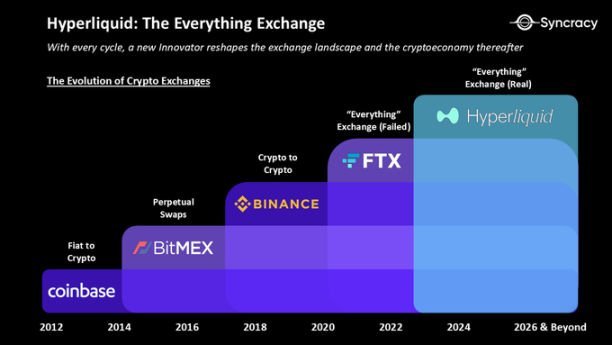
Although centralized exchanges (CEXs) like Binance currently dominate perpetual trading with ~83% market share, the most exciting evolution in this space is the accelerating growth of decentralized perpetual exchanges.
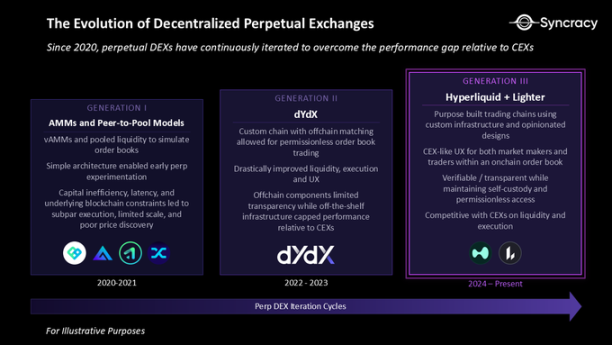
The vision behind decentralized exchanges (DEXs)—self-custodial, real-time auditable, permissionless, and globally accessible trading venues—has existed for over a decade. Yet many of these features historically came with severe performance trade-offs. Early perpetual DEXs suffered from low throughput, high latency, and crude risk engines—rendering them noncompetitive against mature CEXs.
That changed with the launch of Hyperliquid—the first truly competitive perpetual DEX experience. Rather than simply replicating exchange logic on-chain, Hyperliquid rethought blockchain architecture from first principles, optimizing for trading as its core use case.
Its validator set is tightly co-located, significantly reducing consensus latency and enabling market-maker colocation—a feature long considered essential for traditional high-frequency trading. The team also implemented unique ordering rules that allow market makers to prioritize cancel requests, dramatically reducing harmful order flow caused by auction-based sequencing prevalent on early blockchains. Finally, the chain uses predefined transaction fees—not variable gas pricing—reducing execution uncertainty and lowering costs for sophisticated strategy participants.
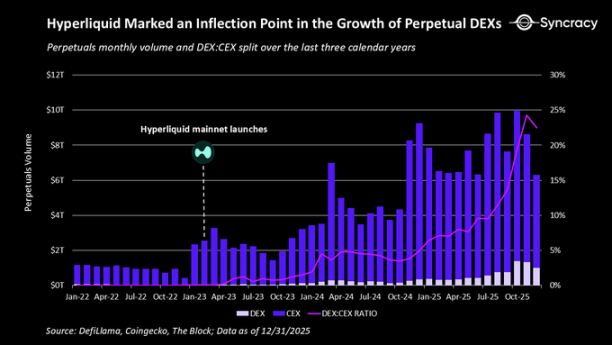
Hyperliquid’s emergence marked a clear inflection point in the DEX vs. CEX competitive landscape. Since its launch, DEXs have captured market share from CEXs at an accelerating pace—and performance and UX are no longer limiting factors. Today, Hyperliquid and Lighter rank among the top execution venues for retail traders across major crypto assets.
The Great Expansion of Perpetual Contracts
In November 2025, Hyperliquid took a decisive step beyond crypto-only perpetuals with the launch of HIP-3—a proposal that redefined itself from a crypto-only exchange into a universal perpetual platform. HIP-3 allows third-party deployers to create new perpetual markets on Hyperliquid’s order book—provided they meet minimum technical requirements and stake 500,000 HYPE as collateral.
Because perpetuals are freely floating derivatives, in principle they can be created for any asset with a reliable price index. Within three months of HIP-3’s launch, Hyperliquid witnessed rapid proliferation of new markets—including single stocks, stock indices, commodities, and even pre-IPO private companies. To date, these new markets have generated over $100 billion in trading volume—the most successful attempt yet to bring traditional asset classes onto-chain at scale.
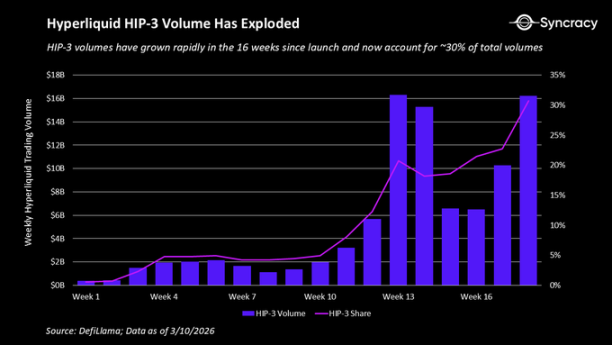
Hyperliquid’s HIP-3 success has sparked immense interest from incumbents and new entrants alike. Over recent months, both Binance and Coinbase launched their own stock and commodity perpetuals. As investors chase the “next Hyperliquid,” venture funding in this space has surged. Meanwhile, leading blockchains like Solana have declared “cracking” perpetuals their top priority.
The central argument underpinning all these dynamics is that perpetual contracts represent the fastest, most liquid way to introduce new assets on-chain while embedding real utility—especially compared to spot tokenization. After all, crypto has largely served as an asset class for speculators chasing outsized returns—and perpetuals provide precisely the speculative incentive needed to make tokenization valuable for real users.
With perpetual markets now expanding into equities, commodities, currencies, and long-tail alternative assets—and combined with core crypto markets (a concept we previously called the “universal exchange” in our original Hyperliquid report)—we believe the opportunity for perpetual DEXs has grown by a full order of magnitude. This development also reshapes their business models, drastically reducing dependence on crypto market cycles.
How Perpetuals Will Capture Retail Speculation
So far, stock and commodity perpetuals have primarily attracted crypto-native traders. For this group, the appeal lies in convenient access to traditional assets—enabling some non-U.S. users to trade assets otherwise requiring jurisdiction-specific brokerage accounts or private banking relationships.
Although crypto’s relative underperformance versus equities and commodities since the historic “10/10” liquidation event in 2025 accelerated adoption among this cohort, the key question remains: Where does future growth come from? Beyond crypto natives—who else can this innovation serve next?
We believe the answer lies in one of finance’s clearest long-term growth trends: the rise—and re-rise—of global retail speculators.
The Rise—and Re-Rise—of Retail Speculators
“Wherever you look, leverage is becoming higher in the equity infrastructure of what has become a nation of traders.” — Paul Tudor Jones
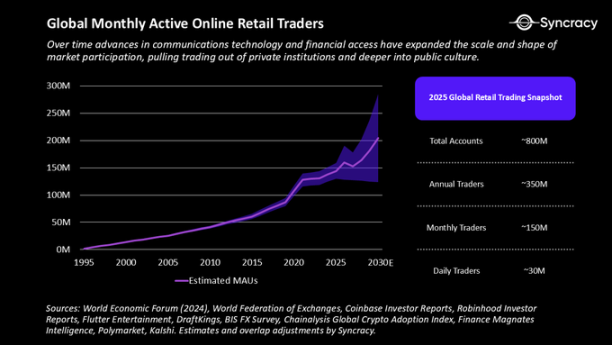
As increasingly observed by market participants and social commentators, the world appears to be entering a retail-driven speculative supercycle. While drivers remain debated—whether rising cost-of-living pressures and declining social mobility push people toward speculation, or whether smartphones and deregulation simply make speculation more convenient—the trend is unmistakable: More people worldwide become traders every day. With growing middle classes in emerging regions, expanding internet communities centered around trading, and over 4 billion people still “unbanked” globally, we believe this trend has massive acceleration potential.
As this phenomenon evolves, demand for leverage grows alongside it. Retail participation in derivatives markets has surged, hitting record shares of volume in options, CFDs, and traditional futures.
- According to the Chicago Board Options Exchange (CBOE), retail broker activity accounted for over half of total U.S. options volume in 2025.
- In the same year, retail CFD volume hit record highs—with five brokers averaging over $1 trillion in monthly volume for the first time.
- Meanwhile, the U.S. Commodity Futures Trading Commission (CFTC) noted average U.S. retail futures volume remains ~50% above pre-pandemic levels.
Critically, these flows aren’t just larger—they’re faster and increasingly short-term. CFTC’s 2024 sampling data shows the average retail futures trader holds positions for just days, while CBOE data indicates retail participation peaks in options expiring within a single trading day.
Ironically, options and futures—currently fueling risk appetite—were originally designed for risk management. Perpetuals, by contrast, are purpose-built for directional risk.
Retail traders may be passively using imperfect tools out of necessity—while perpetuals represent an elegant alignment between product design and user needs. Evidence already exists in crypto: A new generation of derivatives traders has clearly expressed preference for perpetuals. Below, we analyze several inherent advantages perpetuals hold over existing alternatives.
Perpetuals vs. Options
“Occam’s Razor—or the principle of parsimony—tells us the simplest, most elegant explanation is usually closest to the truth.”
Perpetuals’ enduring appeal over options lies in their simplicity.
For retail traders seeking leveraged directional exposure, perpetuals eliminate much of the cognitive overhead present in other derivatives: No need to choose expiries, no fear of time decay, no guessing at implied volatility. Instead, exposure—long or short—is linear, continuous, and intuitive—akin to holding a spot position.
From a market-maker perspective, perpetuals are equally efficient. Liquidity concentrates in a single order book—not fragmented across expiries and strike prices like options and futures markets. The result is deeper liquidity and more robust price discovery.
While perpetuals lack the flexibility of options for constructing custom payoff structures or hedging complex portfolios, their simplicity makes them effective across all holding periods. For trades intended to last days—not months—perpetuals offer a clear advantage by eliminating expiry management entirely. In the CBOE example cited earlier, retail traders relying on zero-day options for leverage face extreme theta decay. With perpetuals, they simply adjust their desired leverage ratio to manage preset liquidation thresholds.
Though perpetuals won’t fully replace options, we’re confident they better satisfy retail speculators’ needs—without adding unnecessary complexity. Options remain critical for expressing volatility views, managing tail risk, and building structured exposures. Their convexity-driven returns and absence of liquidation risk before expiry retain strong appeal. But these use cases sit at the periphery of most retail activity.
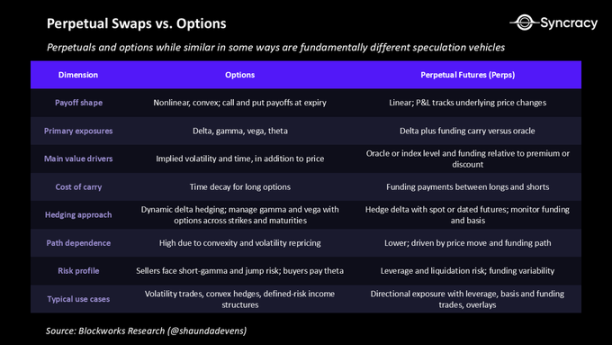
At their core, we believe perpetuals embody Occam’s Razor—meeting retail traders’ growing demand for leveraged trading with elegant simplicity.
Perpetuals vs. CFDs
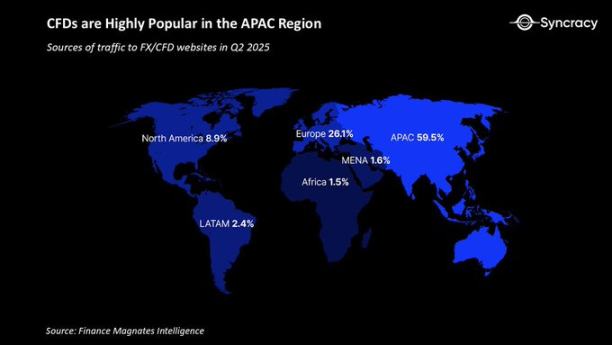
Options trading has exploded among U.S. retail traders, while in Asia, retail traders increasingly favor CFDs. In 2025, global FX/CFD industry monthly volume exceeded $30 trillion—far surpassing less than $10 trillion a decade earlier. Notably, ~60% of CFD website traffic originates from Asia-Pacific, while North America accounts for only ~9%.
Mechanically, CFDs resemble perpetuals in several important ways. They allow traders to gain leveraged directional exposure without owning the underlying asset, typically lack fixed expiries, and embed holding costs over time. Like perpetuals, they’re used for short-term speculation across diverse asset classes. In many respects, CFDs represent traditional finance’s attempt to emulate the cleaner economic properties of perpetuals.
Yet CFDs remain structural compromises. They’re offered over-the-counter by brokers—creating bilateral counterparty risk between trader and dealer. Pricing lacks transparency; spreads are set at dealers’ discretion; and risk controls can be unilaterally adjusted. Liquidity is fragmented across individual brokers’ books—not centralized in one transparent order book. Each position is essentially an isolated, arbitrary agreement between broker and trader—terms dictated unilaterally by the broker.
While options may possess certain advantages perpetuals lack, it’s difficult to identify any durable value proposition for CFDs. They inherit the inefficiencies, opacity, and trust dependency that perpetuals were designed to eliminate. In this sense, CFD brokers may be the easiest incumbent participants to disrupt via perpetual markets.
Democratizing 24/7 Trading
Another underappreciated advantage of stock and commodity perpetuals is their ability to unlock 24/7 trading—delivering a paradigm shift in how and when retail traders capture returns.
In equities, researchers have confirmed that limited trading hours impose structural disadvantages on retail traders—largely due to a phenomenon known as “overnight drift.” Data shows a disproportionate share of U.S. equity long-term returns accrues outside regular trading hours, with overnight price moves accounting for a large portion of realized performance.
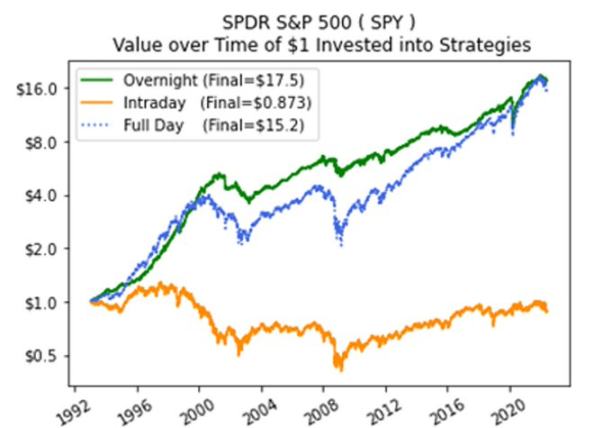
This becomes understandable given that earnings reports and major news often drop before market open or after close—and U.S. public markets are closed far longer than they’re open. Much market-moving news breaks overnight or on weekends—when retail traders are structurally marginalized. Traditionally, only hedge funds, institutions, and high-net-worth individuals accessing extended-hours venues or OTC channels with preferential terms could meaningfully participate during those windows.
Academic research suggests this imbalance may be amplified in so-called “attention stocks”—where retail participation is high. A 2022 study found retail traders disproportionately submit orders at market open—the very moment liquidity is thinnest and adverse selection highest. The authors illustrated the severity with a striking example: “An intraday trader buying AMC Entertainment at market open and selling at close every day from early 2019 through late May 2022 would have lost 99.6% of capital—but holding overnight positions over the same period would have yielded 30,000% returns (both ignoring transaction costs).” Though extreme, this highlights how trading-hour boundaries themselves can dramatically impact real-world outcomes.
One theory explaining this behavior posits that retail traders often think about potential trades in the evenings or on weekends—then submit execution orders at the next market open. So why not eliminate this friction entirely—allowing traders to participate whenever convenient?
Today, perpetual DEXs may be the only platforms globally capable of delivering this. By offering continuous exposure, they let traders react instantly to news—free from traditional market hours. In fact, this is no longer theoretical. Last weekend, amid heightened concerns over Iran conflict, Hyperliquid processed over $1 billion in crude oil trades—letting traders capture 30% of the spot price move between Friday close and Monday open, while retail elsewhere watched helplessly.
It should be noted that bid-ask spreads tend to widen during traditional market closures and illiquid windows. Yet we believe many users accept imperfect execution conditions for the privilege of participating. As perpetual DEX products mature, 24/7 trading may prove one of their most powerful user-acquisition channels.
Convergent Destinations: The Case for DEXs
As the opportunity for perpetuals becomes increasingly evident, traditional exchanges will inevitably enter this space. We’ve already seen announcements from ICE, CME, and Nasdaq about launching 24/7 trading on their respective markets. We believe it’s only a matter of time before they offer perpetual-like instruments.
If traditional financial exchanges—and incumbent U.S. CEXs—roll out and expand their own perpetual offerings, what lasting advantages remain for DEXs?
The Incompatibility Problem
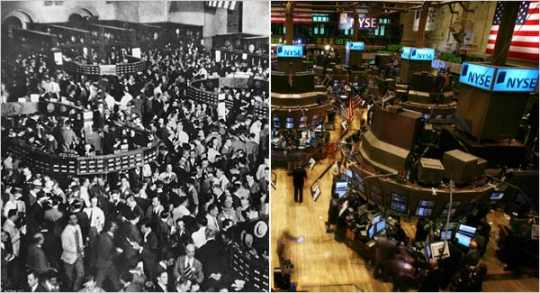
Perpetual DEXs may be the most misunderstood technology in crypto. Many critics dismiss platforms like Hyperliquid as regulatory arbitrage vehicles—waiting to be sued. Yet over time, it may become clearer that these exchanges are actually modernizing trading systems. Just as electronic trading transformed execution, monitoring, clearing, and settlement at the end of the 20th century, crypto-native exchanges are rethinking how to integrate and automate these functions into a single system. It’s hard to imagine that just decades ago, global trading activity was still centered in physical exchange floors.
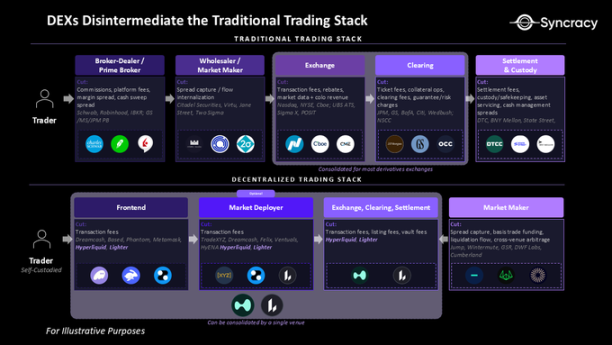
Rather than dispersing responsibility across multiple intermediaries, perpetual DEXs integrate most of the trading workflow into a single, unified system—with atomic margining and settlement. The exchange itself performs many functions traditionally handled by separate participants: frontends act as broker interfaces; smart contracts manage clearing and settlement in real time; APIs let market makers natively interact with takers inside the platform. In other words, work once coordinated across multiple institutional layers and internal operating systems can now be orchestrated by a single, always-on protocol.
Moreover, we believe DEXs’ ability to autonomously and transparently maintain solvency remains underappreciated. At its core, Hyperliquid has built the world’s best algorithmic liquidation engine on a verifiable ledger. Retail traders receive strong, predictable guarantees: they deposit specified collateral, leverage is applied programmatically, and only that deposited margin can be liquidated. Internally, positions remain continuously balanced between longs and shorts—triggering automatic deleveraging when necessary to prevent insolvency.
While critics highlight tail risks of automatic deleveraging during extreme market events, it’s precisely this mechanism that enables unprecedented leverage levels—typically 20x–50x—without reliance on centralized capital support. Unlike traditional margin systems, there’s no intermediary chain, no discretionary credit decisions, and no bilateral lending agreements. On Hyperliquid, risk management is deterministically handled by code—and everyone follows identical rules.
For large institutions accustomed to layered counterparty agreements and negotiable margin terms, this model may seem rigid or unfamiliar. But for the vast majority of retail traders, the product is more than sufficient—and lets them speculate with maximum flexibility and capital efficiency. In a sense, Hyperliquid is commoditizing leverage.
While extending trading hours may be relatively simple for traditional exchanges, integrating the full suite of perpetual mechanisms is fundamentally incompatible with current regulatory and infrastructure frameworks. In the U.S., stock/commodity perpetuals remain governed by the Commodity Exchange Act and Dodd-Frank Act—which require trades to occur on regulated venues and clear through central counterparties. These rules fragment workflows across brokers, exchanges, and clearinghouses—each extracting economic rent and accumulating technical debt. The result is a system where execution, risk management, and settlement are handled by numerous bloated, siloed parties operating on different tracks.
Traditional institutions cannot simply bolt perpetuals onto this framework. They’d need either sweeping top-down regulatory reform—or coordinated efforts to integrate operations across all participants in the process. This means truly replicating crypto exchanges’ 24/7 algorithmic functionality remains a multi-year project for incumbents. Although frameworks like Dodd-Frank were reasonable responses to shocking risk failures exposed by the 2008 crisis, some reforms may now appear overreactive in hindsight. In attempting to eliminate entire categories of risk, they may have left industries powerless to innovate amid technological change.
Given this, the real question isn’t whether incumbents can replicate crypto’s perpetual experience—but whether they can build competitive products before it’s too late. Can companies like Robinhood or ICE eventually build their own versions of HyperCore and HIP-3? With sufficient capital, determination, and regulatory alignment, it’s possible. Yet tech winners often exhibit path dependence—and by the time incumbents secure the regulatory clarity and complete the structural reforms needed to support perpetuals, the competitive landscape may already be settled.
Users won’t wait five years for a familiar brand to deliver perpetuals. Hyperliquid has already garnered broader media attention thanks to its viral product adoption. As Hyperliquid Labs and its partners accelerate go-to-market strategies, incumbents’ window to compete meaningfully is shrinking rapidly. Meanwhile, Hyperliquid continues iterating its own system—making it increasingly difficult for new entrants to merely achieve functional parity.

In the race to meet global perpetual demand, native crypto exchanges are the fastest horses—and may soon reach escape velocity. Betting on incumbents weighed down by legacy infrastructure feels akin to betting on The New York Times winning the online media market, Intel winning GPU computing, or Blockbuster winning streaming. History repeatedly shows new technologies create new winners.
Permissionlessness as a Scaling Advantage
Blockchains are inherently open, borderless systems. They let anyone with internet access use applications—and empower developers to build on top of them, effectively serving as the global API for money and finance. DEXs built on blockchains inherit these “permissionless” traits—and we believe this provides them with a significant scaling advantage over incumbents, long term.
From a builder’s perspective, as developer ecosystems grow, DEXs benefit from a virtuous cycle of utility and distribution. Hyperliquid again offers a compelling example—via its Builder Code and HIP-3 markets.
Builder Code establishes a revenue-sharing mechanism—giving third-party apps strong incentives to integrate Hyperliquid in the background. Practically, this means while CEXs struggle to acquire new trading flow, Hyperliquid has a fleet of frontend apps competing to acquire it. Incremental distribution can switch on instantly—like when Phantom Wallet introduced over 10 million new traders overnight. In the future, this could mean a major regional exchange offering Hyperliquid access in local language, a U.S.-regulated broker layer providing enhanced leverage or protection for Hyperliquid traders, or even a social media giant introducing perpetuals to its user base to boost ARPU.
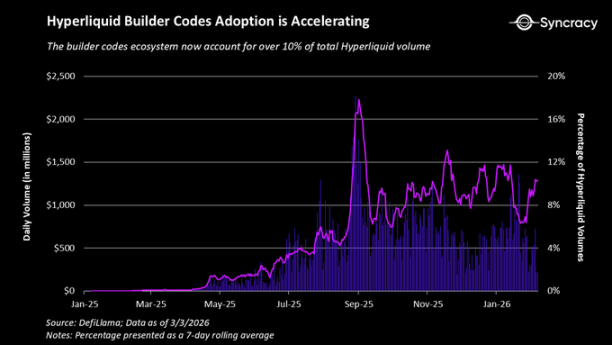
As noted earlier, HIP-3 allows third-party deployers to create new perpetual markets on Hyperliquid’s order book for novel assets. This open market-creation process lets Hyperliquid launch assets faster than any centralized incumbent. At equilibrium, each new auction should surface the next batch of assets with highest potential speculative demand—ensuring Hyperliquid consistently captures volume where attention and volatility concentrate. This has already been a huge tailwind in the recent metals boom: a single silver perpetual market run by a third-party team achieved over $1 billion in daily volume.
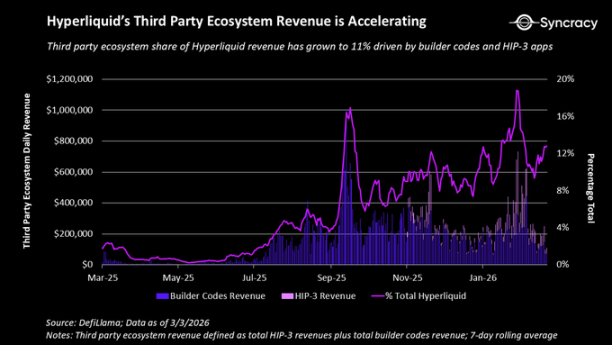
Combined with Builder Code, these mechanisms allow deployers to launch full exchanges built atop Hyperliquid. Today, Hyperliquid’s entire third-party ecosystem generates $90 million in annualized revenue. Competitors now face a critical question: Is it better to compete with Hyperliquid—or partner with it?
From a user perspective, DEXs democratize capital markets. While U.S. users may ultimately benefit from easier access to foreign assets, the greatest beneficiaries will likely be non-U.S. users. Over 6 billion people globally have internet access—yet 4 billion remain “unbanked.” Meanwhile, stablecoin adoption—the leading dollar asset on-chain—is growing exponentially internationally.
Additionally, a large portion of speculative activity occurs outside traditional brokerage channels—especially in Asia, the Middle East, and South America—where overnight and weekend trading dominates and access to U.S. markets is restricted. DEXs let these users participate directly—aggregating global liquidity without jurisdictional barriers or access restrictions.
In summary, we believe DEX architecture enables faster experimentation, broader asset coverage, and larger addressable markets.
The Economics of Autonomous Systems
In our original Hyperliquid report, we described Hyperliquid as “one of the world’s most efficient cashflow machines.” Today, it runs at $1 billion annualized revenue—with a 99% net profit margin and only 12 employees. These metrics are unparalleled not just among S&P 500 or Nasdaq companies—but with $83 million in revenue per employee, it ranks among the world’s most revenue-efficient organizations.
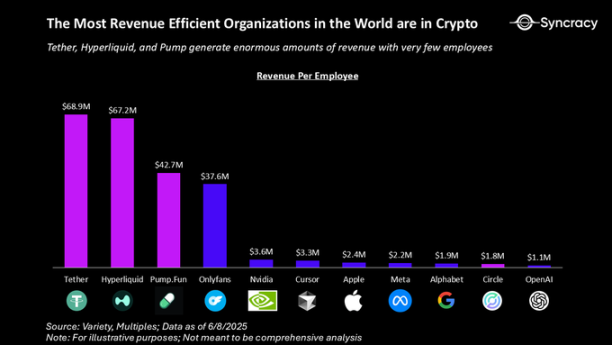
While Hyperliquid represents the most extreme manifestation of this model, it’s not the only DEX with such economic potential. Understanding this requires distinguishing what’s internal to the exchange economy—and what’s external.
The core argument is that DEXs are software—not institutions. Core teams bear upfront costs of building the exchange—and may earn token rewards for ongoing development. But unlike CEXs, they don’t maintain fiat rails, massive compliance teams, regional branches, customer support, or large-scale custody and treasury operations. Once live, the only ongoing fixed cost is minimal token inflation paid to validators. For example, estimated Hyperliquid validator operating costs total ~$10,000 per month—negligible against Hyperliquid’s $1 billion annualized revenue.
In fact, as user acquisition, localization, and asset onboarding increasingly get outsourced to third-party frontends and ecosystem builders, the protocol itself scales like software—at near-zero marginal cost. This means once DEXs reach escape velocity, they enjoy enormous operating leverage. At the limit, a sufficiently mature DEX might require no direct team compensation whatsoever. Instead, third-party teams contribute to the core protocol via open-source contributions—funded by revenues generated from businesses they build atop the exchange. Such a DEX would effectively operate at 100% net profit margin.
Most importantly, perpetual DEXs exhibit compounding advantages as they scale. Deeper liquidity improves liquidation quality. Better liquidations support tighter margin requirements and higher capital efficiency. Higher capital efficiency and stronger solvency assurances boost user confidence—and attract more liquidity. Over time, we believe this dynamic will lead to winner-take-all outcomes in the industry—with capital accumulating where risk management is most effective.
The Silent Power of Trust
“Not your keys, not your coins.”
“Don’t trust, verify.”
These mantras get passed down in every crypto cycle—warning newcomers about the risks of trusting centralized counterparties. For a long time, due to the challenges outlined above, trading crypto required centralized intermediaries. As a result, crypto’s history is littered with exchange failures—from Mt. Gox to FTX.
While decentralization is often viewed as a philosophical commitment in blockchain, at the practical level, blockchain applications significantly reduce counterparty risk for users. Unlike CEXs—which are effectively closed, opaque systems—DEXs give users non-revocable rights enforced by code.
For perpetual use cases, this means users can verify margin logic, funding rate mechanisms, liquidation rules, and exchange solvency in real time—rather than relying on broker guarantees or post-hoc interventions. We believe this is critically important, as CEXs continue eroding user trust even years after FTX’s collapse—from opaque withdrawal controls to unclear internal risk failures. Moreover, similar transparency and governance failures aren’t unique to crypto—they’re broadly endemic to closed financial systems.
Ultimately, financial markets are confidence systems. Traders participate more readily when rules are clear and enforcement is mechanical. That’s DEXs’ structural advantage. By offering maximum transparency, auditability, and fallback guarantees (e.g., Lighter lets users withdraw collateral to Ethereum mainnet anytime), users face lower counterparty risk. All else equal, this should make users more willing to use DEXs—and give regulators a clear differentiation point versus offshore CEXs.
The Path to Hundreds of Billions
“Young/emerging companies open new markets—and it’s easy to underestimate the total addressable market. Is Uber or Lyft replacing taxis—or redefining car ownership?” — Philippe Laffont
Today, leading perpetual DEXs collectively have a fully diluted market cap under $40 billion. Outside crypto, the largest publicly traded exchanges and brokerages represent over $1 trillion in market cap. We believe the perpetual DEX industry can penetrate—and meaningfully grow—this overall pie.
To recap, our thesis rests on three core assumptions about the perpetual DEX industry:
- Perpetuals can be created for any asset with a clear price index.
- Perpetuals can capture meaningful shares of traditional futures and options volume—particularly in retail-driven markets.
- DEXs possess structural advantages over centralized incumbents—and will continue leading the perpetualization of new asset classes.
Estimating the Opportunity Size
Today, given CEX scale, DEXs capture only a small fraction of crypto perpetual volume. Against the broader global derivatives market, they’re essentially negligible. Options, futures, and CFD markets generate over $8 trillion in daily notional volume—while perpetual DEXs account for just $20 billion.
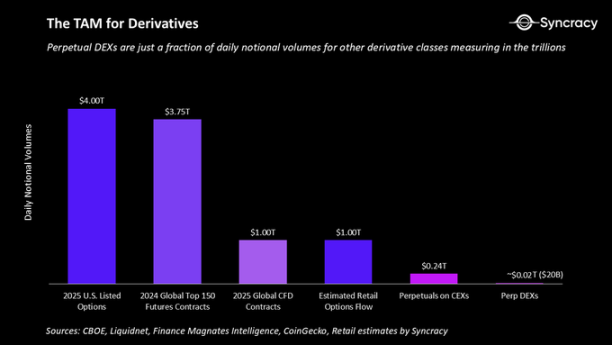
Of course, not all this flow is capturable. Yet we do believe short-dated options and global CFD markets represent realistic opportunities for these exchanges in the coming years. As these products become more accessible, retail participation in these markets will only increase—and perpetuals offer an elegant alternative for leverage-hungry retail traders. The scale of this opportunity cannot be overstated. For example, capturing just 20% of our estimated retail options flow (5% of total options volume) would expand the entire perpetual DEX market tenfold.
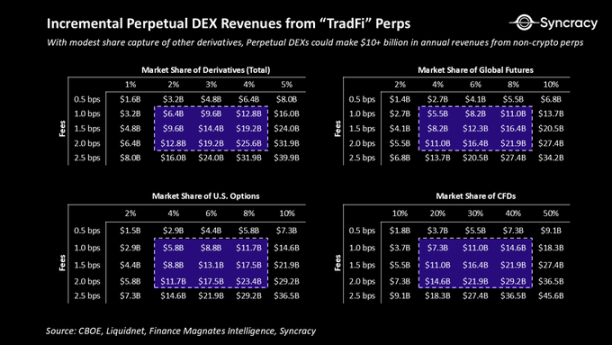
Even modest market-share capture yields massive revenue impact. The table above illustrates annual fee opportunities across a range of plausible fee levels and market penetration rates in global derivatives. At practical fee rates of 1–2 basis points, capturing just 1% of derivatives volume translates to ~$3–7 billion in annual revenue. Reaching 2%–4% share quickly scales this opportunity into the tens of billions. Recall—as noted above—perpetual DEXs boast incredible margins, so these revenues can be treated as profit.
The key point is that perpetual DEXs don’t need to monopolize global trading to become highly valuable enterprises. Even low-single-digit penetration of these end markets is enough to trigger major reassessments of expected business outcomes. We believe the retail speculation channel is large enough to accommodate this initial capture rate.
As a benchmark, on January 30—a day of record metal volatility—Hyperliquid captured ~2% of global silver derivatives volume while offering competitive spreads to retail traders. Sustaining this performance across diverse assets and market conditions is challenging—but early progress is encouraging.
Looking further ahead, as perpetuals evolve, traditional fixed-term futures may retreat to their original purpose: hedging long-term risk—especially for physically delivered assets. This isn’t far-fetched. In today’s major contracts, most futures volume is driven by speculative, arbitrage, or volatility traders—not producers or corporations hedging operational risk. CFTC cross-asset data shows well over half (likely ~80%) of futures activity is speculative—not commercial.
If perpetuals can replicate these contracts’ economic exposure—while offering continuous trading, simpler contract design, and unified cross-asset margining—they possess structural advantages in speculative share. In that world, fixed-term futures remain essential for real-world risk managers—commodity producers, airlines, banks—while perpetuals become the dominant contract type for speculation. Given this end state, there exists a credible—even if difficult—path to double-digit penetration of the entire derivatives market.
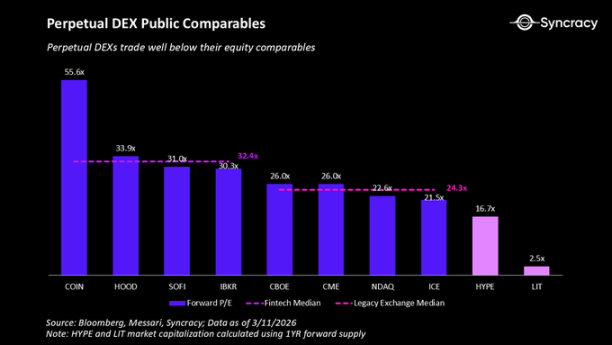
We believe markets haven’t yet recognized this potential—or the long-term competitiveness of perpetual DEXs. Market leaders Hyperliquid and Lighter trade at P/E multiples of just 17x and 3x respectively—far below fintech and traditional exchange peers. Below, we quantify this opportunity using peer multiples and our 2030 industry profit estimates (derived from the analysis above).
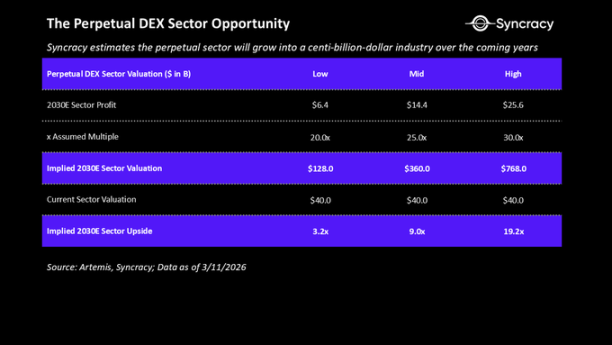
As shown above, numbers balloon with minimal assumptions. Still, it’s worth noting all analysis above is U.S.-centric—and assumes no growth in total derivatives volume. Considering global derivatives volume overall—and the expanded addressable surface from 24/7 trading—this TAM should expand significantly.
The Endgame Exchange—Perpetuals as Trojan Horse
Finally, it must be emphasized that the endgame for perpetual DEXs isn’t merely more efficiently replicating existing derivatives markets—but massively expanding the derivatives market’s scope. Through initiatives like HIP-4, Hyperliquid can natively support adjacent products—including prediction markets and options—in the same unified system. Combined with portfolio margining, this opens the door to an endgame exchange architecture—far exceeding today’s fragmented traditional systems in capital efficiency and expressiveness.
Platform Opportunity
By now, it should be clear how lucrative perpetuals are for blockchains. The data alone proves it—Hyperliquid is the world’s highest-revenue blockchain. Less obvious—but equally important—is that perpetuals are among the hardest use cases to build on-chain—and by succeeding, every other blockchain use case becomes easier to “plug in.”
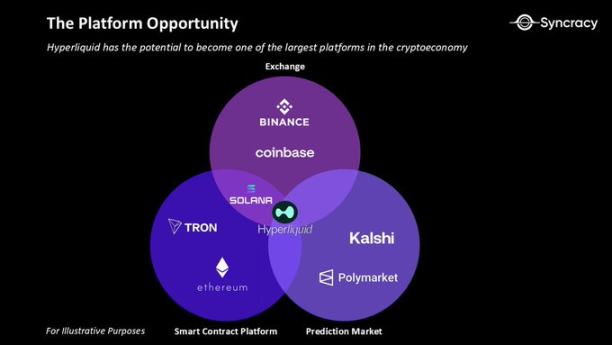
Historically, blockchains suffered from microstructural weaknesses—including high latency, adverse selection, and limited throughput—that made perpetuals infeasible. While many of these issues matter for use cases like payments and spot trading, they’re not mission-critical. For example, latency and throughput issues might mean stablecoin transfers don’t arrive instantly—but you’ll still get your money. By contrast, a perpetual exchange that can’t liquidate collateral fast enough goes insolvent.
Now that leading perpetual DEXs have solved these problems, they’re unsurprisingly expanding into new domains. Hyperliquid and Lighter both launched spot markets and EVM sidechains in the past year—the latter letting them offer products compatible with general-purpose platforms like Ethereum and Solana. In the same period, Hyperliquid launched its own community-driven stablecoin. Recently, it announced HIP-4—providing foundational building blocks for prediction markets and options trading on Hyperliquid. Synergies between these use cases are exciting—and best illustrated by a hypothetical example.
In the future, as more assets get tokenized on Hyperliquid, imagine a world where you can use any basket of assets as collateral to create any synthetic exposure. For instance, you’re bullish on USD depreciation and AI infrastructure—and hold a concentrated portfolio including Bitcoin, gold, and tokenized stocks of NVIDIA, SK Hynix, and TSMC. You post that portfolio as collateral to short a software stock index—believing these firms are obsolete in the era of proxy coding. Via the native options market, you hedge your liquidation threshold using rollable term contracts. After speaking with a friend in Washington, you worry about geopolitical risk—so you protect your portfolio by buying “yes” shares on Hyperliquid’s prediction market (“China invades Taiwan before 2030”). Your track record is so strong that you begin offering portfolio management services via a real-time-auditable, self-custodial vault—accessible to anyone. A user deposits stablecoins into this vault via a privacy pool on the connected EVM sidechain. That user discovered this opportunity via a new social trading interface built around transparent on-chain financial data. All this activity happens on a single, global, permissionless system.
This is where the endgame exchange transcends traditional notions of an exchange. Any venue that aggregates these foundational modules under one roof achieves incremental growth—where the whole exceeds the sum of its parts.
Many steps remain before realizing this future. But the core idea is that when assets share a unified ledger, a Cambrian explosion of financial activity becomes possible. Thus, we believe if perpetual DEXs successfully seize this platform opportunity, they can generate Solana- or Ethereum-scale outcomes—and break the trillion-dollar mark long term.
Conclusion
To many, this seems like a serendipitous financial tool born from the industry’s hunger for endless speculation—but it may ultimately become one of crypto’s most important innovations. One day, this innovation may join digital gold, stablecoins, and prediction markets as members of the industry’s “Mount Rushmore.”
The evidence is in the data. Perpetuals don’t just have clear growth prospects as the dominant derivative in the long-expanding crypto economy—they hold distinct advantages over options and futures that will let them absorb larger shares of retail demand from traditional asset classes. In the first few months of perpetual “real-world asset” expansion, they’ve already begun influencing global financial markets—most recently serving as a weekend oil price discovery engine during the Iran conflict. We believe perpetuals’ primacy will only become more pronounced over time.
Throughout this process, we believe DEXs like Hyperliquid will continue capturing market share from CEXs like Binance and Coinbase. Hyperliquid has already become the runaway leader in stock and commodity perpetuals—a harbinger of things to come. DEXs possess structural advantages: they’re self-custodial, real-time auditable, permissionless to build on, and globally accessible. These traits will let them outcompete CEXs long term. Meanwhile, incumbents like CME and ICE face years of incompatibility due to regulatory and architectural constraints.
Finally, as DEXs lead perpetual growth, we believe they’ll expand into adjacent categories. Perpetuals are the hardest product to get right on-chain—and once a blockchain succeeds at hosting them, it naturally begins aggregating other crypto use cases as a byproduct. Early evidence is already visible: Hyperliquid expanded into spot trading and stablecoins—and will soon add prediction markets and options. In this sense, perpetual DEXs are also the Trojan horse for the future financial platform.
Of course, growing pains remain. DEXs still lack regulatory clarity. Perpetual DEXs need to fine-tune their risk engines—from optimizing automatic deleveraging to exploring incremental insurance funds. They’ll also need to reduce funding costs and gap risk for traditional markets over time. Yet we believe these are detail-level issues—not dealbreakers—and the most important thing is maintaining directional accuracy on the trend—not arguing over obstacles along the way.
Ultimately, we believe blockchains are natural monopolies—boasting powerful network effects around liquidity, integration, security, and developers. At scale, these networks become digital superstructures—interconnected assets, applications, enterprises, and users—that cannot be easily replicated or imitated. As noted above, the TAM can reliably be measured in trillions—and winning the blockchain that hosts perpetuals will be among the largest prizes in global finance.
Though perpetuals have come a long way in their first decade since invention, the truth is this category remains just a grain of sand on the beach of global finance.
Yet that’s precisely why all this is so exciting.
The “perpetualization” has only just begun.
Join TechFlow official community to stay tuned
Telegram:https://t.me/TechFlowDaily
X (Twitter):https://x.com/TechFlowPost
X (Twitter) EN:https://x.com/BlockFlow_News
 @defi_monk















