
Ethereum Foundation Sells Another 10,000 ETH; BitMine OTC Takes Delivery—What Happened to the “No More Token Sales” Pledge?
TechFlow Selected TechFlow Selected
Ethereum Foundation Sells Another 10,000 ETH; BitMine OTC Takes Delivery—What Happened to the “No More Token Sales” Pledge?
The third large-scale Bitcoin sale in 2026, with a single transaction volume setting a new annual high.
 Navigating Web3 tides with focused insights
Author: Claude, TechFlow
TechFlow Intro: On April 24, the Ethereum Foundation (EF) completed an over-the-counter (OTC) sale of 10,000 ETH at an average price of $2,387, totaling approximately $23.87 million. The buyer was BitMine, led by Tom Lee. This marks EF’s third major ETH sale this year—but the buyer is accumulating ETH at a pace of tens of thousands per week, targeting 5% of total circulating supply. EF’s timing—selling ETH in the same week that the Kelp vulnerability triggered DeFi’s largest-ever rescue effort—has once again drawn criticism from the community.
The Ethereum Foundation shows no sign of slowing its ETH sales pace.
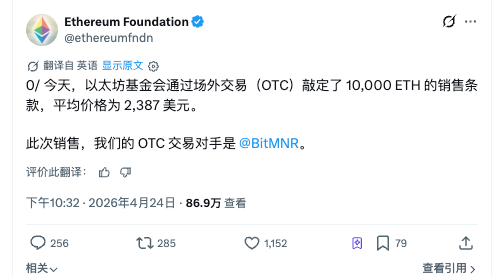
On April 24, EF announced on X that it had completed an OTC sale of 10,000 ETH at an average price of $2,387, for a total of approximately $23.87 million. The counterparty was BitMine Immersion Technologies (NYSE: BMNR). The on-chain transaction originated from EF’s Safe multisig address (0x9fC3dc011b461664c835F2527fffb1169b3C213e). According to EF’s statement, proceeds will fund protocol development, ecosystem growth, and community grants.
The context of this sale is particularly delicate: that same week, the DeFi industry was fully engaged in responding to the $292 million Kelp DAO exploit. Aave joined over a dozen protocols to launch the “DeFi United” rescue fund, aiming to raise 100,000 ETH. EF’s decision to sell ETH rather than participate in the rescue has triggered another wave of community dissatisfaction.
Third Major Sale of 2026—Largest Single Transaction This Year
This is not an isolated incident. Since the start of 2026, EF has completed at least three large-scale ETH liquidations:
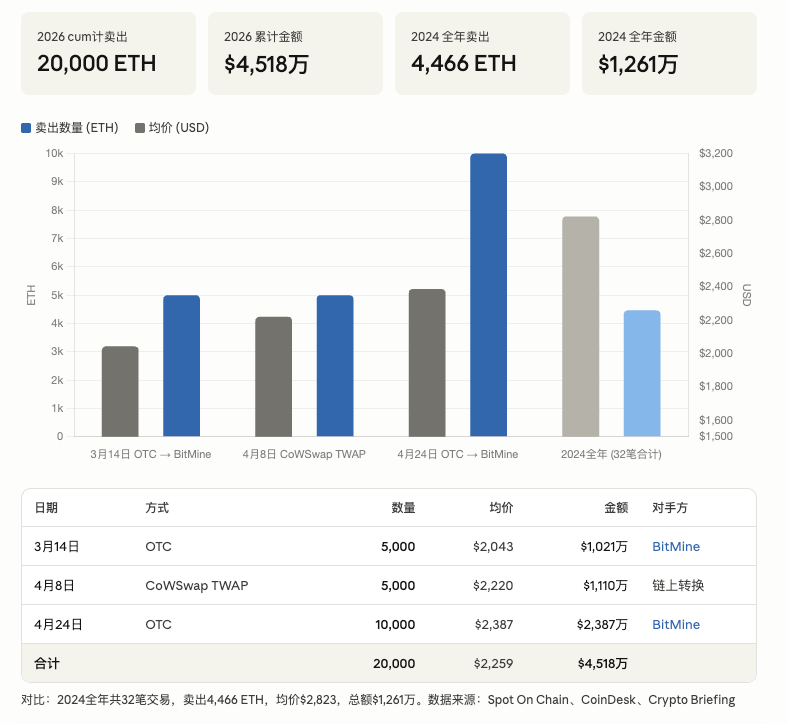
On March 14, EF sold 5,000 ETH via OTC to BitMine at an average price of ~$2,043, for a total of ~$10.21 million. On April 8, EF used CoWSwap’s TWAP (time-weighted average price) functionality—splitting a large order into multiple smaller trades to minimize market impact—to convert 5,000 ETH into ~$11.1 million in DAI stablecoins, when ETH traded at ~$2,220. The April 24 OTC sale of 10,000 ETH is the largest single transaction of the year.
These three transactions collectively sold 20,000 ETH, worth approximately $45.18 million.
Looking further back, according to Spot On Chain data, EF sold roughly 4,466 ETH across 32 transactions in 2024, totaling $12.61 million at an average price of $2,823. Of those, 15 occurred near阶段性 ETH price peaks, earning EF the community-given nickname “Top-Exit Master.”
The key shift in 2026 is the dramatic scale-up: sales have jumped from the “retail-style” batches of ~100 ETH in 2024 to institutional-sized transactions of 5,000–10,000 ETH each. This aligns with EF’s Treasury Management Policy released in June 2025, which stipulates that annual operating expenditures should equal 15% of total treasury value, while maintaining a 2.5-year fiat operational buffer. When fiat reserves fall below this target buffer, automatic ETH sales are triggered.
Buyer BitMine: Holds Nearly 5 Million ETH, Targeting 5% of Circulating Supply
The identity of the buyer, BitMine, adds another layer of significance to this sale.
BitMine is chaired by Tom Lee, founder of Fundstrat. In June 2025, BitMine formally launched its ETH treasury strategy via a $250 million private placement. As of April 24, BitMine holds approximately 4.97 million ETH—about 4.12% of total ETH circulating supply—with total assets valued at ~$12.9 billion. It is now the world’s largest corporate ETH treasury and the second-largest corporate crypto treasury globally, trailing only Strategy (formerly MicroStrategy) in BTC holdings.
BitMine’s buying pace is extremely aggressive. According to CoinDesk, BitMine acquired 101,627 ETH (~$230 million) during the third week of April alone—the largest weekly purchase since the start of 2026. The company aims to hold 5% of ETH’s circulating supply (~6 million ETH), having currently achieved ~81% of that target. Approximately 3.33 million ETH are already staked, generating an estimated $221 million in annualized staking income.
In February, when ETH fell below $2,000 and BitMine’s unrealized losses reached ~$8 billion, Tom Lee continued buying—and publicly declared ETH to be in the “final stage of a mini crypto winter.” On April 13, he labeled ETH a “wartime store of value.”
In other words, EF’s 10,000 ETH did not enter the open market but instead went directly to an institution that has explicitly stated its long-term holding intent—and is acquiring ETH at a pace far exceeding EF’s selling rate. From a supply-structure perspective, the actual market impact of this OTC transaction is effectively zero.
If EF Has Staked 70,000 ETH, Why Is It Still Selling?
On February 24, EF announced the launch of a 70,000-ETH staking initiative, largely completed by April 3, with ~69,500 ETH staked—worth ~$143 million at the time. At an annualized staking yield of 2.7%–3.8%, this generates ~$3.9–5.4 million in yearly income.
The community initially interpreted this as signaling EF “no longer needs to sell ETH.” Even Reddit hosted discussion threads titled “EF Has Stopped Selling ETH.” But that illusion was quickly shattered by the March OTC sale and the April 8 CoWSwap conversion.
The arithmetic is straightforward: EF’s Q1 2025 grant disbursements totaled $32.6 million—equivalent to ~14,700 ETH at prevailing prices. Annual staking income of $3.9–5.4 million covers only about one-third of a single quarter’s grants. Likewise, the $11.1 million converted on April 8 represents just 33% of a quarterly grant budget. While staking and DeFi lending have improved treasury flexibility, they fall far short of replacing direct ETH sales.
Beneath the “Top-Exit Master” Label: Historical Correlation Between EF Sales and ETH Price
The relationship between EF’s ETH sales and ETH price remains a perennial topic in the crypto community.
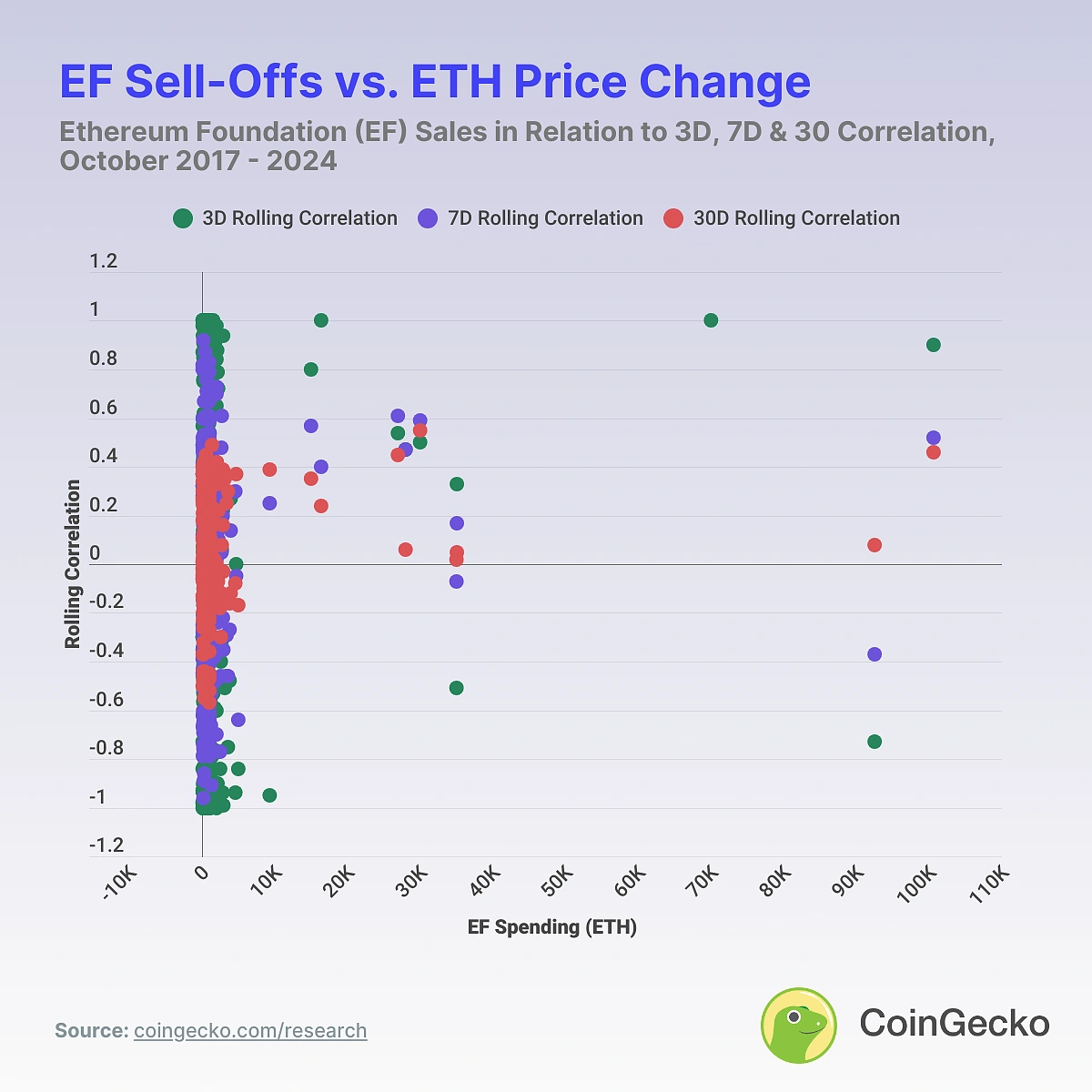
According to a March 2026 CoinGecko research report analyzing all EF on-chain transfers of more than 100 ETH between October 2017 and January 2025, the 30-day rolling correlation coefficient ranged mostly between −0.3 and +0.5—indicating weak to moderate correlation. Short-term (3-day) correlations fluctuated wildly—from −0.999 to +0.999—reflecting market sentiment more than any causal effect of EF’s sales themselves.
Nonetheless, several specific cases left strong impressions. After EF’s concentrated sales in December 2017, ETH dropped nearly 40% from its $850 peak to $520. In May 2023, EF transferred 15,000 ETH to Kraken exchange, after which ETH price fell ~6%. Among the 32 transactions in 2024, on-chain analyst Spot On Chain flagged 15 as occurring near local price highs.
At press time, ETH trades at ~$2,328—down ~52% from its all-time high of $4,897 set in August 2025—and is consolidating just below the critical resistance level of $2,500.
Join TechFlow official community to stay tuned
Telegram:https://t.me/TechFlowDaily
X (Twitter):https://x.com/TechFlowPost
X (Twitter) EN:https://x.com/BlockFlow_News
 深潮TechFlow