Perpetual Contracts + Tokenization: The Driving Force Behind the RWA Boom?
TechFlow Selected TechFlow Selected
Perpetual Contracts + Tokenization: The Driving Force Behind the RWA Boom?
The significance of tokenization lies more in the series of actions traders take after going on-chain: betting, hedging, and leveraging.
 Navigating Web3 tides with focused insights
Author: Nina Bambysheva, Forbes
Translation: Saoirse, Foresight News
Today we're diving into a seemingly niche but deeply intricate area of the crypto world: perpetual futures for tokenized real-world assets (RWAs). Sounds complicated? Yet many insiders believe that what might truly ignite the RWA boom isn't the currently popular tokenized stocks, but rather these hidden derivatives. Let's unpack how this actually works.
A Quick Guide to "Perpetual Contracts"
Perpetual futures—also known as "perpetual contracts"—are a type of cryptocurrency derivative that allows traders to speculate on an asset’s future price without the contract ever expiring. For example, if you’re bullish on Bitcoin, you can buy a Bitcoin perpetual contract and hold it indefinitely.
This trading doesn’t require full upfront payment; instead, traders only need to post margin—a fraction of the total position value—with the rest covered by leverage. This enables small amounts of capital to control large positions, which is one reason why perpetuals are so popular among traders.
Surely someone is wondering: with no expiration date, how do you prevent the contract price from drifting away from the actual market price? The answer lies in the "funding rate" mechanism. Every few hours, participants on opposite sides of the market settle fees: if long positions dominate, longs pay shorts; if the market turns bearish, shorts pay longs. These fees are automatically deducted from or added to your account while holding a position. For example, if you hold a $10,000 long Bitcoin contract during a period when the funding rate is 0.01%, you’d pay $1 to short holders at settlement; if you were short, you’d receive $1.
It sounds complex, but traders love it. According to CoinGecko data, perpetual contract trading volume on centralized exchanges reached $58.5 trillion in 2024—more than triple the spot market. Decentralized exchanges saw $1.5 trillion in perpetual trading volume.
The Collision of Tokenization and Perpetuals
Now let’s turn to another hot topic in crypto: tokenization. Industry executives often say “the market is going on-chain.” From BlackRock’s Larry Fink to Robinhood’s Vlad Tenev, many have painted a vision where Tesla shares, Apple stock, bonds, or even Grandma’s antique collection could be traded on blockchain. Markets would never close, settlement times would shrink from days to seconds, and capital previously tied up in clearing processes could be freed up.
While platforms like Robinhood and Kraken have launched tokenized stocks, far more activity happens in perpetual contracts based on these assets. The reason is simple: traders don’t just want to hold tokenized Apple stock—they want to profit from speculating on its price movements.
Take xStocks, launched in late June as a tokenized product for stocks and ETFs. It trades on centralized exchanges like Kraken and Bybit, as well as decentralized platforms such as Raydium and Jupiter on Solana, and has already achieved $558 million in trading volume.
Then there’s iAssets, developed by Injective Labs on the Injective blockchain, traded via the Helix decentralized exchange, with cumulative trading volume exceeding $1.7 billion. iAssets aren’t direct representations of stocks, but rather perpetual futures linked to “Magnificent Seven” tech giants, Circle, and even SharpLink Gaming, which uses Ethereum as its treasury backbone. Like most crypto perpetuals, iAssets support leveraged trading, typically up to 25x.
"Last week alone, trading volume hit $107 million, and the week before peaked at $291 million," said Eric Chen, co-founder and CEO of Injective. Trading fees hover around 0.05%. Importantly, Injective does not actually own Circle or Nvidia shares. Instead, it uses "oracles" to pull real-time prices from traditional markets, allowing iAssets to simply track those prices so traders can speculate on the underlying stocks.
John Wang, Kalshi’s newly appointed head of crypto, sums up the appeal of RWA perpetuals: “Want to trade $1 billion worth of Apple-related exposure? You don’t need to raise $1 billion in actual Apple stock—just matching long and short positions will do.” In short, no one is buying Apple shares; traders are merely betting on price movements, and collectively those bets create a $1 billion trading volume. Add leverage into the mix—25x leverage means $40 million can control a $1 billion position.
"Most RWAs aren’t assets people want to hold long-term. Traders don’t care about dividends, transfer rights, or voting in shareholder meetings. They just want to trade: go 10x long on the S&P 500, short Tesla, play oil swings based on CPI data, bet on interest rate moves..."
There’s truth in that. Some joke that the core product in crypto is simply “tokens,” and if so, perhaps the industry’s real innovation lies in new forms of speculation. That helps explain the success of Polymarket, Pump.fun, and Hyperliquid—the perpetual giant that dominates 80% of the market.
So here’s the question: before tokenized RWAs even gain solid footing, will perpetuals render their spot trading irrelevant? Injective’s Chen says no. He argues that without tokenized Tesla stock as a market anchor, synthetic derivatives like iAssets would struggle with pricing chaos and insufficient liquidity.
In traditional finance, market makers providing liquidity for derivatives on assets like Tesla (options or futures) often hedge their risk by trading the underlying stock. Crypto works similarly. Tokenized spot assets provide traders with hedging tools—even if perpetuals dominate trading volume, spot RWAs remain foundational.
Think about it: traders are essentially betting on "derivatives of derivatives" of companies like Tesla and Nvidia. It sounds absurd—as if crypto has once again overcomplicated things. So why not just trade options or futures through a regulated broker?
Because for crypto users, these products are simply more convenient!
"Perpetuals are much simpler than options," says TK Kwon, co-founder of tokenization startup Theo. "The pricing and funding rate mechanisms are basic enough for anyone to understand (though I have my doubts), and they’re highly capital-efficient." In practice, this means traders can control large positions with minimal upfront capital via leverage, roll positions indefinitely, and avoid worrying about expiration dates or the complex math behind options pricing.
In contrast, trading stock options or futures in the U.S. comes with high barriers—usually requiring accredited investor status or access through brokers connected to platforms like the Chicago Mercantile Exchange (CME).
TK Kwon hopes Theo will eventually run both spot and perpetual markets, enabling users to, for example, buy tokenized gold (spot) and speculate on gold’s future price (gold perpetuals) on the same platform. This setup enables strategies like "arbitrage trading," where traders profit from tiny price differences between the two. For professionals, it’s standard practice; for the broader market, it boosts liquidity.
That day may come sooner than expected: perpetual giant Hyperliquid is planning a system upgrade allowing anyone to create new perpetual markets for nearly any asset.
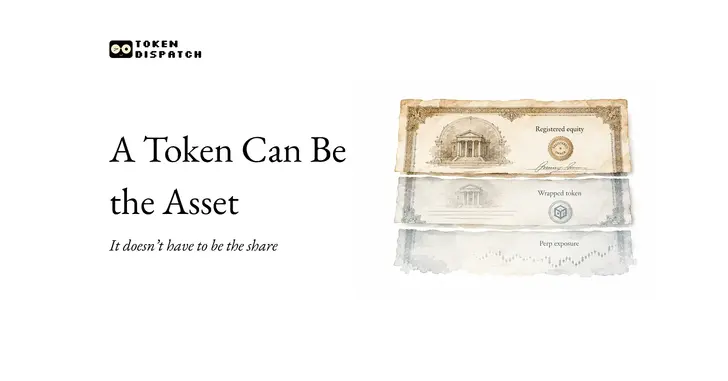
At the end of the day, tokenization isn’t just about “putting Apple stock on-chain.” It’s about everything traders do afterward—speculating, hedging, leveraging. Crypto developers’ creativity shouldn’t be underestimated, especially when designing new ways to trade (and speculate on) their own digital assets. That creativity is both a strength—and a potential risk.
Join TechFlow official community to stay tuned
Telegram:https://t.me/TechFlowDaily
X (Twitter):https://x.com/TechFlowPost
X (Twitter) EN:https://x.com/BlockFlow_News
 Forbes