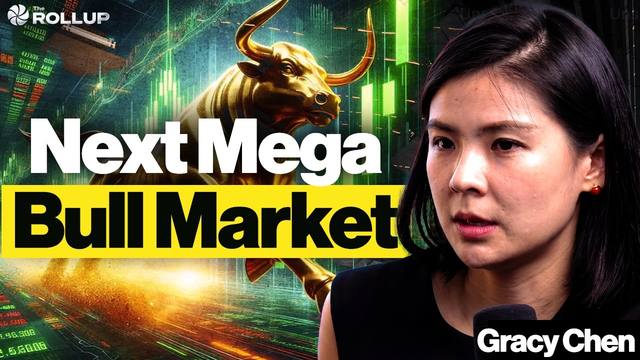
Dialogue with Bitget CEO and Dragonfly Partner: BTC at $60,000–$70,000 Is an Ideal Opportunity for Dollar-Cost Averaging; CEXs Are Moving Toward an “All-in-One” End State
TechFlow Selected TechFlow Selected
Dialogue with Bitget CEO and Dragonfly Partner: BTC at $60,000–$70,000 Is an Ideal Opportunity for Dollar-Cost Averaging; CEXs Are Moving Toward an “All-in-One” End State
If you expect Bitcoin to surge rapidly in the short term, it may not be a suitable asset class for short-term speculation.
 Navigating Web3 tides with focused insights
Compiled & Translated by TechFlow
Guests: Gracy Chen, CEO of Bitget; Rob Hadick, Partner at Dragonfly Capital
Host: Laura Shin
Podcast Source: Unchained
Original Title: Why Crypto Exchanges Want to Become the 'Everything App'
Air Date: March 10, 2026
Key Takeaways
Crypto exchanges are gradually transforming from single-purpose token trading platforms into more comprehensive, all-in-one platforms.
In this episode of the Unchained podcast, host Laura Shin engages in an in-depth discussion with Dragonfly partner Rob Hadick and Bitget CEO Gracy Chen on the rise of the “universal exchange.” These platforms go beyond crypto trading to include tokenized stocks, commodities, and other real-world assets (RWAs), evolving into multifunctional financial hubs.
The conversation explores why exchanges are increasingly converging with fintech, how tokenized stocks and RWAs could reshape global trading, and why more crypto platforms are striving to become “universal exchanges.”
Additional topics include Bitget’s integration of AI tools into trading, the future of altcoins, and how geopolitical conflicts, oil prices, and other macroeconomic factors influence the crypto market.
Rob and Gracy also compare crypto adoption across Eastern and Western markets, examining why Asia tends to adopt digital finance faster than other regions—and why tokenized assets hold particular appeal for investors who lack access to traditional financial systems.
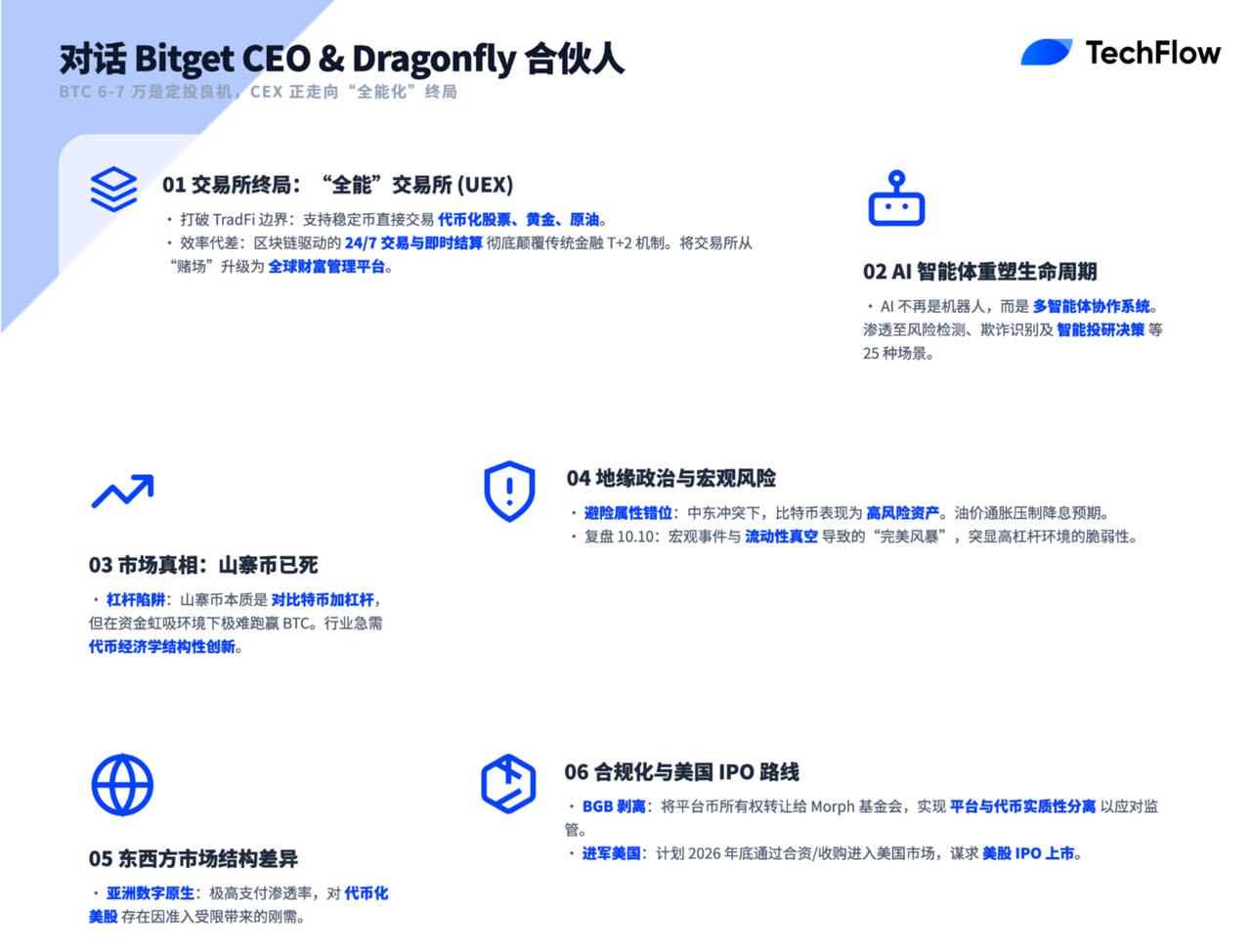
Key Insights Summary
On the Vision of the “Universal Exchange” (UEX)
- It’s no longer accurate to call ourselves just a CEX—we now serve not only crypto users but also traditional finance users, or at least those wishing to buy traditional financial assets using stablecoins. That’s why we decided to evolve into a UEX—a universal platform supporting all asset classes.
- User behavior clearly shows demand for a single place to trade all assets.
- Demand for cross-asset trading is rising, with users seeking complex trading strategies that may require combining on-chain and off-chain elements—or integrating CEX and DEX options, as Gracy noted.
On “Altcoins Are Dead” and Their Survival Challenges
- Investing in altcoins is like leveraging—yet this leverage rarely outperforms Bitcoin.
- The overall altcoin market is shrinking while the number of altcoins increases. Consequently, each individual altcoin’s market share naturally declines—this is why I say “altcoins are dead” or “investing in altcoins is getting harder.”
- Token holders essentially get nothing. This further confirms that some tokens exist merely as “concept coins” or “meme coins”—even if associated with strong businesses or products, the tokens themselves carry little intrinsic value.
On Bitcoin’s Positioning and Dollar-Cost Averaging Advice
- The $60,000–$70,000 price range for Bitcoin is actually an ideal window for dollar-cost averaging.
- I still consider it “digital gold” for millennials—and the purest expression of liquidity.
- Bitcoin is increasingly viewed as a high-risk asset rather than a safe-haven asset.
- If you expect rapid short-term gains, Bitcoin may not be suitable for short-term speculation—it needs time to mature.
On How Blockchain Technology Disrupts Traditional Finance
- Over the past century, the financial world hasn’t evolved much—it remains stuck on T+2 settlement cycles, and account opening is still cumbersome. We don’t want to return to that old system. In our view, blockchain technology—like stablecoins and cross-border payments—is faster and cheaper than traditional cross-border transactions.
- Bitcoin’s current $60,000–$70,000 price range is an ideal window for dollar-cost averaging.
- Though Bitcoin underperformed gold last year and currently, I still regard it as “digital gold” for millennials—and the purest expression of liquidity.
On AI Agents and Trading
- These Agent Operating Systems (Agent OS) can truly understand users’ portfolios, goals, behaviors, and habits—helping them make better decisions.
- A key message the market is sending right now is that nobody really knows how far AI will advance in even one year—let alone less. It’s an exciting era—one worth exploring, experimenting with, and mastering.
On IPO Plans
- We may plan to list in the U.S. within the next two to three years.
On Behavioral Differences Between Eastern and Western Markets
- Digital adoption is far higher in Asia. For example, Alipay’s penetration rate reaches 98% in certain Asian regions—an acceptance and familiarity with digital currencies unseen elsewhere.
- In Asian households, mothers often manage family finances—even executing complex investments—a behavioral pattern uncommon elsewhere.
- Western users tend toward longer-term investment horizons, viewing crypto as a store of value or portfolio diversifier. Eastern users, by contrast, exhibit more trading- or speculation-oriented behavior.
On Macro Conditions and the October 10 Crash Post-Mortem
- We’ve consistently advised our users to diversify—not just within crypto. Especially now, Bitcoin is seen more as a high-risk asset than a safe-haven asset.
- 2025 was a terrible year for crypto investors. Arguably, traditional investors lost more capital in crypto last year than in any prior year.
- Last year’s crypto market liquidation volume exceeded the total liquidation volume across the entire history of crypto up to that point.
What’s Driving Bitget’s Universal Exchange Strategy?
Laura Shin:
Hello everyone, and welcome to Unchained. I’m your host, Laura Shin. Today, I’m thrilled to welcome Rob Hadick, Partner at Dragonfly Capital, and Gracy Chen, CEO of Bitget.
In 2025, we’ve witnessed fintech and crypto converge in the same competitive arena. There have been prior attempts at building an “everything app,” and we’re seeing some players pivot while others double down on this path—a concept largely originating in Asia, with WeChat perhaps the most frequently cited example.
Meanwhile, we’ve seen Bitget, Robinhood, and others fuse crypto with traditional finance (TradFi). Bitget’s “universal exchange” is a prime illustration.
So Gracy, I’d love to hear more about the universal exchange—and what your vision for it looks like.
Gracy Chen:
Absolutely. In the crypto world, terms like CEX and DEX are second nature. After the FTX collapse, there was intense debate around shifting more toward DeFi trading and DEXs—and concerns about excessive power held by CEXs, given their dual role as custodians and trading venues. Some users even park assets on CEXs to earn yield, among other things.
Three years post-FTX, sentiment has cooled, yet trust in CEXs remains clear. By market share (measured in total trading volume), UEXs have risen to ~20%—up from ~5–10% previously.
But for us—from 2022 through 2025—we observed emerging trends compelling our shift toward a UEX.
The first trend is: DEXs continue gaining popularity—especially for new tokens. Many realize listing on CEXs is relatively cumbersome. While we do have dedicated teams and resources for this—and must coordinate with market makers when listing tokens on centralized exchanges—the number of tradable tokens on CEXs remains limited. On Bitget, it’s roughly 600–700 tokens; Binance and Coinbase cover even fewer. So what happens if someone wants to trade tokens outside that top 600–700? To address this, we embedded on-chain trading and swapping capabilities into Bitget Wallet—enabling users to trade DEX tokens directly on our CEX, vastly expanding choice.
The second trend is the rise of RWAs, particularly tokenized equities and commodities (e.g., gold, silver, copper, oil). Though RWA discussions have long existed, 2025 marked the emergence of truly robust players—such as Xstocks and ONDO—which offer well-structured tokenized equity solutions. They use oracles for pricing data and auditing processes to verify underlying asset authenticity. Each stock’s underlying asset resides in a specific SPV (special purpose vehicle), with tokens minted or burned on demand. Projects like these dramatically increased visibility and appeal for RWAs, tokenized equities, and commodities—prompting us to partner with them and bring these assets onto our platform.
Thus, labeling ourselves solely a CEX no longer fits. We now serve not only crypto users but also traditional finance users—or at least those wanting to purchase traditional financial assets using stablecoins. That’s why we chose to transform into a UEX (universal exchange)—a universal platform supporting all asset classes. Our goal is enabling users to trade all universally valuable assets—including forex, commodities, equities, and cryptocurrencies. This strategic pivot became central to our 2025 roadmap. I first introduced the concept of the “universal exchange” in my CEO Annual Letter in September 2025. We’ve also seen peers articulate similar visions—Coinbase and Binance are pursuing “universal exchanges”; OKX is moving in the same direction. Last year, Nasdaq announced plans to tokenize U.S. equities and enable 24/5 trading. In January this year, they signaled potential expansion to 24/7 trading—demonstrating greater ambition regarding trading-hour flexibility. Collectively, we’re building platforms offering RWAs, broader tokenization options, and blockchain-powered settlement and order matching. That’s our understanding of the universal exchange vision.
Laura Shin: Rob, as Bitget’s investor, what aspects of this vision excite you—and why do you believe this strategy matters for Bitget’s future?
Rob Hadick:
Gracy outlined several high-level trends we’ve also observed as investors. We engage not only with all major CEXs but also with DEX teams and their ecosystems. User behavior makes one thing abundantly clear: users want one place to trade all assets. Within crypto, we see growing discussion around trading equities and other assets—and rising demand for cross-asset trading. Users seek sophisticated strategies that may require blending on-chain and off-chain components—or combining CEX and DEX options, as Gracy highlighted.
Bitget’s team was among the first to seriously explore this universal exchange model—and that’s highly meaningful. While many competitors are contemplating “omni-exchanges,” Asian users generally adopt emerging digital technologies faster. We’ve already seen this in payments—and Bitget has consistently led this trend. So we’re genuinely excited by their vision and eager to see how it unfolds.
Moreover, integrating tokenized equities, tokenized commodities, and crypto on a single platform unlocks unprecedented global service models—uniquely positioned within today’s regulatory frameworks. It enables platforms like Bitget to expand from Asia into Europe, Latin America, Africa—and even the U.S. Coinbase is attempting globalization too, but historically, Asian exchanges often demonstrate deeper user insight than their U.S. counterparts. This global convergence presents an unusually compelling industry opportunity—one hard to replicate elsewhere.
Gracy Reveals Bitget’s U.S. Market Plans
Laura Shin: Regarding Bitget’s user base—you clearly draw most users from non-U.S. regions. Who are your traditional customers? And secondly, with new features like tokenized equities and forex, are different types of users joining because of these offerings? Are existing users now engaging more with these TradFi-adjacent investment products?
Gracy Chen:
Bitget launched seven and a half years ago, initially anchored in Asia. Even today, over half our users come from Asia—especially East and Southeast Asia, which remain our core growth markets.
Then in 2022—the year I joined Bitget—we began globalizing. Since then, we’ve attracted more users worldwide, including from Latin America and Europe, where we’ve also seen growth.
In 2022, we debated launching a U.S. subsidiary—but the FTX crisis prompted us to pause. We even terminated many U.S.-based partnerships and development efforts—including collaborations with partners or KOLs. But in 2026, we’re seriously reevaluating U.S. entry—so stay tuned for positive news by year-end or early 2027.
Beyond the U.S., however, we’re already deeply international. Returning to your question about user perceptions of our UEX offering—I’d like to clarify a possible misconception: Is Bitget still a crypto exchange—or is it now competing head-on with Robinhood? In Asia, FUTU and MUMU are the same company, operating under different brands for local versus global markets. Some traditional brokers might seem like direct competitors—but I disagree.
We continue serving users holding stablecoins—not fiat—and even when they trade traditional financial assets like U.S. equities, these are tokenized versions—not direct equities. Traditional finance has existed for at least 400 years—dating back to Amsterdam’s first stock exchange—but in the past century, it hasn’t evolved much: T+2 settlement persists, and account opening remains arduous.
In our view, we don’t want to revert to that old financial system. We see blockchain technology—as with stablecoins and cross-border payments—as faster and cheaper than legacy cross-border methods. Similarly, while tokenized equities and RWAs may still need liquidity improvements, their settlement speed and underlying tech are already faster, cheaper, and more advanced. So we remain focused on serving crypto users.
The key distinction is this: Previously, users typically used stablecoins (e.g., USDT, USDC) on our platform to buy crypto. Now, we aim for them to use stablecoins to trade many other asset classes. Again, our target users remain primarily crypto-native, trading tokenized versions of various assets—not reverting to traditional finance’s settlement paradigms.
Since rolling out the UEX in 2024, 2025, and 2026, we’ve observed structural shifts—such as attracting more VIP and institutionally oriented users. Though our user base remains predominantly crypto-focused, many VIP clients have shifted portions of their funds from other exchanges—or even traditional brokers—to Bitget, drawn by the ability to trade all asset classes on one platform. This differentiation strengthens our ability to sell higher-value assets and attract more VIP users.
Laura Shin: I’d like to follow up on your U.S. market plans. Will you establish a U.S. entity like Binance did with Binance.US?
Gracy Chen:
We haven’t finalized that decision yet. Currently, we’re pursuing licenses and negotiating with local partners—which is why I estimate completion by year-end or early 2027.
For Q1 and Q2 2026, our focus lies squarely on compliance and global expansion—particularly securing Dubai’s Virtual Assets Regulatory Authority (VARA) license. Originally slated for Q1, VARA approval was delayed to Q2 due to regional conflict.
That said, I can share that—for our U.S. strategy—we won’t necessarily go fully solo. We’ll certainly collaborate with partners—whether via joint ventures or acquisitions—to build infrastructure, including physical infrastructure. Going fully independent would take longer and cost more—but that’s broadly our current plan.
What Is Bitget’s AI Agent Hub?
Laura Shin: I’d also like to ask about a new Bitget feature closely tied to broader crypto trends: your AI Agent Hub. Clearly, everyone’s pondering how crypto and AI will intersect—and this will likely become one of crypto’s biggest innovation frontiers. So tell us: What is the AI Agent Hub—and how does it work?
Gracy Chen:
You’re definitely tracking the latest developments—because we just announced Bitget’s AI Agent Hub. Within 24 hours, it attracted 44,000–80,000 users. Since ChatGPT’s late-2022 launch, AI has undergone massive evolution—from basic chatbots to advanced protocols delivering domain-specific skills and expertise, like Claude and GPT. OpenClaw gained popularity thanks to its integration of persistent memory, multi-agent collaboration, and cross-platform interoperability. In my view, OpenClaw may be the first open-source framework successfully unifying chatbots, MCP, skill modules, and agents—deployable as a full system.
We see tremendous potential for such technology in helping users make better investment or trading decisions—because these Agent Operating Systems (Agent OS) can truly understand users’ portfolios, goals, behaviors, and habits, empowering better decisions. Thus, we invested heavily in launching the OpenClaw platform—and rapidly integrated numerous features to help users prepare for trading.
Additionally, since its formation early last year, our AI team has developed 25 distinct internal applications at Bitget. Customer support and translation represent simpler use cases—but subtler applications exist within CEXs or UEXs, like Know-Your-Transaction (KYT) for fraud detection or identifying sanctioned accounts. Recently, we launched an experimental project called Gracy AI, which created a charming virtual avatar of me, captured my voice, generated an AI voice clone, and built a “virtual memory” based on my past interviews and views—including personal development and career advice. Though fun, Bitget Agent is a more serious chatbot designed to aid trading decisions.
We realized we’d accumulated substantial capability—and it was time to share with customers what these diverse AI tools can do. That’s why we launched 58 tools, grouped into 9 core modules, covering the full trading lifecycle—including spot, derivatives, copy trading, P2P, etc.—integrating MCP, APIs, and chatbots.
Laura Shin: Rob, I know Dragonfly is deeply engaged here too. Congratulations on raising your $650M fund—I heard Haseeb mention on Bankless that AI agents’ unique use cases involve tasks humans simply can’t perform. Could you elaborate on how crypto and AI might converge—and how CEXs like Bitget might adopt more AI technology?
Rob Hadick:
This space remains extremely early-stage, with abundant online discourse about AI and AI agents in crypto—both permissionless crypto and permissioned or centralized exchanges. Many of Gracy’s described modular tools are fascinating and superior to earlier alternatives—but I wouldn’t classify them as the autonomous, self-evolving, task-learning agents we usually discuss.
We’ve seen intriguing work on decentralized inference and training—but many attempts haven’t succeeded yet. Still, market signals suggest gradual progress. Compared to decentralized counterparts, results may still fall short—but projects like Erik Voorhees’ are providing permissionless, private wrappers for mainstream models (Claude, OpenAI) and permissionless models alike—free from restrictive rules, enabling sensitive outputs like portraits or other content.
Discussions also exist around agent payments—e.g., using stablecoins. This segment will inevitably materialize, along with microtransactions. Today, we can already deploy one-time tokenized credentials or tokenized credit cards, drastically lowering costs and operating atop stablecoin infrastructure. I foresee stablecoins replacing existing settlement infrastructures—like Visa’s network—while Visa remains highly useful for agent payments.
Overall, it’s an exceptionally exciting experimental phase—with Bitget clearly at the forefront, rapidly delivering services to customers. Iteration cycles are accelerating—and that’s thrilling. The market’s key message today is that nobody truly knows how far AI will advance in even one year—let alone less. It’s an exhilarating era—one worth exploring, experimenting with, and mastering.
Crypto Trading Differences Between Asia and the West
Laura Shin: You have massive user bases across Asia, and Dragonfly invests across both Asian and Western markets. Could you discuss how you view crypto differences between East and West?
Rob Hadick:
As you noted, Dragonfly operates offices in both New York and Singapore—and we’ve invested globally for roughly eight years, achieving broader geographic reach than many peers. Our lens has always centered on practical utility: What value do tokenized equities deliver? Tokenized commodities? A shared trait of these products is making the world more global. They broaden access to global audiences—and unlock resources unavailable via legacy technical infrastructure.
We believe understanding crypto’s future requires understanding end-users. Today’s end-users are global citizens—and for years, most crypto end-users were more likely Asian than American—or more likely based on the Asian continent than elsewhere. So our perspective is: When launching a new protocol, you must recognize your customer base spans countries—and grasp their behavioral nuances.
In Asia, digital adoption is far higher. For instance, Alipay’s penetration reaches 98% in certain Asian regions—an acceptance and familiarity with digital currencies unmatched elsewhere. You don’t need to ask whether people here habitually trade across asset classes. In the U.S., my mother may never have traded anything in her life—but in Asian households, mothers routinely manage household finances—even executing complex investments—just as fathers do. Entire families lean toward active investing—a behavioral pattern rare elsewhere. This comfort, attention, and interest means Asia adopts diverse products and asset classes far faster than the U.S.
So when designing a consumer-facing DeFi app or financial product, we ask: How will it resonate across Asia, the U.S., Europe, and Latin America? Is it multilingual? Intuitive? Appealing to diverse users? Does the founder understand how to reach these users?
We’re also seeing rapid U.S. growth now—driven by government push and improving regulation. Overall, crypto performance varies significantly across regions—closely tied to user behavior and demographic differences. Thus, our investment decisions must begin with deep understanding of regional user behavior and adoption patterns.
Gracy Chen:
You could actually ask Gracy AI this question—e.g., “How do crypto user behaviors differ between East and West?”
Gracy AI responds: Key differences exist. First, investment philosophy and time horizon: Western users favor longer-term perspectives—viewing crypto as a store of value or portfolio diversifier. Eastern users lean more toward trading or speculation. Second, risk appetite and leverage usage differ. Third, asset preferences and regulatory mindsets diverge. Finally, community and social influence dynamics vary.
It’s fascinating—I sometimes forget how many interviews I’ve done in four years, yet Gracy AI captures them all. I fully agree with its analysis—it’s remarkably comprehensive.
Adding context: Early crypto stages revealed differences aligned with Gracy AI’s summary. For example, SocialFi or play-to-earn gaming thrived more actively in Asia—like Tap-to-Earn at end-2024, drawing many users from Asia and even Africa.
Yet once we added RWA or Universal Exchange functionality, behavioral differences between East and West narrowed considerably for RWA or TradFi asset trading. For instance, Bitget users trading RWAs—whether Eastern or Western—exhibit minimal behavioral divergence. However, our RWA offerings—especially tokenized U.S. equities—attract more Asian users. Why? Because Western users already easily access U.S./European brokers like Robinhood. Meanwhile, many Asian users—especially in East Asia—face capital controls or account-opening hurdles, limiting access—making our platform a preferred venue for trading tokenized U.S. equities.
Still, certain behaviors align—e.g., winner-takes-all dynamics persist. M7 stocks (U.S. mega-cap tech) or ETFs like QQQ dominate trading volume. On our platform, the top 10 tokenized equities capture ~80% of total volume—despite offering 200+ equity choices.
So for RWAs, East-West differences are minor. But for crypto-only users, I broadly endorse Gracy AI’s summary—it comprehensively captures the distinctions.
Why Rob Believes the U.S.-Iran Conflict Will Weigh on Crypto Markets
Laura Shin: The U.S. and Israel have been at war with Iran for weeks—shutting the Strait of Hormuz, through which one-fifth of the world’s oil flows. Oil prices surged from ~$70/barrel a month ago to over $110. Is the crypto market now entirely driven by these macro trends? What factors do you see influencing crypto prices?
Rob Hadick:
Undoubtedly, macro factors will continue significantly impacting crypto—a reality shared across all risk assets. The Iran/Middle East conflict will persistently drag down overall risk-asset performance.
We must zoom out to assess crypto’s structural backdrop. As repeatedly discussed on this show, blockchain’s real-world applications are surging—especially institutional use cases like tokenized equities and RWAs. Adoption is accelerating across fintech—tokenized payment rails are widely deployed—and everything Bitget is doing—launching the universal exchange and expanding globally—makes this space even more exciting.
Yet in the short term, the Iran conflict dominates headlines—and oil-price spikes ripple across the global economy. Rising oil prices negatively impact GDP growth, inflation, household disposable income, and consumer confidence. Beyond the Strait of Hormuz, we’ve seen attacks on oil refineries elsewhere. Though their oil may not transit Hormuz, the Middle East supplies 70% of global oil.
Domestically, U.S. terrorism risks are also rising—e.g., Kansas City or St. Louis airports recently closed due to potential terror threats. Such broad security concerns directly undermine consumer confidence and market sentiment. If the conflict ends quickly, markets may rebalance faster—but prolonged conflict—combined with AI-related uncertainty—will intensify market anxiety.
For example, Block recently cut 40% of its workforce—triggering immediate market reaction and sharp stock declines. With little new news, markets showed palpable unease—making the current environment exceptionally complex.
Longer-term, however, I remain optimistic about crypto—and other risk assets—given their strong growth prospects. Whether crypto, AI, or broader tech sectors, immense potential exists. So I’m bullish on the future—but short-term risk-asset investing remains challenging.
Gracy Chen:
I completely agree. First, the Middle East tension feels deeply personal—since we operate in Dubai and I frequently visit war-affected regions. Three months ago, I strolled Jumeirah Beach in Dubai with my seven-year-old son and mother daily—passing the Fairmont Hotel, admiring Palm Jumeirah. Today, that hotel suffered fire damage from missile debris. This geopolitical instability feels visceral—and directly impacts global markets.
This situation directly shapes my investment strategy: Risk aversion and asset diversification are no longer buzzwords—they’re necessities. You cannot pin all hopes on one region or asset class. For our users, we consistently advise diversification beyond crypto. Especially now—Bitcoin is viewed more as a high-risk asset than a safe haven. So we recommend allocating across other global asset classes—including commodities.
Currently, Bitcoin’s $60,000–$70,000 price range is indeed an ideal window for dollar-cost averaging. I believe everyone should set a personal Bitcoin accumulation goal. Whether starting with one Bitcoin—or ten, fifty, or one hundred—all are sound choices. Though Bitcoin underperformed gold last year and currently, I still regard it as “digital gold” for millennials—and the purest expression of liquidity.
Regarding Kevin Warsh: I believe if the new Fed implements more QE and rate cuts, Bitcoin will catch up to gold. Thus, I remain highly bullish on Bitcoin’s growth potential—especially for investors with longer horizons (e.g., three to five years). Bitcoin remains worth investing in—but if you expect rapid short-term gains, it may not suit short-term speculation. It needs time to mature.
Will Trump’s Fed Chair Nominee Kevin Warsh Adopt a Hawkish or Dovish Stance?
Laura Shin: Let’s revisit Kevin Warsh. How do you think he’ll handle Fed policy this year—and how might that shape crypto’s outlook?
Gracy Chen:
I’ll briefly share my view: The market has largely priced in Warsh as “hawkish”—likely a primary reason Bitcoin fell from $95,000 to $60,000. Especially post-October 10, market liquidity weakened sharply—making any bad news disproportionately impactful. Conversely, good news could trigger strong rebounds—meaning near-term volatility is inevitable. Beyond that, I have little novel insight into Warsh’s thinking—essentially echoing consensus market views.
Rob Hadick:
My view may be slightly more nuanced—because I sense market ambiguity around Warsh. As Gracy noted, he’s clearly hawkish—evident in his speeches, writings, and past actions. Yet considerable discussion centers on Trump personally selecting Warsh. We know Trump prioritizes loyalty and aggressive agenda advancement above all.
In my view, Jerome Powell performed admirably post-2021—though the Fed initiated rate hikes somewhat slowly, management overall was solid. So it’s worth exploring Warsh-Trump dialogues—and how that relationship might influence Warsh’s decisions.
Yet, as noted, prolonged Iran conflict complicates this role. Goldman Sachs forecasts inflation could rise from 2.4% to 3% if conflict continues—if extended further and oil pressure mounts, inflation could climb higher. Sustained inflation makes rate cuts extremely difficult for any Fed chair—including Warsh.
Thus, uncertainty prevails. I lean toward Warsh being more willing than Powell to cooperate with government—potentially signaling earlier rate-cut initiation. But given Iran’s impact, I can’t predict outcomes confidently.
What Really Happened on October 10?
Laura Shin: Since October 10, crypto markets feel irrevocably changed. Was it truly a turning point? What do you think occurred that day—or is this just part of the typical four-year cycle?
Gracy Chen:
I’ll start—because October 10’s events linked closely to technical issues at a certain CEX, and we largely understand what transpired.
It began with a macro event: Trump mentioned initiating a new trade war with China—later easing tensions, but still triggering volatility. Concurrently, Binance experienced technical failures, compounding problems during a liquidity vacuum—occurring Saturday morning in Asia while U.S. markets were closed.
Thus, overall market liquidity was extremely low—yet crypto markets remained open. High leverage triggered issues across CEXs and DeFi protocols. I specifically note USDE: Its main liquidity crisis and so-called “depeg” occurred on Binance—not DeFi platforms. Many have clarified this—and I fully concur.
But beyond USDE, wrapped assets like WBETH and BNSOL (wrapped Solana and Ethereum) severely depeged from native SOL and ETH—further straining liquidity and causing altcoin prices to plummet.
So that’s the core of October 10 (or 11, depending on timezone). I believe this resulted from multiple converging factors—macro shocks, high-leverage structures, liquidity vacuums, technical failures, and market uncertainty—not a single cause. Undoubtedly, the market landscape transformed dramatically post-October 10.
Rob Hadick:
I’ll add two points. First, microscopically, this event underscored risk management’s criticality. Whether oracle design, redemption mechanics, or platform asset management—robustness is essential. As Gracy noted, some platforms faltered on infrastructure and risk management.
Second, at a macro level, 2025 was a terrible year for crypto investors. Arguably, traditional investors lost more capital in crypto last year than ever before—amid rising institutional and stablecoin adoption. Market excitement over crypto’s U.S. entry was high—but events like the Trump-Melania meme coin, LUNA’s collapse-triggered liquidations, and the October 10 crash meant last year’s crypto liquidation volume surpassed the entire history of crypto up to that point.
Restoring investor trust is extraordinarily difficult. As an industry, we must redouble efforts explaining why users should keep investing here—not just trading, but long-term Bitcoin holding—its role against inflation and as “digital gold.”
Yet when users lose money here, they rarely return. We must deeply reflect: How do we deliver user value—not just speculative trading products that cause losses?
We can learn from Robinhood. Long criticized for “gamifying” trading—many saw it as encouraging gambling and speculation—Robinhood also succeeded brilliantly: offering broad wealth management products and financial services, positioning itself as a platform for planning financial futures—enabling investment across asset classes.
This circles back to our opening discussion: By launching the universal exchange, Bitget provides users an all-in-one platform managing financial lives and creating value. As an industry, we must persistently focus on delivering user value—not just speculative trading products.
Are Altcoins Really “Dead”?
Laura Shin: When I see AI agent-related developments, I sense a promising crypto frontier. Do you believe this will materially impact markets soon—and if so, how?
Gracy Chen:
Let me first respond to my bold statement “altcoins are dead.” As CEO of a major CEX, declaring altcoins dead is admittedly extreme—especially since they underpin part of our business. But my point is: Overall, investing in altcoins resembles leveraged exposure—and this leverage rarely beats Bitcoin.
Certainly, some altcoins retain growth potential—building seriously—but regarding AI-crypto altcoins, I’m conflicted. A year ago, I predicted AI’s rise would make AI-related altcoins a growth area—perhaps the sole growth area. My forecast proved half-right: AI advanced rapidly—but AI altcoins underperformed badly.
Per CoinGecko’s AI category data, AI altcoin market cap halved from early to late 2025—prompting my “altcoins are dead” remark. Market-share-wise, altcoin growth is extremely difficult. Bitcoin’s share of total market cap keeps rising—while countless new altcoins launch daily. Yet market size stays flat or shrinks—and institutions allocate overwhelmingly to Bitcoin and Ethereum. The altcoin market shrinks while altcoin count grows—so each altcoin’s market share inevitably falls. Hence, “altcoins are dead”—or “altcoin investing is getting harder.”
Regarding AI: No one disputes AI’s macro-trend status—but I remain skeptical of AI tokens or altcoins. First, elite AI products like OpenAI issue no tokens. Second, many purported AI projects or altcoins deliver poor actual AI services—leaving me pessimistic about this sector.
One area I am optimistic about: How AI agent communication and growth could enable more cross-agent transfers using stablecoins or crypto. But if discussing projects claiming to build AI tools or agents—many resemble “AI concept coins” or “AI meme coins.” If this sparks controversy, I apologize. Of course, I acknowledge excellent projects building real products—but finding them grows harder.
Rob Hadick:
I’ll add: I don’t believe altcoins are universally “dead”—but I do believe now more than ever, each token needs a clear rationale: Why must it exist? How does it accrue value? Is it tied to a protocol worth holding long-term?
In traditional markets, shareholders care deeply about capital returns—dividends or buybacks—that create shareholder value and reflect long-term ownership. In crypto, I believe we urgently need some form of market-structure legislation—enabling innovation in tokenomics and token architecture—so investors feel confident in what they’re buying.
Recent M&A deals—like Circle acquiring Axelar and Coinbase acquiring Vector.Fun—highlight issues: In some cases, capital flowed to shareholders and teams—but token holders got essentially nothing. This further proves some tokens exist purely as “concept coins” or “meme coins”—even if linked to strong businesses or products, the tokens themselves hold no intrinsic value.
We hope to see greater innovation at the token-architecture layer. When this occurs, people will grow more interested in holding certain tokens and participating in certain markets. We’ll see increasing divergence in how tokens accrue value—and which perform well versus poorly. In 2021–2022, all assets rose or fell together. A maturing market’s hallmark is ending that synchronicity. Now, markets distinguish effective from ineffective projects. Though this makes investing harder, it’s ultimately healthy for the industry.
Join TechFlow official community to stay tuned
Telegram:https://t.me/TechFlowDaily
X (Twitter):https://x.com/TechFlowPost
X (Twitter) EN:https://x.com/BlockFlow_News
 深潮TechFlow