Exclusive Interview with Gracy, CEO of Bitget: Printing “Misunderstandings” on Cultural and Creative Tote Bags—Responding to the World with Humor
TechFlow Selected TechFlow Selected
Exclusive Interview with Gracy, CEO of Bitget: Printing “Misunderstandings” on Cultural and Creative Tote Bags—Responding to the World with Humor
From personal public opinion and corporate strategy to family matters, Gracy shared Bitget’s strategic evolution and business logic comprehensively for the first time.
 Navigating Web3 tides with focused insights
Author: TechFlow
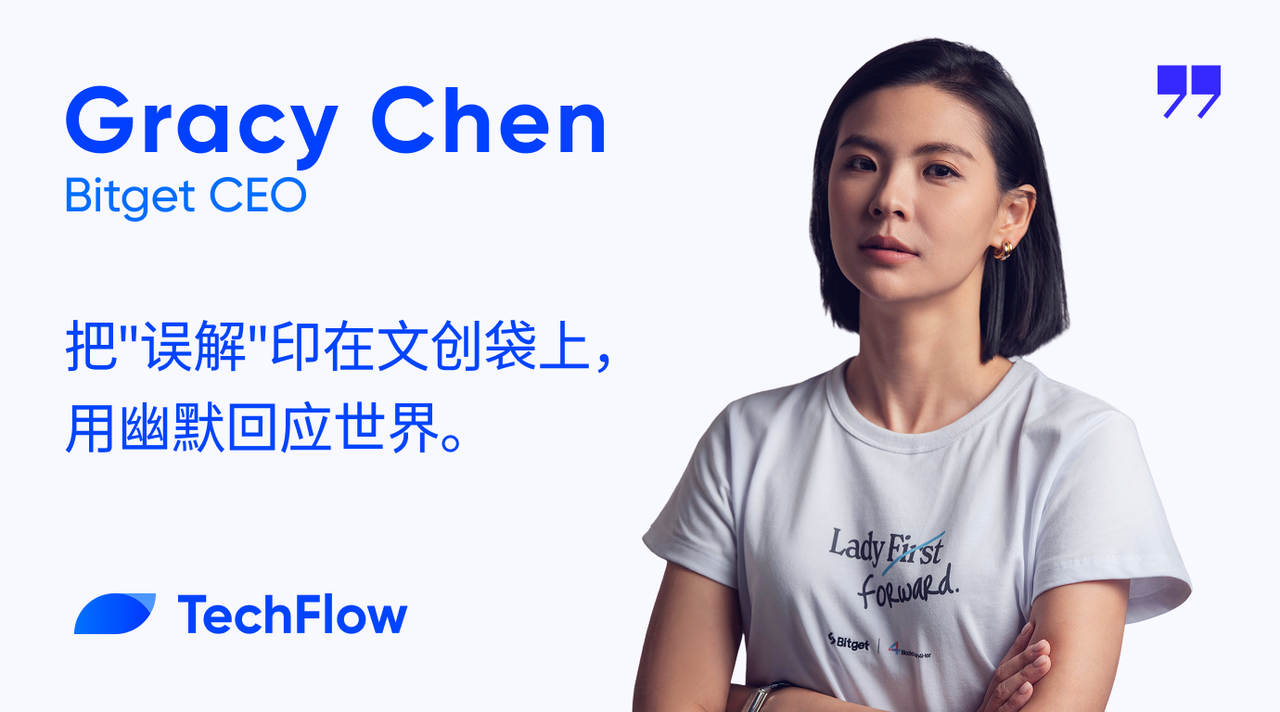
She’s jokingly called “a master of pretending”—so she boldly printed that very quip onto a branded tote bag and carried it into an industry conference.
As CEO of Bitget—the world’s leading cryptocurrency exchange—Gracy has steered this 2,000-person organization over the past two years from a focus on “quantity” to one on “quality.”
From deepening its presence in Chinese-speaking markets to expanding globally; from pioneering the UEX strategy to embrace traditional assets, to committing its entire workforce to AI in preparation for the silicon-based era—Bitget is rapidly reshaping the trading ecosystem through unprecedented speed of evolution.
During the Web3 Carnival, we held an in-depth conversation with Gracy. Covering topics ranging from public perception and corporate strategy to family life, she shared—for the first time—Bitget’s strategic evolution and operational logic in full. She also reflected on her personal transformation from Managing Director to CEO. Amid a cycle defined by uncertainty, witness how this female leader harnesses “quiet focus in a secluded corner” to command “a much larger stage”—and discover the tenderness and resilience she embodies beyond the CEO title, as a single mother.
Facing Criticism Head-On: Turning “Misunderstandings” Into Branded Totes
Q1: You frequently appear in Chinese-speaking markets. In your view, which regions is Bitget currently most focused on—and how does the Chinese-speaking market differ from other regional markets?
Gracy:
Bitget focuses on the regions where the crypto industry is most active.
Users and trading volume from Chinese-speaking markets account for 25% to one-third of global market share—roughly comparable to the U.S. market. The European English-speaking (EUEN) market is sizable but highly fragmented, with linguistic and cultural differences across countries, and markedly distinct characteristics between Eastern and Western Europe. In derivatives trading, certain East Asian markets stand out; yet in spot markets, all the core regions mentioned above remain primary markets, while Latin America, Southeast Asia, and emerging European markets represent new growth frontiers.
Having operated in the industry for over seven years, Bitget serves users across more than 100 countries, with a truly global operational outlook. Most members of our core team are ethnically Chinese, and I myself grew up in a Chinese-speaking environment—Mandarin is my native language. Many team members come from traditional finance and Web2 tech backgrounds, so our commitment to the Chinese-speaking market is unquestionable. It remains our most familiar business region—and simultaneously one of the world’s mainstream markets.
Q2: On Xiaohongshu, I’ve seen many of your travel and personal growth posts. How do you balance travel with your CEO responsibilities? What’s your favorite travel destination—and why?
Gracy:
I actually enjoy answering questions like this—it’s refreshing to step away from work talk.
New Zealand was my destination last National Day holiday. Major holidays—including Christmas, National Day, Labor Day, and Spring Festival—are when many team members take time off. During last year’s National Day break, I was invited to speak at a local innovation-and-entrepreneurship competition in New Zealand and met several friends there—including a former MIT classmate who is now a Member of Parliament in New Zealand. She even accompanied me on a tour of the New Zealand Parliament. I favor immersive cross-border trips—typically staying five to six days—but in New Zealand, I stayed about seven or eight days, making it deeply enriching and genuinely joyful.
For me—and for our company—travel reflects a broader ethos. Yes, we’re known for being intensely hardworking—even jokingly dubbed “the Huawei of crypto.” But let me clarify: That label isn’t about long working hours. Rather, it embodies a “Work hard, play hard” spirit. For instance, we don’t require clocking-in or daily office attendance—even though we maintain offices worldwide. We prioritize outcomes above all. As long as results are delivered, individuals enjoy tremendous flexibility.
Our team certainly takes vacations—but disappearing entirely during leave isn’t acceptable. So I typically schedule travel around major holidays. This year, for example, I attended Consensus in Miami over Labor Day, as we had key U.S.-related matters underway.
If purely for leisure, I’m especially drawn to exotic destinations like Morocco and Turkey. For relaxed, low-effort travel, Italy is a favorite. Yet my bucket list still includes places I haven’t visited—like Tanzania, to witness the Great Migration, or polar expeditions to the Arctic and Antarctic. Those adventurous journeys excite me deeply.
Q3: On Xiaohongshu, I noticed you directly address negative comments. What’s the most common misconception about you—and what’s the reality?
Gracy:
You may have seen our viral tote bag recently. This year’s conference didn’t feature a physical booth, so our marketing team suggested: “Since we lack a booth, let’s create a mobile one.” They asked if I minded using my photo on an attention-grabbing tote. Without hesitation, I agreed. One slogan read: “I’m socially anxious—but this bag is socially bold.” So yes—one misconception is people genuinely believe I’m socially bold. Truth is, I’m neither extremely extroverted nor socially anxious—I’ve lately grown to cherish solitude.

At heart, I’m an E-type personality—but this role has gradually shifted me toward I. A second misconception featured on that same tote: “I’m great at pretending.” So we embraced that misunderstanding head-on—printing it directly onto the bag. It’s my way of responding. And frankly, in such a competitive industry, capturing attention is valuable—even if it’s polarizing. After all, “infamous fame” is still fame.
Moreover, today’s society is remarkably tolerant. People readily accept that female CEOs—or women leaders in general—can be assertive, hold sharp opinions, “pretend” occasionally, and also lead rich personal lives. Likewise, audiences increasingly embrace brands experimenting with unconventional, breakout marketing approaches.
That said, one controversial incident involved Bitget Wallet using a widely circulated Dubai kissing photo on a promotional card. Our Wallet team obtained consent from both individuals—but bypassed my approval before publishing. When I saw it, I felt it crossed a line. Public backlash followed, prompting swift removal.
What I want to emphasize is that, from the company’s perspective, we actively foster innovation. And in pursuing innovation, missteps like this are inevitable—we must strike the right balance. We must encourage experimentation; if even minor errors aren’t tolerated, no one dares innovate. Indeed, a brand’s core communicative power and creativity often emerge precisely from such boundary-pushing efforts.
Breaking Through & Restructuring: The UEX Strategy, RWA Wave, and Trading’s New Paradigm in the Silicon-Based Era
Q4: Bitget was among the first—and most proactive—in listing stocks, IPOs, and precious metals. I hear some exchanges’ stock-trading volumes already constitute a significant portion of their total activity. Could you share how user behavior and portfolio composition have changed since Bitget launched traditional assets? From a data perspective, what percentage of your UEX vision has been realized so far?
Gracy:
UEX is our long-term strategic pillar—listing diverse assets is merely the first step. Data already reveals early shifts: in Q1 this year, non-crypto asset trading volume on our platform approached 40%. Moreover, regional patterns clearly emerge in user adoption of UEX’s non-crypto offerings.
Take U.S. equity tokens, for example. In regions with strict capital controls, foreign exchange restrictions, and high barriers to opening U.S. brokerage accounts, adoption rates are notably higher. First, we explicitly avoid serving sanctioned jurisdictions—such as Iran. No amount of revenue would sway us to operate there.Yet conversely, many regions face real difficulty opening U.S. brokerage accounts. For users seeking global asset allocation, Bitget becomes a natural, even indispensable, choice—because alternatives simply don’t exist. Thus, in these markets, adoption is exceptionally high.
Second, over half of Bitget’s users hail from Asia. Geopolitical tensions in January–February triggered sharp volatility in precious metals and oil prices—prompting surges in trading volume. At peak, gold’s daily volume on our platform neared Bitcoin’s.
Since launching UEX in September last year, we completed broad U.S. equity listings in Q4, then expanded into commodities (gold, oil) and FX via CFDs in January. Naturally, users need time to adapt to new products—and geopolitical shocks act as catalysts accelerating adoption. Even during gold’s sharp price corrections, trading activity spiked—amplified by leverage, resulting in notable liquidations—a normal occurrence in highly volatile markets.
Assessing UEX today, I’d say we’ve only completed Phase One: comprehensive asset coverage. Phase Two involves continuous optimization of already-listed products.
Consider U.S. equity tokens—they’re now mainstream in the RWA space. Yet established players like Ondo and xStocks have operated similar offerings for nearly a year. Though we launched ours in September–October last year, persistent issues remain.A top user concern is dividend distribution. The mechanism is subtle: dividends *are* paid—but not directly into users’ accounts. Instead, underlying SPVs repurchase the asset, reflecting value appreciation in the token price. Users thus receive economic benefits—but never see cash dividends directly. Because of this structure, the SPV’s price (e.g., Meta’s tokenized version) may rise—from $500 to $510 after a dividend—while the underlying Meta stock remains at $500. Users then question widening spreads and grow uneasy. These nuances are easily overlooked.
Unless you’re an active trader, you might miss such complexities—and resolving them defines Phase Two. Can we refine dividend mechanisms? Or enhance user awareness? Extending trading hours to 24/7 or 24/5 sounds appealing—but how do we optimize liquidity during weekends when U.S. markets are closed? These are just some challenges inherent in integrating traditional assets.
Q5: I noticed Bitget recently launched IPO Prime—an apparent extension of UEX from secondary to primary markets. What drove your decision to partner with Republic—and why debut preSPAX first? Compared to other exchanges’ on-chain models, reservation systems, or derivatives approaches, how does Bitget’s “compliant SPV + structured subscription” design offer advantages?
Gracy:
I wrote an article detailing our collaboration story with Republic. I’ve known Republic Crypto’s two co-CEOs for years. A fun anecdote: Andrew, one co-CEO, and I were both portfolio companies of Dragonfly Capital. Dragonfly hosted closed-door sessions inviting founders—and Andrew and I happened to be on the same team. We collaborated on numerous tasks and even won first place—a memorable experience that strengthened both my professional rapport with Republic and my personal bond with Andrew.
Last year, we began exploring Pre-IPO product development. Knowing Republic’s deep expertise here, I instructed our team to initiate talks—but stressed that personal ties shouldn’t override due diligence. Our team conducted extensive market research, ultimately selecting Republic for three reasons: robust licensing (U.S., EU, and beyond), proven experience—including prior launches of U.S. equity Pre-IPO tokens on other exchanges (with lessons learned from past pitfalls)—and transparent mechanisms. Their missteps helped inform our own risk mitigation—for instance, emphasizing that our product represents a debt instrument—not equity—backed by third-party SPVs holding actual shares. External messaging carefully balances compliance with clarity.
Republic’s Pre-IPO products pose greater complexity than standard U.S. equities, given unpredictable IPO timing and pricing. Take SpaceX: only Elon Musk decides its listing date. We began designing this product last year,but in February–March this year, SpaceX’s merger with xAI—and acquisition of Grok—disrupted negotiations. Suddenly, counterparties selling pre-IPO shares withdrew or renegotiated entirely—forcing us to restart discussions from scratch. Such intricacies only surface once you execute the product. We priced this offering near cost—not to profit, but to deliver user value.
Many users ask: “Why is Bitget’s valuation ($1.5T) lower than Reuters’ post-IPO estimate ($2T)—or chain-based platforms exceeding $2T? Is there a 1:1 mapping risk?” Let me clarify: Six months ago, our third-party SPV secured and verified this valuation in the market. So users benefit from a time-lag discount—receiving a valuation locked in half a year ago, at today’s price point. This isn’t flawed mapping—it’s a genuine advantage. Ensuring 1:1 mapping remains our absolute priority across all RWA products. Our Pre-IPO mechanism guarantees that upon IPO, “pre-sale” tokens will trade at parity with the underlying stock token.
Q6: In prior interviews, you noted the “four-year cycle remains valid—but has been ‘smoothed’ by Wall Street capital represented by ETFs and DATs.” Global markets are reassessing macro risks at accelerated pace. How does this impact exchanges—and what strategic shifts are you implementing?
Gracy:
We’re undergoing major strategic recalibration.Why did we launch UEX? Because pure crypto no longer meets our users’ needs—or aligns with our own growth trajectory. Meanwhile, clear macro trends demand our attention—and action.
First: stablecoin growth. Stablecoins are attracting traditional capital at unprecedented speed—even family offices and endowments—and driving cross-border payments. Recently, a friend (unrelated to crypto) told me his family’s Yiwu-based retail businesses hold large USDT reserves. Why? Because USDT simplifies cross-border transfers—making it their most efficient asset.
Such use cases abound. I’m confident stablecoin holdings—and stablecoin-to-fiat ratios—will keep rising. So we aim to capture incremental stablecoin trading volume. Bitget primarily focuses on trading; Bitget Wallet or sister entities handle more payment scenarios. But as stablecoins gain traction in payments, they’ll equally drive trading demand. Capturing this “U-for-trading” opportunity is our first priority.
Second: RWA. U.S. equity tokens currently represent just 0.1% of the U.S. equity market—but in money market funds or private credit RWAs, adoption is already 0.5%–1%. With NYSE and Nasdaq entering tokenization, progress will accelerate dramatically—potentially reaching a tipping point soon. We’ve observed them deeply engaging with newly listed companies about issuing native tokens—albeit still built atop existing infrastructures like ATS platforms and custodial frameworks (e.g., DTCC). Yet SEC applications are already filed; approval timing is the only remaining variable.
We seek channel partnerships with such institutions. Broadly, RWA growth is undeniable: gold, oil, U.S. equities—and even Pre-IPOs—can all be tokenized.
But boundaries exist. Real estate RWA, for instance, is trending—but as a global exchange, Hong Kong property RWA differs vastly from Dubai’s. Non-standardization, jurisdiction-specific regulations, and limited trading appeal make real estate less suitable for our platform. We prioritize standardized financial assets—not art or real estate RWAs.
Thus, our stance is clear: we largely avoid art and real estate RWAs—but fully support standardized financial RWAs.
Q7: Bitget has been highly visible in AI—both internally (employee adoption) and externally (launching GetAgent). Why such strong AI conviction—and do you fear an AI bubble? With ~2,200 employees, how would company-wide AI adoption transform Bitget?
Gracy:
Regarding AI assets—yes, certain U.S. equities show bubble-like valuations, especially long-tail names. NVIDIA remains reasonable, albeit expensive—but some smaller AI stocks are clearly inflated.Yet AI *application* carries no bubble.
At least within our company, I recently discussed this with our VIP team lead: “How many AI use cases are you running?” Then I shared my own practices.
I’ve tested countless AI tools—like Nano Banana, which I use with my son to generate images (a lifestyle application). I’ve used AI for images and videos since Midjourney’s early days—two or three years ago. Lately, I’m obsessed with Manus—waiting monthly for my 8,000-credit refresh. Its magic lies in specialized AI agents: for instance, I created a dedicated “U.S. Strategy Officer” agent for our U.S. expansion—feeding it curated content (avoiding sensitive data), then tasking it with preparing meetings, drafting LinkedIn outreach, researching partners, and suggesting collaborations—all while respecting confidentiality.
I’ve built knowledge bases so it inherently knows Bitget, Gracy, my goals, and stance—eliminating redundant effort. I even have a Manus agent teaching me dating tips—fun, indeed!
With AI lead Bill, we mapped ~22 AI use cases across the company last December—now surely more.
Back to core functions: AI handles customer service, translation, and knowledge base management—areas where it excels. In compliance, AI powers KYT (Know Your Transaction) monitoring. For trading tools, we anticipate AI-to-AI trades surpassing human-to-human ones—so we’ve built accordingly. This year’s “crayfish” meme inspired GetClaw: not just informational, but executable—via Telegram. Tell GetClaw your trade idea, get execution advice, or request risk alerts—all AI-powered.
A core belief guides us: The future belongs to carbon-based and silicon-based life collaborating. This trend is irreversible—you must embrace it or be left behind. Not by your company—but by history itself. Hence, we mandate AI adoption across Bitget. Those resisting will fall behind; those mastering AI will multiply their productivity five- or tenfold.
On Role Models: Riding the Waves of the First 35 Years—and Finding Quiet Focus in Seclusion
Q8: You turned 35 last year. If you could summarize your first 35 years in three words, what would they be? How has Bitget evolved since you assumed the CEO role in 2024—and how have you personally grown?
Gracy:
Bitget’s evolution since 2024: First,our definition and prioritization of users shifted. In 2024, the TON ecosystem boomed—and our close TON partnership brought massive user growth. Yet a major 2024 pivot moved us beyond raw user acquisition metrics. Back then, teams like “Listing” were judged by new KYC or FTTS (First-Time Trader) users added per token launch. My key adjustment: shifting focus from quantity to quality—deeply evaluating each user’s lifetime value (LTV), VIP tiers, and institutional clients.Thus, company-wide KPIs pivoted from Quantity to Quality—a pivotal transformation.
Second, aligned with earlier themes, since 2024 we’ve responded to evolving macro trends—especially RWA and TradFi’s growing market participation. In January 2024, BlackRock launched the first Bitcoin ETF—triggering institutional interest. After Bitcoin hit $100K last year, many wealthy friends and family offices asked whether allocating 5% of assets to Bitcoin made sense. At $100K, I actually advised against it—my Twitter posts reflect this, drawing criticism. Yet hindsight confirms it was sound counsel. I emphasized cyclical dynamics—and warned strongly against leverage at that level. This signals crypto’s maturation: no longer a niche—it demands regulatory compliance, institutional integration, and large-capital engagement. Our strategic shift intensified last year.
Personally: First, as noted, this role pushed my MBTI type (ENTJ) toward the I-E midpoint. Once hyper-extroverted, constant external-facing demands gradually increased my introversion.
Second, I now obsess over operational depth. Coming from marketing—and previously serving as Managing Director (akin to a CMO)—my CEO role demanded broader scope: building cohesive 2,000-person teams, talent strategy, and granular execution (e.g., our U.S. expansion). In 2024, discussing IPO Prime or Ondo’s mechanics would’ve been beyond my grasp—yet today, such details define my leadership.
My first 35 years: First word—“Ever-expanding stages.” At Chengdu No. 7 High School, I told myself, “This is Sichuan’s best school—I must attend Asia’s finest university.” So I went to NUS. Then, “Now I need the world’s best university”—leading me to MIT. This pattern continued professionally: from Web2 startups to Bitget CEO, scaling the company—and my own achievements—along the way.
Second word—“Quiet focus in seclusion.” Embracing introversion, savoring quiet moments with my child.
Third word—“Less pretense.” Earlier, “pretending” was mocked—but now I relish stand-up comedy, even performing myself. My Xiaohongshu post about doing stand-up reflects this: mocking things—including criticism—because I no longer care deeply. Life is a one-way journey—make it playful. Joy in the process matters most.
Q9: Many of your posts highlight your son. If you were to choose a role model for him, who would it be—and why?
Gracy:
Sometimes I notice my son constantly learning from me—so, in this moment, I may be his role model.
At six months old, he made a curious “Ah!” sound after drinking milk. I wondered where it came from—until our nanny pointed out, “Haven’t you done that yourself after enjoying something?” Indeed, he’d mirrored my mannerisms since infancy. As a single mother—with no father figure present (his biological father hasn’t seen him since 2022)—my influence—and that of my parents, who help raise him—is profoundly decisive.
That said, I hope one day I’ll no longer be his role model—he’ll surpass me, finding his own ideal inspiration.
Q10: Who’s your most admired historical figure—and what qualities draw you to them?
Gracy:
I have several role models. In building Bitget, J.P. Morgan inspires me deeply—I’m reading his biography and encouraging executives to do likewise. He lived through the late 19th–early 20th century: a transformative financial era—the Gilded Age—marked by extreme inequality, political corruption, rapid U.S. industrialization, and wholesale financial restructuring, predating even the Great Depression. How did he navigate such upheaval? We too stand at a historic inflection point—where crypto is reshaping traditional finance. Building a billion-dollar company here feels profoundly mission-driven—so J.P. Morgan’s lens resonates strongly.
For investing, I admire Duan Yongping—and Li Lu—both shaped by Buffett’s value-investing philosophy. When applying to business school, Columbia University was a serious contender—its value-investing program excels, and opportunities to learn from Wall Street legends abound.
For life, Yang Lan stands out—my childhood idol. Her intellectual grace captivated me as a teen; I loved her book *By the Sea, Facing the Wind*. I interned at *Yang Lan One-on-One*, met her personally, and worked extensively at her Sun Media Studio. Many of my role models I’ve met directly—and learned immensely from. J.P. Morgan, alas, remains purely historical.
Join TechFlow official community to stay tuned
Telegram:https://t.me/TechFlowDaily
X (Twitter):https://x.com/TechFlowPost
X (Twitter) EN:https://x.com/BlockFlow_News
 深潮TechFlow