Texas establishes Bitcoin reserve—why BlackRock's BTC ETF is the top choice?
TechFlow Selected TechFlow Selected
Texas establishes Bitcoin reserve—why BlackRock's BTC ETF is the top choice?
Texas has officially taken the first step toward becoming the first U.S. state to list bitcoin as a strategic reserve asset.
 Navigating Web3 tides with focused insights
Author: Oluwapelumi Adejumo
Translation: Saoirse, Foresight News
Texas has officially taken the first step toward becoming the first U.S. state to list bitcoin as a strategic reserve asset.
On November 25, Lee Bratcher, chairman of the Texas Blockchain Council, revealed that this $2.7 trillion economy—ranked eighth largest globally—has purchased $5 million worth of BlackRock's spot bitcoin ETF (ticker IBIT).
He added that once the custody and liquidity framework required by the state’s new reserve bill is finalized, a second $5 million appropriation will be used for direct bitcoin acquisition.
These two funding tranches will serve as a bridge between current institutional operating models and a future government model in which governments not only buy but also hold bitcoin.
Texas Builds Blueprint for First State-Level Bitcoin Reserve
Rather than directly holding bitcoin on-chain at the outset, Texas chose IBIT as its entry point. For large capital allocators seeking to deploy into bitcoin within familiar regulatory and operational frameworks, IBIT has become the default choice.
The legal basis for this purchase is Senate Bill 21—a law signed by Governor Greg Abbott in June that formally establishes the "Texas Strategic Bitcoin Reserve."
Under the bill’s framework, so long as bitcoin maintains an average market capitalization of at least $500 billion over 24 months, the state comptroller is authorized to continue accumulating the asset. Currently, bitcoin is the only cryptocurrency meeting this market cap threshold.
This reserve system operates independently from the state treasury, defines governance procedures related to asset holdings, and establishes an advisory committee responsible for risk monitoring and oversight.
Although the initial $5 million allocation is small relative to Texas’ overall fiscal scale, the operational logic behind the transaction carries far greater significance than the amount itself.
Texas is using this move to test whether bitcoin can be formally integrated into public reserve toolkits within a state financial system already managing hundreds of billions in diversified funds.
Once the relevant operational processes are implemented, the second tranche will fund “self-custodied bitcoin”—a model that will have profoundly different implications for asset liquidity, transparency, and auditability.
Texas is currently designing a “sovereign-grade custody” process rather than relying on traditional institutional brokerage models. The reserve system will require qualified custodians, cold storage facilities, key management protocols, independent auditing mechanisms, and regular reporting requirements.
These components will form a replicable template that other states could adopt directly without having to redesign their governance architecture.
Why Did Texas Choose BlackRock’s IBIT?
Selecting IBIT as the vehicle for entering the bitcoin market does not imply that Texas prefers ETFs over native bitcoin. Rather, it represents a practical workaround based on real-world constraints.
Launched just two years ago, IBIT has quickly become the most widely held bitcoin ETF among mainstream institutions. As the largest bitcoin ETF by assets, it has recorded over $62 billion in net inflows to date.
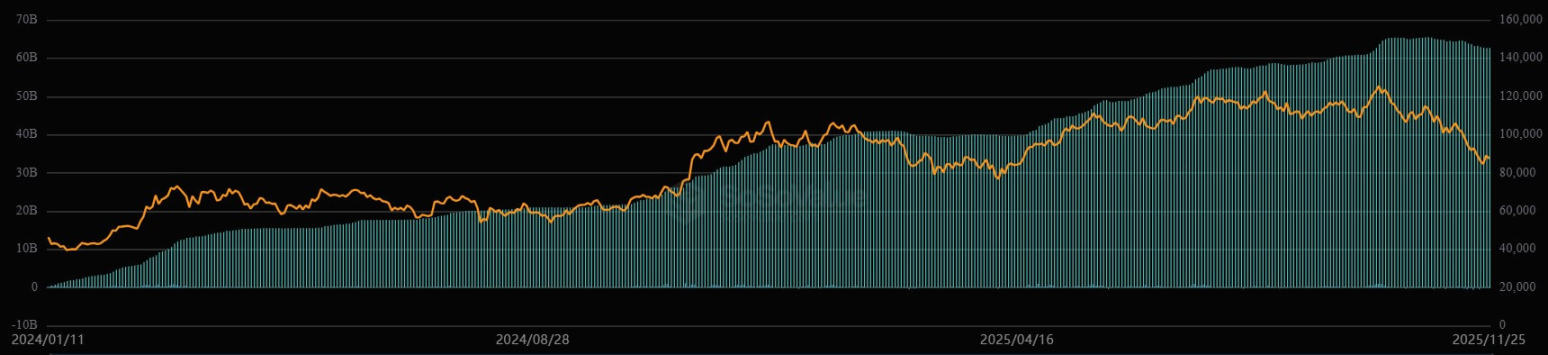
(Image caption: Cumulative net inflows into BlackRock's IBIT. Source: SoSo Value)
Moreover, most jurisdictions have yet to establish self-custody infrastructure for public-sector bitcoin holdings, and building such systems involves complex processes including procurement, security modeling, and policy approvals. Therefore, Texas is treating IBIT as a "transitional instrument"—using it to gain bitcoin exposure while finalizing its permanent reserve architecture.
This "indirect strategy" holds strong precedent value, as it closely mirrors the approach taken by other major institutional investors.
Harvard University disclosed that IBIT became one of its largest U.S. equity positions in Q3 this year; the Abu Dhabi Investment Authority increased its IBIT holdings to approximately 8 million shares during the same period—tripling its prior position; and Wisconsin’s pension system earlier this year allocated over $160 million into spot bitcoin ETFs via IBIT.
The trend is clear: despite differences in investment objectives, geographic contexts, and risk frameworks, major institutions are converging on IBIT. Its core advantages lie in custody provided through reputable intermediaries, simplified reporting workflows, and clear accounting compliance under the new fair-value rules effective in 2025.
These conveniences make IBIT the "default entry point" for public and quasi-public institutions allocating to bitcoin. Texas is unique only in that its use of IBIT is explicitly framed as a temporary transition.
What Happens If Other States Follow Suit?
A more critical question remains: Is Texas’ move an isolated case, or will it become a blueprint adopted by others?
Bitcoin analyst Shanaka Anslem Perera stated:
“This chain reaction is predictable. Within the next 18 months, we expect 4 to 8 additional states to follow, collectively controlling over $1.2 trillion in reserves. In the short term, momentum-driven institutional inflows could reach $300 million to $1.5 billion. This isn’t speculation—it’s game theory in action.”
Currently, politically aligned states like New Hampshire and Arizona have already passed legislation regarding bitcoin reserves—treating bitcoin as a strategic asset to hedge against risks in the global financial system.
More states may join soon: with new accounting standards eliminating previous punitive mark-to-market provisions, they can now use structural surplus funds to diversify into bitcoin.
Beyond symbolism, state-level participation in the bitcoin market carries tangible consequences. ETF purchases do not alter bitcoin’s circulating supply, as trust structures do not remove bitcoin from liquid markets during share issuance or redemption.
In contrast, self-custody produces the opposite effect: once bitcoin is purchased and moved into cold storage, it exits the tradable supply pool, reducing the amount available to exchanges and market makers.
If Texas expands its bitcoin reserve beyond the initial $10 million, this difference will become increasingly significant. Even if individual state demand remains modest, it introduces a new class of buyer—one whose behavior is counter-cyclical to “noise traders” (investors who trade not based on rational analysis, fundamental data, or macroeconomic signals, but driven by irrational factors) and who do not frequently adjust their holdings.
This impact acts more like a “stability anchor” than a source of volatility. If more states adopt similar policies, the elasticity of bitcoin’s supply curve will further decline, increasing price sensitivity.
Join TechFlow official community to stay tuned
Telegram:https://t.me/TechFlowDaily
X (Twitter):https://x.com/TechFlowPost
X (Twitter) EN:https://x.com/BlockFlow_News
 @CryptoSlate