GPT-5 "Lacking Innovation"? You May Have Missed the Most Important Investment Signal This Year
TechFlow Selected TechFlow Selected
GPT-5 "Lacking Innovation"? You May Have Missed the Most Important Investment Signal This Year
The public's disappointment stems from GPT-5 lacking "earth-shattering" new features; yet the insightful recognize the revolutionary power brought by its profound "evolution."
 Navigating Web3 tides with focused insights
By: Gui Tu Jun
GPT-5 has finally arrived.
Yet amid the AI community's screen-filling discussions, a subtle sense of "disappointment" is spreading. Many argue that compared to the stunning debut of GPT-4, GPT-5 feels more like a steady but "boring" upgrade—some have even jokingly dubbed it an "enhanced version of GPT-4.1."
Meanwhile, ongoing talent drain and organizational instability within OpenAI have further fueled claims of "innovation fatigue." From the mass departure of core safety team members to key technical staff being poached by competitors, observers wonder: Has internal turmoil at OpenAI begun affecting its products, weakening its ability to deliver disruptive innovation?
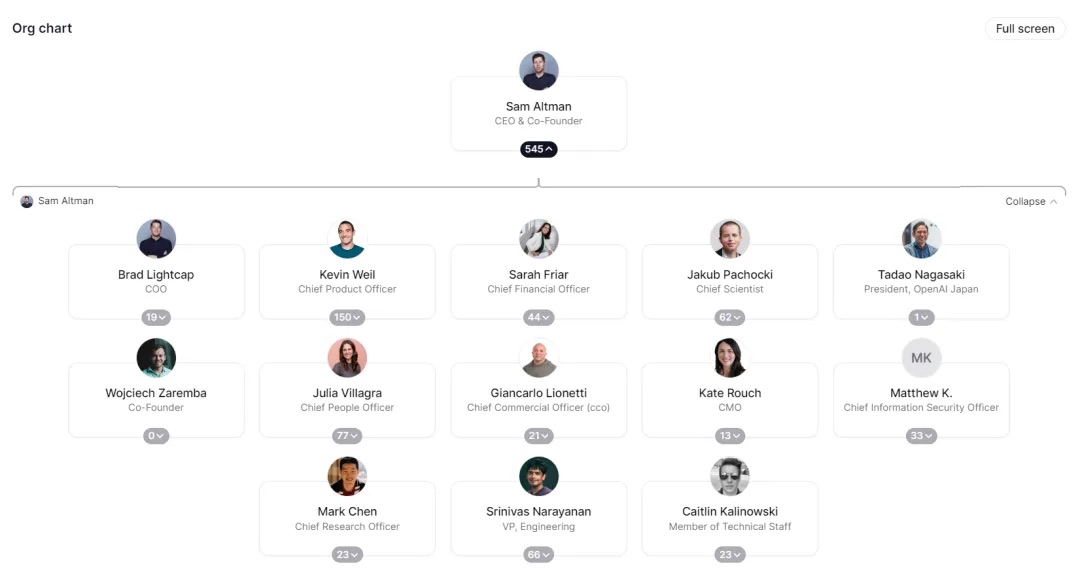
Yet when we shift focus away from organizational changes and return to the product itself, as the market fixates on perceived "lack of innovation," are they overlooking GPT-5’s astonishing leap in "reliability" and "practicality"?
To find out, we immediately connected with a former senior research scientist at Google DeepMind, who had deeply contributed to the development of the PaLM 2 model. We asked just one question: How will GPT-5 reshape investment logic in the secondary market?
In three sentences, he delivered a judgment starkly different from mainstream consensus.
01
"The market is chasing the 'iPhone moment' wow factor, but they’ve completely missed the point. GPT-5’s real moat is the qualitative shift from 'toy' to 'tool.' Its leap in reliability—the 45% reduction in factual errors—means enterprise AI applications are reaching the tipping point where they move from 'small-scale pilots' to 'large-scale deployment.'
This will fundamentally revalue all AI-dependent SaaS companies. Investment logic will shift from chasing 'model parameters' to embracing 'business processes.'"
The scientist pinpointed the market’s core misconception: an obsession with "wow moments." He explained that since ChatGPT’s launch, both the public and capital markets have been waiting for a single, simple demo that could ignite global excitement—an innovation as transformative as the original iPhone’s touchscreen.
But this expectation overlooks the inevitable trajectory of the technology maturity curve: after a breakthrough innovation comes a long, critical phase of "reliability ramp-up."
In the GPT-4 era, AI hallucinations were the biggest barrier to commercialization.
For individual users, an AI occasionally fabricating facts might be harmless—even fodder for social media jokes. The classic example: which is bigger, 9.11 or 9.9?

But for enterprises—especially in finance, law, healthcare, and engineering, where accuracy is non-negotiable—a unreliable AI is akin to a ticking time bomb.
No law firm would dare use an AI assistant that might invent contract clauses; no investment bank would let an AI model that misreads financial statements build valuations; no pharmaceutical company would rely on an AI that fabricates chemical formulas for drug discovery.
This is precisely why GPT-5’s 45% reduction in factual errors is revolutionary. This number isn’t just linear improvement—it marks AI usability crossing a critical threshold.
It means AI outputs are shifting for the first time from "requiring 100% human expert review" to "needing only key-point human verification." This shift unlocks a trillion-dollar enterprise application market.
02
"Everyone talks about model capability, yet ignores its 'economic intelligence.' The built-in 'smart router' is the key to profitability. It uses the lowest-cost computing resources to answer most simple queries, dramatically reducing inference costs and boosting gross margins. This directly addresses the secondary market’s biggest concern about AI companies being 'bottomless money pits,' proving scalable profitability isn’t just a distant dream—but an achievable reality."
If reliability solves the question of whether AI can be "used," then GPT-5’s built-in "smart router" solves the fatal issue of whether AI can be "afforded."
Since large-model competition intensified, the shadow of "burning cash" has loomed over the entire industry.
Every user interaction with a large model involves thousands of expensive GPUs running at full speed in data centers, keeping inference costs stubbornly high.
This has led to deep skepticism about AI business models: Can this "using Lamborghinis to deliver takeout" approach ever be profitable?
GPT-5’s "smart router" architecture is a masterpiece of engineering and business integration. It acts like an experienced traffic dispatcher, instantly assessing the complexity of a user request.
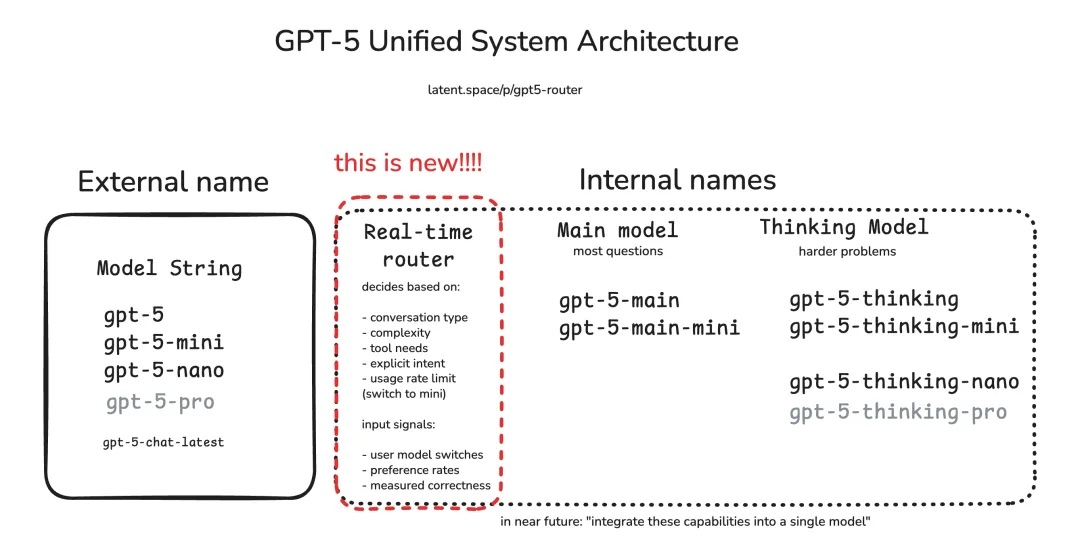
When a user asks, "What’s the weather today?" or "Write me a simple thank-you email," the router routes the query to a lightweight, efficient, low-cost small model;
Only when faced with PhD-level tasks—like "Analyze this 200-page financial report and forecast its cash flows for the next three years"—does the router wake up and invoke the full power of the GPT-5 core model.
This granular cost control completely transforms the unit economics of AI services. It means OpenAI has, for the first time, proven to the world that large-scale AI services don’t have to be loss-leading operations.
03
"GPT-5’s 'agentic' capabilities are severely underestimated. It’s no longer just a 'coding assistant,' but the prototype of a 'junior digital employee.' When a model can end-to-end complete website development or complex data analysis, it ceases to be a SaaS tool—and becomes a SaaS disruptor.
Investors in the secondary market must immediately ask: Which listed software companies’ moats will be eroded by these 'AI Agents' within the next 24 months? This opens a brand-new window for hedging and shorting."
This was the scientist’s most disruptive—and unsettling—insight. While the public celebrates GPT-5’s improved code-writing assistance, they fail to realize the co-pilot is quietly sliding into the driver’s seat.
GPT-5’s agentic capability means it no longer merely responds passively to commands. Instead, it can understand a complex goal, autonomously break it down into steps, invoke various tools (like browsers, code interpreters, APIs), execute them, and complete the task.
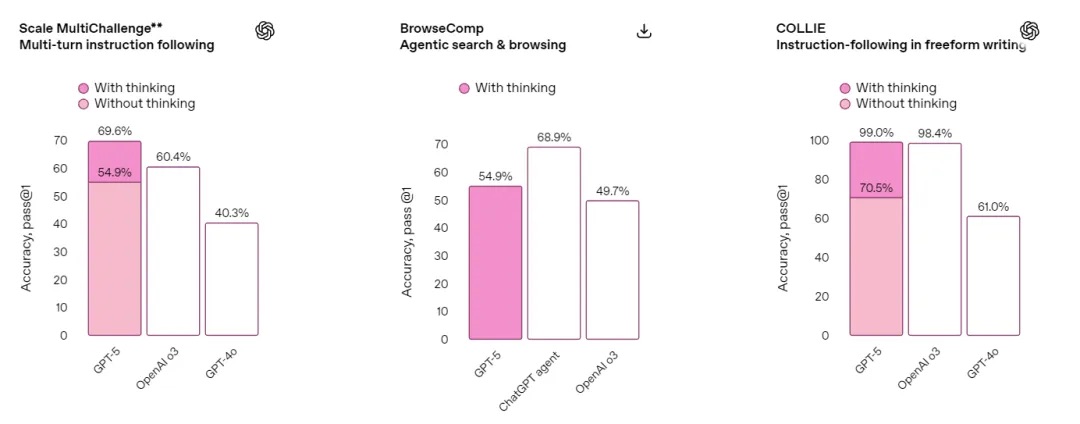
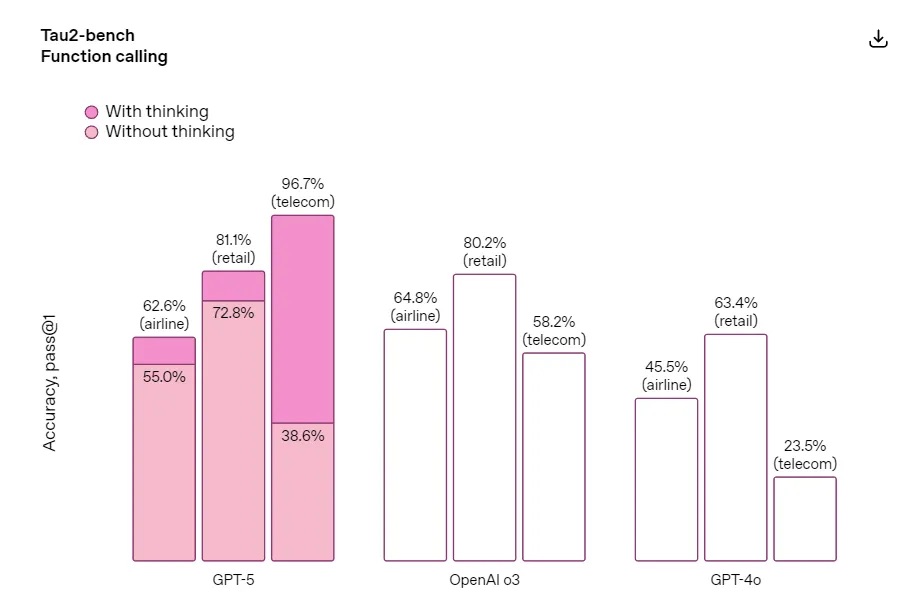
This "end-to-end" capability delivers a paradigm-shifting blow to traditional Software-as-a-Service (SaaS) models. Over the past decade, the core logic of SaaS has been "defining and standardizing optimal workflows via software." GPT-5 flips this: "Tell me your goal in natural language, and I’ll dynamically generate and execute the workflow for you."
This is a fundamental paradigm shift. The most powerful demonstration of this came during GPT-5’s launch event.
In a live demo, GPT-5 completed a company data visualization dashboard in just five minutes—a task that previously required a professional team days to deliver. Even more striking was its autonomy: it fixed bugs in real time, corrected logical errors, iterating like an experienced engineer refining their own work.
The final interactive dashboard was not only aesthetically pleasing and tasteful but also featured a clear hierarchical structure, allowing decision-makers to easily focus on core data.
As one researcher remarked afterward: "An experienced human engineer might spend several days just learning and mastering the latest frameworks needed to complete such a task."
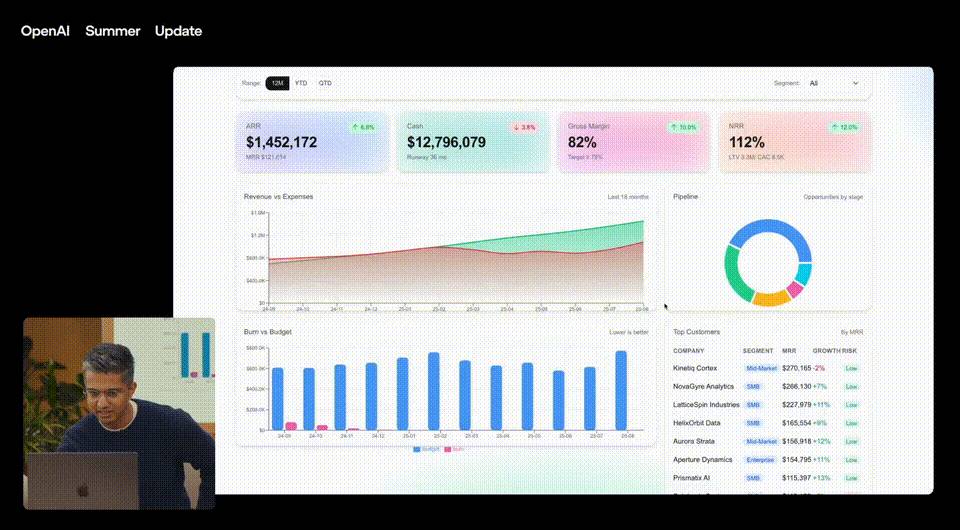
When an AI can deliver work at such speed and quality, the value proposition of traditional, monthly-subscription, single-function SaaS tools is rapidly disintegrating.
Conclusion
Public disappointment stems from GPT-5 lacking "earth-shattering" new features; smart observers, however, see the revolutionary power of profound "evolution." What GPT-5 brings first is an explosion of enterprise applications driven by "reliability," followed by a business model profitability inflection point powered by "economic intelligence," and ultimately, industry disruption and reshuffling fueled by "agentic" capabilities.
The essence of investing is finding certainty amid uncertainty. And engaging with the most brilliant minds is the most effective way to withstand uncertainty.
When your team debates technical directions, when your investment decisions hang in the balance, when your product strategy is clouded in fog… remember, the confusion you face may already be a path someone else has walked. We at Gui Tu Jun believe: authentic, firsthand experience always comes from those actively driving industry transformation.
Join TechFlow official community to stay tuned
Telegram:https://t.me/TechFlowDaily
X (Twitter):https://x.com/TechFlowPost
X (Twitter) EN:https://x.com/BlockFlow_News