Space Review | The New Order of Stablecoins: Could USD1 + TRON Become the Third Global Force After USDT and USDC?
TechFlow Selected TechFlow Selected
Space Review | The New Order of Stablecoins: Could USD1 + TRON Become the Third Global Force After USDT and USDC?
TRON is not simply choosing a "stablecoin supermarket" or a unified settlement layer, but rather creating "species diversity" in digital finance.
 Navigating Web3 tides with focused insights
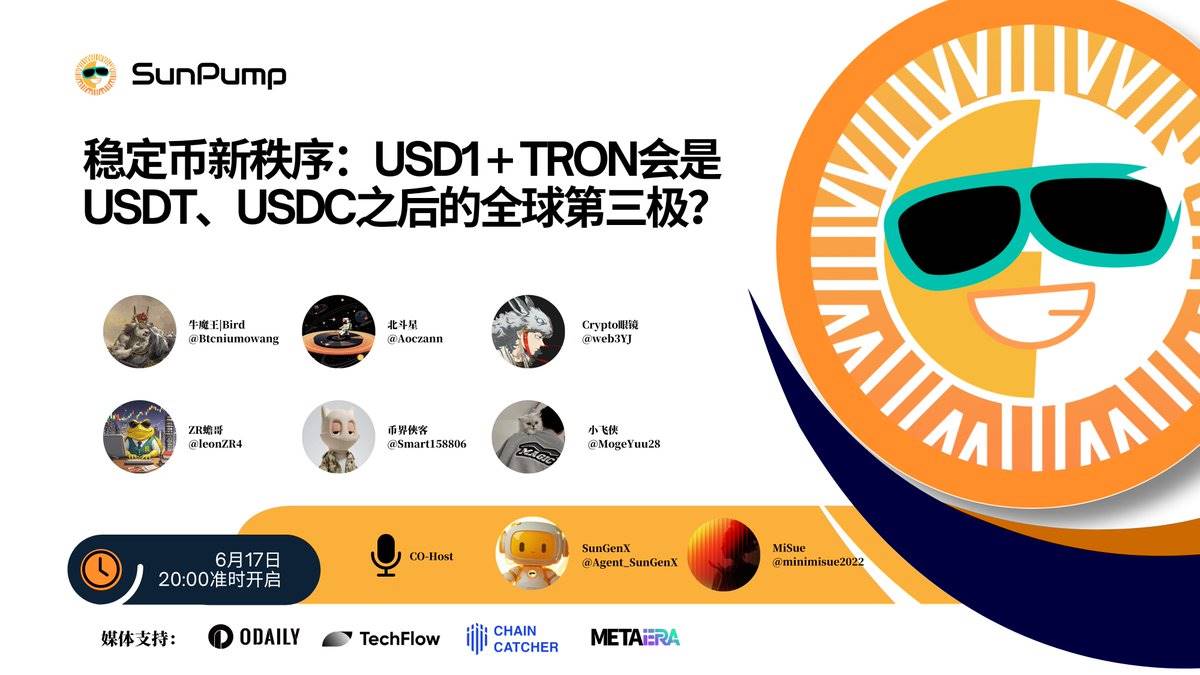
In June 2025, USD1, a stablecoin backed by the Trump family, officially launched on the TRON network, marking a direct challenge to the duopoly dominance of USDT and USDC and quickly sparking market debate. At 8 PM on June 16, #SunFlash Roundtable hosted an in-depth discussion on X Space titled "A New Stablecoin Order: Can USD1 + TRON become the global third pole after USDT and USDC?"
The event brought together several veteran industry KOLs who conducted a deep analysis across technical capabilities, asset models, compliance, and capital pathways—examining whether USD1 can break through the existing barriers, and whether the TRON network has the capacity to support a “third pole” stablecoin.
June 2025 marks a pivotal shift in the stablecoin landscape. World Liberty Financial, the cryptocurrency project backed by the Trump family, integrated its USD1 stablecoin onto the TRON network. This milestone not only solidifies TRON’s position as the leading public blockchain for stablecoins but also places the USD1-TRON alliance at the forefront of industry attention: In today's increasingly consolidated stablecoin market, can USD1 emerge as a true “third pole” leveraging political capital alongside TRON’s technological and ecosystem strengths?
Behind this stablecoin race lies a comprehensive upgrade of the TRON ecosystem. From being dominated by USDT to the strong entry of USD1, TRON is transforming from a mere “stablecoin conduit” into a full-fledged “financial infrastructure.” The success or failure of USD1 will not only determine the fate of a single stablecoin but also test whether TRON can truly live up to the industry’s expectations of becoming the “third pole.” This article focuses on key insights from the roundtable, recapping the guests’ insightful dialogue and unique perspectives.
1. The Disruptor USD1: Challenging the USDT-USDC Duopoly
The global stablecoin market currently exhibits a clear duopoly, with USDT and USDC collectively holding nearly 90% of the market share. However, panelists generally agree that both face structural bottlenecks, while USD1—with political backing, capital flexibility, and claims of sovereignty independence—is breaking through the monopolistic barriers held by these two giants.
● Bottlenecks Facing USDT and USDC
Beidouxing pointed out: "The EU’s MiCA regulations require stablecoin issuers to be licensed and mandate that reserve assets be strictly pegged to the referenced currency. This could lead exchanges like Coinbase to delist USDT trading pairs in Europe. Additionally, ongoing concerns about reserve transparency further increase risks. Although claiming 1:1 USD backing, actual issuance often fluctuates with market demand, deviating from initial commitments." Beidouxing added: "While USDC excels in compliance with 100% U.S. Treasury bonds and cash reserves, it simultaneously reveals excessive reliance on the traditional financial system."
● Emerging Demand and the Rise of a Third-Pole Space
Demand for non-traditional stablecoins is breaking through the duopoly's dominance. Xiao Feixia believes the stagnation of the two giants is “inevitable,” as they struggle to overcome triple bottlenecks in regulatory adaptability, sustainable profitability, and product innovation—creating opportunities for new stablecoins to differentiate themselves.
On future trends in the stablecoin landscape, Bijie Xiake noted: "The future may not be defined by one or two dominant stablecoins, but rather a diversified, multi-layered ecosystem of stablecoins with stronger suitability—aligning with the global trend toward decentralized and multipolar financial development."
● USD1’s Core Competitiveness: Political Backing and Capital Flexibility
ZR Chan Ge highlighted that USD1’s multi-chain deployment and flexible issuance mechanism enable it to meet diverse use-case demands. Xiao Feixia argued that USD1’s sovereignty independence presents a dual nature: On one hand, its “decentralized governance council” model helps it avoid oversight from any single nation, giving it better censorship resistance than USDC; on the other hand, its reserves remain heavily dependent on the U.S. Treasury system, meaning it still operates within the framework of dollar hegemony. For users prioritizing censorship resistance, USD1 is a superior choice; for those seeking legal stability, USDC holds an advantage.
However, Bijie Xiake offered a counterpoint, noting that while USDC’s strong compliance makes it the preferred option for traditional financial institutions, it also exposes concentrated policy risks—such as potential asset freezes due to changes in U.S. regulation. USD1, by contrast, attempts to balance regulatory pressure through political resources, making it better suited for cross-border settlement needs. He emphasized, “Compared to USDC, USD1 indeed demonstrates greater sovereignty independence and global applicability—a valuable stablecoin form for future cross-chain finance and multinational business ecosystems.”
2. USD1 + TRON: A Powerful Alliance Shaping a New Stablecoin Ecosystem
In the 2025 stablecoin market, where “regulatory divergence” and “technological breakthroughs” coexist, the TRON network—boasting over 2,500 TPS, ultra-low transaction costs, a rich application ecosystem, and strong regulatory resilience—has built a differentiated moat for emerging stablecoins like USD1. Leveraging TRON’s technological empowerment and the Trump family’s political capital, USD1 has rapidly penetrated emerging markets such as Southeast Asia and Africa, achieving a circulation volume exceeding $2.1 billion.
Beidouxing noted that USD1’s decision to launch primarily on TRON offers multiple compounded advantages:
1. Dominance in High-Frequency Payment Scenarios: With high throughput, low cost, and a robust ecosystem, TRON gives USD1 an edge in B2B instant settlements, cross-border payments, and micro-transactions. These characteristics attract retail investors and small-to-medium merchants alike, fostering user stickiness.
2. Regulatory Adaptability Design: Through the Bubblemaps V2 compliance traceability system, TRON anonymizes addresses while preserving necessary regulatory information via a compliance metadata layer. This “visual anonymity” technology satisfies GDPR requirements and aligns with FATF standards, earning recognition from the European Blockchain Observatory.
Niu Mowang explained from an infrastructure perspective: The TRON network is essentially a “financial highway.” Its tech stack—including energy staking mechanisms—reduces transfer costs to near zero while maintaining high concurrency, enabling rapid user onboarding. With payment efficiency rivaling Visa, TRON has established a “moat” in cross-border remittances and merchant settlements.
3. TRON’s Expanding Stablecoin Ecosystem Offers Large-Scale Operational Capacity for USD1
TRON has become the primary battlefield for real-world stablecoin applications, driven by its “low-cost + high-efficiency” technical architecture and expanding DeFi ecosystem. From an ecological development standpoint, ZR Chan Ge outlined key milestones achieved since TRON’s inception:
● Closed-loop Ecosystem Layout: From the BitTorrent cross-chain protocol to JustLend lending platform; from major DEX SunSwap to SunCurve focused on stablecoin trading, and further to SunPump’s meme sector and APENFT’s NFT marketplace, TRON has formed a diversified matrix of stablecoin applications.
● Compliance Milestones: Securing financial licenses consecutively from the UAE, EU, and Singapore has cleared hurdles for global expansion.
Bijie Xiake further highlighted TRON’s ecosystem synergy: “TRON has built the world’s most mature stablecoin financial environment, elevating stablecoins from mere transaction tools to integrated infrastructure for ‘earnings–payments–asset management.’” In his view, TRON’s moat isn’t just technical specs—it’s the ability to transform stablecoins into a “financial operating system.”
4. USD1 and USDD Synergy Enables a Diversified Stablecoin Framework on TRON
Currently, the total circulating supply of stablecoins like USDT, USDD, and USDJ on TRON approaches $80 billion, firmly placing it among the top public blockchains globally. With USD1 now integrated into TRON, the ecosystem’s stablecoin matrix becomes even richer. Panelists believe TRON has now established a multi-tiered, complementary stablecoin system.
Xiao Feixia explained: “TRON is essentially a diversified ‘stablecoin supermarket’: USD1 serves compliant scenarios, USDD meets DeFi users’ demand for high yields, and USDT continues to function as a payment channel, with all three sharing liquidity pools for seamless capital flow.” Bijie Xiake further emphasized the core complementarity between USD1 and USDD: Together, they form a “regulation–decentralization” dual-track system—USD1’s rigorous auditing attracts institutional capital, while USDD’s algorithmic flexibility meets the anti-censorship needs of crypto-native users.
From a liquidity hub perspective, Beidouxing noted that USD1, USDD, and TRX Vault on TRON are creating a virtuous synergistic effect: USD1 derives value from strong compliance and authoritative endorsement, whereas USDD—the native decentralized stablecoin on TRON—maintains price stability through algorithmic adjustments and over-collateralization, embodying self-governance ideals within the crypto community. In cross-border payments, the trio enables a closed loop of “compliant entry → on-chain circulation → yield generation.”
As the roundtable concluded, Niu Mowang summarized: “TRON isn’t simply choosing between being a ‘stablecoin supermarket’ or a unified settlement layer—it’s creating species diversity in digital finance. USD1 is the compliant bridge to the traditional world, USDD is the value engine for DeFi, and TRX Vault will become the lubricant powering global capital flows.”
5. Conclusion
At the intersection of technological advancement and political capital, the collaborative experiment of “USD1 + TRON” is reshaping the power structure of stablecoins. As consensus emerged during the roundtable, TRON—through ecosystem expansion and a closed-loop liquidity architecture—has built an unprecedented “biodiversity” in the stablecoin space. If USD1 can continuously balance political empowerment with transparent compliance, and leverage TRON’s technical infrastructure and expanding DeFi ecosystem, its ultimate value—and mission—will transcend competition between individual tokens, ultimately advancing blockchain from a transaction tool to a global financial operating system, ushering in the next decade of digital finance.
Join TechFlow official community to stay tuned
Telegram:https://t.me/TechFlowDaily
X (Twitter):https://x.com/TechFlowPost
X (Twitter) EN:https://x.com/BlockFlow_News