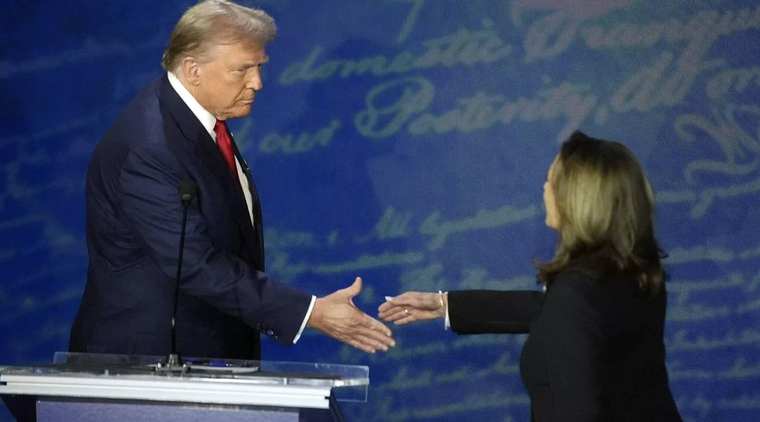
Looking back at historical extremes, when was the latest time a U.S. presidential election result was finalized?
TechFlow Selected TechFlow Selected
Looking back at historical extremes, when was the latest time a U.S. presidential election result was finalized?
What should be done in case of a tie?
 Navigating Web3 tides with focused insights
Author: Azuma, Odaily Planet Daily
The U.S. presidential election officially begins today, but many readers still have questions about when the final results will be known.
Under normal circumstances, preliminary results are available the same night
According to data compiled by Yahoo Finance, voting in various states will conclude between 11:00 AM EST on November 5 (7:00 AM Beijing Time on November 6) and 1:00 AM EST on November 6 (2:00 PM Beijing Time). States will then begin announcing popular vote results as they complete counting. However, due to differences in voting methods, ballot processing, and counting rules across states, the timing of result announcements will vary.

Given the reality of U.S. elections, the overall outcome largely hinges on seven key swing states: Georgia, North Carolina, Michigan, Pennsylvania, Arizona, Wisconsin, and Nevada. Among them, Georgia will finish voting earliest at 8:00 AM Beijing Time on November 6. Pennsylvania—the swing state with the most electoral votes—will close polls at 9:00 AM Beijing Time, while Nevada will be the last, closing at 11:00 AM Beijing Time.
Based on this timeline, major U.S. media outlets such as CNN predict that under normal circumstances, a preliminary determination of the election outcome could be made on election night, corresponding to midday or afternoon Beijing Time on November 6.
Could there be “abnormal” scenarios?
If there are normal cases, abnormal ones are also possible.
Looking back at 236 years of U.S. election history, there have indeed been instances where results were delayed. Reasons varied: extremely narrow margins or even ties; no candidate securing the required minimum number of electoral votes; unexpected extensions in vote counting; or recounts triggered in pivotal states due to near-even vote distributions...
In 1800, a tie occurred between presidential candidates—an extreme scenario that forced the U.S. to amend its election rules (though a minimal chance of a tie remains today, discussed below). In 1824, none of the candidates secured enough electoral votes, leading to the only instance in history where the House of Representatives elected the president.
Even excluding these historical precedents from over two centuries ago, several 21st-century elections have seen delays of varying lengths—including the 2020 election involving Trump himself, and the 2000 election, whose result wasn’t finalized until 36 days after Election Day.
2020 Election (4-day delay)
The 2020 U.S. Election Day was November 3 local time (U.S. presidential elections occur every four years on the first Tuesday of November). Due to the pandemic, significantly more voters opted for mail-in ballots, which extended the vote-counting period.
It wasn't until November 7, when Joe Biden won both Pennsylvania and Nevada—two crucial swing states—and surpassed the 270 electoral vote threshold, that the outcome became preliminarily clear.
Notably, Trump prematurely declared victory during this election and repeatedly accused Democrats of voter fraud after initial results emerged, yet ultimately failed to alter the outcome. Should Harris win this time, a similar replay cannot be ruled out...
2000 Election (36-day delay)
The 2000 U.S. Election Day was November 7. Initially, progress was smooth. By the morning of November 8, as states announced their counts, Democratic candidate Al Gore had secured 250 electoral votes, while Republican candidate George W. Bush trailed slightly with 246. Both were just short of the 270 needed to win.
All eyes turned to Florida, which held 25 electoral votes—enough to push either candidate past the threshold. Florida eventually declared Bush the winner by an extremely narrow margin: just 1,700 more popular votes than Gore, a difference of only 0.03% of total ballots cast. Under Florida law, any margin under 0.5% triggers an automatic recount.
On November 10, Florida completed a machine recount, reducing Bush’s lead to only 327 votes. Gore promptly requested manual recounts in select counties. A fierce legal battle then erupted over whether manual recounts should proceed, which counties should be included, and deadlines for completion. On December 9, the U.S. Supreme Court halted the manual recount process. On December 11, it ruled definitively against further manual recounts, upholding the previously certified results by the Secretary of State. Gore conceded on December 13.
By then, 36 full days had passed since Election Day.
In the most extreme case, could there be a 269–269 tie?
For this year's election, while highly unlikely, a 269–269 electoral vote tie is still theoretically possible.
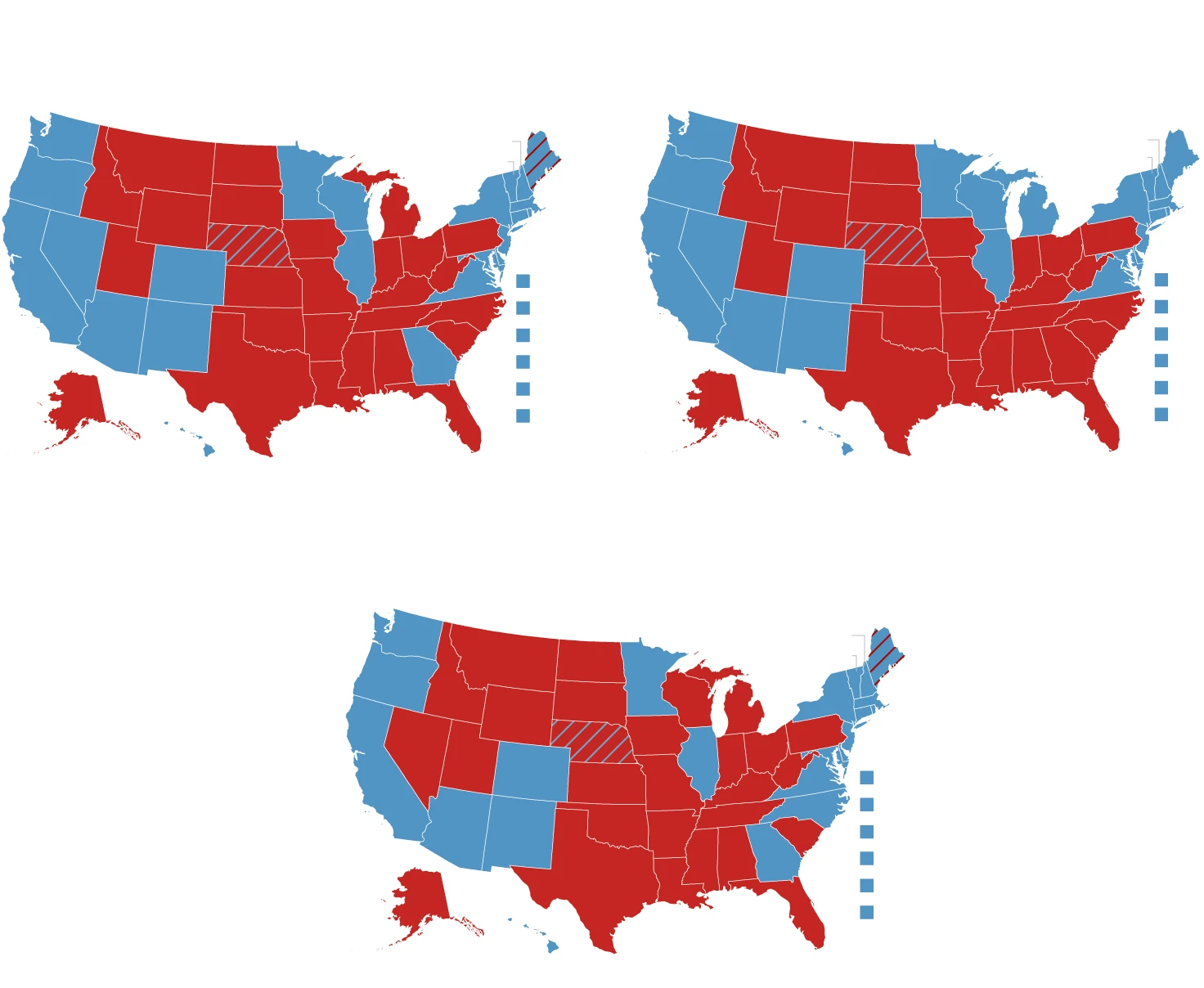
For example, if Harris wins Wisconsin, Michigan, Arizona, and Nevada—and secures one electoral vote in Nebraska (which Biden won in 2020)—but loses Pennsylvania and Georgia, the electoral count would end in a perfect tie at 269–269.
As shown in the image below, the election forecasting site 270toWin lists other potential tie scenarios.
If such a scenario occurs, how would the president be decided?
Per the Twelfth Amendment ratified after the 1800 election, if no candidate receives a majority of electoral votes (currently 270), the newly sworn-in Congress on January 3 will elect the president, while the Senate will elect the vice president. This process is known as a "contingent election."
According to analysis by the Congressional Research Service, in such an extreme case, the contingent election would likely take place on January 6. Since each state delegation in the House gets one vote regardless of size, and Republicans currently control more state delegations, Trump would be more likely to become president under this scenario.
Wait—there’s an even more extreme possibility: If the House fails to elect a president before the January 20 inauguration day, the newly elected vice president chosen by the Senate would serve as acting president… though the likelihood of this scenario is so low it’s practically negligible.
Waiting for the outcome
In summary, the above discussions of exceptional cases like the elections of 1800, 1824, 2000, and 2020 aim only to illustrate that the timing of U.S. election results carries some uncertainty. Nevertheless, under normal conditions, markets still expect the new occupant of the White House to be preliminarily determined on November 6.
Readers need only wait another day or two to witness the final result. When that moment arrives, the current murky market trends may finally begin to clarify.
Join TechFlow official community to stay tuned
Telegram:https://t.me/TechFlowDaily
X (Twitter):https://x.com/TechFlowPost
X (Twitter) EN:https://x.com/BlockFlow_News
 Odaily