EigenLayer advisors in flux, how is Ethereum's neutrality being practiced?
TechFlow Selected TechFlow Selected
EigenLayer advisors in flux, how is Ethereum's neutrality being practiced?
The Ethereum community is distancing itself from project teams.
 Navigating Web3 tides with focused insights
By Pzai, Foresight News
As one of Ethereum's most significant derivative projects, EigenLayer has underperformed in price action following its token launch.
On November 2, two project advisors to EigenLayer—Dankrad Feist and Justin Drake, both members of the Ethereum Foundation—publicly announced their resignation from advisory roles after nearly six months, stating they would refocus on “more neutrally aligned” work. Back in May, when they first joined as advisors, their appointments sparked controversy within the native Ethereum community. Their decision to step down only now, long after the token launch, has further fueled community skepticism about whether they leveraged their positions for personal gain. This article compiles recent developments and offers insight into the complex relationship between the Ethereum community and affiliated projects.
Warm Invitation
At the time of their appointment, both individuals disclosed receiving multi-million-dollar token incentives. Justin Drake even stated that the size of his incentive package exceeded the total value of all his other assets combined. Although EigenLayer operates within the Ethereum ecosystem, it inherently presents certain conflicts of interest with Ethereum—particularly around issues of centralized staking and compromised neutrality due to dual affiliations. Some Ethereum builders lamented: “Even foundation members are now restaking themselves.”

Regarding neutrality concerns, Dankrad emphasized that his involvement would not bias core protocol development in favor of EigenLayer. He highlighted several risks associated with restaking mechanisms, including potential centralization, protocol-level attacks, and misaligned interests between token holders and stakers. However, he also argued that if properly implemented, restaking could bring some benefits of liquid staking tokens (LSTs) to independent stakers and offer temporary solutions for projects constrained by Ethereum’s network resources. A primary goal of his advisory role was to help mitigate centralization risks and prevent potential attacks arising from restaking services.
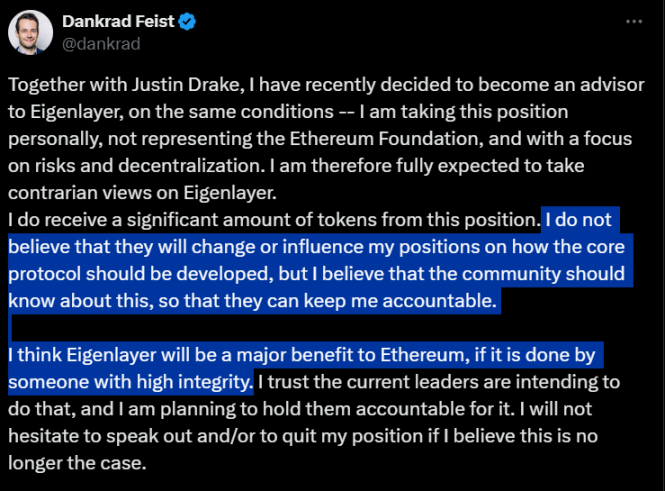
Justin Drake pledged to reinvest all compensation received as advisor into valuable projects within the Ethereum ecosystem and committed to resign immediately should EigenLayer act against Ethereum’s interests.
Nonetheless, the broader community questioned: Why would key contributors to the Ethereum Foundation accept advisory roles in a project with conflicting interests? Where lies credible neutrality? The Ethereum Foundation, long regarded as a public-good organization operating under a non-profit ethos, leaves unanswered whether such engagements violate internal principles. One fact remains clear: early contributors and investors (VCs and team) collectively hold 55% of the token allocation, fueling user suspicion about alignment and motives.
Quiet Departure
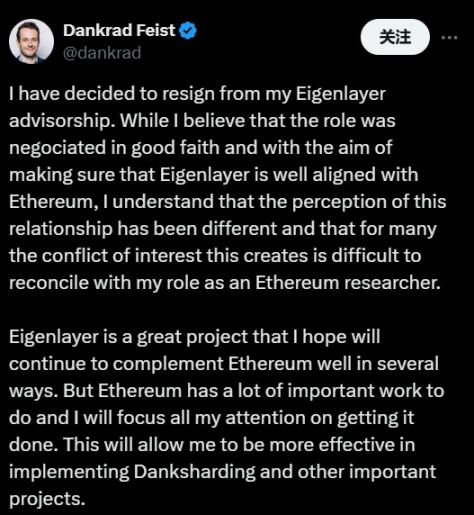
Yesterday, Dankrad Feist and Justin Drake officially stepped down from their advisory positions at EigenLayer. Dankrad stated: “While I believe this role was entered into in good faith, with the intention of ensuring EigenLayer remains aligned with Ethereum, I recognize that perceptions of this relationship vary—and for many, the conflict of interest is difficult to reconcile with my role as an Ethereum researcher.” He added that he will now focus on advancing Danksharding, his proposed scalability solution.
Justin Drake had already exited the advisory role back in September, apologizing to the Ethereum community and EF colleagues: “I want to apologize for creating drama. In hindsight, this was a wrong decision for me,” and clarified that he did not receive any tokens.
Still, the community remains skeptical. Given EigenLayer’s post-launch price performance, many believe they stepped away only after securing personal benefits—essentially leveraging their reputations for profit.
What Remains of Ethereum’s Neutrality?
Within the Ethereum ecosystem, the Ethereum Foundation serves as one of the central authorities influencing this vast public good. EigenLayer, as a relatively independent project, sought influence over Ethereum’s trajectory through interpersonal connections—with the Foundation serving as a natural gateway. Despite an annual budget exceeding $100 million, Foundation members often engage in external ventures; for example, Justin Drake himself serves as advisor or committee member for multiple projects including Polygon, Arbitrum, and Bankless.
Ethereum founder Vitalik Buterin frequently speaks publicly about technological neutrality. Yet beyond technology, what preserves neutrality may ultimately come down to individual ethics and professional integrity. Beyond EigenLayer, numerous projects maintain intricate ties with the Ethereum Foundation, prompting the Foundation to reconsider how neutrality should be maintained within such a large and growing ecosystem. As Vitalik once said: “While there are many paths toward building a scalable, secure, long-term blockchain ecosystem, they all seem to be converging toward very similar futures.” We hope to see an Ethereum ecosystem defined by neutrality—one capable of embracing diversity and inclusivity.
Interestingly, shortly after Dankrad Feist and Justin Drake announced their departure from EigenLayer, Keone Hon, founder of Monad, posted on X urging founders not to hastily appoint advisors. He noted: “The people who can give you truly valuable advice probably won’t become your advisors. Conversely, those who readily offer advisory support often don’t provide truly valuable insights.”
In fact, those most likely to offer valuable advice usually do so without charging fees—they just won’t take an official advisor title.”
Join TechFlow official community to stay tuned
Telegram:https://t.me/TechFlowDaily
X (Twitter):https://x.com/TechFlowPost
X (Twitter) EN:https://x.com/BlockFlow_News
 Foresight News