EigenLayer: Building Decentralized Cloud Services for Web3 AI
TechFlow Selected TechFlow Selected
EigenLayer: Building Decentralized Cloud Services for Web3 AI
EigenLayer can be regarded as a Web3 decentralized cloud service provider.
 Navigating Web3 tides with focused insights
Author: Decentralised.Co
Translation: TechFlow
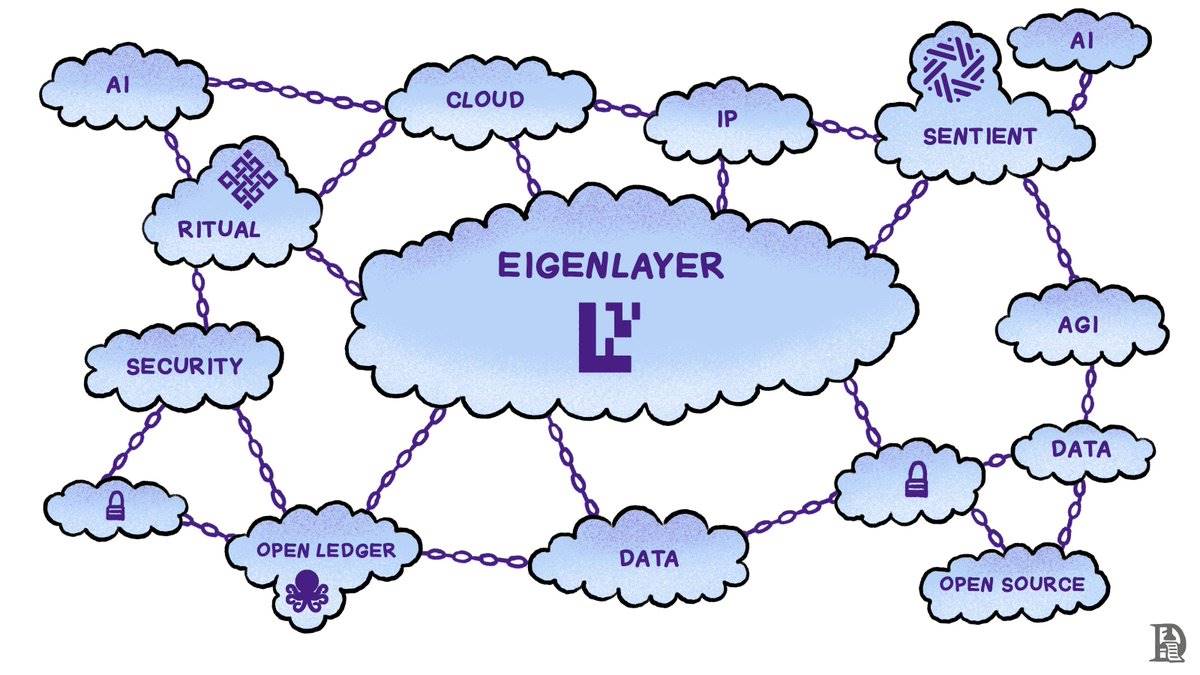
If AI needs the cloud, then Web3 AI needs Web3 cloud services.
Over the past year, @eigenlayer and artificial intelligence have been the hottest topics in crypto. In this article, we’ll explore their intersection and some of the projects innovating in this space.
What is an AVS?
First, we need to understand Active Validation Services (AVS) on EigenLayer.
Think of EigenLayer as a marketplace for security and compute power.
Blockchains and other cryptographic protocols (like bridges) rely on decentralized node operators to process transactions. These node operators are responsible for maintaining the current state of the network and processing incoming transactions. To validate a transaction, a majority of node operators must agree on its validity. Therefore, the more nodes there are, the more secure the network becomes.
New protocols often face a cold-start problem when building a strong base of node operators. Operators are typically incentivized with the protocol’s native token. However, in early stages, these tokens may have limited value due to the lack of a robust node network.
To solve this, teams might offer more tokens to attract node operators, but this can lead to high inflation and token dilution—an undesirable outcome. Additionally, a small number of nodes in the early phase introduces security and centralization risks.

EigenLayer solves this by helping any blockchain service—called an Active Validation Service (AVS)—bootstrap Ethereum-backed security. The protocol consists of specialized operators that provide computation and security. Users allocate ETH or liquid-staked ETH to these operators, who then validate one or more AVSs.
If operators fulfill their duties, they receive rewards from the AVS, which they then distribute to depositors. If operators fail in their duties, their stake is slashed.
By enabling a shared set of operators to validate multiple services, governed by a common economic layer, EigenLayer simplifies the launch of projects that depend on distributed nodes for security. This proposition has attracted various projects including data availability solutions, bridges, oracles, and ZK processors.
Artificial Intelligence
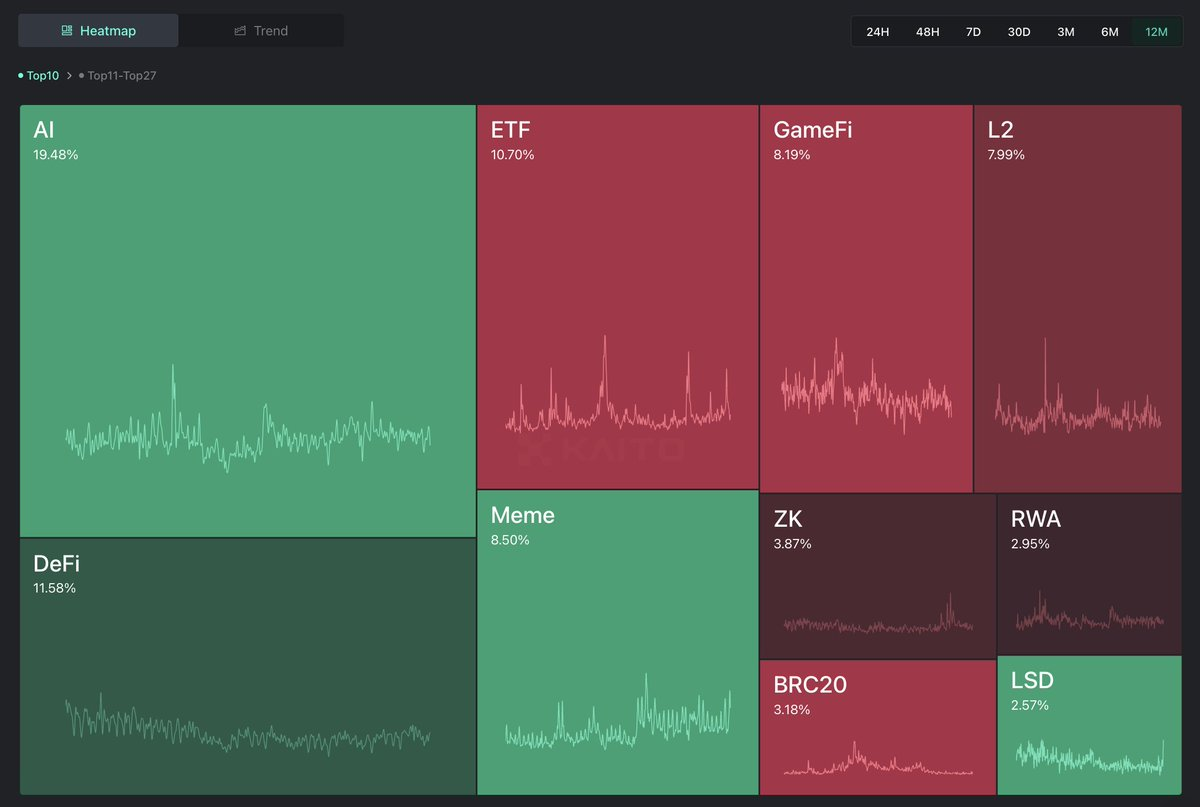
Over the past two years, AI has become the focal point of the tech world, capturing the attention of entrepreneurs, investors, and users alike. This trend has naturally spilled into the crypto space. According to @_kaitoai, AI has become the most discussed topic across all crypto domains over the last 12 months.
In the context of blockchains, operators are essentially computers. When validating rollups, they receive incoming transactions, process them, and output a new state. But if operators could also provide hardware like GPUs, SSDs, and ZK provers, this input-process-output model could extend to any distributed computing task. Thus, EigenLayer can be seen as a Web3 distributed cloud provider.
Today, most AI processing happens in the cloud—from hyperscalers like AWS to specialized providers such as Lambda and Coreweave. These services support model training and inference, making EigenLayer, as a Web3 cloud, a natural fit for Web3 AI applications.
Let’s look at some real-world examples.
Ritual
Currently, most users and developers access AI services through APIs provided by centralized cloud providers. However, this setup brings several issues: lack of privacy, questionable computational integrity (how do you know the response came from the model you requested?), and potential censorship.
In contrast, smart contracts run in a highly secure, transparent, and trusted environment. There are cases where smart contracts need to interact with AI services, but running any AI process on-chain is computationally infeasible. Existing cloud providers cannot serve smart contracts either, as doing so would break their trust assumptions.
@ritualnet is solving this by building an open, privacy-first, censorship-resistant, and verifiable AI layer designed specifically for blockchain AI services. Their first product, Infernet, allows smart contracts to request AI model inferences with computational integrity proofs. In the future, Ritual plans to expand by creating a sovereign chain—Ritual Chain—that will enable more advanced capabilities like fine-tuning and training AI models.
The Ritual Chain will be built as an AVS on EigenLayer. Operators equipped with specialized hardware (such as GPUs) will execute AI queries for the chain. A decentralized validator set will ensure high availability and censorship resistance, as each query will be processed by multiple operators. Additionally, these operators will also provide foundational security for the Ritual Chain itself.
OpenLedger
A few weeks ago, we discussed the data challenges in AI and how blockchain protocols can help address them. While we recommend reading the full piece, the most critical issue we highlighted was the centralization of AI data. Platforms holding valuable data enter into multi-million dollar deals with well-funded companies while restricting access for smaller startups and research institutions.
@OpenledgerHQ aims to solve this by creating an "AI sovereign data blockchain." OpenLedger provides AI teams with:
High-quality annotated data to ensure effective training and accuracy
Enhanced reinforcement learning and human feedback (RLHF) services for model improvement
Tools to evaluate AI models for accuracy, reliability, and safety
OpenLedger is also building an AVS on EigenLayer. While specific implementation details haven’t been fully disclosed, we can make reasonable assumptions. To build a distributed, highly available data layer, chain nodes will require large amounts of fast memory. EigenLayer operators are well-suited to provide this, along with basic compute and security services.
Sentient
@sentient_agi recently announced an $85 million seed round, attracting top-tier investors and operators in crypto. Their goal is to create an "open AGI development platform." What does that mean exactly?
Currently, leading AI models are mostly closed-source and controlled by a few powerful organizations. This level of control over one of the most important technologies of our time is unhealthy. As a result, a growing open-source movement has emerged, where model weights (configurations) are made publicly available, allowing anyone to run the models on their own hardware or fine-tune them for specific needs.
However, while open-source models are crucial, their creators struggle to monetize them. Once weights are public, anyone can host, modify, retrain, and build services based on them without sharing revenue with the original creators. This fundamental misalignment of incentives could slow down the progress of open-source AI.
Sentient aims to bring “ownership rights” to AI development. It wants to create a technology that enables researchers and developers to monetize AI models while keeping them open and secure. When developers use models created via Sentient, they can verify the model’s authenticity—just like with open-source models—but they must pay inference fees to compensate the model creators.
Sentient is being built using Polygon CDK technology and operates as an AVS on EigenLayer. Although Sentient’s exact use of EigenLayer hasn’t been fully revealed, we can speculate it may follow an approach similar to Ritual—likely involving operators providing both the computational resources needed for inference and contributing to chain security.
In a blog post last year, the EigenLayer team mentioned AI inference as one of 15 potential unicorn ideas that could be built as an AVS. Clearly, many teams believe in this potential. While both EigenLayer and the Web3-AI space are still in early stages, their convergence feels inevitable. If AI needs the cloud, then Web3 AI needs Web3 cloud services.
The projects we’ve mentioned are just the first wave of early experiments. We look forward to seeing many more emerge.
Join TechFlow official community to stay tuned
Telegram:https://t.me/TechFlowDaily
X (Twitter):https://x.com/TechFlowPost
X (Twitter) EN:https://x.com/BlockFlow_News
 @Decentralisedco