Four Pillars Research Report: Tracing the Origins of Re-staking, A Comprehensive Understanding of the Current Ecosystem and Innovations
TechFlow Selected TechFlow Selected
Four Pillars Research Report: Tracing the Origins of Re-staking, A Comprehensive Understanding of the Current Ecosystem and Innovations
Restaking redefines blockchain security.
 Navigating Web3 tides with focused insights
Author: Ingeun
Translation: TechFlow
Key Takeaways
-
Restaking is a mechanism that allows users to reuse already staked assets across multiple blockchain networks or applications to provide additional security. This enables users to leverage existing staked assets, enhancing system scalability and liquidity while earning extra rewards.
-
The restaking stack is a conceptual framework that systematically categorizes the main components of the restaking ecosystem, including base blockchain networks, staking infrastructure, staking platforms, restaking infrastructure, restaking platforms, and restaking applications.
-
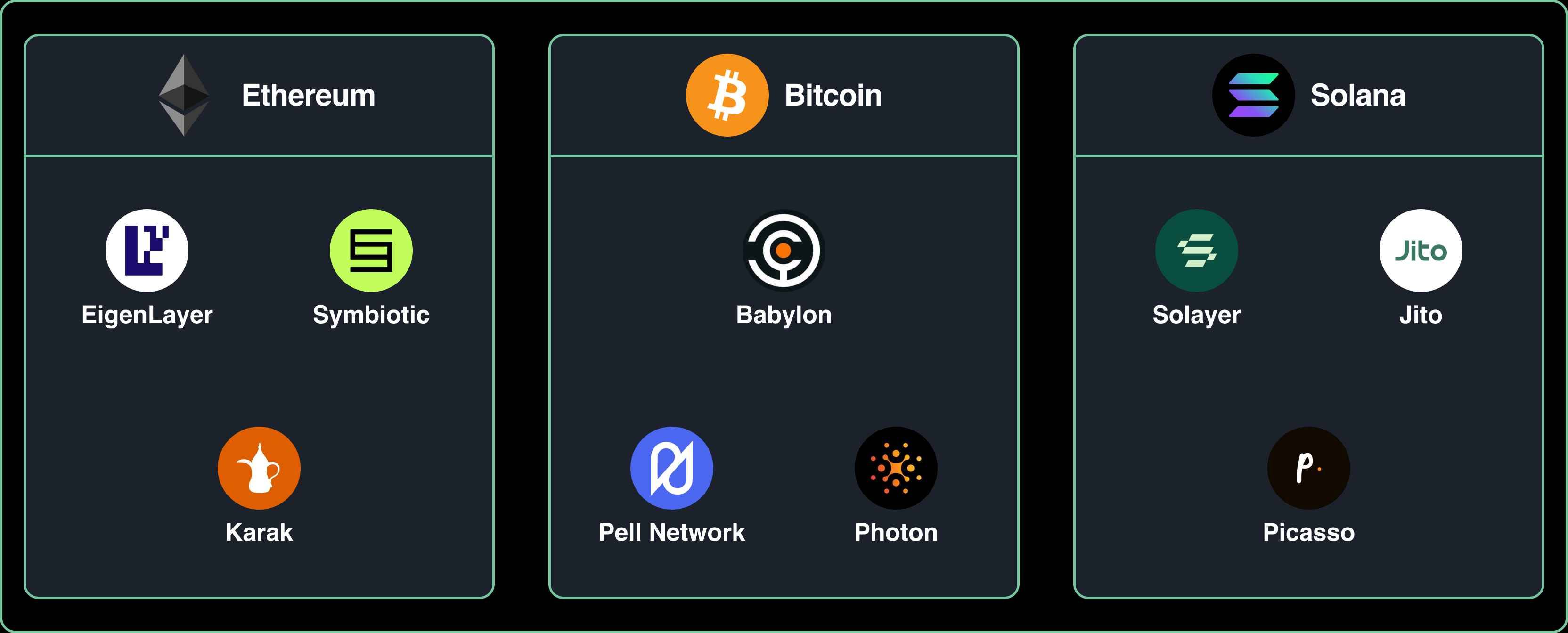
Restaking infrastructure provides the technical foundation for enabling staked assets to secure other protocols or networks. Notable projects in this space include EigenLayer for Ethereum, Babylon for Bitcoin, and Solayer for Solana—each focused on ensuring liquidity, strengthening security, and improving network scalability.
-
Restaking is redefining blockchain security and rapidly evolving into a full-fledged ecosystem. Its ability to enhance scalability and liquidity through economic security makes it highly attractive, despite ongoing concerns about the risks and profitability of the restaking model.
-
The next part of this series will explore restaking platforms and applications, which are critical for the potential mass adoption of the restaking ecosystem.
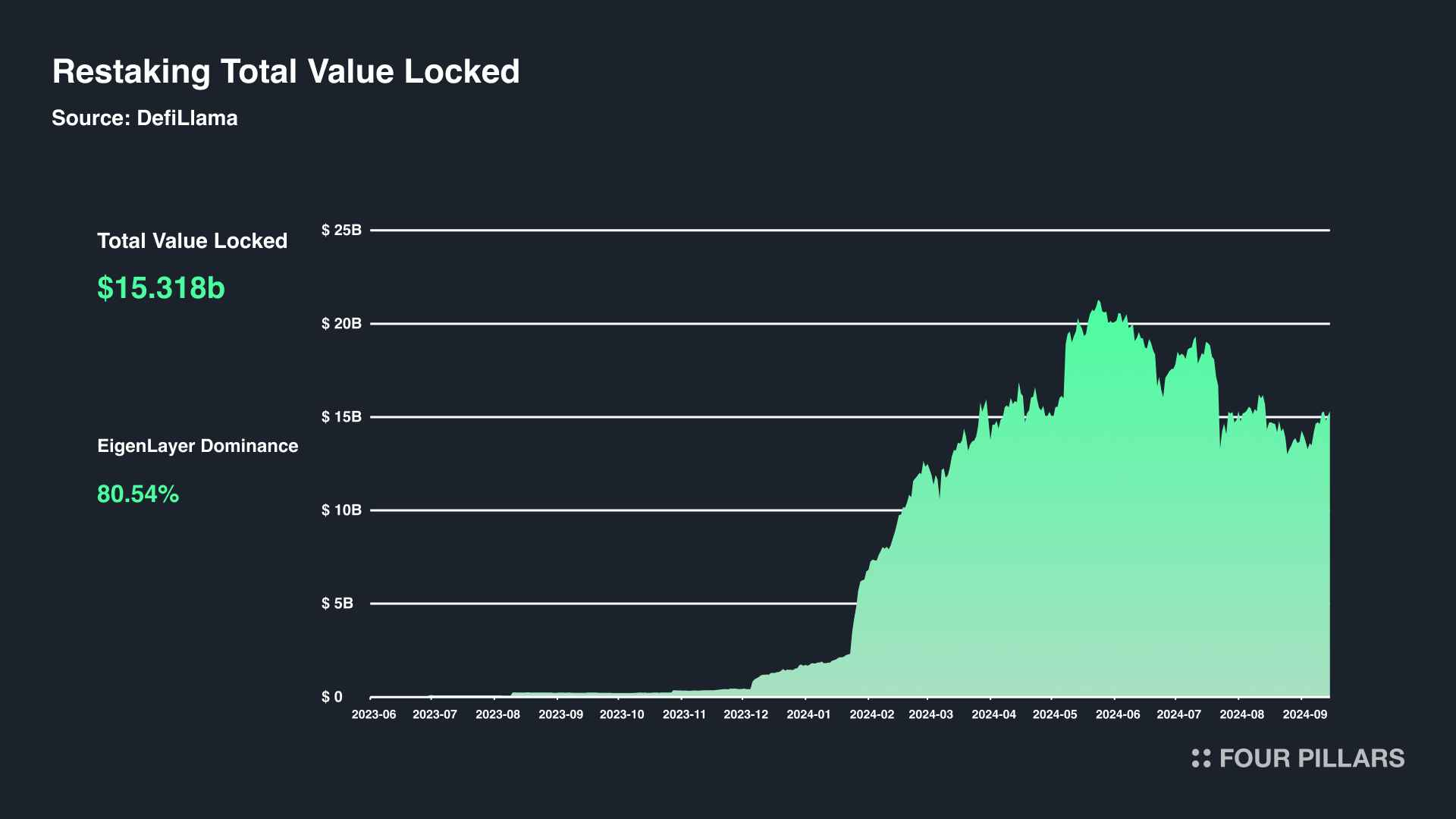
As of September 28, 2024, the total value locked (TVL) in the restaking ecosystem led by EigenLayer reached approximately $15.3 billion. This surpasses Aave’s $13 billion TVL in crypto lending and exceeds half of Lido’s TVL ($26.48 billion), the leading Ethereum liquid staking platform. This highlights the remarkable growth of the restaking ecosystem.
Given this, you might wonder: what exactly is restaking, and why has it captured the attention of crypto holders and driven such rapid expansion? To answer these questions, this two-part series will explain what restaking is, how to view the expanding restaking ecosystem, and highlight some of the most interesting projects within it.
This series begins with an overview of restaking, defines the restaking stack around robust restaking infrastructure, and explores projects classified as restaking infrastructure along with their unique characteristics.
1. Introduction to Restaking
1.1 Before Restaking
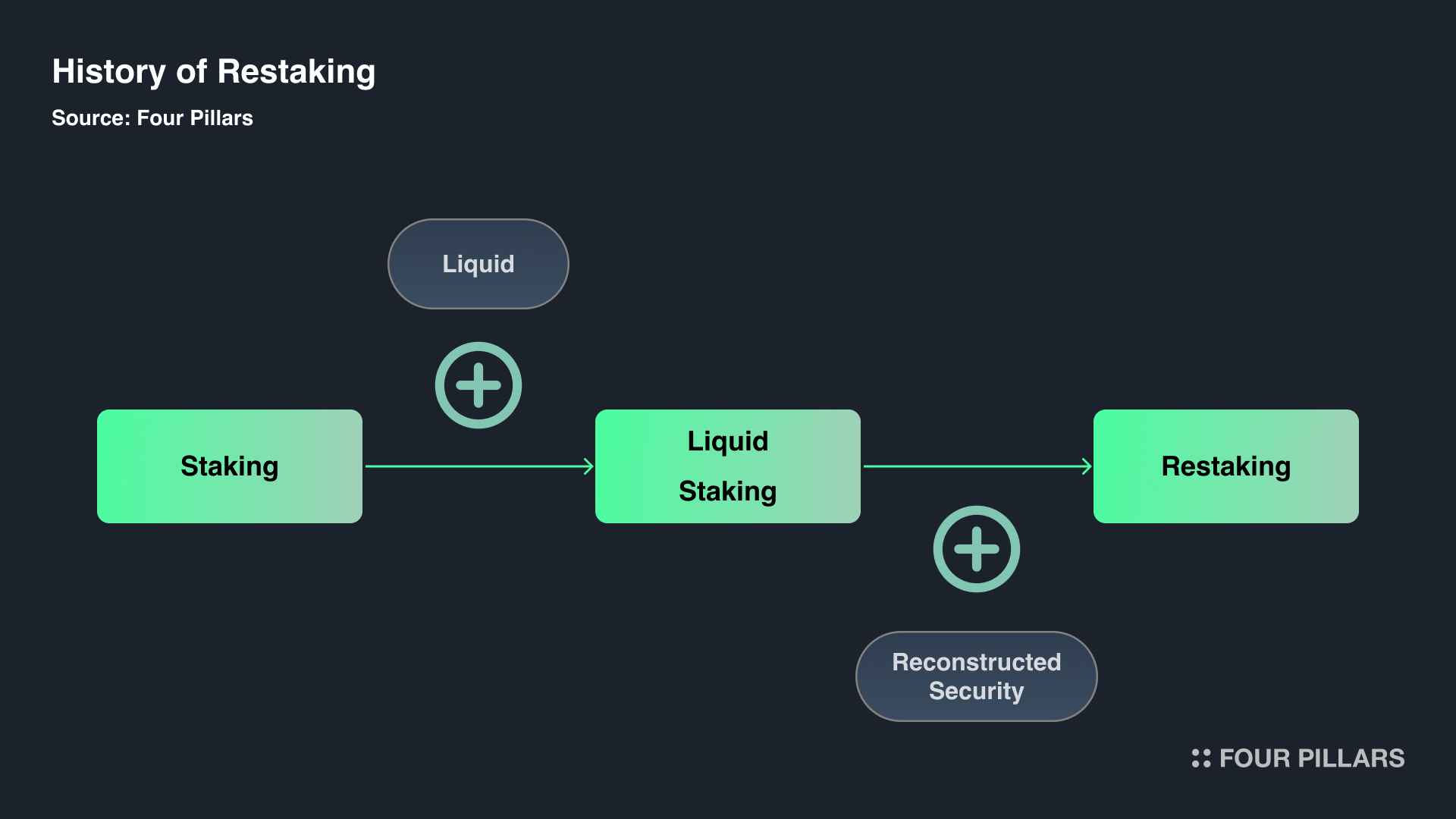
After Ethereum transitioned from Proof-of-Work (PoW) to Proof-of-Stake (PoS) via the highly anticipated "Merge" upgrade, many ETH holders began staking their ETH to support network stability and earn staking rewards. This process gave rise to various staking services and platforms.
The first need was for staking pools. The minimum requirement of 32 ETH posed a significant barrier for smaller Ethereum holders. To address this, staking pools were developed, allowing those with less than 32 ETH to participate in Ethereum staking.
The next challenge was liquidity. When ETH is staked, the asset is locked in smart contracts, reducing liquidity. In the early days following the PoS transition, staked ETH could not even be withdrawn, meaning staked ETH had virtually no liquidity. To solve this, services like Lido and Rocket Pool issued liquid staking tokens (LSTs). These tokens mirror the value of staked ETH, allowing stakers to use them as substitutes for their staked ETH in other DeFi applications. Effectively, LSTs enabled users to regain partial liquidity of their staked assets.
With liquidity ensured via LSTs, new opportunities emerged for utilizing these tokens. However, LSTs were largely confined to the Ethereum DeFi ecosystem and were not used to secure Ethereum-based scaling solutions such as Layer 2s (L2s). This introduced new challenges to Ethereum's security model, including:
-
Scalability issues: Ethereum’s limited transaction throughput means the network can become congested during periods of high demand, causing transaction fees to spike significantly. This makes it difficult for dApps and DeFi platforms to serve large user bases. Layer 2 (L2) solutions emerged to tackle this issue, but they require their own security and validation mechanisms.
-
Additional security needs: Ethereum’s core security operates at the protocol level and relies on participants staking ETH to maintain network integrity. However, these built-in security measures do not always meet the specific security requirements of various L2s and applications, necessitating additional security layers for each application.
-
Liquidity constraints: While Ethereum activated staking through PoS, a key limitation remained: staked assets are used solely for network security. For example, staked ETH cannot be repurposed for other useful functions or applications. This restricts liquidity and limits participants’ ability to explore additional revenue-generating opportunities.
These challenges underscored the need for a new security mechanism tailored to the current state of Ethereum and other PoS blockchains.
1.2 The Rise of Restaking
The demand for a new security approach ultimately gave birth to the concept of restaking.
"Restaking is the latest answer to a core problem in crypto: how to use economic games to protect decentralized computing systems." — Sam Kessler, CoinDesk
As noted, restaking leverages financial engineering principles to strengthen blockchain security through economic security.
Before diving deeper into restaking, it’s important to understand how PoS blockchains maintain security. Many blockchains, including Ethereum, use PoS, where a common attack involves an adversary accumulating enough staked assets to influence the network. The cost of attacking a blockchain is typically proportional to the total value staked in the network, acting as a deterrent to attackers.
Restaking builds on this idea by aiming to apply economic security more broadly. Major protocols like Ethereum already have vast amounts of capital staked. Restaking reuses this capital to provide enhanced security and functionality at the L2 or application level. In return for increased security, restakers can earn higher returns than traditional staking. Thus, restaking emerges as a solution to the above challenges:
-
Scalability: Restaking allows L2 solutions and other applications to leverage the staked resources of major blockchains. This enables L2s to maintain higher security levels by utilizing the mainnet’s staked capital without building independent security mechanisms.
-
Enhanced security: Restaking enables the staked resources of major blockchains to be used not only to protect the mainnet but also to validate and secure application-level functions. This creates a stronger, more comprehensive security framework.
-
Improved liquidity: Restaking aims to make staked mainnet assets reusable for other purposes. For instance, staked assets can be used for validation tasks across different networks or applications, increasing the overall liquidity and utility of the security ecosystem while providing participants with additional rewards.
In summary, restaking emerged as a response to the limitations of PoS mainnets like Ethereum, aiming to enable these networks to support more participants while offering greater security and liquidity.
A notable early implementation of the restaking concept is Interchain Security (ICS). Cosmos operates an ecosystem where multiple independent blockchains interact via cross-chain concepts. However, each chain must maintain its own security—a significant burden. ICS addresses this by allowing blockchains within the Cosmos ecosystem to share security resources.
Validators on the Cosmos Hub are responsible for securing the network, and newer or smaller chains can leverage this security without establishing their own validator sets. This reduces security costs and helps new blockchain projects launch more easily within the Cosmos ecosystem. However, challenges such as increased infrastructure costs, limited utility of native tokens, and the need for consumer chains to generate high profits have constrained ICS’s success.
Nevertheless, these efforts paved the way for EigenLayer in the Ethereum ecosystem, which has since become the leader in the restaking industry. Therefore, to thoroughly understand restaking, studying EigenLayer—a well-established player in the Ethereum ecosystem—is an excellent starting point. Let’s delve into EigenLayer and the restaking ecosystem.
1.3 Case Study: EigenLayer
1.3.1 From Fragmented Security to Reconstructed Security
How does restaking fundamentally operate to deliver stronger security and liquidity?
"If I have seen further, it is by standing on the shoulders of giants." — Isaac Newton
This famous quote by Isaac Newton acknowledges the contributions of past scientists to his achievements. More broadly, it suggests that leveraging existing resources is often a wise strategy.
Many current blockchain services rely on large Layer 1 (L1) networks, leveraging their ecosystems, trust, and security resources. However, choosing a less mature network or attempting to independently become a major player can be risky, as these projects may encounter setbacks before reaching their full potential.
To illustrate this through EigenLayer, consider the scenario depicted in the figure below.
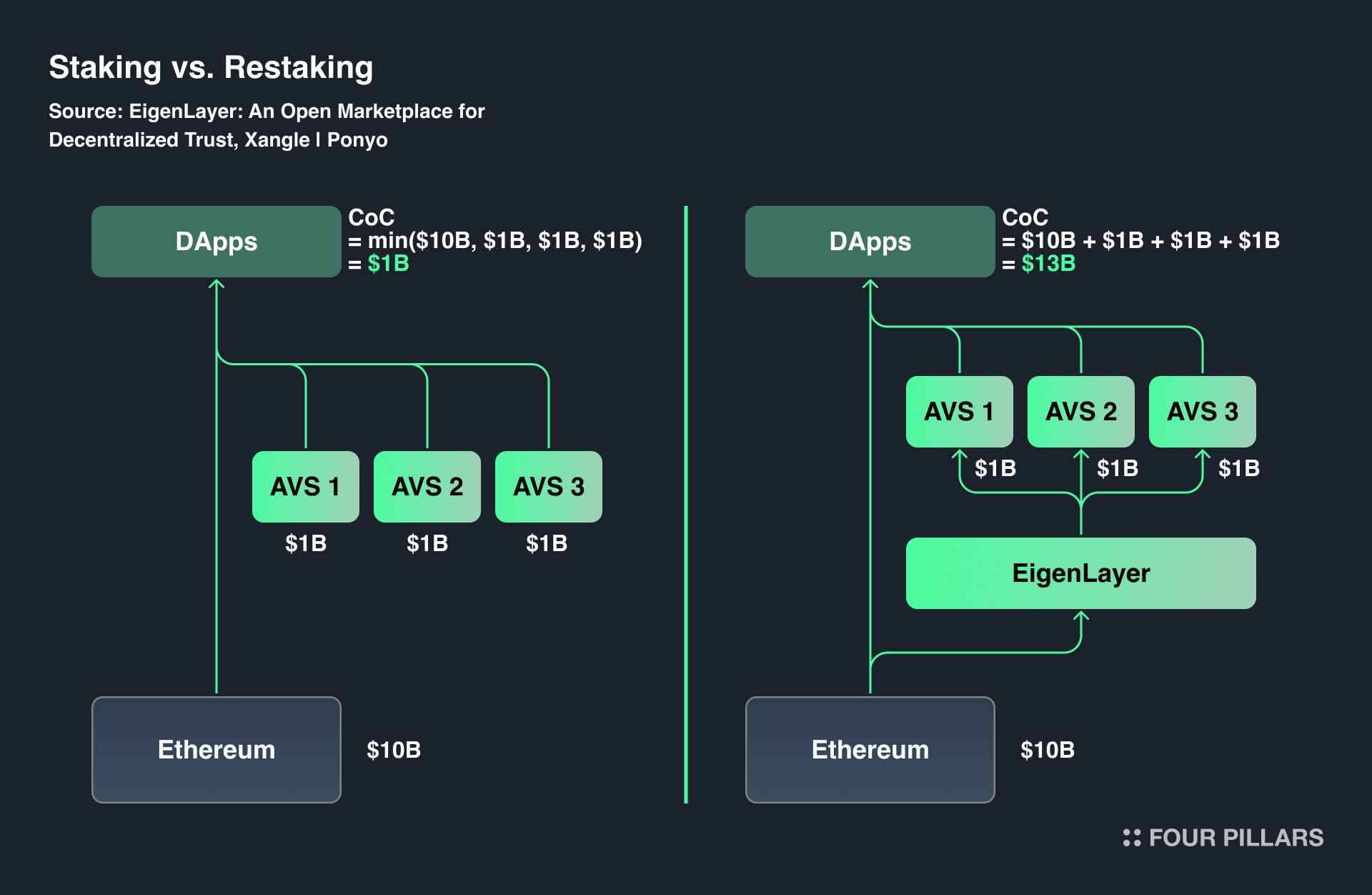
In the diagram, two ecosystems each have $13 billion in staked capital. On the left, Ethereum and an Active Validator Service (AVS)—an intermediary network service—are not interconnected, whereas on the right, they are connected via EigenLayer.
-
Left-side ecosystem: Here, Ethereum and AVS are not directly linked, so although value can be transferred between networks via bridges, this is unrelated to shared security. As a result, Ethereum and AVS cannot share economic security, leading to fragmented security. Attackers may target the network with the lowest staked capital. This results in fragmented security, where the cost of corruption (CoC) aligns with the minimum required amount. This creates a competitive environment between services rather than synergy, potentially weakening Ethereum’s economic security.
-
Right-side ecosystem: What if Ethereum and AVS were interconnected? EigenLayer integrates Ethereum and AVS through the concept of restaking, consolidating fragmented security into a reconstructed form. This integration offers two benefits: AVS services can share Ethereum’s capital instead of competing with it, and all AVS services can fully utilize shared economic security. This effectively creates an environment where these “giants” combine their strength, enabling them to see further together.
1.3.2 Pillars of Restaking (Using EigenLayer as Example)
From this explanation, we understand that AVS services can inherit Ethereum’s economic security, allowing them to leverage substantial security at lower costs. However, this complex financial ecosystem relies on various roles to function smoothly. Let’s examine these roles:
-
Active Validator Services (AVS): AVS refers to services requiring decentralized validation systems, such as data availability (DA) layers, sidechains, or oracle networks. AVS depends on node operators who reliably run nodes to maintain network security. AVS employs two mechanisms: slashing, where part or all of the staked amount is confiscated due to poor performance, and rewards for successful operations. AVS can leverage Ethereum’s security by utilizing restaked ETH without needing to build a separate trust network.
-
Restakers: Restakers are individuals or institutions who restake native ETH or LSTs on the Ethereum Beacon Chain. If a restaker is unsure which specific AVS to choose or wants to earn additional rewards, they can delegate their restaked capital to node operators. In this case, the restaker entrusts their capital to nodes operated by node operators, earning restaking rewards in return.
-
Node Operators: Node operators receive delegated capital from restakers and operate nodes to perform the validation tasks required by AVS. They use restaked capital to establish and run more secure nodes. They play a crucial role in maintaining the reliability and security of AVS and are rewarded accordingly with restaking and node operation rewards.
1.3.3 Bringing It All Together
EigenLayer integrates these roles into an open market structure, allowing each participant to operate freely according to economic principles.
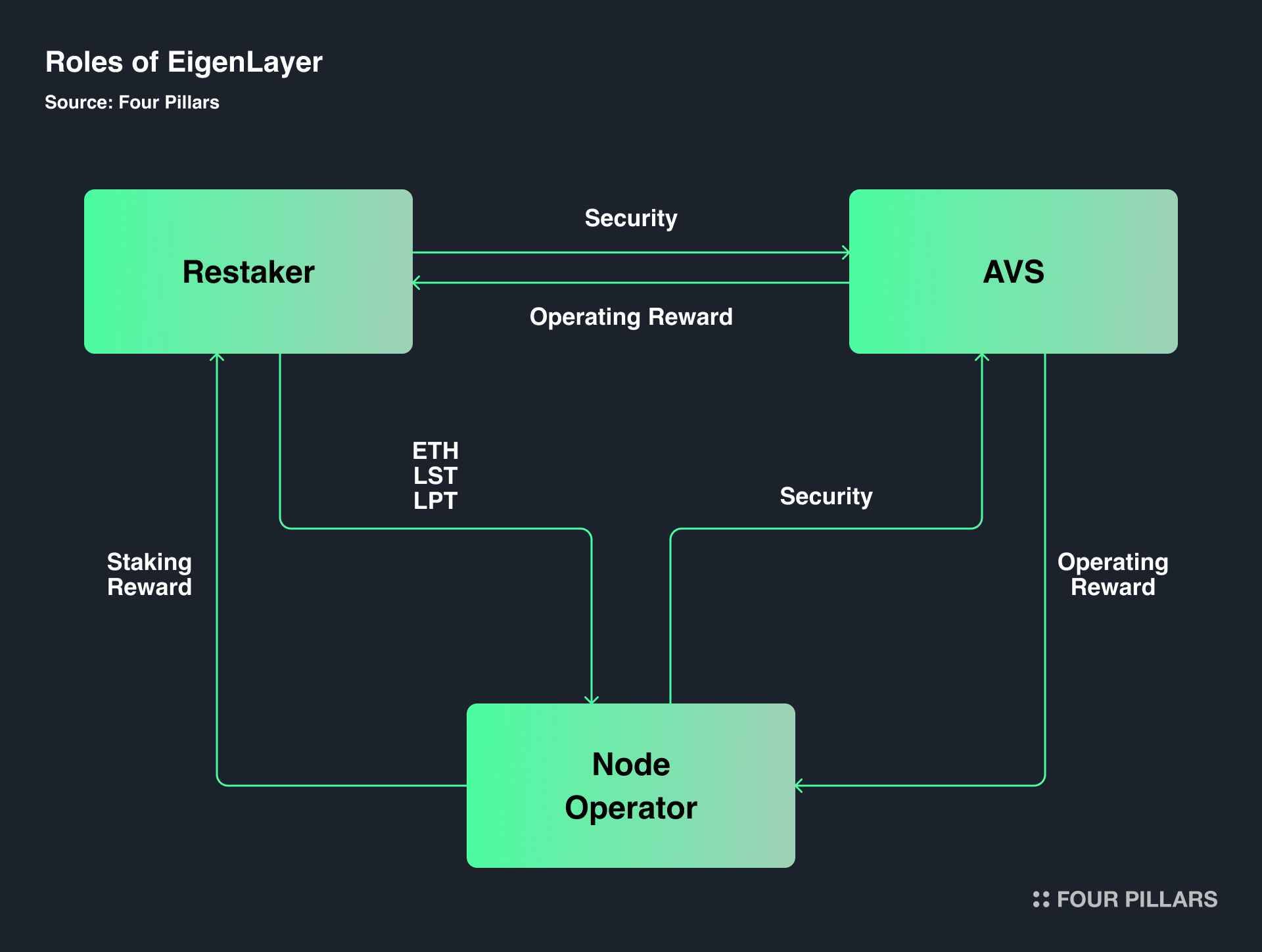
In this setup, restakers delegate their assets (such as ETH, LSTs, or LPTs) to node operators, who then protect AVS services via their nodes and earn rewards. Simultaneously, AVS pays operational rewards to node operators in appreciation of their security contributions, ensuring network safety and trust.
1.3.4 Strengthening the Restaking Ecosystem
EigenLayer serves as a quintessential example of restaking, offering a comprehensive perspective on the concept. Most emerging restaking services strictly adhere to the core principles of restaking, making EigenLayer an effective reference for understanding the restaking model.
With EigenLayer at the forefront, the restaking ecosystem continues to expand. This growth is not merely quantitative; the ecosystem is becoming increasingly sophisticated, with more specialized roles and categories emerging. This calls for a deeper understanding of the evolving landscape. In the next chapter, we will closely examine the restaking stack and explore projects within each category.
2. The Restaking Stack
Since the restaking ecosystem is still actively evolving, clearly defining each category can be challenging. However, as the ecosystem matures and stabilizes, it will foster the development of more advanced projects. Leveraging available data and my perspective, I introduce a framework for classifying the restaking ecosystem—the restaking stack.
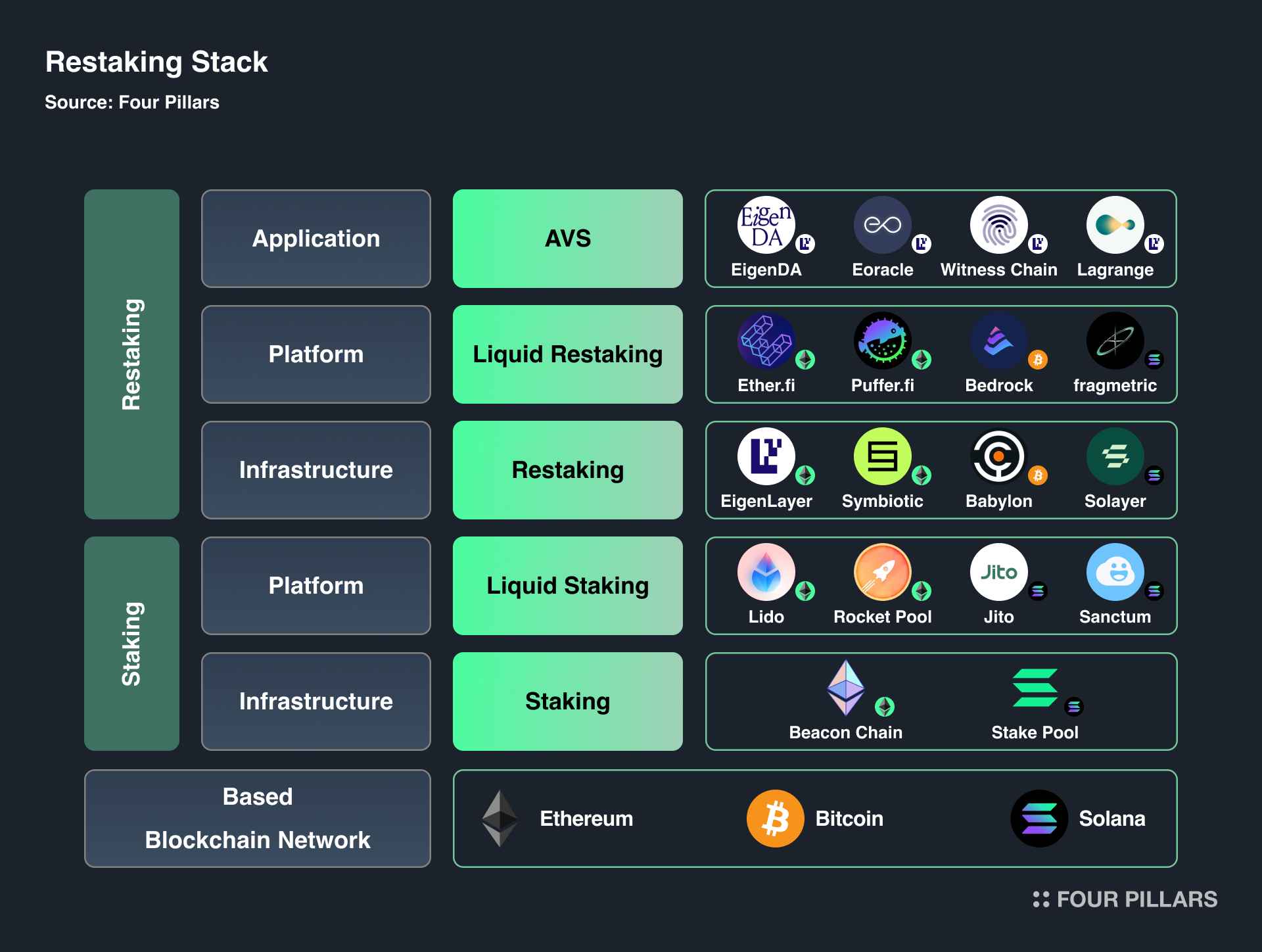
2.1 Base Blockchain Networks

The base blockchain network layer forms the foundation for staking or restaking, possessing its own native token and security mechanism. PoS (Proof-of-Stake) blockchains like Ethereum and Solana, due to their massive TVL (total value locked), provide stable and efficient environments for staking and restaking. Although Bitcoin is not a PoS blockchain, its dominance in blockchain capital has spurred efforts to incorporate its economic security into restaking.
-
Ethereum: Ethereum is the primary blockchain network for restaking and plays a pivotal role throughout the ecosystem. With its PoS system and smart contract capabilities, Ethereum enables users to participate in various restaking activities through platforms like EigenLayer.
-
Bitcoin: Due to its PoW (Proof-of-Work) mechanism, Bitcoin lacks the native staking capability found in PoS blockchains. However, projects like Babylon aim to integrate Bitcoin’s vast capital into the restaking ecosystem, leveraging its economic security to support other blockchains. Projects such as Babylon allow Bitcoin’s capital to be used without wrapping or cross-chain bridging, enabling direct staking of Bitcoin on its native blockchain.
-
Solana: Known for high performance and low transaction costs, Solana offers an ideal environment for staking, DeFi, NFTs, and restaking. As Solana’s staking infrastructure evolves, platforms like Solayer are emerging, aiming to leverage Solana’s strengths through unique restaking models and establish a significant presence in the restaking ecosystem.
2.2 Staking Infrastructure

The staking infrastructure layer includes systems that allow participants to stake their native tokens, thereby enhancing the security and efficiency of blockchain networks. These infrastructures are central to PoS consensus mechanisms, supporting the decentralized process of block validation and generation. Participants stake their assets to become validators, helping maintain network stability and earning rewards. Additionally, staking infrastructure monitors validator behavior, enforcing slashing penalties for misconduct to enhance security.
-
Beacon Chain: The Beacon Chain plays a critical role in Ethereum’s transition to PoS, improving scalability, security, and energy efficiency. Unlike the previous PoW Ethereum, the Beacon Chain operates around validators who stake native ETH. It is responsible for selecting validators and managing the process of proposing and validating blocks. This shift reduces the high energy consumption of PoW mining while maintaining decentralization and improving efficiency. Furthermore, the Beacon Chain oversees participating users, locking their staked ETH and monitoring whether validators correctly validate blocks. Misbehaving validators face slashing penalties, involving confiscation of their staked ETH.
-
Staking Pools: Solana’s staking pools enhance network security and simplify user participation in staking. Staking pools aggregate smaller SOL stakes, enabling users to collectively support a single validator. Through this process, users who delegate their stake to validators earn rewards when these validators create blocks or validate transactions. Staking pools also improve network stability by allocating staked SOL to reliable validators.
2.3 Staking Platforms

The staking platform layer includes services that allow users to contribute to the security and operation of blockchain networks while maintaining asset liquidity. These platforms play a crucial role in PoS blockchains, offering simple services that enable users to stake native tokens and earn rewards. Staking platforms go beyond merely locking assets—they provide liquid staking, tokenizing staked assets so users can deploy them in DeFi applications. This structure allows users to maintain liquidity and maximize rewards while participating in network operations. Through these features, staking platforms streamline the user experience, making staking more accessible to a broader audience.
-
Lido: Lido is one of the most popular liquid staking platforms in the Ethereum ecosystem, allowing users to stake their native ETH and receive stETH in return. This liquid token retains the value of staked ETH, enabling users to earn additional rewards through other DeFi services. Lido’s focus on Ethereum has since expanded to support Polygon’s PoS network.
-
Rocket Pool: Rocket Pool is a community-owned, decentralized staking platform compatible with native ETH staking on Ethereum. Initially conceived in 2016 and launched in 2021, it aimed to provide a solution for users lacking the technical expertise to run nodes or the financial means to meet the 32 ETH requirement. Rocket Pool strives to build a liquid and reliable platform, enabling users to leverage their staked assets across various services.
-
Jito: Jito is a liquid staking platform for Solana users that offers MEV (Maximal Extractable Value) rewards. Users stake their native SOL through Jito’s staking pool and receive JitoSOL tokens, which accumulate staking and MEV rewards while maintaining liquidity. Jito aims to optimize returns for JitoSOL holders and enrich Solana’s DeFi ecosystem.
-
Sanctum: Sanctum leverages Solana’s speed and low fees to provide enhanced security as a staking platform through open-source and multisignature frameworks. It allows users to utilize staked SOL in DeFi services. By integrating liquidity from various LST pools, it addresses liquidity fragmentation, giving users access to richer liquidity pools. Notably, through the Infinity Pool, users can deposit LSTs or SOL to receive INF tokens, simplifying staking and liquidity provision. Additionally, Sanctum runs a rewards program called Wonderland, encouraging active user engagement through points and incentives for completing specific tasks or using the platform.
2.4 Restaking Infrastructure
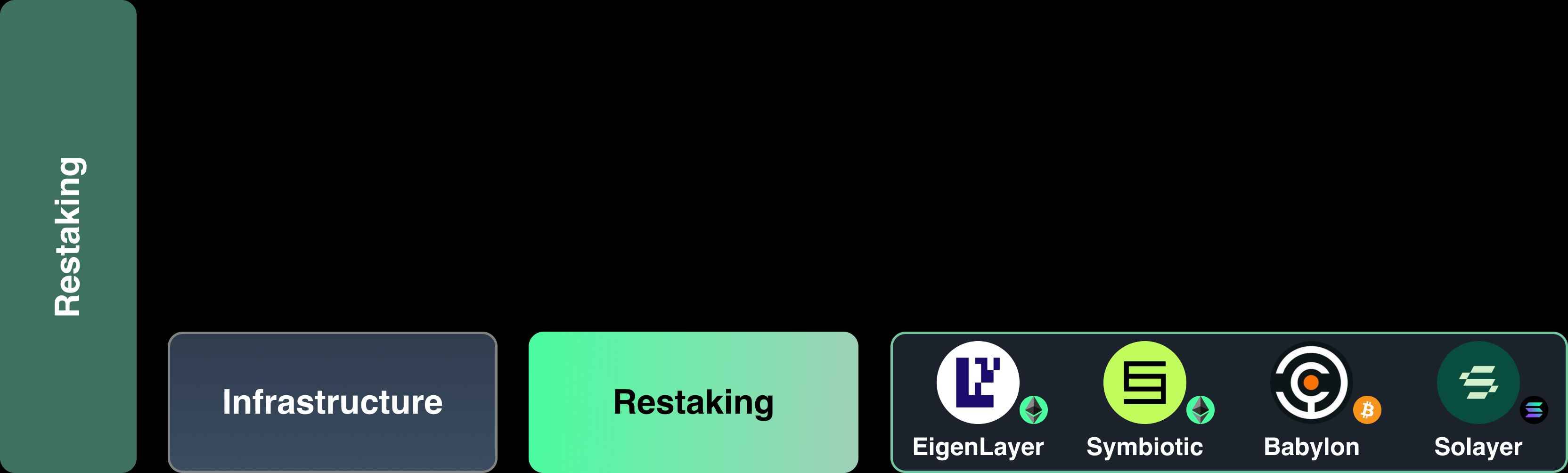
The restaking infrastructure layer is crucial for enhancing the economic security of blockchain networks while providing scalability and flexibility. It enables users to reuse their staked assets to protect multiple networks or applications, offering restakers opportunities to participate in various services while maximizing rewards. Applications built on this infrastructure can leverage restaked assets to ensure stronger security frameworks and expand their functionalities. Restaking infrastructure also supports restaking platforms and applications, allowing them to create customized staking and security models. This enhances the scalability and interoperability of blockchain ecosystems, making restaking a key technology for sustaining decentralized networks. Below are some examples; further details on restaking infrastructure will be provided in Chapter 3.
-
EigenLayer: EigenLayer is restaking infrastructure built on Ethereum, enabling users to restake their native ETH or LSTs to protect additional applications and earn extra rewards. By reusing staked ETH across various services, EigenLayer lowers the capital requirements for participation while significantly enhancing the credibility of individual services.
-
Symbiotic: Symbiotic is restaking infrastructure that provides an open and accessible shared security model for decentralized networks. It enables builders to create custom staking and restaking systems with modular scalability and decentralized operator reward and slashing mechanisms, delivering enhanced economic stability to networks.
-
Babylon: Babylon connects Bitcoin’s powerful economic security to other blockchains like Cosmos, aiming to strengthen security and promote cross-chain interoperability. Integration with Babylon allows connected networks to leverage Bitcoin’s proven security for safer transactions. It uses Bitcoin’s hash power to enhance finality and offers a suite of protocols to securely share Bitcoin’s security with other networks.
-
Solayer: Solayer extends appchains by leveraging economic security, built atop Solana’s network to offer application developers customizable blockspace and efficient transaction alignment. It uses restaked SOL and LSTs to maintain network security while enhancing specific network functions, aiming to support scalable application development.
2.5 Restaking Platforms
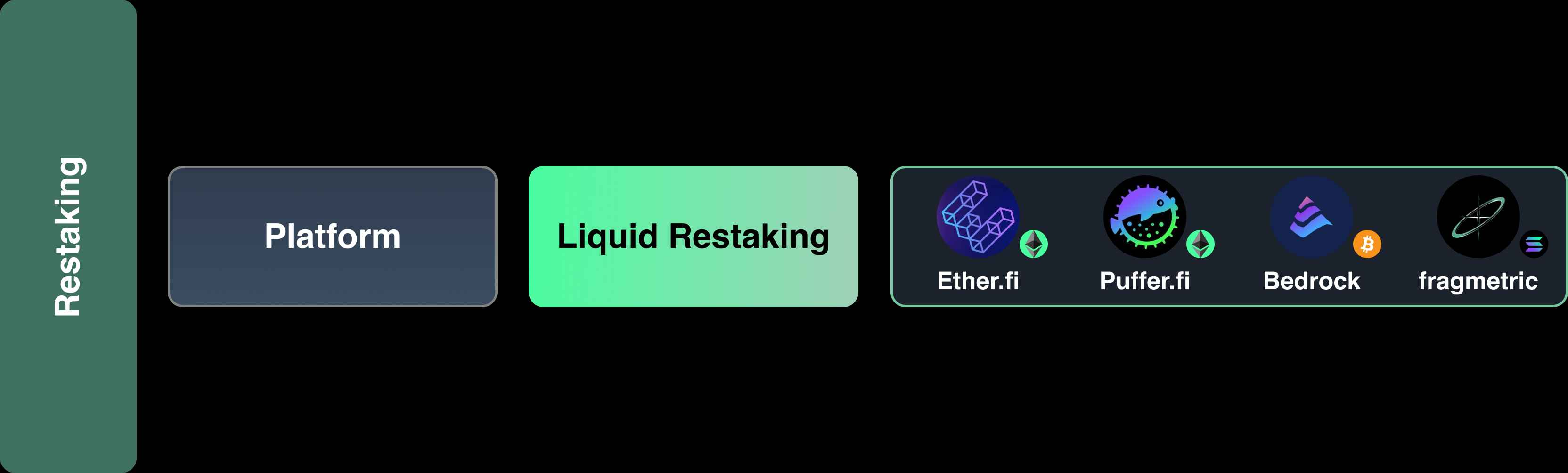
The restaking platform layer includes platforms that provide additional liquidity or integrate restaked assets with other DeFi services, enabling users to maximize their rewards. These platforms typically issue liquid restaking tokens (LRTs) to further enhance the liquidity of restaked assets. They also promote user participation in restaking through flexible management models and reward systems, contributing to the stability and decentralization of the restaking ecosystem.
-
Ether.fi: Ether.fi is a decentralized restaking platform that allows users direct control over their restaking keys. It provides a marketplace where node operators and restakers interact. The platform issues eETH as a liquid staking token and achieves decentralization on the Ethereum network through multi-step restaking processes and node service provisioning.
-
Puffer.fi: Puffer.fi is a decentralized native liquid restaking platform based on EigenLayer. It allows anyone with less than 32 ETH to stake their native Ethereum tokens, maximizing rewards through integration with EigenLayer. Puffer.fi offers high capital efficiency, providing liquidity and PoS rewards through its pufETH token. Restakers can earn stable returns without complex DeFi strategies, and Puffer.fi’s security mechanisms ensure asset safety.
-
Bedrock: Bedrock supports multiple asset types in its liquid restaking platform, developed in collaboration with RockX. It provides additional rewards by restaking assets such as wBTC, ETH, and IOTX. For example, uniBTC restakes BTC on the Ethereum network to enhance security, while uniETH similarly restakes ETH to maximize rewards via EigenLayer. Bedrock adopts a capped tokenomics structure to prevent unlimited supply growth, aiming to increase token value over time.
-
Fragmetric: Fragmetric is a liquid restaking platform in the Solana ecosystem that addresses reward distribution and slashing rate issues by leveraging Solana’s token scalability. Its fragSOL token sets a new standard for restaking on Solana, offering a platform structure that enhances both security and profitability.
2.6 Restaking Applications
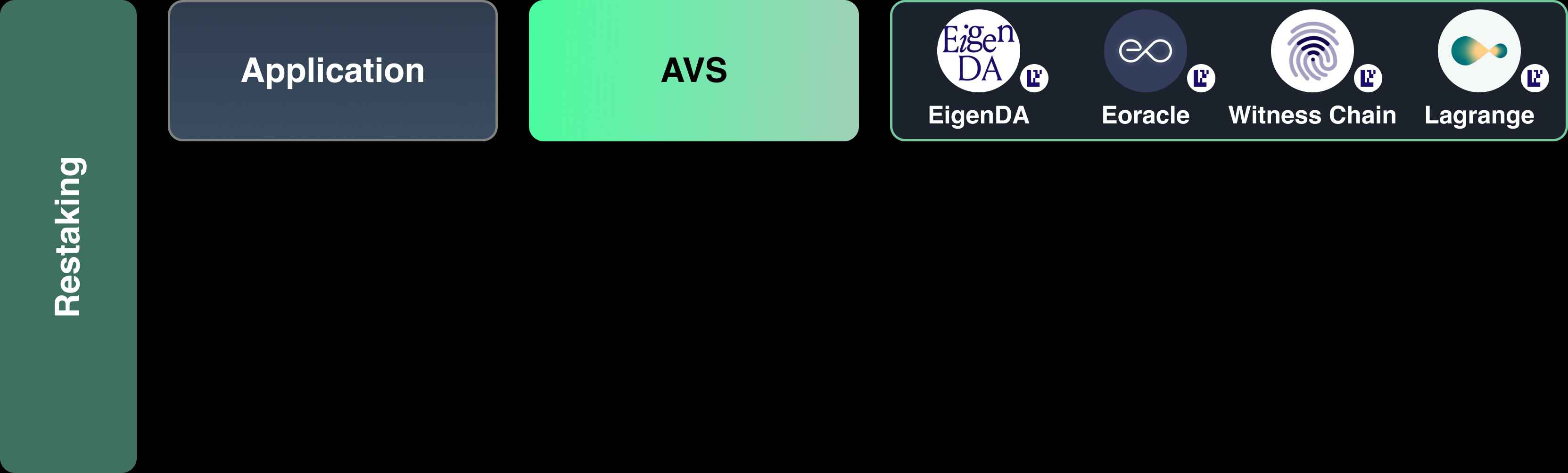
The restaking application layer includes decentralized services and applications that leverage restaked assets to enhance the security and functionality of existing blockchain infrastructure. These applications ensure economic security through restaking while focusing on delivering specific functionalities such as data availability storage, oracles, physical infrastructure validation, and cross-chain interoperability.
By allowing validators from Ethereum and other blockchain networks to restake their assets across multiple services, these applications reduce capital costs while improving security and scalability. They also ensure data integrity and security through decentralized processes and apply economic incentives and penalties to guarantee reliability. These applications enhance the scalability and efficiency of blockchain systems and promote interoperability among different services.
-
EigenDA: EigenDA is a highly scalable data availability (DA) storage solution for Ethereum rollups, integrated with EigenLayer. EigenLayer requires operators to post bonds to participate and penalizes those who fail to properly store and verify data. This incentivizes decentralized and secure data storage and enhances EigenDA’s scalability and security through EigenLayer’s restaking mechanism.
-
Eoracle: Eoracle is an oracle service in the EigenLayer ecosystem that uses restaked ETH and Ethereum validators for data verification. Eoracle aims to create a decentralized competitive market for data providers and users, automating data verification and enabling smart contracts that integrate external data sources.
-
Witness Chain: Witness Chain supports the development of new products and services for various applications and decentralized physical infrastructure networks (DePIN). It uses a DePIN Coordination Layer (DCL) module to convert physical attributes into verifiable digital proofs. Within the EigenLayer ecosystem, EigenLayer operators run DePIN challenge clients to ensure a reliable validation environment.
-
Lagrange: Lagrange is the first zero-knowledge AVS on EigenLayer. Its state committee is a decentralized network of nodes leveraging zero-knowledge technology to secure cross-chain interoperability. Lagrange’s ZK MapReduce solution supports efficient cross-chain operations while ensuring security and scalability. By leveraging EigenLayer’s economic security, Lagrange enhances performance and strengthens cross-chain messaging and rollup integration.
Through this overview of the restaking technology stack and project examples, we see that as the restaking ecosystem matures, its structure becomes more refined, offering deeper insights. Shall we dive deeper into these emerging categories? In this series, we will first focus on restaking infrastructure, while other components will be explored in subsequent parts.
3. The Restaking Infrastructure Ecosystem
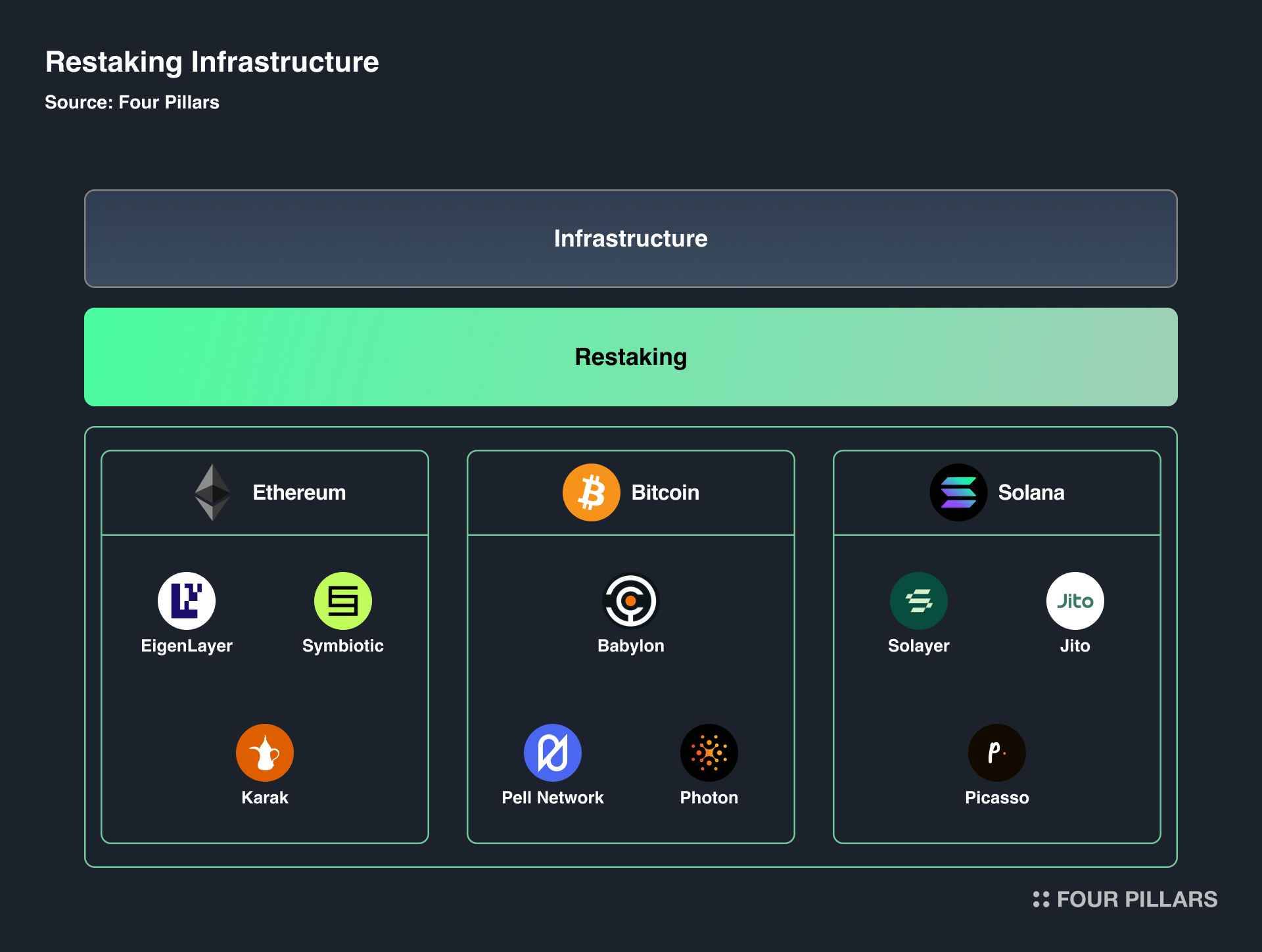
Restaking infrastructure serves as a foundational framework, enabling staked assets to be reused across different networks and protocols to enhance network security and maximize utility. As the concept of restaking gains traction, major blockchain networks like Ethereum, Bitcoin, and Solana have developed infrastructure tailored to their unique characteristics. This section explores the reasons behind the emergence and evolution of restaking infrastructure on these networks, examines their advantages and challenges, and analyzes the impact of various projects on the restaking infrastructure landscape.
3.1 Ethereum
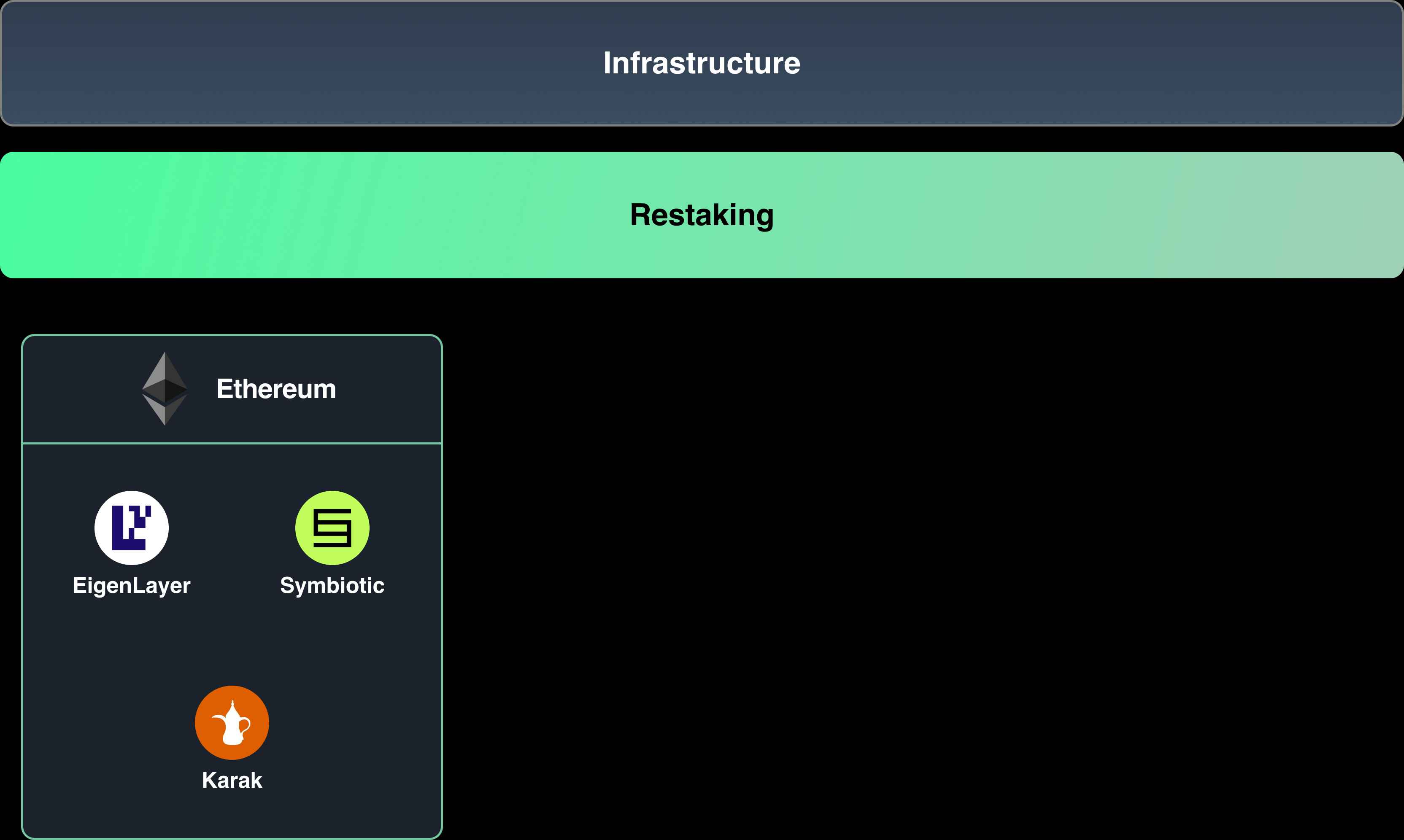
During the "Merge" upgrade, Ethereum’s transition from PoW to PoS laid the groundwork for the growth of restaking infrastructure. Ethereum’s PoS model relies on staked assets to secure the network, but the ability to reuse these assets across other protocols greatly increased interest in restaking.
Ethereum has long prioritized scalability, achieving this through Layer 2 solutions. However, as Ethereum co-founder Vitalik Buterin has pointed out, this approach has led to fragmented security, ultimately weakening Ethereum’s security model. EigenLayer emerged as the first solution, addressing this issue through economic security by allowing staked Ethereum assets to be used in other protocols to enhance security and scalability.
EigenLayer enables restaking of Ethereum assets across different protocols while preserving core security, leveraging a large network of operators to deliver stable economic security. It supports restaking of native ETH and plans to extend support to LSTs and ERC-20 tokens, offering a potential solution to Ethereum’s scalability challenges.
The concept of restaking is spreading within the Ethereum ecosystem, with other projects working to address Ethereum’s limitations. For example, Symbiotic enhances Ethereum’s security by integrating with other DeFi services. Symbiotic supports restaking of multiple assets, including LSTs like wstETH and assets such as sUSDe and ENA through collaboration with Ethena Labs. This allows users to provide additional security resources through restaking, boosting Ethereum’s PoS security. Moreover, Symbiotic issues ERC-20 tokens like LRT to offer flexible reward structures, enabling efficient use of restaked assets across various protocols.
Another restaking infrastructure, Karak, aims to address structural inefficiencies in Ethereum that pose challenges for restaking operations. Karak offers multi-chain support, allowing users to deposit assets on chains like Arbitrum, Mantle, and Binance Smart Chain. It supports restaking of ERC-20 tokens, stablecoins, and LSTs in multi-chain environments. Karak uses its own L2 chain to store assets, ensuring security while maximizing scalability.
3.2 Bitcoin
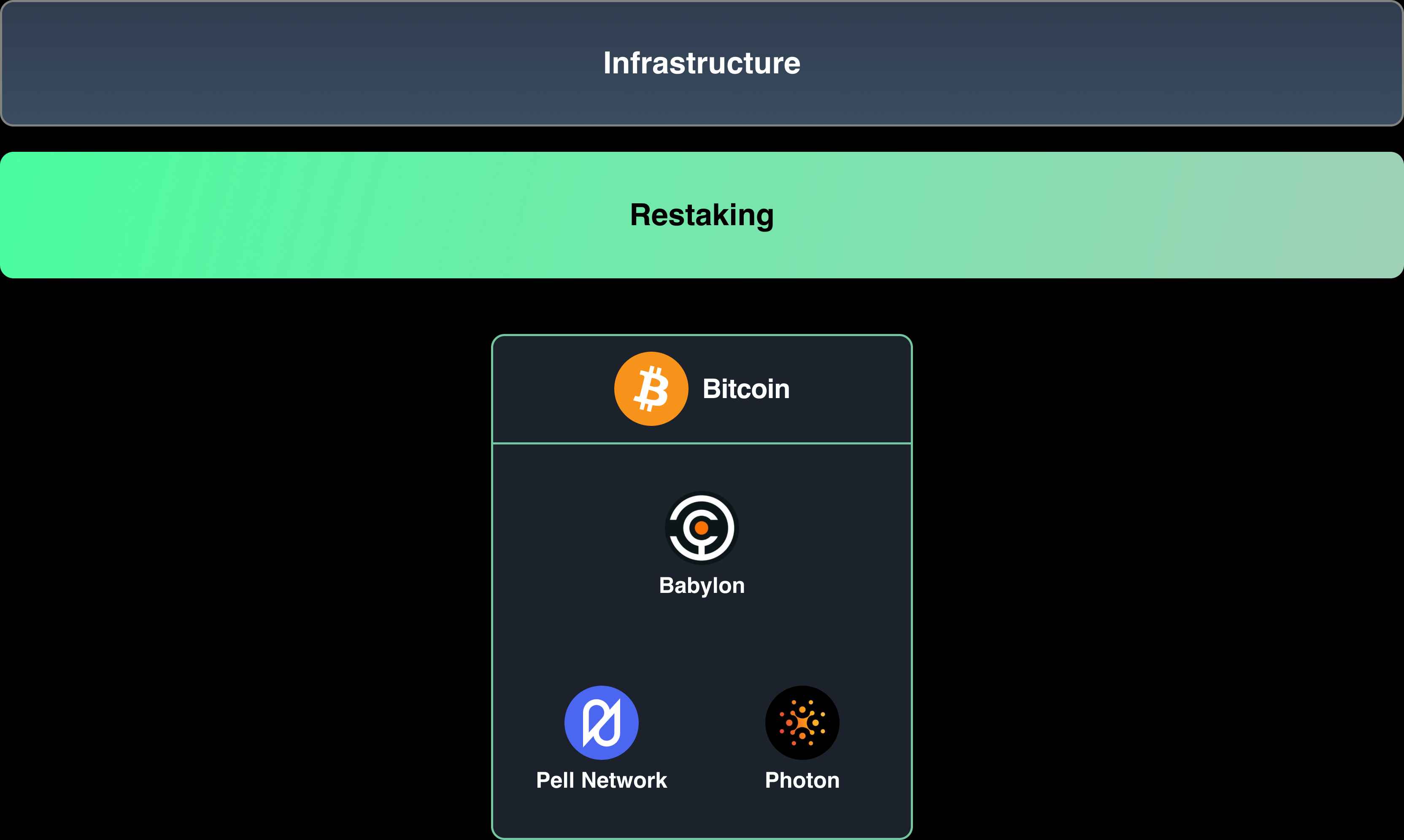
Bitcoin, as a PoW-based network, differs from PoS networks where staked assets are directly tied to security. However, Bitcoin’s dominance in market capitalization has driven the development of restaking concepts that leverage its economic security to generate additional income in other blockchains. Projects like Babylon, Pell Network, and Photon integrate Bitcoin’s security into their ecosystems through various methods, enhancing their scalability.
Bitcoin’s PoW system is one of the most secure in the world, making it a valuable asset for restaking infrastructure. Babylon leverages Bitcoin’s staking and restaking capabilities to strengthen the security of other PoS blockchains. It transforms Bitcoin’s economic value into economic security, providing protection for other blockchains. It operates its own PoS chain using the Cosmos SDK, supporting non-custodial staking and restaking directly from the Bitcoin blockchain without third-party trust.
Bitcoin also faces challenges related to liquidity and additional income opportunities. Pell Network was created to provide liquidity and income opportunities for Bitcoin holders, using cross-chain technology to integrate Bitcoin into the DeFi ecosystem for additional yield.
Bitcoin’s biggest limitation is the lack of native smart contract support. While PoW provides strong security, its design makes internal programming via smart contracts difficult. Photon extends Bitcoin’s capabilities to execute smart contracts without altering its core structure, enabling staking and restaking directly on the Bitcoin mainnet. This ensures all staking and restaking-related processes are validated on the Bitcoin mainnet while offering flexible staking options.
3.3 Solana
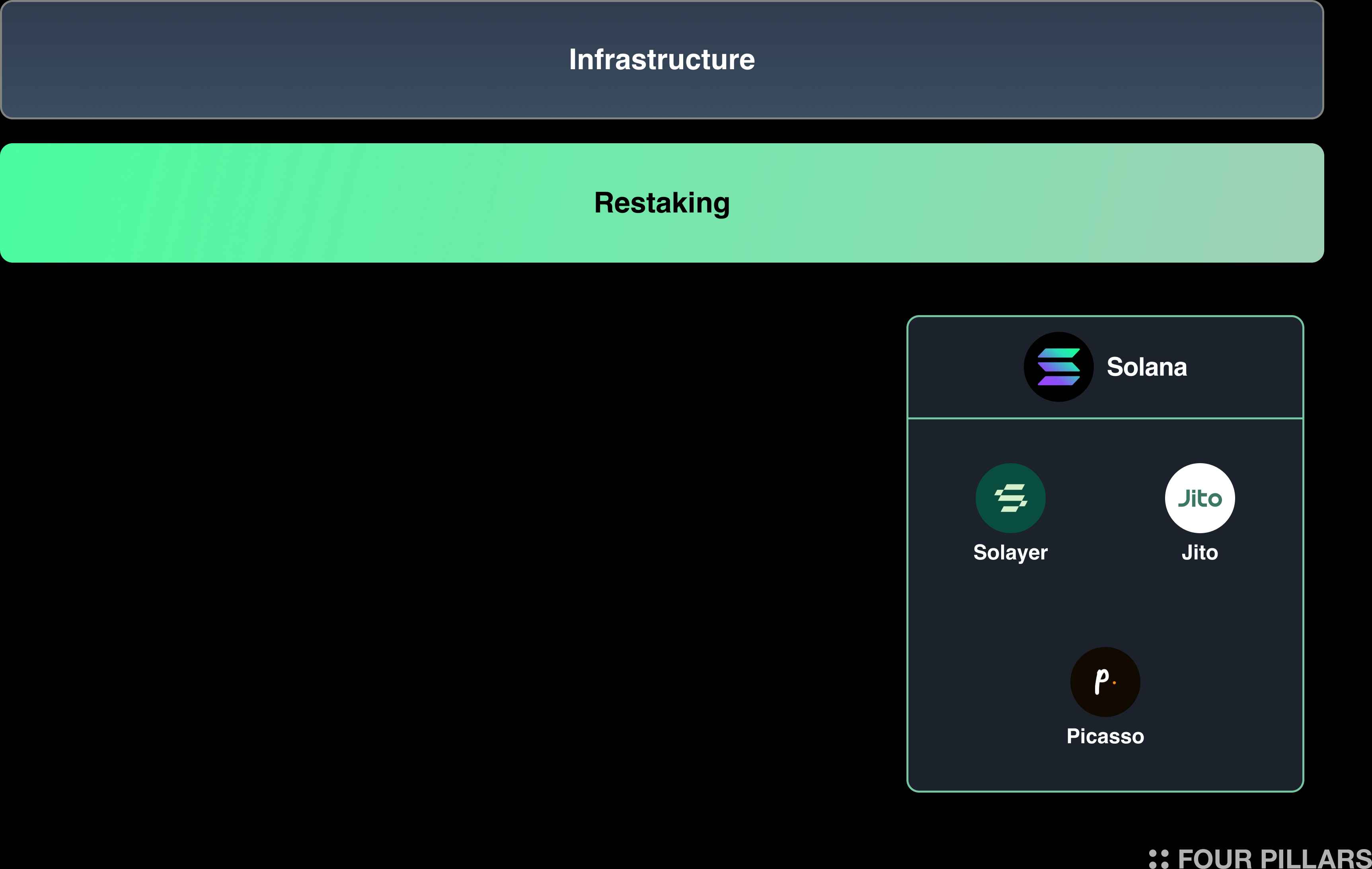
Solana is renowned for its high transaction throughput and low fees, making it an ideal environment for developing restaking infrastructure. Multiple projects within the Solana ecosystem have adopted the restaking model to fully leverage these advantages.
Solana’s rapid growth has directly benefited validators, but achieving fair distribution of economic gains across the broader Solana ecosystem has been a challenge. Solayer addresses this by providing restaking infrastructure focused on economic security and execution to expand appchain networks, offering a framework for staking native SOL and LSTs to support specific application networks. It also allows users to reuse their staked assets in other protocols to maximize returns.
Solayer draws inspiration from Ethereum’s restaking infrastructure (e.g., EigenLayer), adopting a similar user-friendly approach while adapting its restaking model to Solana’s unique properties. This ultimately aims to drive the evolution of the Solana ecosystem.
Jito, already recognized for its role in Solana’s staking infrastructure, is working to expand its influence in the restaking space. Building its restaking services on its established Solana infrastructure, Jito has attracted significant user interest due to its potential scalability and reliability. Jito’s vision is to optimize the MEV in block production through restaking solutions using SPL-based assets. This not only improves security but also offers restakers greater profit opportunities.
Picasso supports Solana’s scalability by building a cross-chain scaling framework and restaking mechanism. Picasso is developing a restaking layer for both Solana and the Cosmos ecosystem, introducing an expansion concept that allows users to restake assets across multiple PoS networks. It aims to bring the restaking ecosystem—previously limited to Ethereum—into Solana and the Inter-Blockchain Communication (IBC) ecosystem, offering tailored restaking services with ambitious goals.
3.4 Increasingly Complex Restaking Infrastructure
A major risk of restaking lies in its nature as a derivative financial asset rather than a core asset. Some view restaking as a promising investment opportunity and a new advancement in crypto security, while others see it as a high-risk rehypothecation model with overly generous returns. Additionally, restaking infrastructure has yet to undergo extreme market stress tests like a “crypto winter,” raising questions about its potential stability.
If this stability remains unproven, restaking may face criticism due to inherent risks in its rehypothecation model. Furthermore, the ecosystem has not yet scaled to achieve the economies of scale necessary for sustainable business models, which remains a challenge.
Nonetheless, the rapid growth of the restaking ecosystem—especially in restaking infrastructure—is undeniable. The ecosystem’s increasingly sophisticated structure supports this momentum. As the ecosystem grows, concerns about profitability may be addressed, and restaking infrastructure may ultimately become a cornerstone of crypto and blockchain security.
The classification and definition of the ecosystem indicate it is ready for the next stage of development. The emergence of the restaking stack reflects significant progress in narrative and product development across various projects.
Now, as restaking infrastructure matures, the focus will shift to restaking platforms and applications—key determinants of whether the restaking ecosystem achieves widespread adoption. Therefore, the next part of this series will delve deeper into restaking platforms and applications, exploring their potential in driving broad ecosystem adoption.
Join TechFlow official community to stay tuned
Telegram:https://t.me/TechFlowDaily
X (Twitter):https://x.com/TechFlowPost
X (Twitter) EN:https://x.com/BlockFlow_News
 Four Pillars