Financial Times interviews TRON founder Justin Sun: Hong Kong's embrace of the crypto industry is a positive signal
TechFlow Selected TechFlow Selected
Financial Times interviews TRON founder Justin Sun: Hong Kong's embrace of the crypto industry is a positive signal
Recently, the UK's Financial Times, a leading international financial media outlet, reported that Hong Kong is actively attracting crypto firms to move from Singapore to Hong Kong.
 Navigating Web3 tides with focused insights
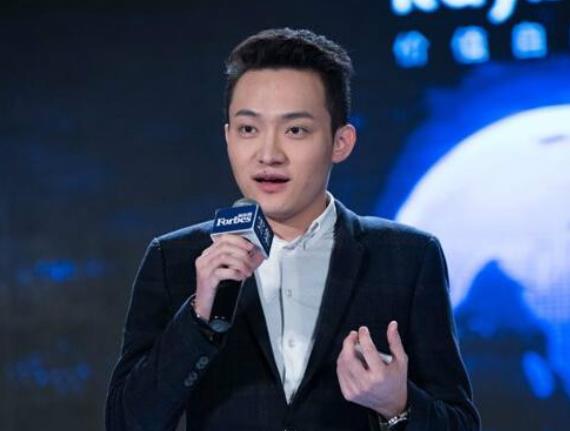
Recently, the UK's Financial Times, a leading international financial publication, reported that Hong Kong is actively attracting crypto firms to relocate from Singapore. Citing comments by Justin Sun, founder of TRON and member of Huobi Global Advisory Council, the report noted that Hong Kong’s crypto industry stands to benefit from mainland China’s market.
Justin Sun said Hong Kong’s embrace of the crypto industry sends a positive signal. "Just as you can trade Tencent shares listed in Hong Kong while being based in mainland China, I believe the same will happen with the crypto industry," he said. Sun also revealed Huobi’s plans to expand its team in Hong Kong to seize opportunities arising from the city’s growing crypto sector.
Regarding the recent lawsuit filed by the U.S. Securities and Exchange Commission (SEC), the Financial Times cited Sun’s response stating, "Justin Sun believes these allegations are unfounded."
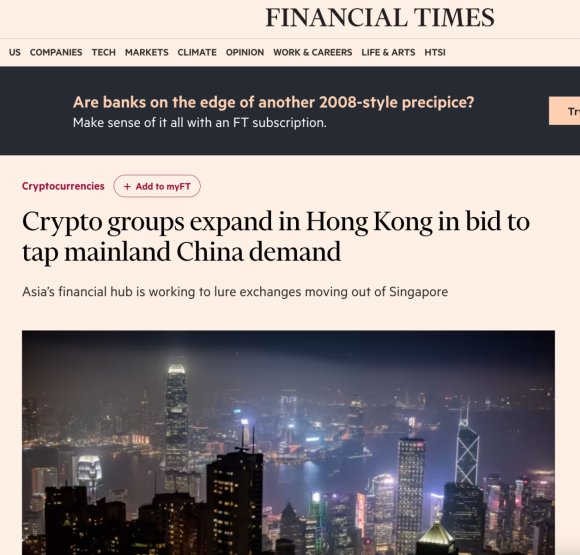
Below is the original article:
Crypto Firms Expand into Hong Kong to Tap Mainland China Market
As Hong Kong aggressively positions itself as a global digital asset hub, cryptocurrency companies are entering the market, hoping to capture demand from mainland Chinese investors seeking access to crypto trading.
After last year’s collapse of several major crypto firms, Singapore has tightened oversight of the crypto sector. As a result, many companies now see Hong Kong’s regulatory environment as more favorable than Singapore’s. Hong Kong is developing new regulations for crypto exchanges and exploring the legalization of retail crypto trading.
Although China banned all cryptocurrency-related activities within its borders in 2021, mainland China remains the world’s fourth-largest crypto market. Companies moving into Hong Kong aim to tap into this rising demand for crypto trading among Chinese investors.
BTSE, a cryptocurrency exchange, recently announced it is preparing to apply for a license in Hong Kong. CEO Henry Liu said: “Many Chinese investors are looking for smarter, safer investment channels… investing via Hong Kong is naturally more reasonable than elsewhere.”
Exchanges including KuCoin, Gate.io, and Huobi are planning to enter or expand in Hong Kong. Huobi announced in February this year that it intends to move its headquarters from Singapore to Hong Kong.
Binance, the world’s largest cryptocurrency exchange—founded in China—is currently advertising multiple job openings in Hong Kong on LinkedIn, with requirements including fluency in Chinese.
According to Binance, Hong Kong “is highly competitive in terms of business environment…”
The expansion of crypto firms into Hong Kong reflects growing optimism that, with regulatory approval from a top-tier financial center like Hong Kong, they may gain legitimate access to the Chinese market. Some believe Hong Kong’s policy shift may have tacit support from Beijing.
Cyrus Ip, partner at Newman Capital, a Hong Kong-based Web3 investment firm, said: “Blockchain companies from China are very bullish on Hong Kong.” He noted that many mainland investors already use VPNs to bypass government restrictions for crypto trading but still face challenges converting crypto profits back into domestic currency. In Hong Kong, they can convert cryptocurrencies into hard currency freely.
“You can use a VPN… but that’s illegal in mainland China. So if Hong Kong offers a legal pathway,… crypto investors won’t need to trade in secrecy anymore.”
In 2021, China declared all cryptocurrency-related activities illegal and took measures to crack down on foreign crypto exchanges operating within the country. Nevertheless, crypto trading has persisted.
A report by blockchain research firm Chainalysis showed that from January to July 2022, mainland China ranked as the world’s fourth-largest crypto market, with investors transacting nearly $220 billion during that period.
Under current rules, Hong Kong’s Securities and Futures Commission (SFC) states that exchanges have a legal obligation to ensure that individual investors from jurisdictions where crypto trading is prohibited cannot access their platforms.
However, many crypto entrepreneurs view Hong Kong’s shifting stance as a sign that China may eventually ease its restrictions.
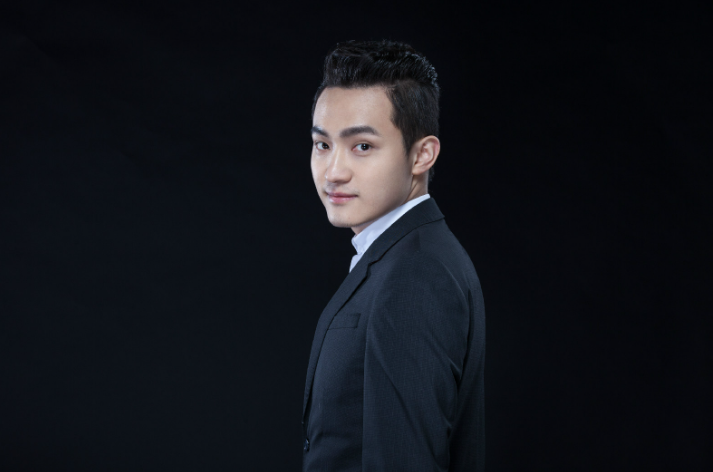
Justin Sun, founder of TRON and member of Huobi Global Advisory Council, expects Hong Kong to benefit significantly from mainland trading demand. He said Huobi plans to grow its Hong Kong team from 70 to 200 employees this year.
Sun said: “This is one of Hong Kong’s key roles… If you’re in Hong Kong, you can trade Tencent shares listed here. I believe the same will happen in the crypto space.”
Last week, the U.S. Securities and Exchange Commission (SEC) filed a lawsuit against Justin Sun alleging fraud. Sun responded on X (formerly Twitter): “We believe these allegations lack merit.”
Join TechFlow official community to stay tuned
Telegram:https://t.me/TechFlowDaily
X (Twitter):https://x.com/TechFlowPost
X (Twitter) EN:https://x.com/BlockFlow_News
 TRON DAO