Behind DeepSeek's Throttling: The AI Era Is Ending the Internet's Free Logic
Author: Li Biao, Tencent Tech
On November 16, DeepSeek adjusted usage quotas for its app and web versions. Some users reported receiving notifications of quota exhaustion after continuous use of less than two hours. The single-input limit was adjusted to around 40,000 characters, and long conversations inactive for more than seven days can no longer be continued.
According to DeepSeek, the adjustment is related to server load and computing power resources, primarily affecting the app and web versions. Pay-as-you-go API services remain unaffected. According to Yicai Global, as of the report's publication, DeepSeek had not yet announced specific quota management rules or subsequent adjustment plans.
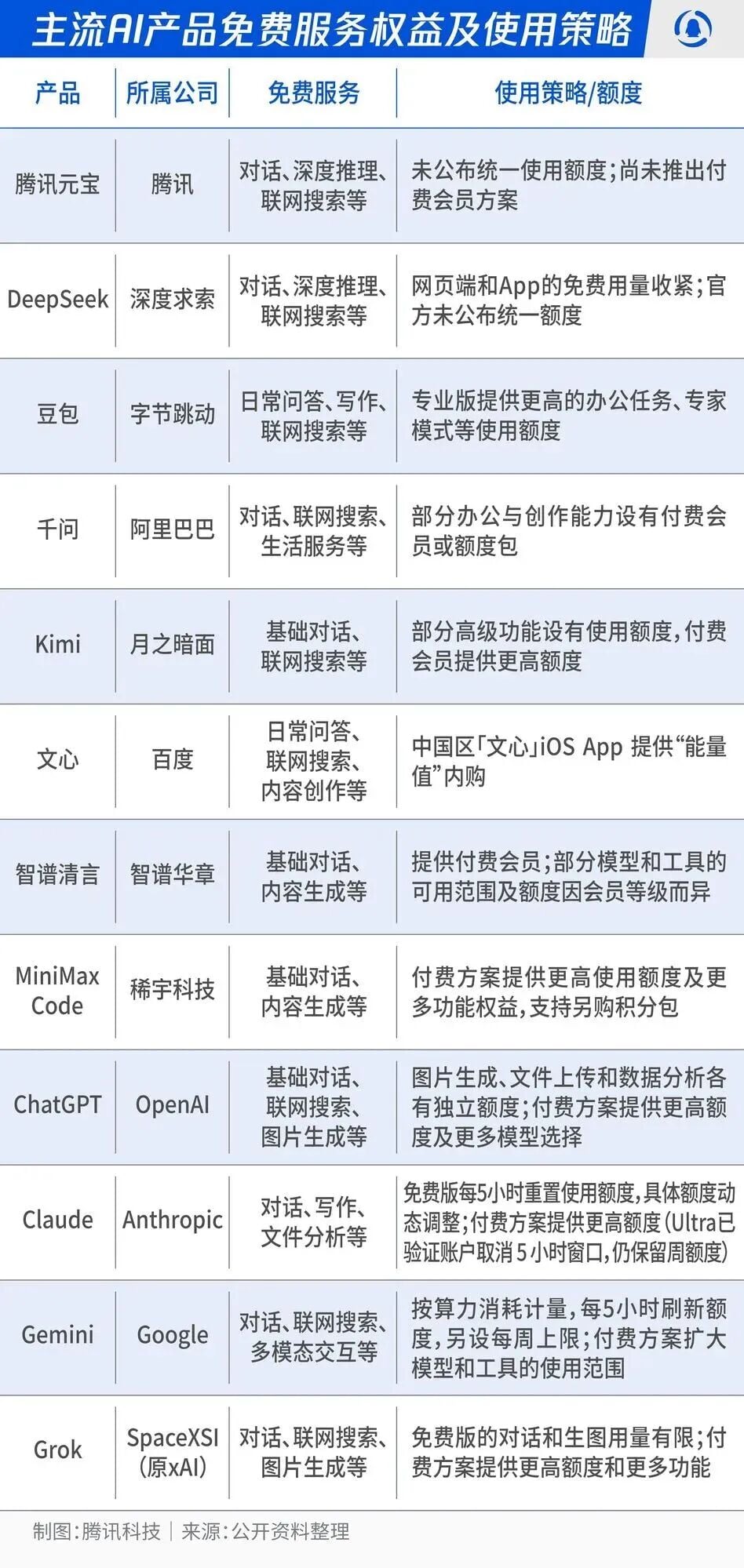
Currently, mainstream AI products, ranging from overseas offerings like ChatGPT, Claude, Gemini, and Grok to domestic ones such as Tencent Yuanbao, Doubao, Qwen, and Kimi, continue to provide free services to general users to varying degrees. However, each vendor has adopted different usage strategies regarding model access permissions, usage frequency, context length, and advanced features.
From the perspective of traditional internet business logic, AI seems to be undergoing a cost dilemma once faced by early video websites: free services struggle to cover costs over the long term, making the introduction of paid subscriptions a natural business choice.
However, this explanation overlooks a more fundamental difference between AI and the traditional internet: in the internet era, platforms pursued maximum user scale; in the AI era, platforms must also consider the efficiency of using limited computing resources.
Over the past twenty-plus years, from communication and search to office work and software development, an increasing number of internet services have been offered to users for free, with the scope and quotas of free services continuously expanding. In 2004, Google launched Gmail, offering users 1 GB of free email storage; in 2016, WhatsApp eliminated its roughly $1 annual subscription fee; in 2019, GitHub opened unlimited private code repositories to free users.
This business model is supported by the relatively low marginal costs of digital services and the commercial value growth driven by economies of scale and network effects. The larger the user base, the greater the opportunity for companies to spread costs, increase revenue, and build competitive barriers.
What AI is changing is precisely the economic foundation that underpins traditional internet business models.
As AI gradually becomes a general-purpose productivity tool, the question is no longer simply free versus paid, but rather: when computing power cannot fully meet everyone's needs, who has the right to prioritize AI usage? Should market prices become the primary basis for allocating computing resources?
This may be the more noteworthy issue behind this round of AI rate-limiting phenomena.
Cheaper Tokens, More Expensive Computing Bills
Serving 100 million users to watch the same TV series is fundamentally different from serving 100 million users asking AI different questions. These are two entirely different businesses.
The former only requires creating content once and distributing it to different users; the latter requires real-time computation and content generation based on each user's request.
This distinction makes it difficult for AI to simply replicate the cost-reduction path of the internet era.
Large model inference does not involve moving pre-made files. There are caches on the inference side, but at best, they only save repeated input segments. Once the context and task change, answers still need to be computed word by word on computing clusters. Bandwidth costs can be reduced through nearby replication, but inference requires actual consumption of computing power every time.
Currently, the unit price of inference continues to decline annually. A September report from research firm Epoch AI estimated that since 2023, the price required to achieve equivalent capabilities has dropped to about one-thirteenth of the previous year. However, agents have multiplied token consumption per task by several orders of magnitude. A study introduced by the Stanford Digital Economy Laboratory found that agents consume token quantities during programming tasks that are in the order of thousands of times higher than those for code Q&A.
British economist William Jevons pointed out in *The Coal Question* that steam engines consuming less coal did not reduce overall coal consumption: once power became cheaper, coal was used in more places, causing total consumption to rise instead. Computing power is replaying this story: prices fall year by year, yet total consumption surges. This April, GitHub suspended new user registrations for individual Copilot subscriptions; in November, DeepSeek began implementing rate-limiting measures.
Internet usage is constrained by human attention, allowing costs to converge. AI usage stems from automatable tasks that can constantly expand. As long as every inference consumes computing power, supply will remain strained.
The More Active Users Are, The Harder It Is for AI Companies to Profit?
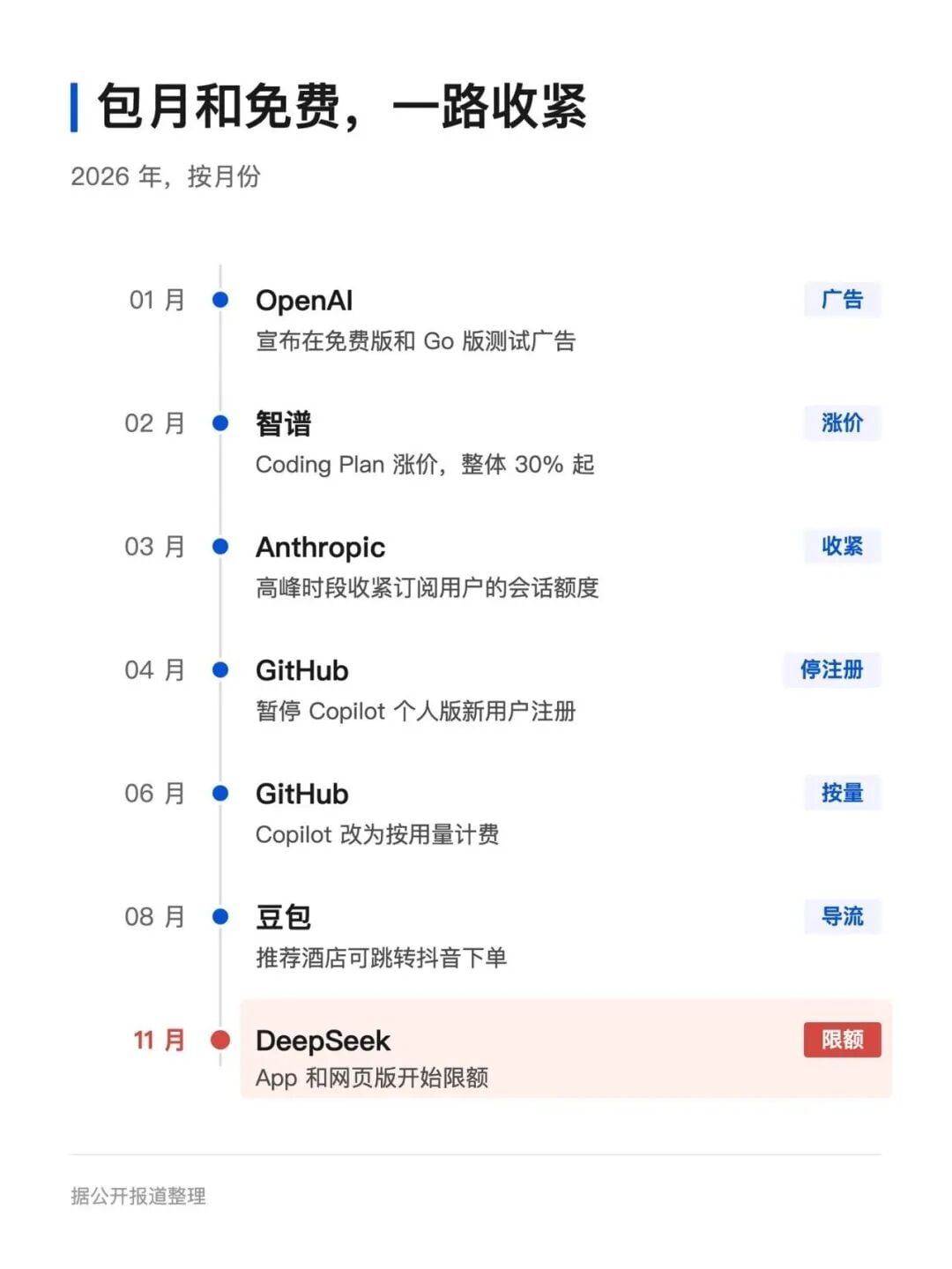
On April 20, 2026, GitHub suspended new user registrations for Copilot Pro, Pro+, and Student versions, while tightening quotas for individual users. A week later, GitHub announced that all Copilot plans would switch to a pay-per-use model starting June 1, deducting quotas based on token consumption. The official blog explained that previously, both simple queries and hours-long automated coding were charged at the same rate, with GitHub bearing a large portion of the rising inference costs, a model that has become unsustainable.
It is not just GitHub. According to a March 2026 PCWorld report, Anthropic quietly tightened session quotas for subscribed users during peak hours, with several top vendors repeatedly adjusting their monthly subscription caps. Domestically, Zhipu sent notices in February to adjust its Coding Plan prices, with overall increases starting at 30%.
Free services cannot bear the costs indefinitely, and blindly copying the internet's membership model is equally unworkable.
The traditional membership model holds true largely due to disparities in user engagement: subscription revenue from a massive number of light users can subsidize service costs incurred by a minority of heavy users. However, with the proliferation of AI agents, token consumption per task exceeds ordinary Q&A by several orders of magnitude. As more users begin employing agents, the equilibrium between fixed subscription revenue and actual inference costs may be shattered.
In traditional internet business models, heavy users are often the platform's most valuable asset; but under a fixed-price AI subscription model, heavy users may instead become the group bearing the greatest cost pressure.
Taking Wikipedia as an example, as contributors increase, the intrinsic value of the product continually rises, thereby forming competitive barriers. Yet in current large model products centered on independent interactions, a single user utilizing the model more frequently does not directly enhance the service value obtained by other users.
The often-touted "data flywheel" from early venture capital circles remains unrealized in AI applications today. Without network effects locking users in, switching costs in a chat interface are virtually non-existent; users can migrate at any moment to whichever model offers stronger performance or lower costs. Relying solely on charging users cannot secure industry health.
Paying for AI Does Not Equal Protection of User Rights
In 1998, Google co-founders Larry Page and Sergey Brin raised a warning in an appendix to a foundational paper on search engines: search engines relying on ad revenue tend to favor advertisers' interests rather than consumers' actual needs. Because evaluating search quality itself is difficult, even professionals struggle to detect such bias.
Nearly three decades later, as AI gradually becomes a new information gateway, this issue has resurfaced.
Against the backdrop of continuously rising AI service costs and numerous challenges surrounding direct user billing, many vendors still opt to offer free services.
Charging users is difficult, prompting many products to remain free. Yet marginal costs are real, and someone inevitably foots the bill for free computing power. In the business world, whoever pays dictates who the product serves.
For AI products that do not charge regular users directly, there are currently two primary commercialization pathways.
One involves supporting free services for the public through paid ventures like APIs, with DeepSeek as a prime example. But this model faces clear cost and resource constraints: when free services compete with paid operations and model R&D for limited computing resources, vendors must readjust allocation strategies. This latest DeepSeek rate-limiting specifically targets the free App and web versions, leaving the pay-per-use API service unaffected.
The alternative continues the internet-era model by introducing advertisements, transaction commissions, or leveraging revenue from other business divisions to subsidize free AI services. Although users do not pay directly, their activity can be converted into commercial revenue through other channels.
The distinction between these two models lies not only in who bears the computing costs but also in whose interests the AI product's commercial gains are tied to.
Traditional search engines primarily influence how users allocate their attention, whereas AI is increasingly intervening in user judgment and decision-making.
In traditional search, even if some results are ads, users can still browse diverse information sources, compare them, and make choices. AI consolidates information retrieval, filtering, and analysis processes, delivering seemingly objective conclusions directly to users. Consequently, it becomes harder for users to discern which information is prioritized, which is ignored, and whether commercial interests are influencing the output.
In January 2026, OpenAI announced it would test advertisements in both its free tier and the $8/month Go tier, promising that ads would not affect responses. While vendors have now clearly delineated the boundaries between monetization and answer independence, the actual effectiveness of these mechanisms awaits further observation.
If free AI relies on ads and lead generation to fund itself, it is the decisions entrusted to it by users that suffer.
Paid models can alter part of this relationship. Under OpenAI's scheme, tiers above $20 exclude ads. Payment transforms users back from sold traffic into customers. Yet customer rights remain limited: pricing, quotas, and model optimization priorities are still dictated by the seller; the $8 Go version, despite being paid, remains within ad-testing parameters; monthly limits can be silently lowered. Even the option to pay is controlled by the seller: when DeepSeek users expressed willingness to pay and suggested monthly passes, the app lacked even a payment portal.
While paying clarifies who covers AI's costs, it fails to address who AI should ultimately serve. As AI gradually becomes a foundational tool for acquiring knowledge, working, and making decisions, users ought to ask: I've paid the money, so what exact obligations does this AI owe me?
Paying for AI Is Not Just a Commercial Act, but Also a Resource Allocation
On November 22, a widely discussed help post appeared on the mathematics Q&A community MathOverflow.
A pure mathematics postdoc working in a developing nation stated that he and his colleagues cannot even afford ChatGPT Plus subscriptions, relying instead on pen and paper for research. Amid growing peer reliance on AI for scientific work, how will they continue publishing papers? Within just a few days, the post garnered nearly a hundred upvotes.
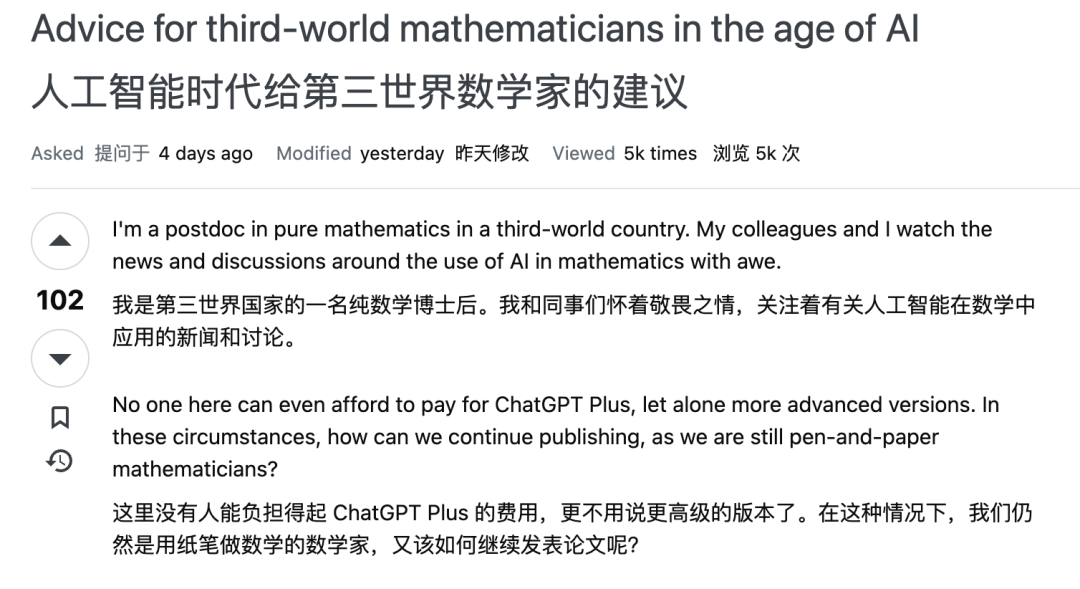
Commenter Daniel Teixeira calculated a purchasing power comparison: subscription fees for Plus and Pro account for less than 1% and 5%, respectively, of doctoral stipends in the United States, and approximately 5% and 25% in Brazil. Others added that even if they could afford it, sanctions mean the service providers do not operate in their countries at all.
The same AI products and identical subscription prices translate to vastly different accessibility thresholds for researchers across different nations.
Meanwhile, AI is also altering the competitive landscape of academic research.
Bogdan Grechuk, an associate professor of mathematics at the University of Leicester in the UK, recommended applying for OpenAI's free scholar program. He also proposed an idea: visit preprint servers specializing in AI-generated proofs, find papers marked with "partial" or "none" for human comprehension levels, contact the authors, offer to fully decipher the proofs, rewrite them into peer-readable papers, and submit jointly. He shared one of his own preprints, annotated as "mainly AI-generated," with a human comprehension level of "partial."
Journal editor Gordon Royle noted in the same thread that submission volumes at his journal skyrocketed without corresponding increases in editors or reviewers, actually resulting in fewer willing reviewers and significantly higher rejection rates. Those unable to quintuple their submission output were hit hardest. Even if a researcher's professional competence hasn't declined, they may face greater publication pressure as peers leverage AI to drastically boost productivity.
As AI becomes a tool capable of enhancing individual cognition and productivity, access to sufficient computing resources is emerging as a new variable affecting personal developmental opportunities.
This lends another layer of meaning to the issues of AI rate-limiting and payment.
When computing supply cannot meet everyone's demands, whether managing volume through quotas or modulating demand via pricing, is fundamentally an allocation of scarce resources.
Regarding AI monetization, a viewpoint worth re-examining is that payments guarantee high-value users receive quality service and foster healthy industry development. But how exactly should "high value" here be defined?
If "high value" is measured by a user's revenue contribution to the vendor, then prioritizing service quality for highly paying users is merely a resource allocation choice made by enterprises based on commercial interests. While aligned with vendor operational logic, it falls short of proving that such distribution methods benefit healthy industry development.
If measuring the actual value created by users leveraging AI, however, price is not an effective metric. Willingness to pay is constrained by purchasing power; users able to shoulder higher costs do not necessarily generate greater economic, scientific, or social value.
When AI serves to augment individual cognition and productivity, allocating computing solely based on price risks converting existing income gaps into capability divides, thereby exacerbating inequality in developmental opportunities.
Looking back at the past two decades, zero-marginal-cost duplication combined with network effects forged an exceptionally unique era of free services. Having persisted too long, markets and users have mistaken exceptions for laws, forgetting what the law originally looked like: when cost-bearing goods aren't enough for everyone, someone must decide who gets to use them.
AI has brought resource allocation issues back into sharp focus, and this time, what is being allocated is no longer just informational resources, but intelligent resources capable of enhancing human reasoning, analysis, creativity, and decision-making. Who foots the computing bill determines whose interests AI serves first; the rules governing computing allocation dictate who acquires the capability enhancements AI brings.
Therefore, following DeepSeek's rate limitations, what truly warrants discussion has expanded beyond whether AI should be paid. The exception of "free" ends at AI; the next question to answer is: who qualifies to think using machines, and who dispenses that qualification.