Bilibili's Over-Decade Foundation Appreciates in the AI Era
Author: Moonshot, Geek Park
When AI can provide detailed answers in seconds, why do people still need to watch long videos?
The platform that needs to answer this question most is Bilibili, but its latest financial report has provided an unexpected answer.
On November 24, Bilibili released its Q3 2026 financial report, showing total revenue reached 8.32 billion yuan, up 8% year-on-year, with adjusted net profit reaching 830 million yuan.
All three core community indicators hit new records: daily active users reached 124 million, monthly active users reached 394 million, and average daily usage time broke through two hours for the first time, reaching 121 minutes. In particular, consumption time for AI knowledge content grew by 108% year-on-year.
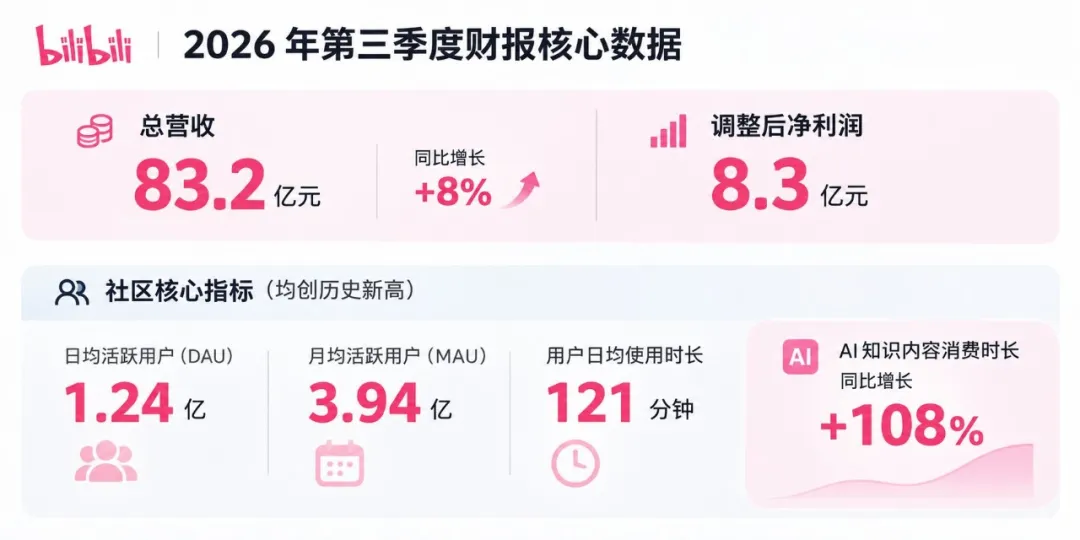
Growth across the three fronts of revenue, users, and content. It seems Bilibili is faring even better in the AI era.
A closer look at this report, along with some of the new content and creators that have emerged on the platform this year, reveals that the opportunities AI brings to Bilibili extend far beyond just adding another hot topic to the tech section.
Bilibili, the Best Hub for AI Tutorials
AI itself has become a skill the public needs to learn, and this emerging "discipline" is becoming a highly potential growth driver in Bilibili's knowledge section.
With AI products flourishing today, simply figuring out which AIs are available on the market and what each specializes in is enough material for a video. Every few months, as model capabilities are updated, much of this content becomes outdated and requires revision.
Product reviews are a traditional strength of Bilibili. From early smartphones and computers to recent new energy vehicles and smart hardware, Bilibili has cultivated a group of creators skilled at reviewing.
The explosion of AI products has brought these creators a completely new category of content.
Bilibili has also embraced this wave of creators. On September 16, Bilibili launched the "AI Infinite Arena," dedicated to AI reviews, gathering large model tests from creators across various fields. Participants set their own prompts around coding, reasoning, professional applications, and creative ideas, allowing mainstream global large models to compete side by side.
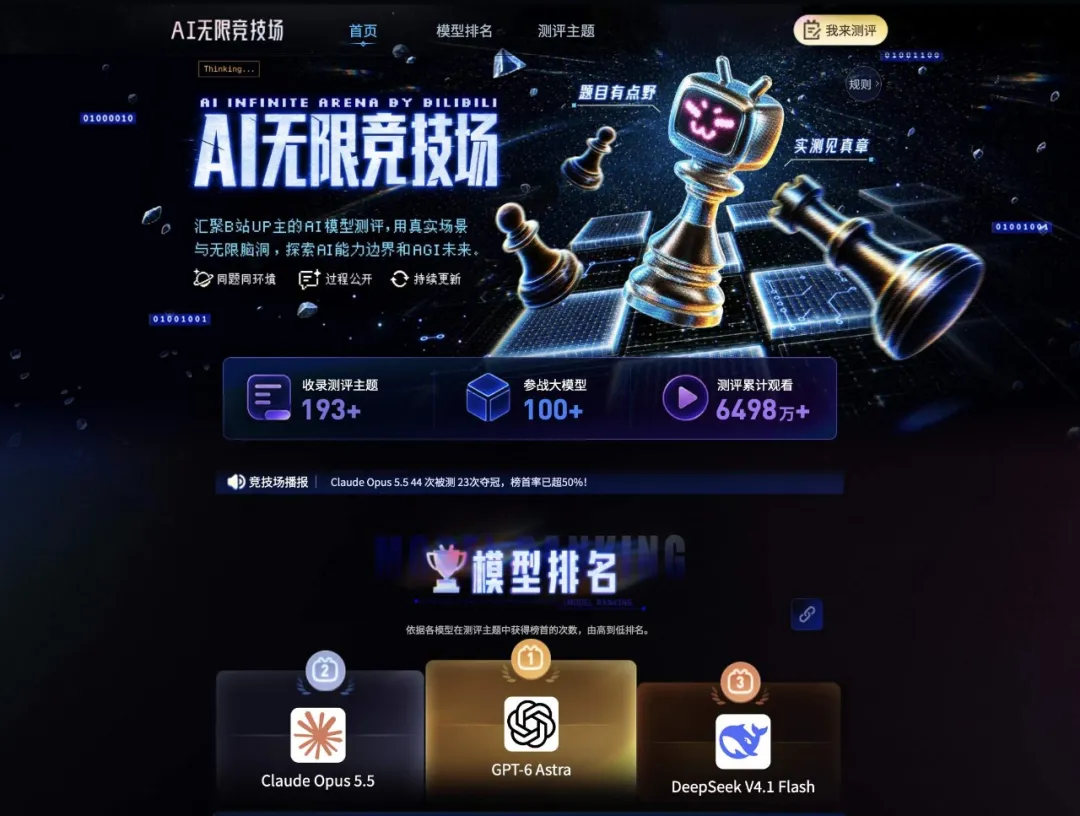
Nowadays, which large model manufacturer doesn't casually release a "topping the charts" performance sheet when launching a new product? But on Bilibili, a gaming-focused creator can take the same game concept to test different large models. Such cross-disciplinary, real-scenario-based reviews give ordinary users a more intuitive understanding of large model capabilities.
In Q3, Bilibili received over 13,000 submissions related to real-scenario testing of large models, covering more than 100 model versions. For an AI company, it would likely be difficult to design such a rich variety of application scenarios on its own.

Moreover, learning AI is quite addictive. From initially figuring out how to chat with AI, to building your own AI workflows, to using AIGC to create your own works... the process of learning AI naturally involves continuous content consumption.
In this regard, the depth and breadth of AI knowledge content on Bilibili are already quite substantial.
This August, DeepSeek open-sourced a developer tool called DeepSeek Harness (hereinafter referred to as DSH). The debut review video by creator "Programmer Yupi" garnered over 3.44 million views, while a detailed 50-minute tutorial by "Git Yuanbao" also exceeded 3 million views.

According to data provided by Bilibili, nearly half of DSH plugin developers share and publish their plugins on the platform. When DSH was first open-sourced, the number-one and third-ranked plugins on GitHub both came from Bilibili creators.
Beyond tutorials, Bilibili users are also exploring AI in creative ways.
For instance, given the same AI coding tool, a gaming creator might use it to recreate childhood mini-games, while a film/TV creator might use it to build their own movie database. Many of these applications are likely unimaginable even to AI manufacturers themselves. In terms of viral spread, an interesting application case is far more likely to spark public interest in trying new technologies than an official press conference.

Fittingly, creators across Bilibili's various sections have diverse interests, needs, and ideas. Each person may discover new uses for the same AI product, and these uses in turn become learning materials for other users studying AI.
And on Bilibili, content sometimes grows organically from the community. Within the bullet comments and discussion sections of a single video, new ideas can emerge. Some viewers get inspired to try it themselves, others offer strategies to help the creator, and some directly submit their own "homework." This back-and-forth interaction also motivates creators to continue researching and updating their next videos.
From learning to doing and then sharing, Bilibili's AI content has developed rich layers.
This suggests that the 108% surge in consumption time for AI knowledge content on Bilibili may only be the beginning. After all, as long as the AI industry continues to grow rapidly, there will never be a lack of topics for this content track.
The Next Generation of Creators May Already Be in the Audience
Another impact of AI on Bilibili's content ecosystem is the changing composition of its creators.
Many of Bilibili's creators actually grew up within specific interest circles. A gaming creator might have years of gaming experience, while a film/TV creator might simply be a cinephile with a massive watch list.
Accumulating interests takes far longer than learning technical skills. However, the emergence of AI provides new creative opportunities for those who have long nurtured certain interests but lacked professional production capabilities.
This summer, Bilibili hosted the "Build in Bilibili · AI Creation Open Competition," attracting 13,400 creators to participate. Among them, 64% had no professional development background, 88% of participating creators had fewer than 10,000 followers, and 56% spent less than 500 yuan on their creations.
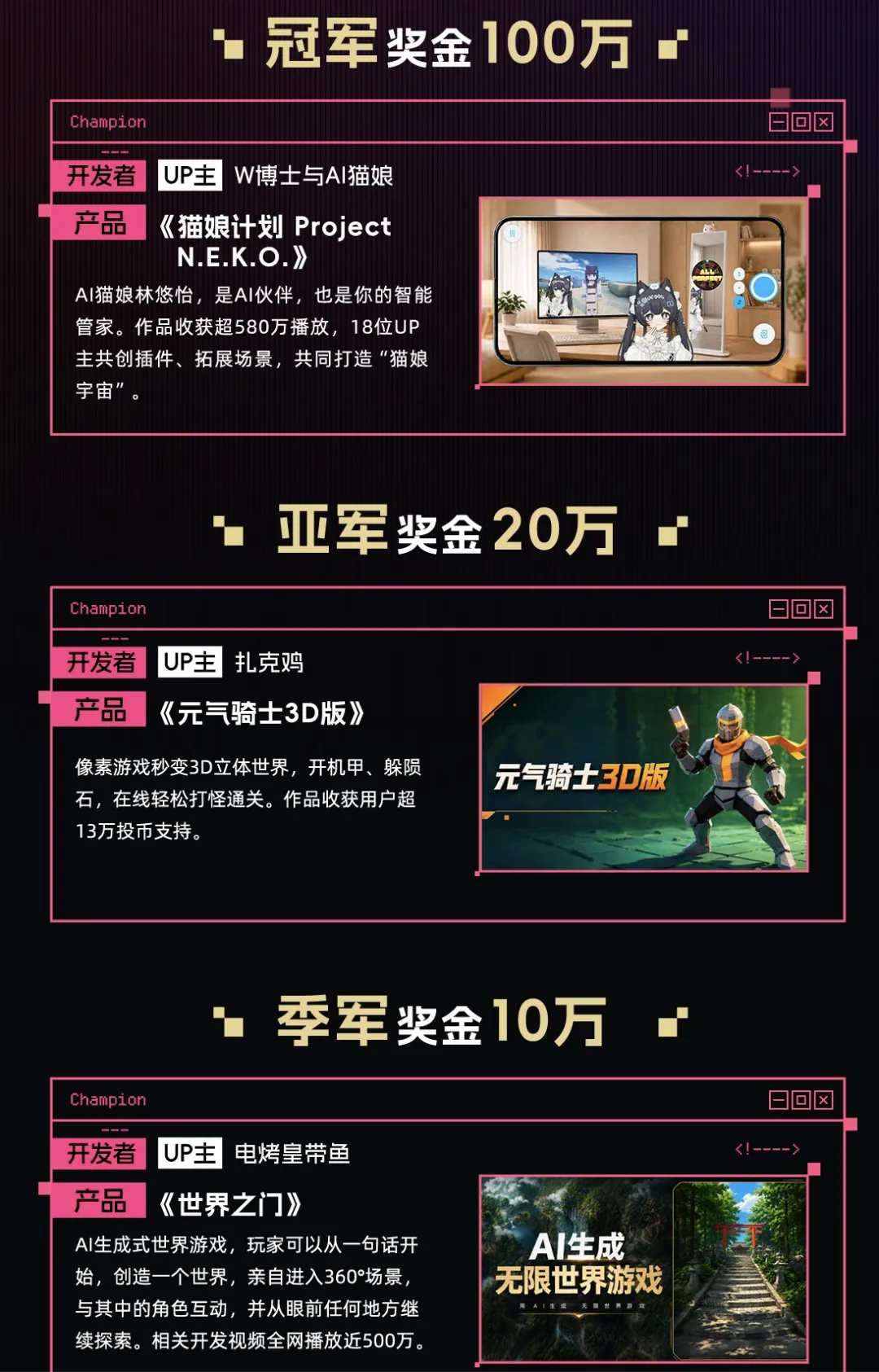
Even if most of them only post once or twice a year, for a UGC platform of Bilibili's size, this represents a substantial content increment.
For existing creators, AI has changed their topic selection logic and content production methods.
In Q3, consumption time for video podcasts on Bilibili surged over 380% year-on-year. Creator "Yun de Sheji Zatan" used AI to produce a "Round Table Pie"-style video podcast, inviting the "Yellow Brow Monster" from *Journey to the West* as a guest to discuss workplace ecosystems. This episode garnered over 2.6 million views on Bilibili and ranked second on the third issue of the "Bilibili Video Podcast Monthly Hot List."
In the past, producing such an episode would involve actor, makeup, and set costs so high that independent creators would likely abandon the idea entirely.
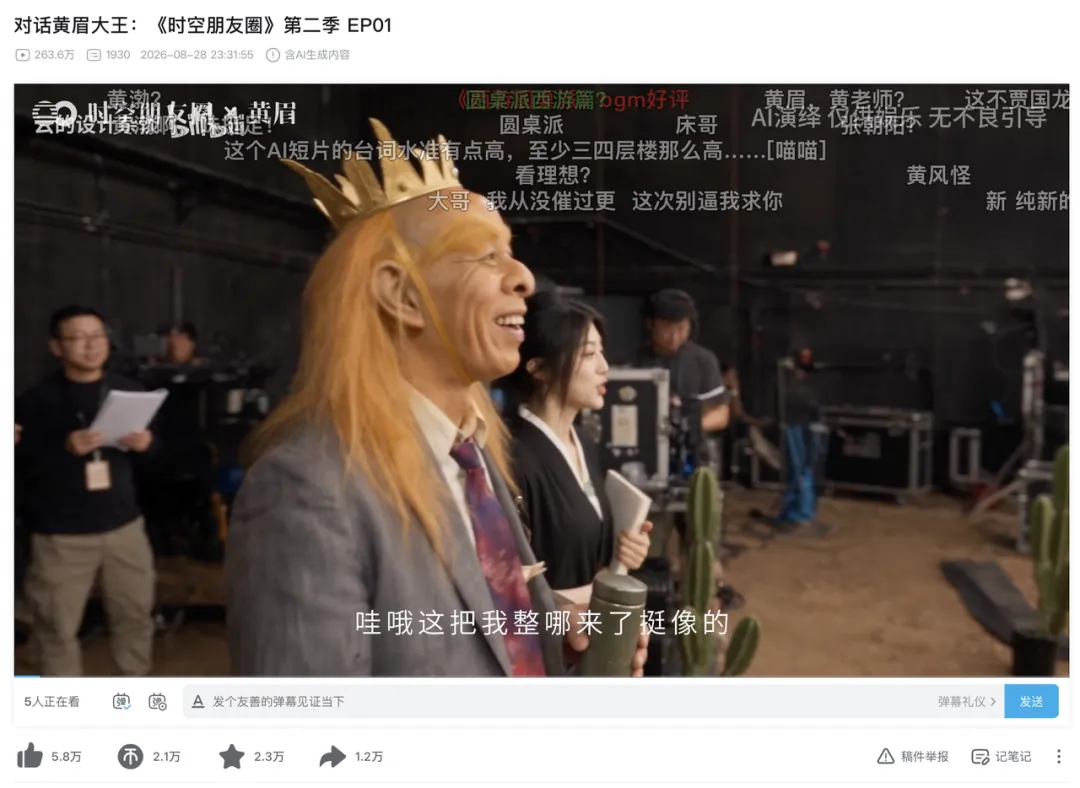
This is also the significance of AI for a community like Bilibili, which boasts rich long-tail content. Many niche topics aren't devoid of audiences; it's just that the audience size isn't large enough to cover production costs. AI, however, has drastically reduced these costs.
This similar creative logic is particularly evident in Bilibili's fan-created content culture.
Recently, BLG won its first League of Legends World Championship title. A Bilibili user rewrote the lyrics to "Boundless Oceans, Vast Skies," used AI to produce a Cantonese music video encouraging BLG, and wove the team's setbacks and regrets from the past few years into the song.
For fans familiar with BLG, the setbacks, frustration, and perseverance written in the lyrics are all viewing memories they have personally experienced. Perhaps the author lacks professional music production skills, but when it comes to knowing the team, a true fan likely understands how this song should be written better than any professional musician.
This kind of creative motivation has always existed on Bilibili. Early MADs, parody remixes, and fan animations were often born from young people's passion for a specific work or character.
Once the desire to create is no longer constrained by technical limitations, in Q3, general entertainment content submissions on Bilibili grew by 46% year-on-year, and consumption time increased by 35%. During this period, a batch of animated, sci-fi, suspense, and other genres featuring millions of views, all created with AI assistance, emerged.
During the same period, the daily average video submission volume on Bilibili grew by 36% year-on-year, and the number of creators with over 1,000 followers increased by more than 25%, as more and more creators accumulated their own audiences on the platform.
AI has lowered the barrier to becoming a creator, adding a fresh set of creative tools to this community culture that has thrived for over a decade.
New AI Businesses Also Require Good Content
This group of users on Bilibili, with their strong demand for learning AI, are also precisely the consumers AI manufacturers hope to reach.
In Q3, Bilibili's ad revenue reached 3.09 billion yuan, up 20% year-on-year. Among this, ad revenue from the AI sector surged by nearly 95%, significantly outpacing the overall growth rate of the ad business.
From a commercial perspective, AI is an industry with an innate need for content marketing.
Often, consumers need to see a concrete application case before realizing their own usage needs. The AI reviews, tutorials, and creative works mentioned earlier inherently take on part of the user education role for manufacturers.
As AI begins to enter more consumer electronics, commercial content is also branching out into more intriguing formats.
For example, back in October, Bilibili creator @Shenqi Ayu Ayu released an episode titled "I Built a Flying Skateboard...", achieving a real-life version of "sword flight." As of now, it has racked up 8.7 million views, 427,000 likes, and 157,000 saves, and was also selected for Bilibili's "Must-Watch Weekly."
This video was also a sponsored collaboration for the AI agent smartphone STEPX Neo. During the flying skateboard's R&D process, Ayu utilized the phone's AI agent for fault analysis, flight monitoring, and training review. A highly sci-fi-inspired concept evolved into a real-world scenario showcasing the AI smartphone's capabilities.

Creators also earn more through this process. In Q3, the average income per creator on Bilibili grew by 25% year-on-year, with per-capita direct user tipping income increasing by 31%.
This tipping income stems from direct payments from users to creators. Users' willingness to financially support their favorite creators provides an economic foundation for sustaining the creation of content with relatively niche audiences and longer production cycles.
These "win-win-win" transactions among users, creators, and brands collectively form the commercial value of Bilibili's content ecosystem.
During this earnings call, Bilibili CEO Chen Rui openly acknowledged that Bilibili is one of the platforms benefiting the most in the AI era, and that the community remains Bilibili's strongest trait and moat.
This indirectly answers the opening question: In the AI era, why do we still need creators?
Because no matter how powerful AI is, it remains merely a tool that relies on human usage. And Bilibili is not just a content platform; it is also a user community. The productivity dividends brought by AI can be enjoyed across the entire content industry, but how much of this productivity translates into consumable content largely depends on the types of people gathered on the platform.
As of Q3, Bilibili's 12-month retention rate for paid members is approximately 80%, with over 60% of new users being Gen Z (born after 2000). This means Bilibili not only retains veteran users who have long participated in community culture-building but also continuously absorbs the interests and creativity of the new generation of young people.
Over the past decade, Bilibili's content, pop culture, and even youth aesthetics have evolved, yet creation and exchange within the community have never stopped.
Before AI arrived, Bilibili had already spent over a decade cultivating young people's creative and consumption habits. Today, AI places a suite of creative tools, once exclusively mastered by professionals, right into the hands of this younger generation.
People, plus content. This might truly be Bilibili's greatest opportunity in the AI era.
Join TechFlow official community to stay tuned
Telegram:https://t.me/TechFlowDaily
X (Twitter):https://x.com/TechFlowPost
X (Twitter) EN:https://x.com/BlockFlow_News
 极客公园