
JPMorgan AI Data Center Research Report: 2028 Installed Capacity Raised to 303GW, Liquid Cooling Market CAGR at 128%
Author: Chaoxiang Research
The energy consumption landscape of AI computing infrastructure is being reshaped. In its latest model update report released on November 25, 2026, the JPMorgan Asia Pacific Technology Hardware and US Equity Electrical Equipment research team (including Albert Hung, Julian Mitchell, etc.) noted that driven by increased CoWoS packaging capacity allocation and higher thermal design power (TDP) for next-generation ASIC chips, global data center installed capacity is projected to reach 303GW by 2028, a 4% upward revision from previous estimates, with annual electricity consumption accounting for approximately 4% of global total demand. Although the penetration pace of high-voltage direct current (HVDC) has slowed, the server power supply and liquid cooling component markets are still expected to record compound annual growth rates (CAGRs) of 83% and 128%, respectively, between 2025 and 2028, with Delta Electronics, Sunon, KingSource and nVent emerging as core beneficiaries.
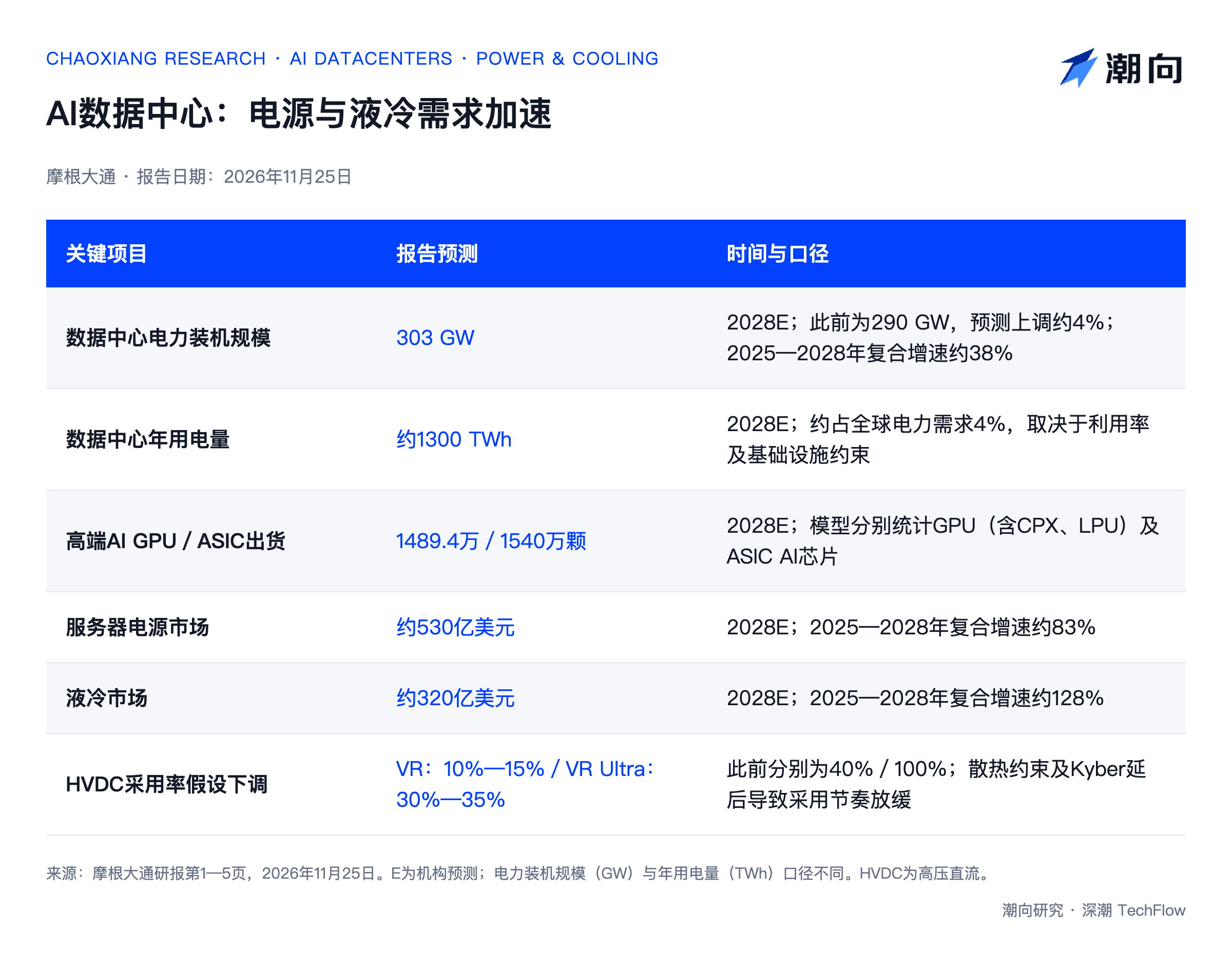
Installed Capacity Revised Up to 303GW, Half of Cloud Giants' Capex Goes Overseas
The upward revision in compute chip shipments directly raises the power ceiling for global data centers.
JPMorgan raised its forecast for global data center power installed capacity to 303GW by 2028 from 290GW (120GW in 2025), achieving a CAGR of 38% from 2025 to 2028, far exceeding the historical normal expansion pace of 10% to 20%. At that time, global data center annual electricity consumption will climb to approximately 1,300 TWh, increasing its share of global total power demand from 1.7% in 2025 to 4%.
Changes at the chip level are the core drivers. JPMorgan projects that AI ASIC chip shipments will grow at a CAGR of 55% from 2025 to 2028 (reaching 15.4 million units in 2028), while high-end AI GPU shipments will see a CAGR of 34% (reaching 14.89 million units in 2028). Meanwhile, driven by agent AI inference demand, the three-year CAGR for general-purpose server shipments was also revised up from 15% to 18%.
Power quotas have become the primary bottleneck constraining data center expansion. To circumvent constraints from the U.S. domestic power grid, hyperscale cloud service providers (CSPs) are accelerating overseas expansion. According to JPMorgan's statistics, of the approximately $210 billion in new investment plans announced by North America's top four cloud giants year-to-date in 2026, roughly half is directed toward overseas markets such as Southeast Asia, Northern Europe, and Australia to accommodate local inference compute and alleviate power shortages in the U.S., while the adoption of nuclear (SMR) and solid oxide fuel cells (SOFC) is also accelerating.
HVDC Penetration Slows, Power Supply Market to Exceed $53 Billion by 2028
The evolution of power architectures has seen slight pacing adjustments, but the increase in value per watt driven by high power density remains certain.
Due to thermal limitations curbing aggressive GPU power ramping, coupled with the delay of the Kyber rack solution, JPMorgan lowered its HVDC penetration rate expectations for Nvidia's Vera Rubin (VR) and Vera Rubin Ultra (VRU) generations from 40% and 100% to 10%-15% and 30%-35%, respectively. Under the base case, VRU NVL576 racks will feature HVDC power cabinets as standard, while HVDC in VRU Oberon racks remains an option; additionally, ASIC power cabinets have been delayed due to supercapacitor certification issues.
The Power Shelf solution retains strong viability in the short term. At the SC26 Supercomputing Conference in November 2026, progress in deploying 800V DC power delivery remained incremental, but Tesla's surprise launch of its 7.4MW medium-voltage solid-state transformer product, Powercore (expected to be operational in 2027), introduced a new competitive variable for traditional electrical giants like Eaton (ETN), Vertiv (VRT), and GE Vernova (GEV).
Even with the deceleration in HVDC pacing, the server power supply (PSU) market is still poised for explosive growth. Driven by the rapid rise in ASIC power consumption and upward revisions in xPU shipments, JPMorgan forecasts the AC/DC server power market will expand at a CAGR of 83% from 2025 to 2028, reaching $53.3 billion in 2028, with approximately $430 million in power demand corresponding to every additional 1GW of installed capacity. The industry landscape is highly concentrated, with Delta Electronics (42% share) and Lite-On Technology (25% share) collectively commanding nearly 70% of the market.
ASICs Drive Liquid Cooling Upgrades, Double-Sided Cold Plates Become Standard
Compared to the power delivery segment, the liquid cooling market within data centers (white space) has seen a more significant upward revision. JPMorgan upgraded its CAGR forecast for the AI server liquid cooling component market from 2025 to 2028 to 128%, projecting an overall market size of $32.5 billion in 2028, with approximately $270 million in liquid cooling demand for every additional 1GW of installed capacity. Among these, the packaging-level heat spreader market boasts a three-year CAGR of 210% (reaching $4.7 billion in 2028), while system-level cold plate modules grow at a CAGR of 137% (reaching $24.7 billion in 2028).
Customized ASIC chips are becoming the largest driver behind leaps in liquid cooling specifications. Adopting Vertical Power Delivery (VPD) architecture moves power modules to the back of the chip, leading mainstream projects including Amazon Trainium 3, Google TPU v8, AMD MI450, and subsequent Meta MTIA and Microsoft Maia models to fully shift to "double-sided cold plate" designs starting from Q4 2026 and 2027. Taking Amazon Trainium 3 liquid-cooled racks as an example, the cooling value per rack reaches approximately $83,000, surpassing the $66,300 value of Nvidia's Vera Rubin NVL72 rack.
Chip-level cooling also sees simultaneous volume and price increases. Nvidia's Rubin Ultra is expected to introduce a 3-piece lid removable cover design in 2027, causing the heat spreader value per GPU to surge by over 6 times compared to Rubin; meanwhile, Google's TPU v9 is anticipated to significantly upgrade heat spreader specifications in 2028, driving a 5x to 10x jump in per-chip value.
Diverging Winners, Focusing on High-Purity Liquid Cooling and Integration Leaders
Facing the dual landscape of progressive power architecture evolution and accelerating liquid cooling penetration, JPMorgan has provided a clear preferred ranking along the industrial chain.
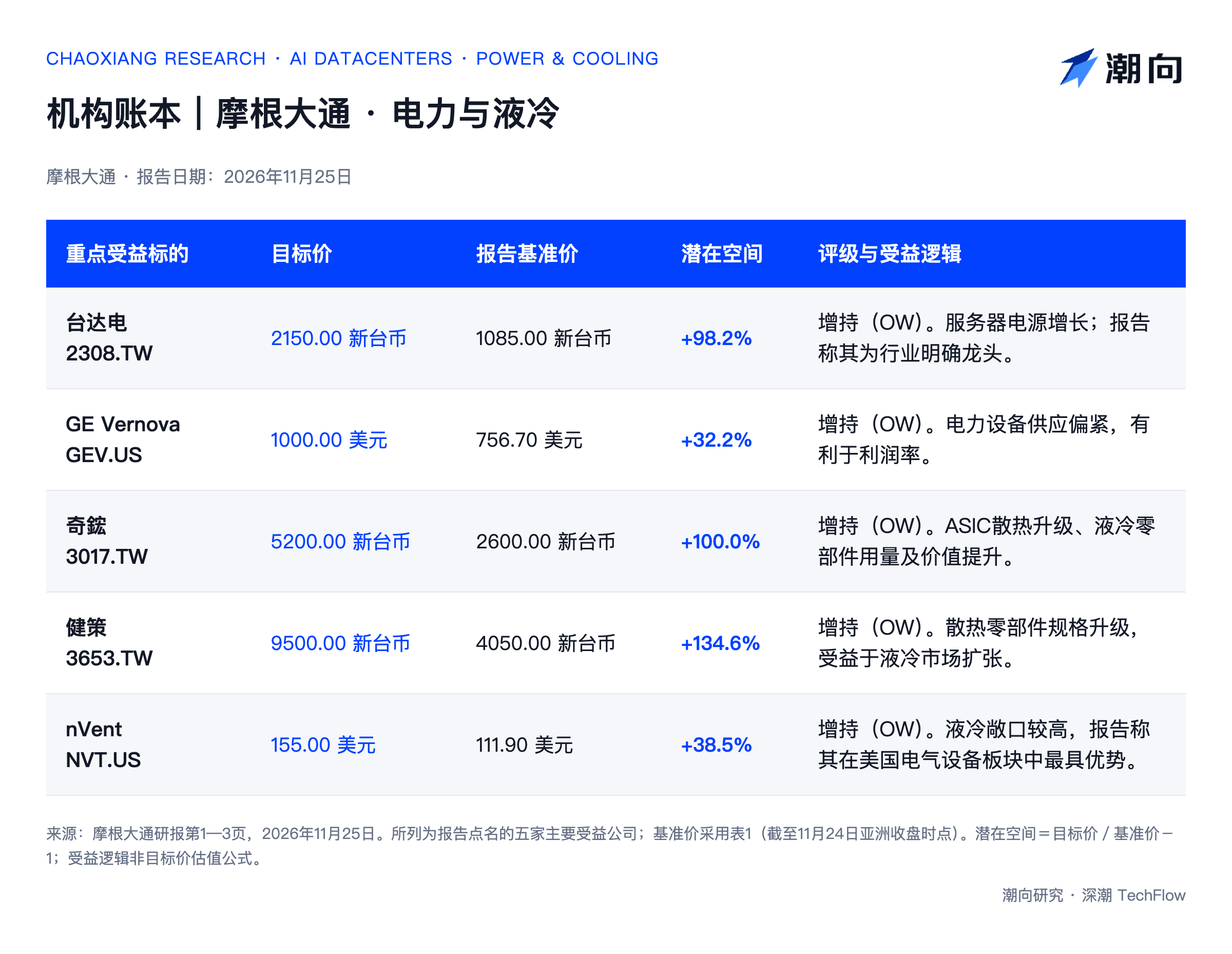
Within the Asian hardware supply chain, Delta Electronics (2308 TT, Overweight, PT NT$2,150) leverages a 42% share in the server PSU market alongside a comprehensive layout in HVDC, solid-state transformers, and side-mounted CDUs. Its AI server PSU revenue share is projected to rise from 13% in 2025 to 33% in 2028, contributing nearly half of its operating profit. In the liquid cooling track, Sunon (3017 TT, Overweight, PT NT$5,200) not only holds 40%-50% of Nvidia's cold plate share but also secures over half the share in core ASIC projects like Amazon Trainium 3; while KingSource (3653 TT, Overweight, PT NT$9,500), as the absolute leader in premium server heat spreaders, will fully benefit from the packaging thermal upgrades of Rubin Ultra and TPU v9.
In the US equity electrical equipment sector, given that new data center installed capacity growth may slow from highs by 2028, some institutions worry about a rebound in equipment order growth in 2027, leaving only pure-play liquid cooling and power bottleneck beneficiaries with stronger certainty. JPMorgan recommends nVent (NVT, Overweight, PT $155) first, as its liquid cooling business accounts for mid-double digits of total revenue without the burden of traditional chillers; it also favors GE Vernova (GEV, Overweight, PT $1,000) for its profit margin expansion potential amid tight gas turbine supply and long-term contracts for solid-state transformers.
This article is compiled and interpreted by Chaoxiang Research based on third-party brokerage research reports. The ratings, target prices, earnings forecasts, and related judgments cited herein reflect only the views of the respective brokerage analysts, representing solely the stance of their affiliated institutions, do not represent Chaoxiang Research's opinions, and do not constitute any investment advice.
The market involves risks, and decisions must be independent. This article should not serve as a basis for buying or selling any securities.Join TechFlow official community to stay tuned
Telegram:https://t.me/TechFlowDaily
X (Twitter):https://x.com/TechFlowPost
X (Twitter) EN:https://x.com/BlockFlow_News
 @chaoxiangooo