
Bernstein Research Report: Airbnb Doubles Down on Long-Term Living Rentals, Projected to Contribute $2.9 Billion in Incremental Revenue by 2035
On November 25, 2026, the Bernstein analyst team led by Richard J. Clarke released an in-depth research report on Airbnb (ABNB.US).
The report focuses on CEO Brian Chesky's proposed "Living" second growth curve, breaking down its business logic and revenue potential for entering the long-term rental market of 12 months or more.
Saying Goodbye to Short-Term Rental Monoculture, 12+ Month Long-Term Rentals Become the Second Growth Engine
Citing CEO Brian Chesky, the report states that "Living" will become Airbnb's second core growth vector after travel and will serve as the company's strategic focus over the next three to five years.
While the ultimate vision of "Living" may encompass grocery delivery to entertainment consumption, Bernstein believes the most logical entry point remains housing itself.
Airbnb is no stranger to medium- and long-term rentals. The report notes that during the pandemic, bookings for stays of 28 days or longer peaked at 24% in Q1 2021 and have since stabilized at around 15%.
However, past monthly rental products primarily catered to the one-to-three-month transitional needs of digital nomads, relying on short-term rental inventory and high commission structures.
Bernstein anticipates that the new "Living" division will feature an independent app entry point, a dedicated database of residential long-term rental listings, and a lower fee structure, directly targeting the traditional long-term rental market for 12 months and above.
US Long-Term Rental Market Hits $772 Billion, Unaffordability of Homeownership Drives Hard Demand
The US long-term rental market is undergoing structural expansion. Data shows that total US household rent expenditure grew at a CAGR of 7.5% from 2020 to 2025, outpacing the 4.4% growth rate between 2000 and 2020.
Total annual rent expenditure reached approximately $772 billion in 2025.
Three structural factors are keeping more Americans in the rental market.
First, homebuying affordability has deteriorated sharply. House price appreciation has consistently outpaced household income growth, and high interest rates have driven up mortgage costs, hindering homeownership among those under 40.
Second, rental regulations are increasingly tilting in favor of tenants. Many US jurisdictions have implemented rent control, security deposit protections, and "just cause eviction" ordinances, granting tenants near-homeownership levels of residential stability.
Finally, shifting consumption preferences among younger generations. Surveys show the proportion of millennials planning to "rent forever" rose from 13.3% in 2018 to 24.7% in 2022.
Beyond the 74% of respondents constrained by purchasing power, 27% and 26%, respectively, value the mobility and maintenance-free convenience of renting.
Traditional Agencies Too Expensive, Zillow Too Heavyweight, One-Stop Digital Living Platform Finds Breakthrough
The current US long-term rental market suffers from two major pain points: using traditional rental agencies incurs high costs, often charging matchmaking fees equivalent to half to a full month's rent plus management cut-outs; meanwhile, self-renting through listing platforms like Zillow or Apartments.com involves highly fragmented processes.
On these traditional information platforms, key terms such as whether landlords accept short-term subleases, lease flexibility, and notice periods for termination are often opaque.
Once a contract is signed, tenants must still arrange utilities themselves, with subsequent maintenance requests and communication stuck at the primitive stage of phone calls, texts, and emails.
Bernstein notes that the market urgently needs an end-to-end one-stop living platform.
By integrating tenant background checks, e-signatures, consolidated rent-and-utility bills, online maintenance requests, and even security deposit escrow and renter's insurance, the platform can not only deliver a seamless experience akin to short-term rentals but also open monetization paths for value-added services beyond base commissions.
Holding 6.5 Million Exclusive Listings and AirCover Infrastructure, Airbnb Holds Cross-Sector Advantages
Compared to startups starting from scratch, Airbnb holds five trump cards when entering the long-term rental track.
First, existing two-sided matching interfaces and AI listing management tools can be directly reused, lowering customer acquisition and R&D costs.
Second, the massive existing inventory pool enables dynamic complementarity between short- and long-term rentals. Bernstein estimates Airbnb holds approximately 6.5 million exclusive listings; residential properties located outside tourist hotspots can generate more stable returns when converted to long-term leases, while vacancy gaps between long-term tenancies can be filled with short-term stays.
Third, the existing "Airbnb-Friendly Apartments" program has already accumulated a large inventory of apartment buildings that allow tenants to sublet part-time, laying an early foundation for long-term rental supply.
Fourth, mature supporting infrastructure can be directly migrated. The AirCover system, covering identity verification, property damage protection, and liability insurance, along with launched lifestyle services, can be directly applied to long-term rental scenarios.
Fifth, the long-term rental business holds strategic synergistic value. Even if initial direct monetization rates are lower than short-term rentals, it will continuously feed new hosts and listings into Airbnb's core short-term rental platform.
Potential to Contribute $2.9 Billion in Incremental Revenue by 2035, But Must Overcome Zillow's Free Model Barrier
Bernstein conducted a quantitative assessment of the long-term financial potential for Airbnb's long-term rental business in the report.
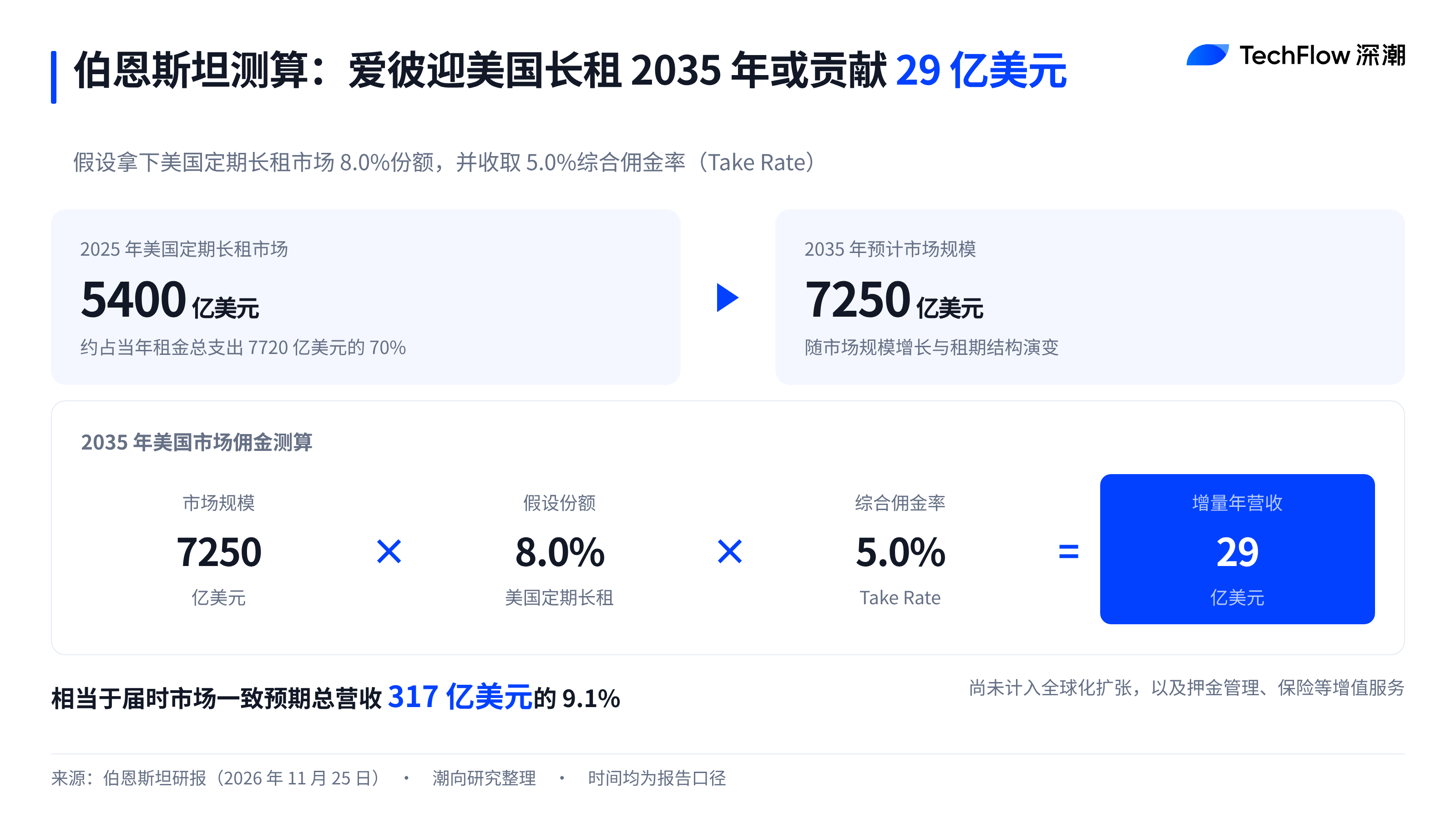
According to model projections, total US fixed-term rental market expenditure was approximately $540 billion in 2025, accounting for 70% of total rent spending.
By 2035, driven by market expansion and evolving lease term structures, total fixed-term rental market expenditure is projected to reach $725 billion.
If Airbnb captures an 8.0% share of the US fixed-term rental market by 2035 leveraging product advantages and charges a 5.0% take rate, commissions alone could generate $2.9 billion in incremental annual revenue, representing 9.1% of the then-consensus total revenue projection ($31.7 billion).
Further combining global expansion with value-added services like deposit management and insurance would push revenue ceilings even higher.
However, the path to this goal is far from smooth.
The biggest challenge stems from clashing business models. Industry leader Zillow currently offers free listing policies for individual and small-to-mid-tail landlords, charging no commission upon signing, primarily relying on advertising for large-scale long-term apartments and value-added tools to achieve a $1 billion+ revenue target.
In an environment where landlords are accustomed to free services, Airbnb must deliver closed-loop fulfillment value far exceeding simple information display to justify its 5% commission cut.
Additionally, stringent local regulations regarding rental agent licenses, security deposit oversight, and fee caps will test the depth of Airbnb's localized operations.
Bernstein Maintains Outperform Rating, $234 Target Price Implies 35% Upside
Based on confidence in steady growth of the core short-term rental business and the long-term optionality value of "Living," Bernstein reiterates its "Outperform" rating for Airbnb.
Based on the closing price of $173.96 on November 23, 2026, Airbnb's current valuation corresponds to a 31.3x adjusted P/E for fiscal year 2026 and a 26.2x adjusted P/E for fiscal year 2027.
Bernstein maintains a $234.00 target price unchanged, derived from 17x forward 12+1 month EV/EBITDA and 29x forward 12+1 month P/E multiples, implying a 35% potential upside from the current closing price.
The report simultaneously flags three downside risks: a decline in global overall travel demand; sudden intensification of competition from Google, Booking, or Expedia; and the implementation of stricter regulatory policies across various regions limiting the supply of short- or long-term rentals.
Institutional Ledger
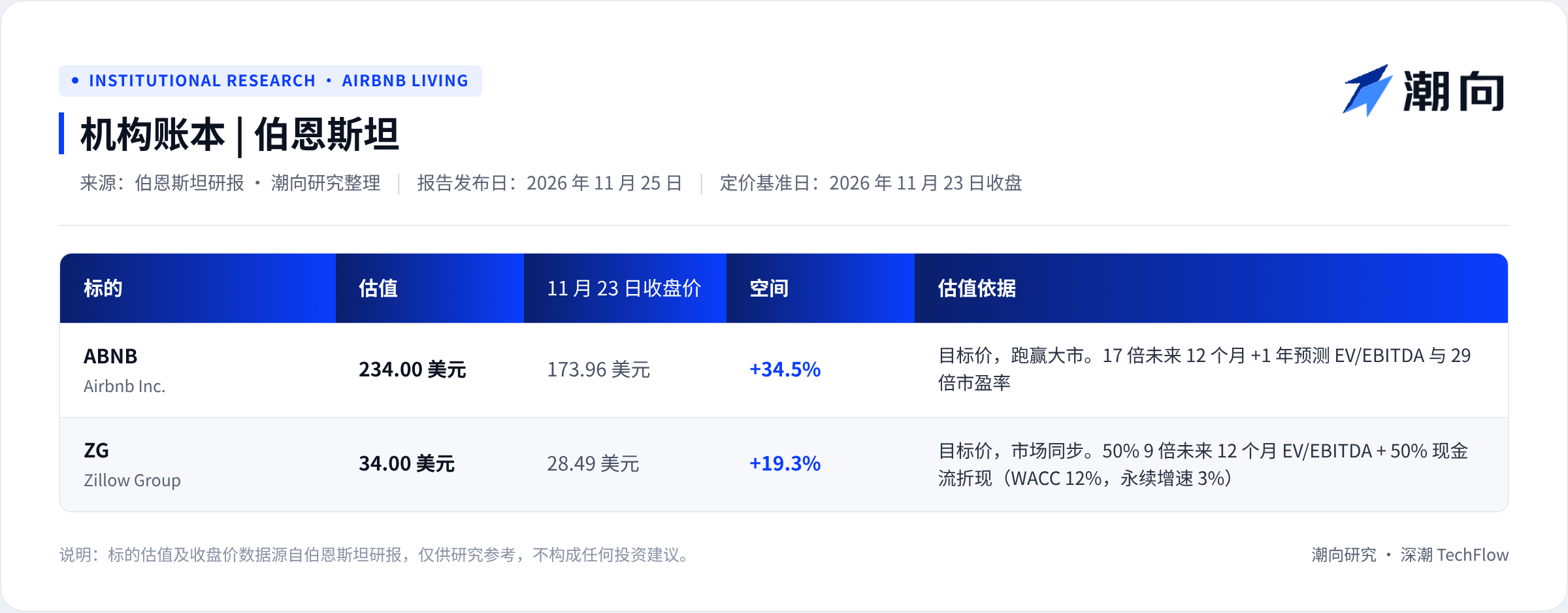
Note: Airbnb's potential upside is precisely calculated at +34.5% based on the $234.00 target price relative to the November 23, 2026 closing price of $173.96 (rounded to 35% on the report cover).
Firm Disclaimer Regarding Research Report Content (Brokerage Viewpoint, Not TechFlow Research Viewpoint)This article is a compilation and interpretation by TechFlow Research of third-party brokerage research reports. The ratings, target prices, earnings forecasts, and related judgments cited herein are solely the views of the respective brokerage analysts, represent only their affiliated institutions' stances, do not reflect TechFlow Research's viewpoints, and do not constitute any investment advice.
Markets involve risk; decisions require independence. This article should not serve as a basis for buying or selling any securities.Join TechFlow official community to stay tuned
Telegram:https://t.me/TechFlowDaily
X (Twitter):https://x.com/TechFlowPost
X (Twitter) EN:https://x.com/BlockFlow_News
 @chaoxiangooo