
Goldman Sachs US Macro Research Report: Q3 GDP Revised Up to 4.3%, October Core Capital Goods Orders Beat Expectations
Author: Chaoxiang Research
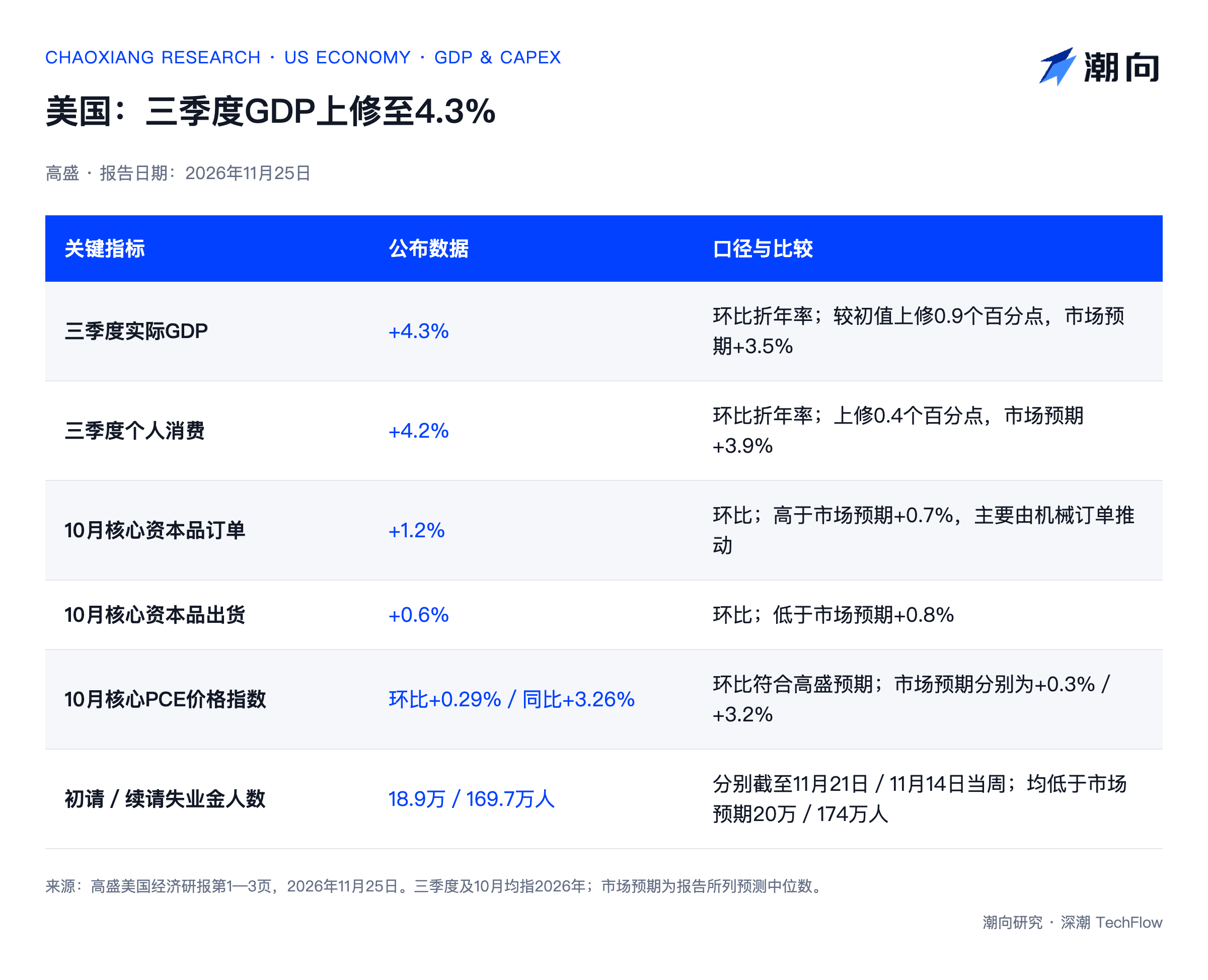
The US economy's growth momentum in Q3 far exceeded initial estimates, with corporate AI capital expenditure emerging as the primary driving engine. In its macroeconomic data commentary released on November 25, 2026, the Goldman Sachs Economic Research Team (led by Jan Hatzius) noted that the US actual GDP annualized quarter-on-quarter rate was revised up by 0.9 percentage points to 4.3%, and core capital goods orders grew 1.2% q/q, significantly surpassing the market expectation of 0.7%. Meanwhile, the October core PCE price index rose 0.29% q/q in line with expectations, and initial jobless claims fell to 189,000, indicating that the US economy maintained strong resilience toward year-end.
Commercial Investment Leads Upward Revision, Consumption Shows Strong Resilience
The second revision of the data has rewritten the growth baseline for the US economy in Q3.
The US Commerce Department reported that the second-revised actual GDP annualized q/q growth rate reached 4.3%, marking a significant increase from the initial estimate of 2.2%, and higher than Goldman Sachs' forecast of 3.7% and the market consensus of 3.5%. Nonresidential fixed investment growth was sharply revised up by 3.4 percentage points to 16.1%, with intellectual property products contributing the most to the upward revision.
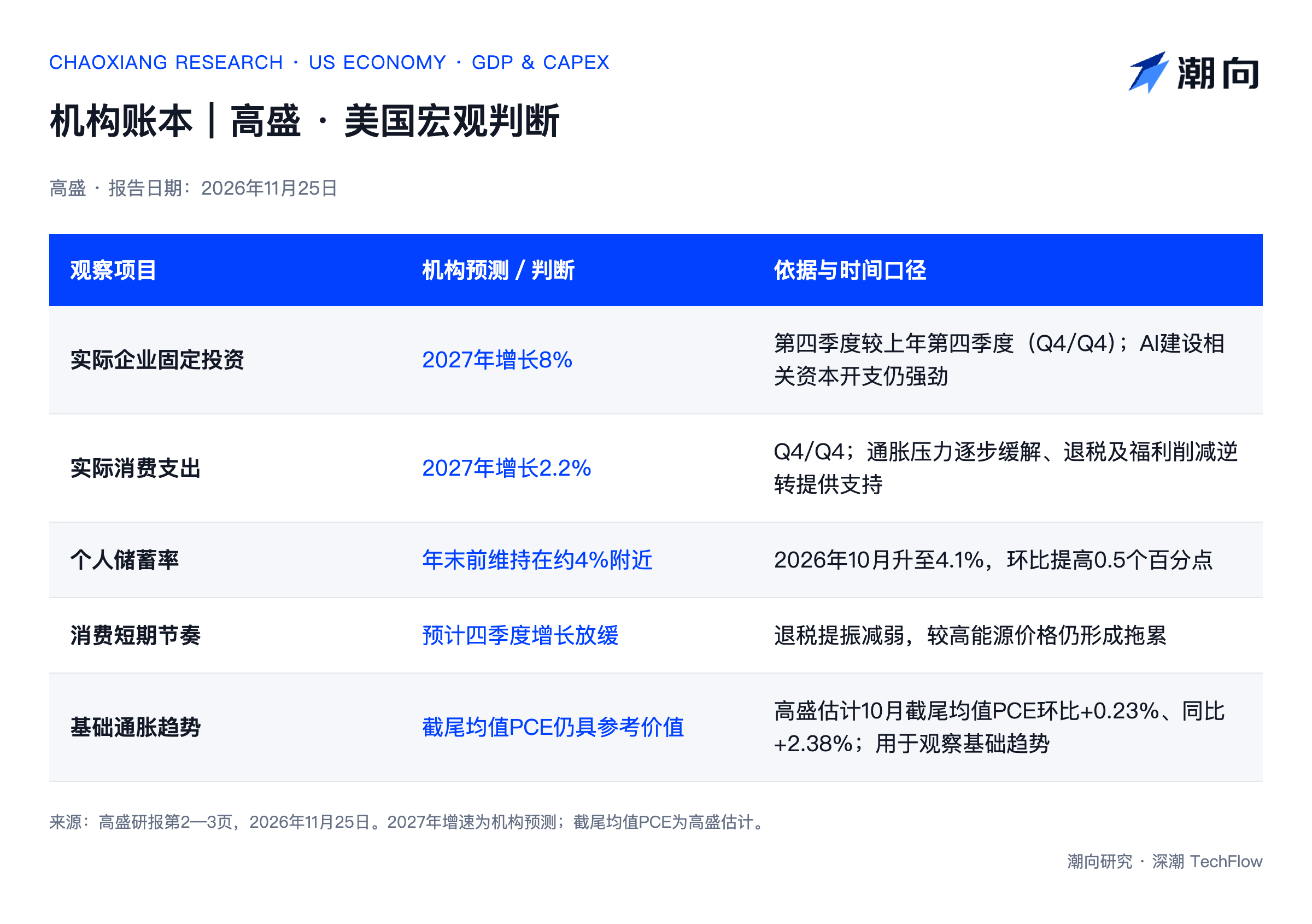
The AI infrastructure wave remains the core driver of corporate capital expenditure. Investment in information equipment surged 41.7% in Q3, while industrial equipment investment grew 20.6%. Goldman Sachs expects that US real commercial fixed investment will maintain a strong quarterly YoY growth rate of 8% in 2027.
Household consumption also delivered surprises. Growth in personal consumption expenditures in Q3 was revised up by 0.4 percentage points to 4.2%, with an upward revision in goods demand offsetting a slight downward revision in healthcare services spending. Goldman Sachs pointed out that the tax rebate effect and the wealth effect from rising US stock markets completely offset the drag from high energy prices, forecasting a steady 2.2% growth in personal consumption in 2027.
October Consumption Cools MoM, Core PCE in Line with Expectations
Entering Q4, US household income and spending rhythms are returning to normal.
US personal income grew 0.7% MoM in October, significantly exceeding the market expectation of 0.4%, mainly driven by a 1.8% surge in personal dividend income. Nominal disposable income grew 5.5% YoY, with real YoY growth reaching 1.6%. Personal consumption expenditures grew 0.3% MoM, slightly below the consensus expectation of 0.4%, while real personal expenditures adjusted for inflation remained flat MoM.
The savings rate consequently began to recover. The US personal savings rate increased by 0.5 percentage points MoM to 4.1% in October, confirming Goldman Sachs' assessment that the savings rate would hover around 4% by year-end. Goldman Sachs expects that as the stimulative effect of tax rebates fades and high energy prices continue to weigh down, consumption growth will decelerate in Q4 compared to the previous quarter.
Inflation data generally fell within the market's expected range. The October core PCE price index rose 0.29% MoM and 3.26% YoY, almost perfectly aligning with Goldman Sachs' expectations. Goldman Sachs calculated the Dallas Fed trimmed-mean PCE rose 0.23% MoM and 2.38% YoY, considering this indicator removes one-off disturbances from tariffs, energy shocks, and AI-related statistical distortions, thereby better reflecting underlying inflation trends.
Core Capital Goods Orders Strengthen, Labor Market Remains Tight
Forward-looking indicators for manufacturing investment have sent positive signals.
US durable goods orders increased marginally by 0.2% MoM in October; although dragged down by transport equipment to fall short of the market expectation of 0.7%, core orders excluding transport equipment steadily grew 0.5% MoM. Core capital goods (nondefense capital goods excluding aircraft), which carry greater forward-looking significance, surged 1.2% MoM in October, far exceeding the market expectation of 0.7%, with new machinery and equipment orders serving as the main driver.
The AI investment chain has maintained rapid expansion over the past year. Data shows that new orders for computers and electronics surged 14.2% YoY over the past 12 months, while machinery and equipment orders grew 16.7% YoY. However, core capital goods shipments grew 0.6% MoM in October, slightly below the market expectation of 0.8%, and manufacturing inventories rose 0.4% MoM.
The labor market concurrently sent robust signals. For the week ending November 21, US initial jobless claims decreased by 13,000 MoM to 189,000, below the market expectation of 200,000, with the four-week moving average dropping to 196,000. For the week ending November 14, continuing claims dropped significantly by 95,000 to 1.697 million, quickly reversing the surge in claims previously triggered by Michigan's rollout of a new unemployment insurance system.
This article is an organization and interpretation by Chaoxiang Research of third-party broker research reports. The ratings, target prices, earnings forecasts, and related judgments cited herein are the views of that broker's analysts, representing only their affiliated institution's stance, not Chaoxiang Research's views, and do not constitute any investment advice.
Markets involve risks, and decisions require independence. This article should not be used as a basis for buying or selling any securities.
Join TechFlow official community to stay tuned
Telegram:https://t.me/TechFlowDaily
X (Twitter):https://x.com/TechFlowPost
X (Twitter) EN:https://x.com/BlockFlow_News
 @chaoxiangooo