
Goldman Sachs MiniMax Research Report: M3 Pro to Launch Soon, Maintains Buy Rating and HK$760 Target Price
Author: Chaoxiang Research
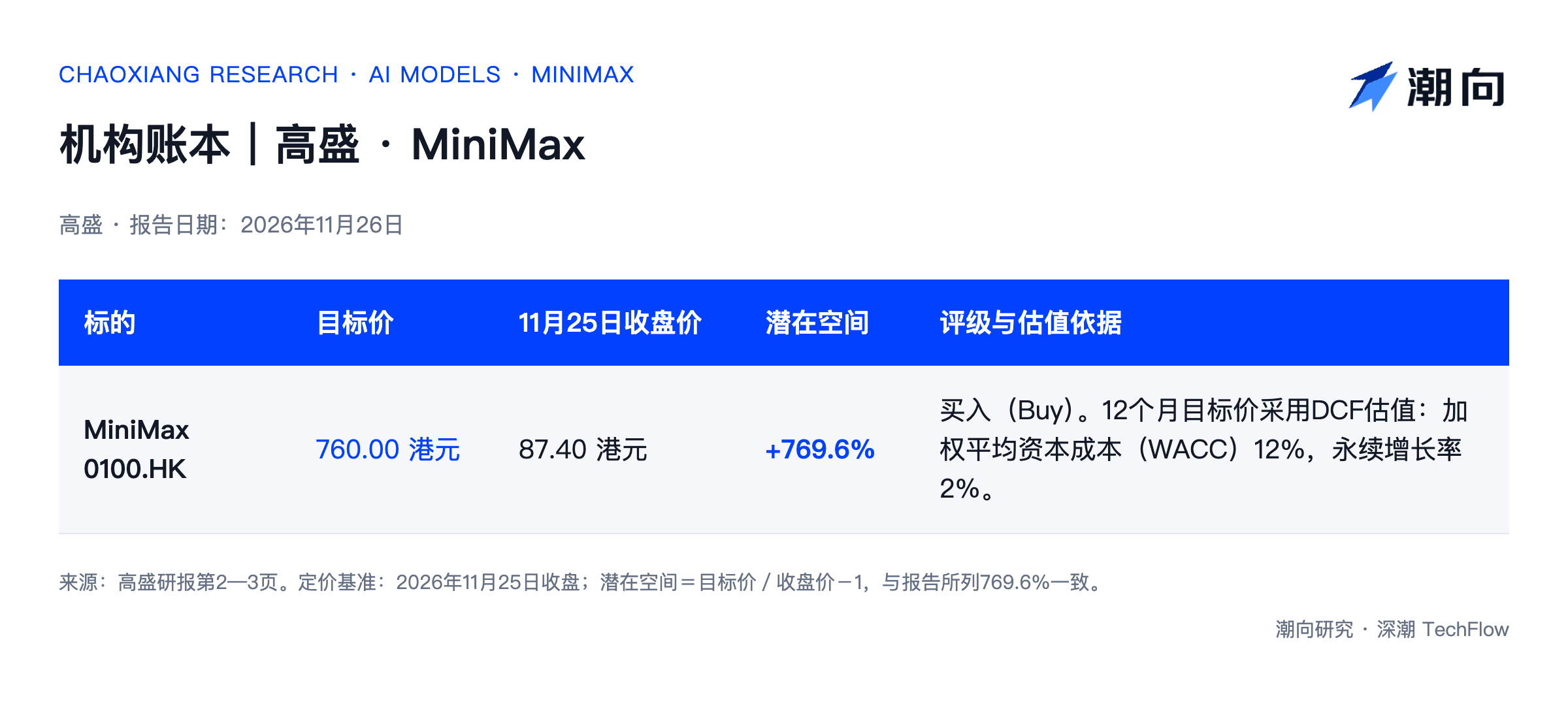
MiniMax (0100.HK) stands at the threshold of releasing its next-generation flagship model and accelerating commercialization. In a China research transcript released on November 26, 2026, the Goldman Sachs Asia Technology Analysis Team (Ronald Keung et al.) noted that although access to external computing power has recently tightened and barriers to anti-distillation have risen, MiniMax’s existing training compute reserves remain intact. The 3-trillion-parameter M3 Pro has completed multiple rounds of reinforcement learning and is imminent for release. Goldman Sachs maintains a “Buy” rating for MiniMax with a 12-month target price of HK$760, implying a potential upside of 769.6% from its current stock price of HK$87.40.
Safeguarded by Existing Compute Reserves, M3 Pro Imminent
The fluctuations in the external computing environment have not disrupted MiniMax’s R&D pace.
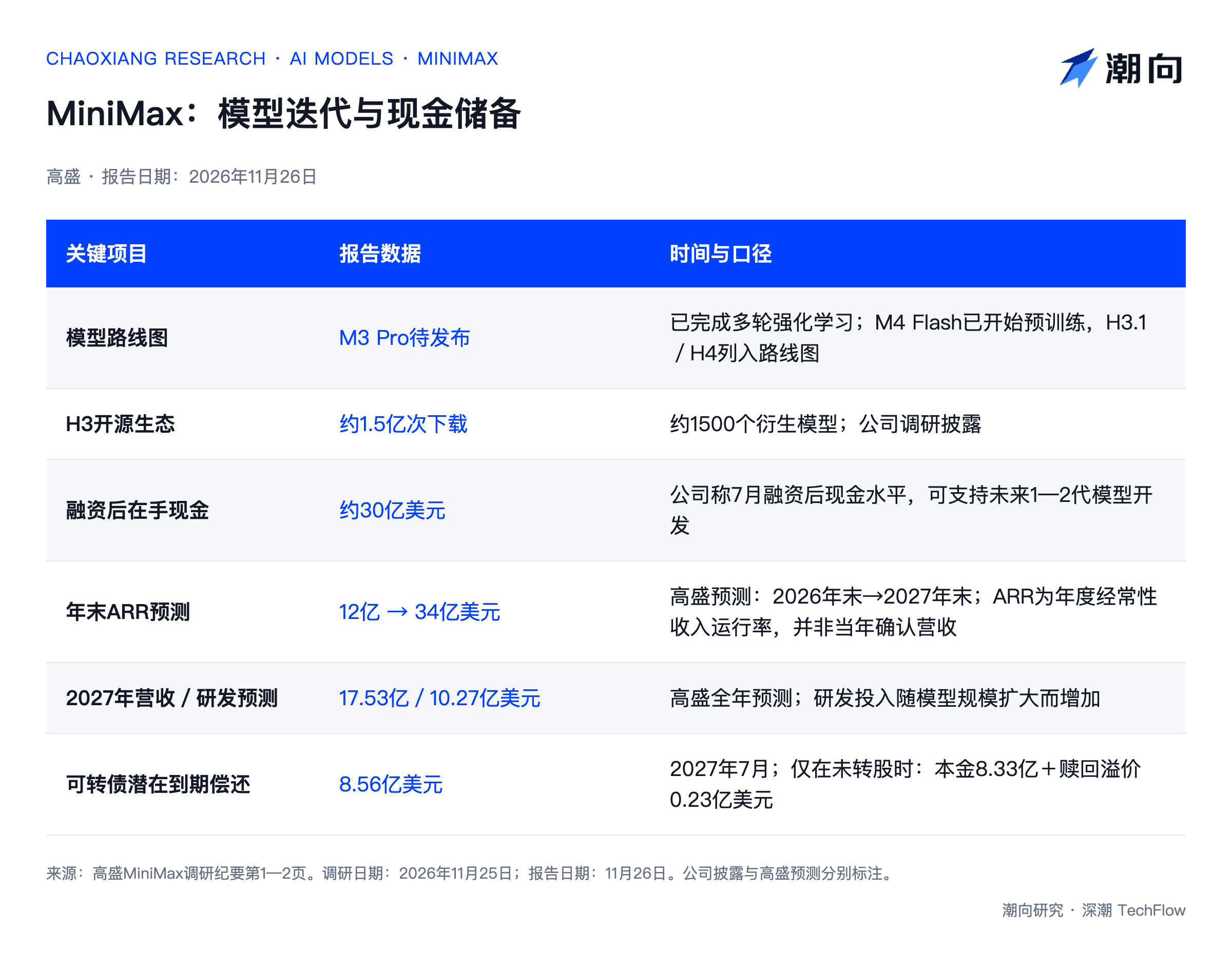
After in-depth discussions with MiniMax’s investor relations team in Beijing on November 25, the Goldman Sachs team learned that while channels to acquire new high-end computing power have recently tightened, the company’s existing training compute reserves remain undamaged. Thanks to a diversified compute deployment architecture, the current compute scale is sufficient to fully support the 3-trillion-parameter (3T) M3 Pro, as well as the subsequent development of larger-scale M4 Flash/Pro series and H-series multimodal models.
Deployment of the new models has entered the countdown phase. Management revealed that the flagship M3 Pro has undergone multiple rounds of reinforcement learning (RL) tuning and is currently in the final preparations before launch. Next-generation M4 Flash has also officially commenced pre-training. The company adopts a prudent strategy of first validating the new model architecture, underlying cluster stability, and data effectiveness at smaller parameter scales before expanding to the larger-scale M4 Pro.
Faced with the industry-wide wave of "anti-distillation," management believes this effectively raises barriers in post-training, high-quality data, and evaluation systems. To address this, MiniMax is continuously increasing investments in reinforcement learning and accumulating proprietary domain knowledge. Its "10X Expert Program" now comprehensively covers highly specialized fields with significant barriers, such as finance, cybersecurity, law, and 3D design.
Ramping Up Domestic Chips, Reducing Inference Costs to Expand Margins
More closely watched by the secondary market than model iteration is the gap between compute costs and commercial gross margins.
The multimodal ecosystem is providing a continuous foundation for traffic. The H3 model is gaining strong momentum in the open-source community, with cumulative downloads reaching approximately 150 million and around 1,500 derivative models developed. The image generation model H3 Image has also been open-sourced, with H3.1 and H4 already scheduled on the R&D roadmap. For complex scenarios such as video generation, the company is exploring the combination of controllability driven by code (coding-based) and the rendering capabilities of diffusion models to simultaneously enhance output quality and generation efficiency.
The compute supply side has reached a crucial inflection point toward localization. MiniMax is accelerating the procurement and adaptation of domestic compute chips, with two sets of domestic chip super-node solutions expected to ramp up significantly for inference in Q4 2026. Management stated plainly that, supported by native FP4 precision and super-node architectures, the return on investment (ROI) for certain domestic chips in large model inference tasks has already surpassed specific overseas alternatives.
Continuous optimization of the underlying inference architecture directly translates into profitability resilience on the financial statements. Even under aggressive pricing strategies, M3.1 Flash maintains a healthy gross margin level. Management expects that as inference costs continue to drop, coupled with greater pricing flexibility provided by more capable Pro-series models, there remains room for overall gross margin expansion.
Holding $3 Billion, Steadily Advancing A-Share IPO
In the high-intensity arms race of large models, the thickness of the balance sheet determines a company's endurance.
Goldman Sachs calculated that MiniMax’s cash on hand was $508 million as of the end of 2025, increasing to $931 million by the end of H1 2026. Following the completion of a $1.211 billion equity placement and a $825 million convertible bond issuance in July this year (totaling net proceeds of $2.036 billion), the company currently holds approximately $3 billion in cash, providing a robust safety cushion for short-term model R&D and commercialization.
Goldman Sachs forecasts that MiniMax’s annual recurring revenue (ARR) will surge from $1.2 billion at the end of 2026 to $3.4 billion at the end of 2027; full-year revenue is expected to climb from $517 million in 2026 (approximately $400 million in H2) to $1.753 billion in 2027, and further reach $3.877 billion in 2028. Although R&D expenditures are projected to reach $512 million in H2 2026 and $1.027 billion in 2027, existing funds are sufficient to cover the R&D cycles for the next one to two generations of core models.
Regarding market concerns over convertible bond repayment pressure, Goldman Sachs provided a clear breakdown in its ledger: the convertible bonds issued in July will mature in July 2027, with a conversion price of HK$335.0; if they fail to convert upon maturity, the total redemption amount, including a 2.75% call premium ($23 million), will be approximately $856 million, well within the company’s cash coverage capacity. Additionally, the company’s previously announced A-share listing plan is progressing steadily.
Based on a discounted cash flow (DCF) model (utilizing a 12% weighted average cost of capital and a 2% terminal growth rate), Goldman Sachs reiterates its “Buy” rating and HK$760 target price for MiniMax, while advising investors to monitor risks including intensifying competition among global foundational models, slower-than-expected profit realization, weaker-than-anticipated commercialization capabilities, intellectual property risks, and geopolitical risks amid US-China tech rivalry.
This article is compiled and interpreted by Chaoxiang Research based on third-party brokerage research reports. The ratings, target prices, earnings forecasts, and related judgments cited herein are solely the views of the respective brokerage analysts, representing only their affiliated institutions’ positions, not those of Chaoxiang Research, and do not constitute any investment advice.
Markets carry risk, and decisions must be independent. This article should not serve as the basis for buying or selling any securities.
Join TechFlow official community to stay tuned
Telegram:https://t.me/TechFlowDaily
X (Twitter):https://x.com/TechFlowPost
X (Twitter) EN:https://x.com/BlockFlow_News
 @chaoxiangooo