Jensen Huang, 11 Days Away from NVIDIA
Author: Xu Shan, Geeker Park
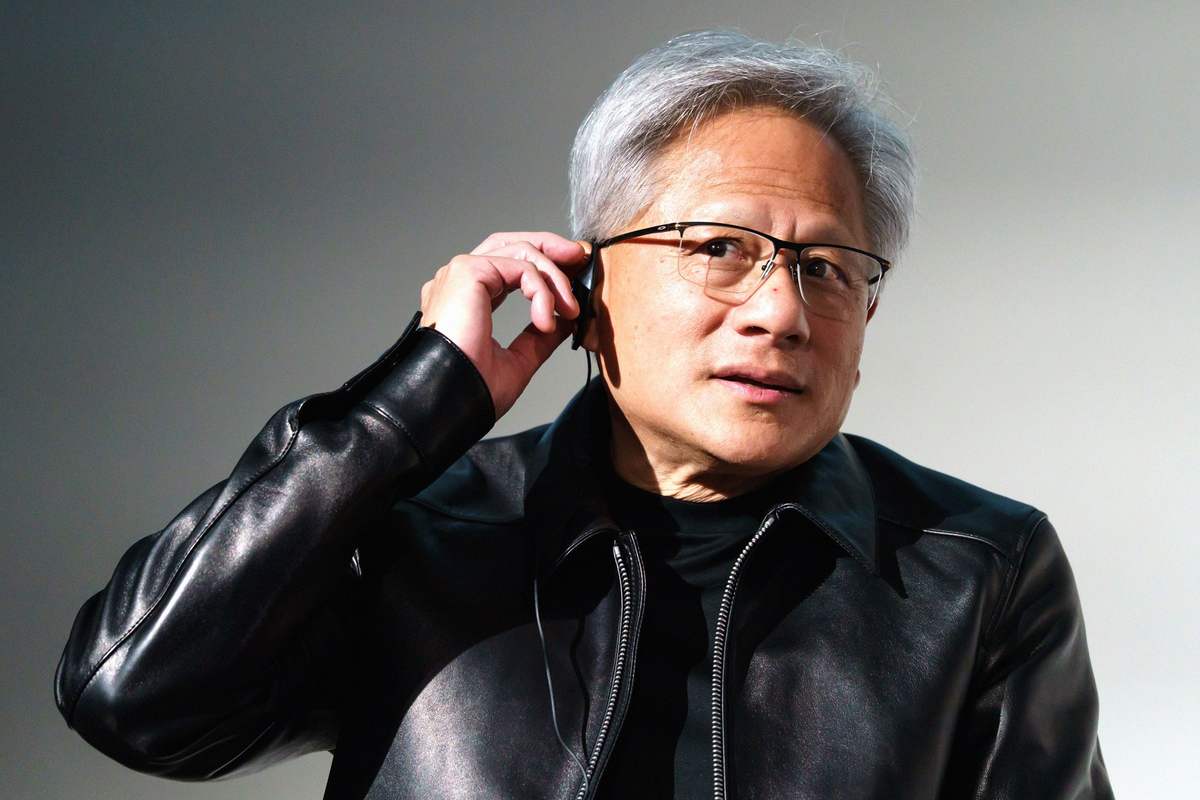
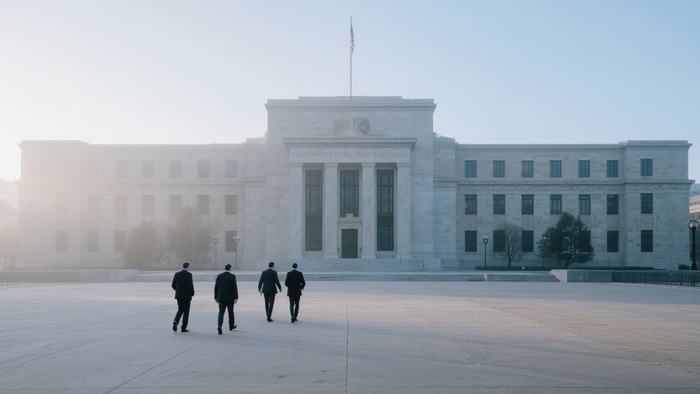
On November 12, Jensen Huang, who has led NVIDIA for 33 years, suddenly resigned from his positions as CEO, President, and Director, effective immediately, following revelations of two extramarital affairs.
Silicon Valley has been hit by a violent storm.
On November 17, Huang spoke out on social media, expressing deep regret for causing trouble for the board, while clearly signaling that he was willing to return at any time as long as it served the best interests of shareholders, employees, and the company. The statement sent NVIDIA's stock price soaring from $150.45 to $155.35 within 27 minutes. However, during the earnings call later that same day, Chairman Harvey Jones firmly shut the door, announcing a unanimous acceptance of the resignation, stating they had "no intention of reinstating him as CEO," and revealed that executive search firm Heidrick & Struggles had been hired to find a successor.
The capital markets and tech circle promptly cast their vote of opposition in the most brutal way. Over the 7 trading days following Huang's departure, NVIDIA's stock price fell nearly 28% in a row, wiping out approximately $1.16 trillion in market capitalization. Meanwhile, a petition website titled "Stand with Jensen" gathered around 204,500 signatures in just 8 days.
By November 23, just 11 days later, the NVIDIA board overturned its public stance from six days prior. After holding two consecutive meetings over the weekend, the board unanimously passed a resolution to reinstate all of Huang's previous titles.
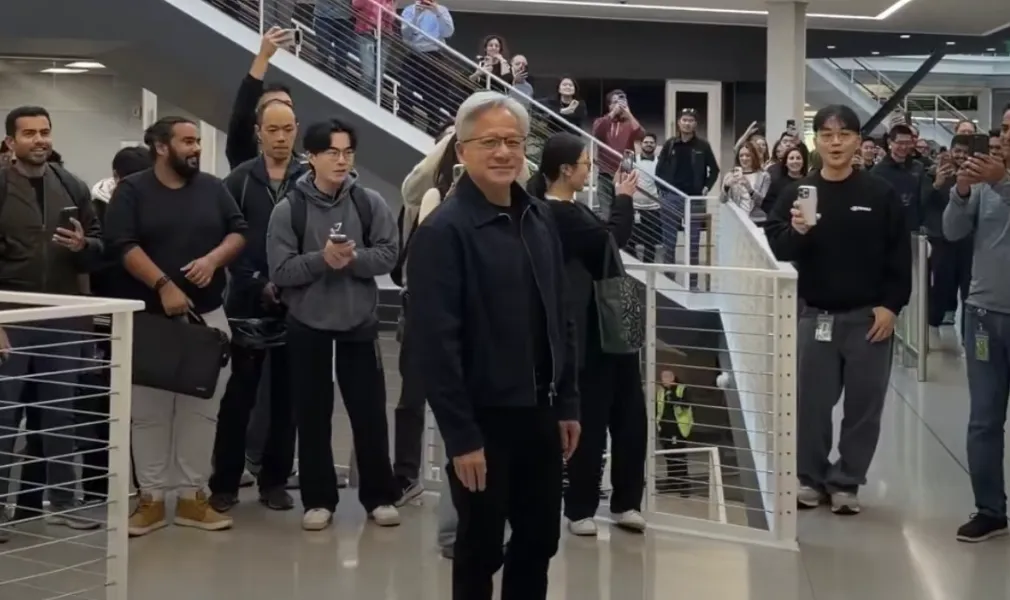
That day, the atrium and multi-level balconies of the Santa Clara headquarters were packed with hundreds of employees. They held up phones, cheered, clapped, and shouted "Jensen! Jensen!" and "Let's get back to work." At the market close, NVIDIA surged 31.48%, adding approximately $954.4 billion to its market cap in a single day, bringing its total valuation back to roughly $3.99 trillion.
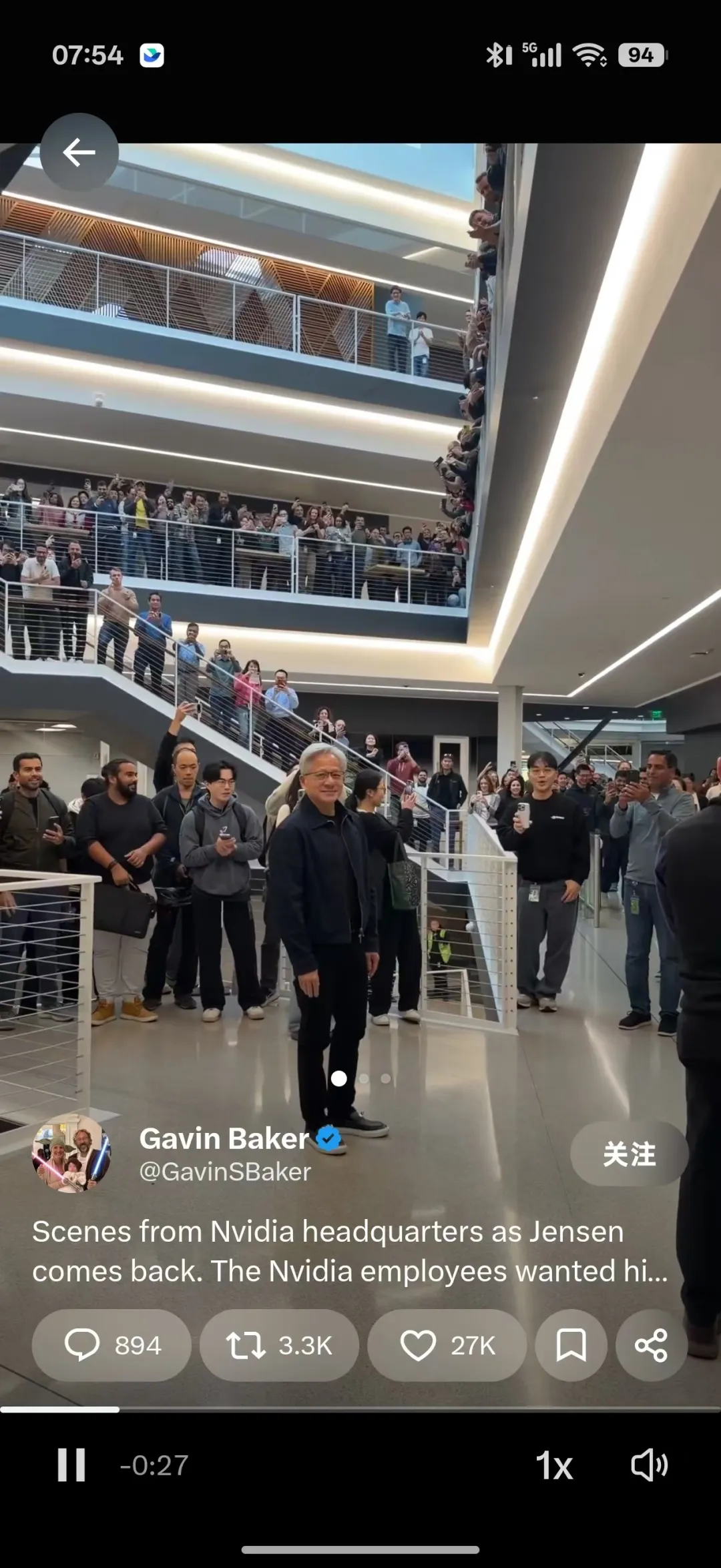
Fig: Employee post: if you come for the king, you best not miss (If you dare touch the king, make sure you don't miss) (Source: X@aburducky)
The noise of breaking news has subsided. In less than two weeks, public sentiment and the stock market went on a super rollercoaster ride.
But this 11-day tug-of-war laid bare the fragile structure underlying NVIDIA and even the entire AI industry, which is usually concealed by its trillion-dollar market valuation.
Three Comebacks
Silicon Valley's history has never lacked stories of super founders coming and going. But placing Huang's 11 days in a historical coordinate system reveals that the underlying logic of power struggles has completely changed.
In 1985, Steve Jobs lost a power struggle with Apple CEO John Sculley, stepped away after being stripped of his authority by the board, and founded NeXT. It wasn't until late 1996 when Apple acquired NeXT that he returned to Apple in 1997 as interim CEO.
This time, Jobs was gone for a full 12 years.
In the business world of that era, the rules of modern corporate governance outweighed the founder's halo. Even as Apple later struggled, the board's authority maintained its decorum for over a decade.
By November 2023, time was drastically compressed.
OpenAI's board ousted Sam Altman citing non-transparent communication, and just 5 days later, Altman announced his return, followed by a reshuffling of most board members. The core reason Altman could stage such a lightning-fast reversal lay in two trump cards he held: first, over 700 of the roughly 770 employees signed a joint letter threatening to leave with him; second, major backer Microsoft stated on the spot that it was willing to take both him and the entire team.
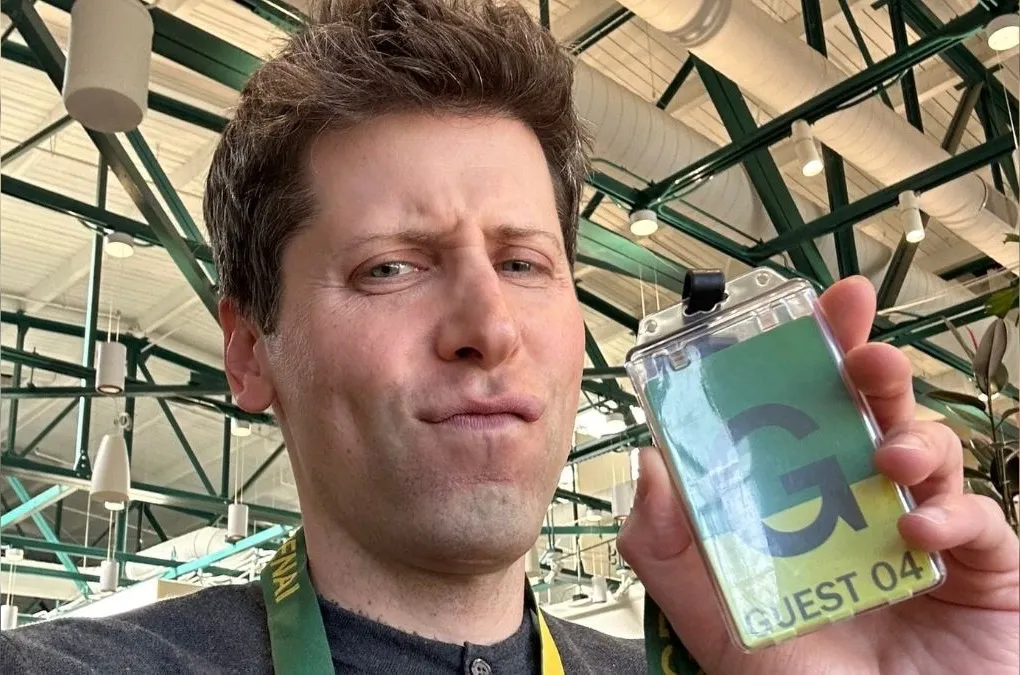
Fig: Altman taking a selfie wearing a visitor badge in 2023 (Source: X@sama)
Huang actually faced a more delicate situation this time. During the brewing of the scandal, external observers made pessimistic predictions. When analyzing Huang's path to return, National Business Daily pointed out that he lacked a powerful external ally like Microsoft, making a short-term reversal unlikely.
Even renowned economist Nouriel Roubini, dubbed Dr. Doom, publicly declared that Huang had absolutely no chance of returning, arguing that NVIDIA's future depended on technology and would continue to function without him. As for equity leverage, Huang's stake in NVIDIA was only about 3.58%, far too small to forcefully override the board's will in voting.
So why did the board swallow its harsh words of no intention to reinstate him within just a few days?
Because this time, the pressure came from a spontaneous force formed by employees, customers, shareholders, and the secondary market. Without a single entity like Microsoft providing a safety net, the entire ecosystem stood up on its own.
Major shareholder and Chief Investment Officer of Atreides Management, Gavin Baker, publicly pushed for his return; investor Leo KoGuan, who had already put about $1.3 billion into NVIDIA this year, explicitly stated that without Huang, he would stop investing a single additional dollar. Coupled with the $1.16 trillion in market value lost over the 7 trading days, every minute ticked down the clock on the board's defiance.
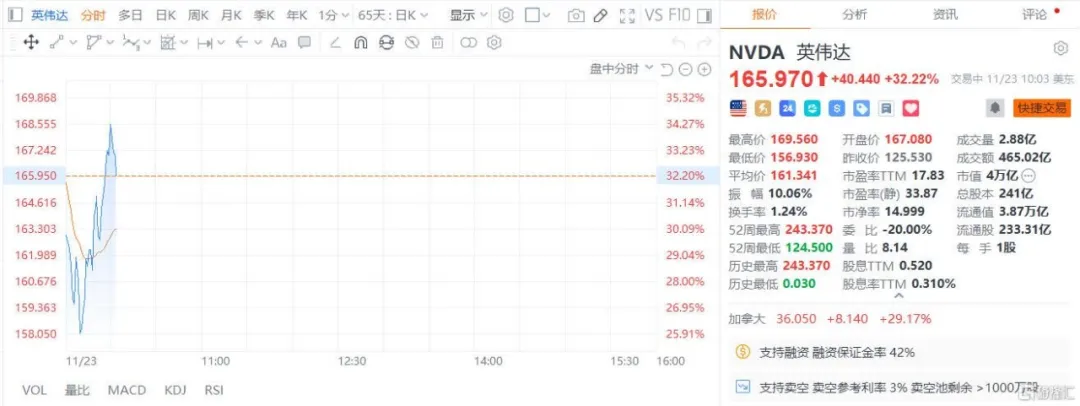
Fig: NVIDIA's stock once surged over 30% on the day Huang was reinstated (Source: Futu)
Harvey Jones initially claimed that Huang's personal conduct did not align with the company's code of ethics, which is a typical logic of mature corporate governance.
But in today's super tech giants, this logic has failed. When a company's four-trillion-dollar valuation bets a significant portion directly on the founder's brain and intuition, the board simply cannot play its card of following the rules.
Although the so-called independent investigation was announced to continue, the side toward which the balance of power tipped was already given final judgment by the near-trillion-dollar surge on November 23.
The Flat Structure Myth and Stress Test
If we shift the perspective back inside the Santa Clara headquarters, these 11 days without Huang were essentially an un-rehearsed stress test for NVIDIA's organizational structure. The results were quite harrowing.
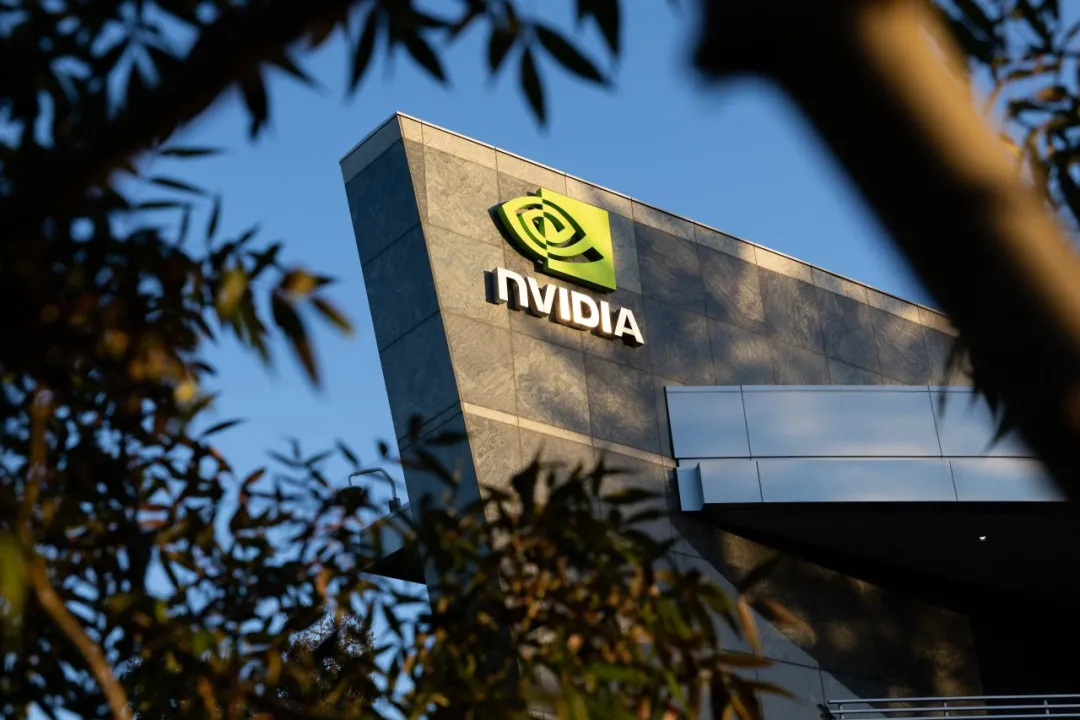
Fig: NVIDIA headquarters building in Santa Clara (Source: Tom's Hardware)
CFO Colette Kress, who stepped in as interim CEO, originally tried to steady the ship.
On November 18, the sixth day after Huang left, she chaired the first all-hands meeting. Over an hour-long hybrid live stream, Kress worked hard to boost morale, urging everyone to look forward and emphasizing we can handle this. But according to attendees, the overwhelming mood in the room was simple: everyone wanted Huang back.
Signals of wavering loyalty soon emerged from all corners. Workplace community Blind analyzed 627 posts by 531 US-based NVIDIA employees between November 12 and 16, revealing that 56% explicitly supported Huang's return. On the petition website with over 200,000 signatures, self-identified current NVIDIA employees reached 10,257 signatories, accounting for roughly one-quarter of the total employee base based on self-reported data.
What truly unsettled management further was the loosening grip on core talent.
Just three days after the resignation news broke, NVIDIA Robotics Learning Engineer Shi Qin Dai published a post openly stating that Huang's departure made him decide it was time to end his own career chapter at NVIDIA. Immediately after, Director of Developer Technology Nader Khalil wrote a warning letter directly to 10 directors and 60 executives, pointing out that if Huang did not return, a batch of irreplaceable core talent was considering leaving.
At the time, even tech journalists began speculating whether Huang might simply strike out on his own to found a new semiconductor company. Though purely unfounded speculation, it sufficiently reflected external concerns about the destabilization of NVIDIA's talent foundation.
Why did a giant boasting a top-tier cluster of engineers experience such severe upheaval just days after its commander left? The answer lies precisely in NVIDIA's management philosophy, which it has always been most proud of.
In recent years, business commentators have held Huang's extremely flat management style as the gold standard. He never holds one-on-one reporting meetings, emphasizing direct synchronization of all information in large group chats. Dozens of subordinates report directly to him, with external reports suggesting the number reaches about 60. This architecture achieves astonishing efficiency in tailwinds; it eliminates the bureaucratic friction of large corporations, allowing Huang to act like a super central processing unit, directly orchestrating every core module of the company.
But the other side of the coin was fully exposed during these 11 days. Extreme flatness is, in essence, an organizational structure that does not cultivate successors.
Without a pyramidal reporting hierarchy, there is fundamentally no number two figure within NVIDIA to oversee the big picture, nor any executive with the prestige and broad vision to mobilize resources across departments. When that sole central processor was suddenly unplugged, 60 high-speed gears instantly lost their meshing hub.
This also explains why, once the board decided to change leadership, it could only immediately look outside the company.
Heidrick & Struggles reached out to Arm CEO Rene Haas to explore the possibility of him steering NVIDIA. Yet on the very day the reinstatement announcement was issued on November 23, Haas turned around and announced his contract extension with Arm until 2033.
Outsiders dared not easily pick up this hot potato, and internally there was no ready-made heir apparent. During these 11 days, NVIDIA truly experienced what a dual vacuum of power and capability feels like. When the reinstatement news finally settled, Jim Fan, head of NVIDIA robotics research, posted on social media, Jensen 2.0 LFG!!! Behind those words lay the entire core R&D team letting out a breath of relief akin to surviving a disaster.
Support from Silicon Valley
The most fascinating moment in this turmoil was the collective backing from half of Silicon Valley.
Standing alongside the Stand with Jensen petition list and public solidarity queue was a lineup of tech leaders who typically operate independently. Y Combinator President Garry Tan and Replit CEO Amjad Masad signed on; Epic Games CEO Tim Sweeney openly blasted the NVIDIA board, stating that refusing to bring Huang back would be as stupid as Apple firing Steve Jobs back then.
Musk was the loudest among them.
During these 11 days, he publicly endorsed Huang multiple times, comparing Huang's importance to NVIDIA to Michael Jordan's to the Chicago Bulls. Once the dust settled on the 23rd regarding the reinstatement, Musk immediately posted to set the tone: The error has been corrected.
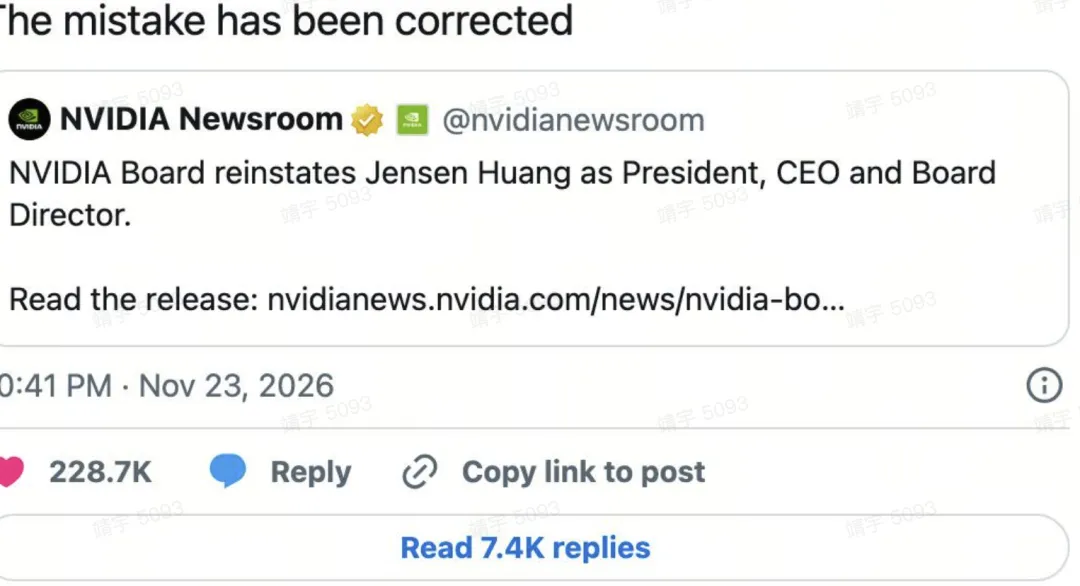
Fig: Musk's response on X (The error has been corrected) (Source: X@elonmusk)
Silicon Valley has always believed in survival of the fittest; poaching peers and fighting for compute power are common occurrences. Why did this group of shrewd business leaders suddenly display such profound camaraderie toward another company's CEO?
A figure Musk previously revealed explains everything. SpaceX had just completed $40 billion in debt financing, and the purpose of this colossal sum was crystal clear: to buy NVIDIA chips.
Putting that $40 billion chip bill on the table instantly clarified the commercial logic behind all the support. From Musk's SpaceX, to Sweeney's game engine, to the thousands of hungry AI startups incubated by YC, today's entire tech industry's compute foundation is tightly bound to the cart of just one company: NVIDIA.
For these downstream customers, individual GPUs are merely the visible portion of the bill; they are also betting on NVIDIA's product roadmap, the certainty of architectural iterations, and its seamless delivery capability integrating software ecosystems with hardware clusters.
To outsiders, the only guarantor ensuring this complex and precise compute machine runs smoothly is Huang. As Huang himself wrote in his statement on the 17th, NVIDIA is a company encountered once in a century. And to his customers, this company absolutely cannot afford to swap in an outsider professional manager for trial-and-error at such a critical juncture.
On the surface, Silicon Valley's celebrities are supporting a legendary founder, but in reality, they are desperately buying insurance for their compute supply chains.
This is an extremely rare sight since the explosion of the AI revolution. For the first time, the industry's profound dependence on a single compute supplier has been laid completely bare in the form of an executive crisis. NVIDIA's board initially thought they were merely handling an internal executive dispute at a public company, but ended up kicking the load-bearing wall of the entire artificial intelligence industry. Customers absolutely will not allow this wall to shake at this moment, let alone waver for ten-plus days.
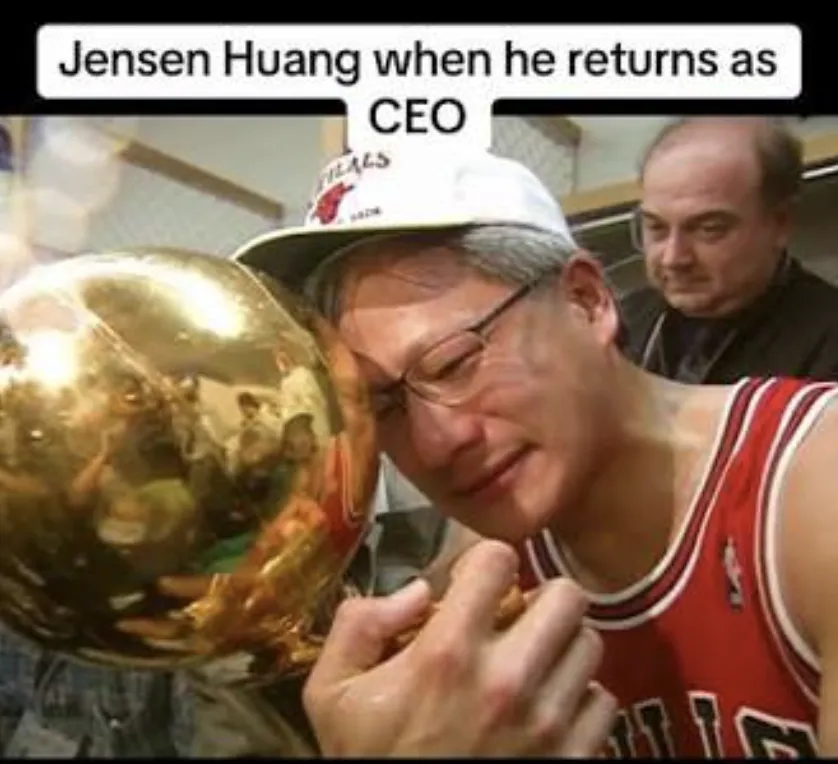
Fig: Internet meme comparing Huang's return to championship-winning Jordan (Source: X)
After these thrilling 11 days, the key person risk that long hung over NVIDIA has not dissipated; instead, capital markets have used fluctuations worth over a trillion dollars to clearly price it and firmly cement it.
These eleven days proved to the entire industry and the whole world that Huang is irreplaceable. Henceforth, the NVIDIA board will find it even harder to exert substantive constraints on this super founder, while Wall Street and Silicon Valley have completely torn off their facades, no longer pretending that the four-trillion-dollar empire can run smoothly without him.
When he returned to the Santa Clara headquarters on the day of his reinstatement, Huang rarely took off his iconic leather jacket and wore a dark blue coat instead.
Placing his hand over his heart in the atrium, he sincerely apologized to the cheering employees, admitting he had made a very serious mistake, and thanked them for giving him a second chance. Then, this 33-year veteran who controls the lifeline of global compute smiled and said to the crowd like a fresh rookie:
"This is my first day at work. I don't have a computer, so the IT department needs to issue me a new RTX Spark."
Join TechFlow official community to stay tuned
Telegram:https://t.me/TechFlowDaily
X (Twitter):https://x.com/TechFlowPost
X (Twitter) EN:https://x.com/BlockFlow_News
 极客公园