Goldman Sachs Research Analysis: CoreWeave Funding Gap Manageable, $38 Billion New Debt Covers $260 Billion Backlog
By: Rita
CoreWeave (CRWV) is currently trading at $61.82, with a Goldman Sachs target price of $106, representing a 71.5% upside. In its October 21, 2026 report, Goldman Sachs addresses investors' most pressing question: how large is the funding gap. Serving existing backlog orders worth $129 billion requires approximately $23 billion in new debt, while expanding already secured 4.2 gigawatts of power capacity requires roughly $38 billion in new debt. Goldman Sachs believes this gap can be covered through debt financing, customer advance payments, and operating cash flow.
On October 19, Goldman Sachs upgraded CoreWeave to Buy, subsequently receiving numerous inquiries regarding financing feasibility. The report breaks down capital requirements into two scenarios. Under the existing backlog scenario, assuming a 4.5-year GPU lifespan, new debt stands at $23 billion; assuming a 6-year lifespan, it drops to $19.5 billion. Under the power expansion scenario, which supports potential backlog of approximately $260 billion, new debt is estimated at around $38 billion.
The $106 target price is based on 18 times forward 12-month earnings before interest and taxes (EBIT). Goldman Sachs acknowledges that financing risks, capacity ramp-up delays, and timing mismatches between contract signings and cost inflation are key risks.
Existing Backlog Requires $23 Billion in New Debt
As of August 2026, CoreWeave's backlog stood at $129 billion. Goldman Sachs estimates serving these orders requires approximately $60 billion in capital expenditures. Under the current Delayed Draw Term Loan (DDTL) structure, 80% can be debt-financed, capped at $48 billion. After deducting approximately $11 billion in committed but undrawn DDTL, the remaining new debt totals $37 billion, supplemented by $1.2 billion in cash contributions from related special purpose vehicles (SPVs).
Customer advance payments alter this calculation. Assuming advance payments account for 20% of total contract value (TCV), new debt falls to approximately $23 billion. Currently, 70% of contracts include advance payment clauses, averaging 15% to 25%. CoreWeave's advance payment ratio has declined over the past six months as the company scales up and manages capital costs more predictably. Goldman Sachs believes the advance payment ratio could rebound as visibility into debt financing decreases.
If the GPU lifespan is assumed at 6 years with positive residual value, new debt could drop to $19.5 billion. The 4.5-year figure aligns with contract tenors, while the 6-year figure reflects a longer depreciation assumption. Both figures are lower than the $37 billion no-advance-payment scenario. Advance payments and lifespan assumptions act as the two primary levers for closing the funding gap.
With loan-to-value ratios ranging between 50% and 75%, CoreWeave can opt for a debt proportion below 80%. Goldman Sachs provided an accompanying worksheet in the report, inviting investor feedback on the assumptions. The final new debt amount hinges on three variables: the advance payment ratio, GPU lifespan, and loan-to-value ratio.
Power Expansion Requires $38 Billion in New Debt
As of August 2026, CoreWeave had secured 4.2 gigawatts of power, with active capacity at 1.5 gigawatts in Q2 2026. Bringing the remaining capacity online would require approximately $38 billion in new debt, supporting potential backlog of roughly $260 billion—double the August figure. This scenario also assumes customer advance payments represent 20% of TCV.
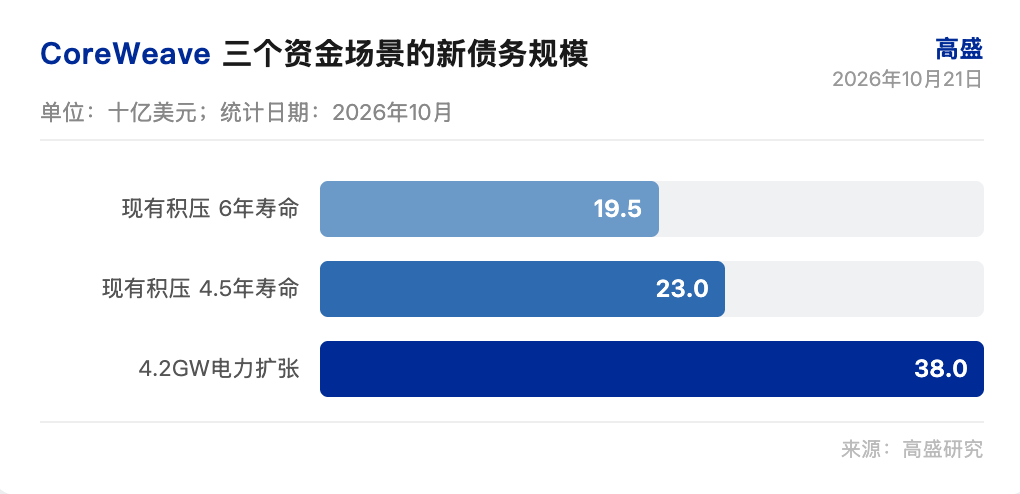
The $38 billion figure pertains specifically to power expansion, extending beyond existing contracts. Timing mismatches among data center capacity ramp-up, grid connection, and GPU delivery will alter the debt drawdown pace. Goldman Sachs lists capacity ramp-up as a critical risk. The time lag between contract signing costs and commissioning-period cost inflation may pressure pricing in new agreements or renewals.
Debt size is capped, but the financing structure remains flexible. Financing cost assumptions were already discussed when Goldman Sachs upgraded the rating on October 19. The report makes no equity financing assumptions, positioning debt as the primary tool. Higher advance payment ratios can reduce debt demand, though they tie up customer capital. Supplier financing offers an alternative path, with scale contingent on payment terms from GPU vendors and construction partners.
Cash Gap Shrinks to Just $1.6 Billion
Goldman Sachs calculated the cash position. With $5.5 billion in available book cash as of Q2 2026, minus a $3 billion operating expense buffer, plus September convertible net proceeds, $2 billion in revolving credit, and an ATM issuance of 35 million shares priced at $64, total liquidity options reach $10.4 billion. Serving the existing backlog requires $1.2 billion, leaving a gap of $1.6 billion.
This $1.6 billion must be supplemented by customer advances, supplier financing, or operating cash flow from the installed base after debt servicing. Goldman Sachs views the gap as manageable but stresses the need for uninterrupted financing channels. CoreWeave’s DDTL structure maps each tranche of debt directly to specific contracts, with SPV cash contributions serving as a complement to debt financing.
Financing feasibility hinges on debt market conditions. The report does not specify a precise range for financing costs but notes that the existing DDTL structure supports an 80% debt financing ratio. If the advance payment ratio reverts to 20%, new debt can be compressed to $23 billion; should the ratio continue declining, new debt will revert to the $37 billion no-advance scenario.
Target Price Relies on 18x EBIT
Goldman Sachs sets a $106 target price using a valuation multiple of 18x forward 12-month EBIT (Q5 to Q8). The current price of $61.82 equates to roughly 6.2x 2027 EBITDA and 4.0x 2028 EBITDA. Goldman expects CoreWeave’s EBIT to turn positive in 2027 and reach $10.18 billion in 2028. EBITDA is projected to grow from $7.69 billion in 2026 to $18.18 billion in 2027 and $32.67 billion in 2028.
There are four main risks listed. Financing disruptions, slower-than-expected data center capacity ramp-ups, timing mismatches between contract execution and cost inflation, and supply-demand dynamics pressuring pricing on new contracts or renewals. Goldman Sachs ranks financing first. Managing the funding gap relies on the debt market remaining open, advance payment ratios holding firm, and GPU lifespan assumptions not being shortened.
The $106 target price implies a 71.5% upside, following Goldman Sachs’ upgrade on October 19. The funding gap has a defined ceiling, and financing tools are available.

Disclaimer
This article is a compilation and analysis by TechFlow Research of a third-party broker research report (Goldman Sachs, October 21, 2026), integrated with publicly available market information. The ratings, target prices, earnings forecasts, and related judgments cited herein reflect solely the views of the broker's analysts, represent only their affiliated institution's stance, do not necessarily align with TechFlow Research's perspectives, and do not constitute investment advice.
Markets involve risk, and investment decisions must be independent. This article should not be used as a basis for buying or selling any securities.
Join TechFlow official community to stay tuned
Telegram:https://t.me/TechFlowDaily
X (Twitter):https://x.com/TechFlowPost
X (Twitter) EN:https://x.com/BlockFlow_News
 @chaoxiangooo