Bernstein Research Report Analysis: CoreWeave Maximizes Debt, Growth Comes at a High Price
Written by: Rita
CoreWeave fell approximately 15% on Wednesday. Its unsecured bonds are yielding close to 15%, with the 2032 bonds yielding around 14.8% against a coupon rate of 9.625%. Bernstein argues that investors are repricing financing costs, not demand. The stock retains an Underperform rating with a $74 target price.
CoreWeave is a capital-intensive business without an independent cash generation engine. Operating cash flow for Q2 was $679 million, with adjusted capex at $9.4 billion. Net interest expense totaled $640 million, roughly a quarter of revenue. The faster the growth, the wider the funding gap. Rising financing costs, weakening contract protections, and heavy debt obligations are three converging issues.
Bond Yields Approach 15%
The 2032 bonds yield approximately 14.8%, compared to a 9.625% coupon rate. This yield level is typically associated with distressed credits. Bernstein notes that this will not overnight reset the interest expense on existing fixed-rate debt, but it raises a critical question: what is the cost of the next dollar of growth?
The market is demanding higher credit spreads for unsecured paper. CoreWeave has total debt of $40.951 billion and total capacity of $57.206 billion, with an effective interest rate of 8.0% and annual interest expenses of $3.262 billion. Maturing debt stands at $11.149 billion in 2030, $9.389 billion in 2031, and $10.366 billion in 2032. Maturities are heavily concentrated between 2030 and 2032.
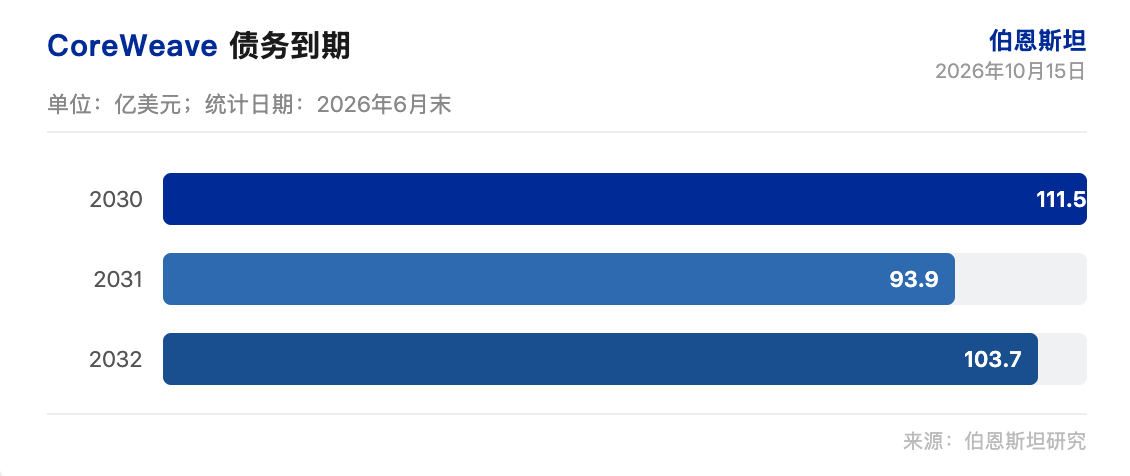
Bernstein points out that market compensation requirements for CoreWeave’s unsecured credit have risen sharply. At a 14.8% yield, the 2032 bonds trade significantly above their 9.625% coupon. Rising financing costs directly alter the economic math of growth.
Financing Costs Become the Central Contradiction
Bernstein has long highlighted CoreWeave’s reliance on financing. High GPU prices mean cash outflows occur far ahead of customer payments, and rapid growth exacerbates the funding gap. The company remains highly dependent on external financing to fund construction.
Bernstein notes that CoreWeave needs not only customers willing to purchase compute capacity but also lenders willing to finance hardware on shareholder-friendly terms. The long-term business model still faces significant economic challenges.
Spreads on DDTL (Delayed Draw Term Loan) 1.0 stand at 9.62%, while spreads for DDTL 2.0 and 2.1 are 4.25%, DDTL 3.0 at 4.00%, DDTL 4.0 at 2.25%, DDTL 5.0 at 4.50%, and DDTL 5.5 at 5.50%. There is a clear divergence in spreads across different debt instruments.
Contract Protections Are Weakening
Contracts supporting future borrowings are critical. As growth shifts toward shorter contracts and subinvestment-grade customers, lenders face fewer contractual protections and will demand higher compensation. Bernstein believes that changes in contract structure will drive up financing costs.
CoreWeave is pursuing insured capital. Bernstein points out that securing more and cheaper capital is becoming an increasingly prominent part of the investment thesis. Gartner released a report reiterating many long-standing concerns regarding new cloud models.
Bernstein argues that weakening contract protections will elevate financing costs. Growth is shifting toward shorter contracts and non-investment-grade clients, reducing the contractual safeguards lenders face. The market will require higher risk premiums.
Heavy Debt Obligations
As of late June, CoreWeave carried approximately $35 billion in debt, plus $16.5 billion in lease liabilities. Additional financing could support greater growth, but it would also increase claims senior to equity. Bernstein highlights that the debt burden itself is already substantial.
The debt maturity schedule shows $531 million due in 2026, $1.276 billion in 2027, $2.576 billion in 2028, $2.665 billion in 2029, $11.149 billion in 2030, $9.389 billion in 2031, and $10.366 billion in 2032. The peak maturity period falls between 2030 and 2032.
Bernstein notes that additional financing can fuel more growth but also increases senior claims over equity. The debt obligations are already heavy, and rising financing costs will further compress shareholder returns.
Underperform Rating Maintained
Bernstein maintains its Underperform rating with a $74 target price. The target implies an enterprise value of $13.26 billion based on 25.5x the next 12 months of adjusted operating profit of $5.2 billion. With the stock trading at $65.78, there is 12% upside.
Bernstein’s long-term revenue forecasts are significantly below market consensus. Data center supply becomes much more abundant after 2028, raising doubts about CoreWeave’s ability to secure large-scale hyperscaler agreements. Hyperscalers may directly compete with new cloud players in the enterprise sector. Bernstein disagrees that CoreWeave’s software moat can withstand pressure from hyperscalers.
Upside risks include delays in hyperscaler-owned capacity coming online, development of CoreWeave’s specialized software platform, and continued power supply shortages preserving pricing power. Bernstein believes structural concerns will not dissipate despite rising AI demand.
CoreWeave’s adjusted EPS is expected to be -$1.20 in 2025, -$4.56 in 2026, and -$4.77 in 2027. Revenue projections rise from $5.131 billion in 2025 to $23.552 billion in 2027. EBITDA is forecast to grow from $2.442 billion to $14.974 billion. The EV/EBIT multiple stands at 264x in 2026 and 33.4x in 2027.
Financing costs determine growth boundaries, and CoreWeave’s long-term business model faces significant challenges.

Disclaimer
This article compiles and analyzes a third-party brokerage research report (Bernstein, October 15, 2026), combined with public market information. The ratings, target prices, earnings forecasts, and related assessments cited herein reflect the views of the respective broker analysts, represent only the stance of their institutions, do not constitute the views of Chaowang Research, and should not be construed as any investment advice.
Markets carry risks, and investment decisions must be made independently. This article should not serve as the basis for buying or selling any securities.
Join TechFlow official community to stay tuned
Telegram:https://t.me/TechFlowDaily
X (Twitter):https://x.com/TechFlowPost
X (Twitter) EN:https://x.com/BlockFlow_News
 @chaoxiangooo