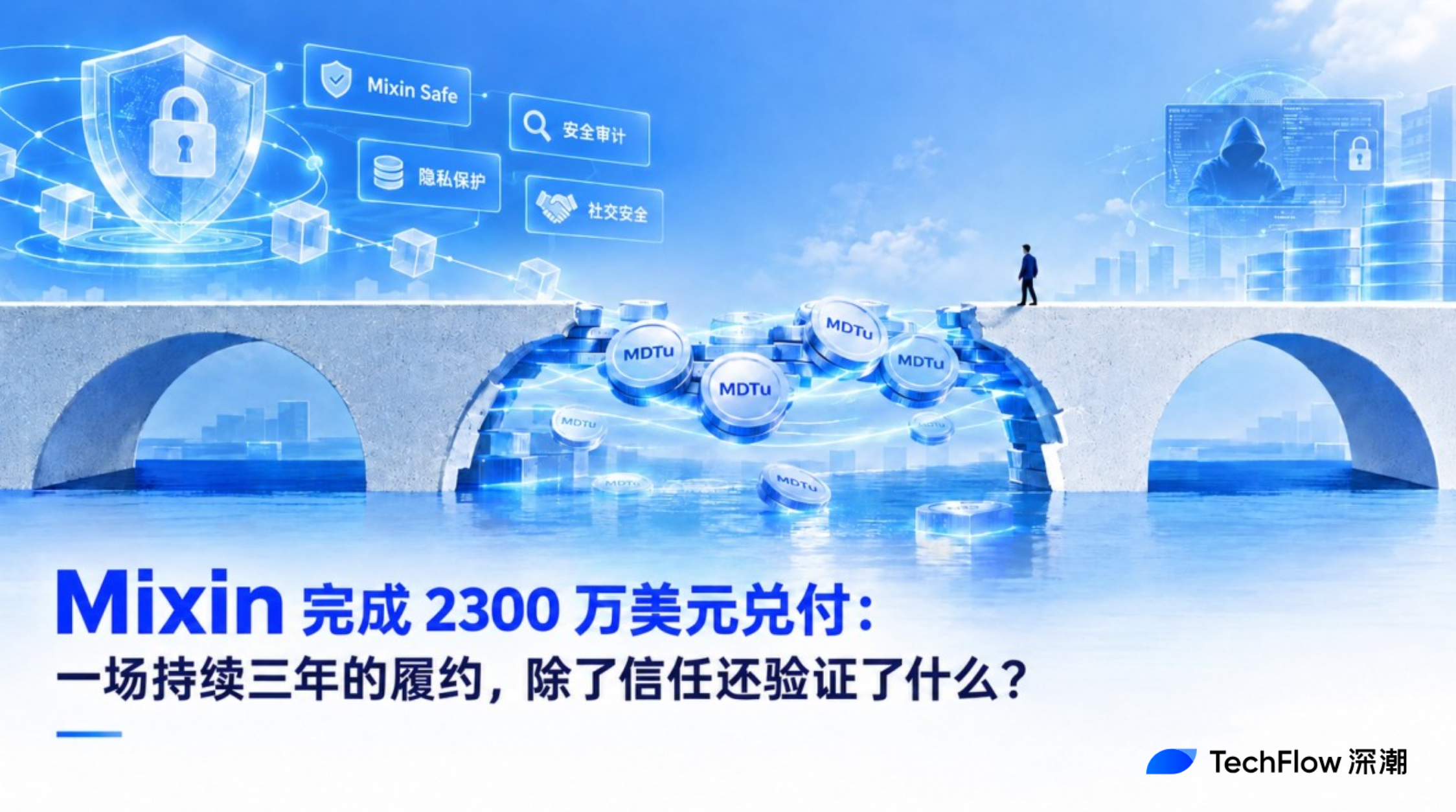
Mixin Completes $23 Million Payout: After Three Years of Fulfillment, What Has It Proven Beyond Trust?
Author: TechFlow
Introduction
In the crypto industry, fulfilling commitments is a rare occurrence, especially after being hacked.
According to the "Hack3d: The Web3 Security Report 2023" released by CertiK: In 2023, there were over 751 security incidents in the crypto industry (including hacks, scams, exploits, etc.).
Continuously tracking these attacked projects reveals an even harsher reality:
Although teams can release announcements, provide solutions, and make promises within hours, very few truly seriously assess user losses and consistently fulfill payouts.
Promises are cheap; it is the time, operations, and costs behind actual payouts that are truly expensive.
This is both an issue of attitude and capability.
At this point, some may have noticed: Why choose a set of data from 2023?
On one hand, three years is enough time for projects to demonstrate their sincerity in fulfilling commitments and showcase payout results;
On the other hand, a recent project has truly delivered on its promises from a hack incident three years ago, presenting concrete results now.
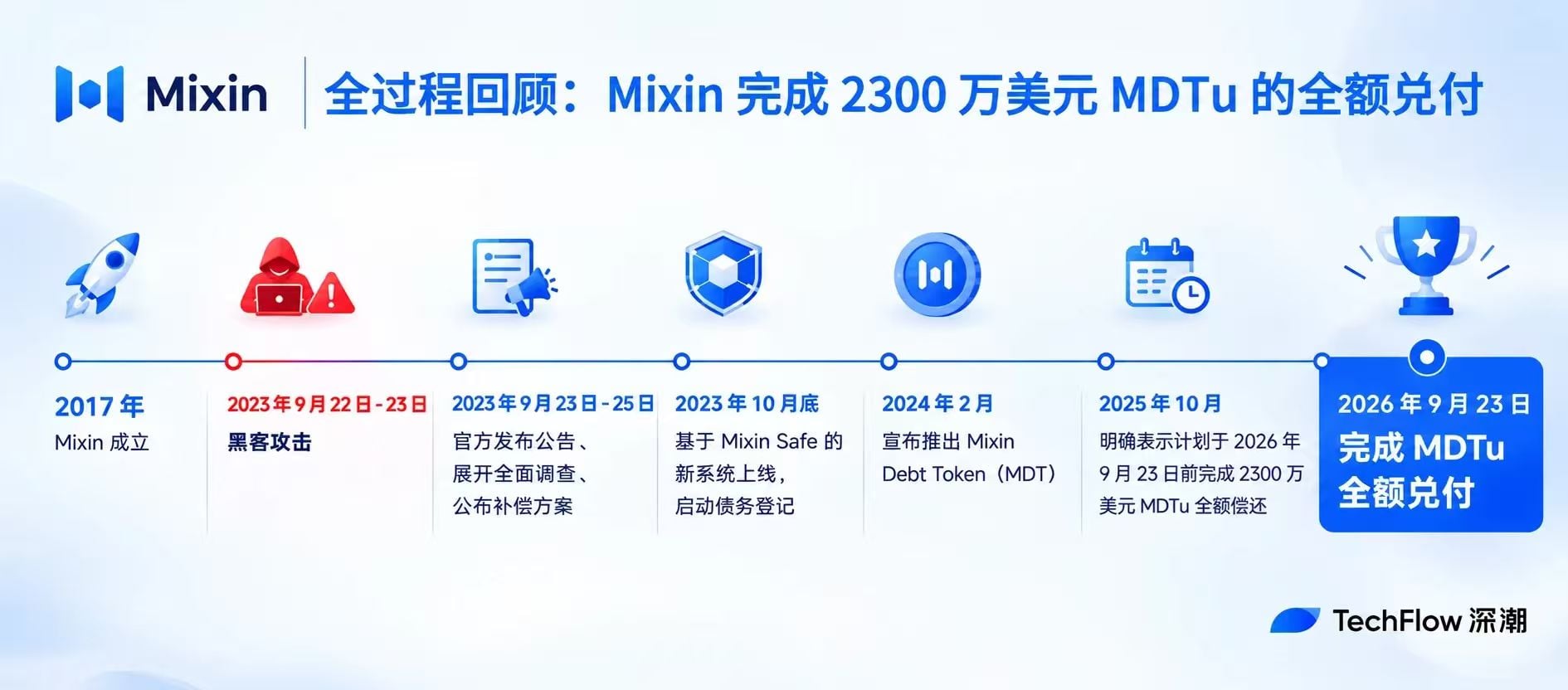
On September 23, 2026, Mixin announced the completion of full payouts totaling $23 million represented by MDTu.
Trust broken three years ago was gradually welded back together with real money three years later, giving this payout ample topic value.
But if we only focus on this $23 million payout, we might actually miss what deserves to be thoroughly dissected.
A Commitment Fulfilled Across Three Full Years
On social platforms, users have been sharing their genuine feelings upon finally receiving the Mixin MDTu payout:
There are still long-term projects in the crypto space.
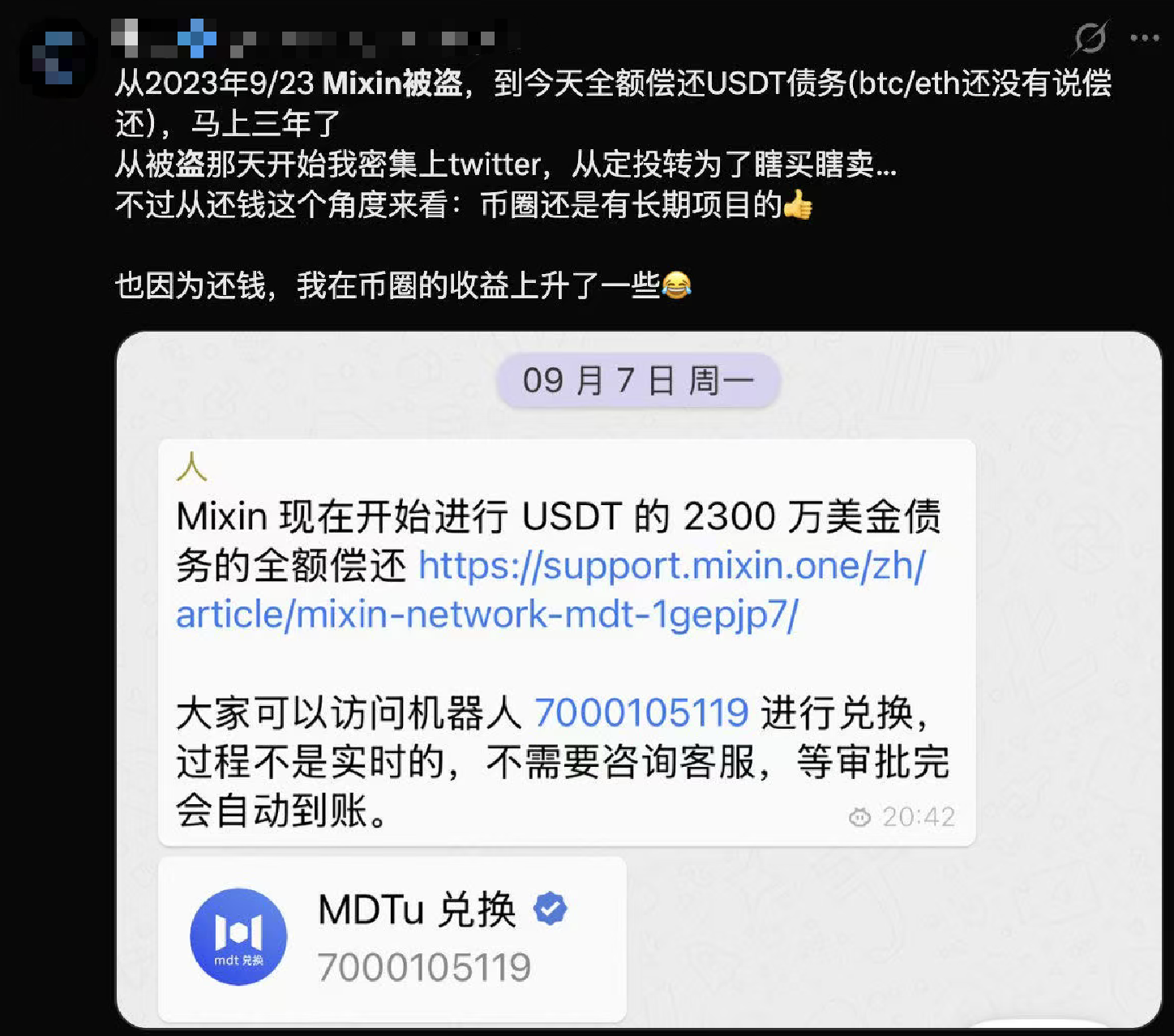
Three years of waiting, one moment of full MDTu payout.
Looking back at this three-year fulfillment, every timeline node is extremely clear. Most importantly, it stems from Mixin's attitude and approach to handling the issue:
No evasion, directly facing the consequences of the incident;
No embellishment, straightforwardly addressing matters factually;
No ambiguity, clearly placing the solution and timeline on the table .
On the evening of September 23, 2023, Mixin discovered it had been hacked. Major losses included BTC, ETH, USDT, etc., amounting to approximately $150 million at the time.
Upon discovering the attack, besides taking emergency measures and investigating the cause, Mixin simultaneously initiated detailed loss accounting and an assessment of the team's payout capacity.
On September 25, 2023, Mixin announced the issuance of the MDT token, including MDTu, MDTe, and MDTb, representing erc20-USDT, ETH, and BTC respectively, and promised to use profits for token buybacks to fulfill user payouts through continued business development.
Meanwhile, the Mixin team promised that before repayment is complete, if hackers return stolen assets, holders of the corresponding MDT tokens could exchange them for the original lost assets.
Embedding promises into tokens reflects both attitude and determination.
Of course, when losses have already occurred, promises cannot remain merely in announcements.
After all, "saying" is far easier than "doing";
Moreover, in the aftermath of incidents, other projects have also promised payouts to comfort affected users, but most ended hastily. Mixin, having made such a promise, must prove itself through actual fulfillment.
Until September 23, 2026, Mixin announced the completion of the full $23 million MDTu payout.
Choosing to complete the payout on the exact same day as the hack incident three years later was likely a deliberate move by Mixin: using a financial action to close the loop of "trust reconstruction."
But compared to the result of "achieving it," what deserves deeper inquiry lies in the logical analysis of "why they could achieve it:"
Continuous operations over the past three years provided the funding for the full payout of $23 million worth of MDTu;
And how could a project that suffered a major security breach, after trust was severely damaged, avoid dissolution, exit, silent death, or mere survival, instead managing continuous operations for three years and gradually fulfilling its initial promises?
The answer is closely tied to the "playbook of trust" Mixin chose from the beginning.
From Fulfilling Existing Trust to Generating Incremental Trust
A Next-Generation Social Network / Capital Network
Mixin's product strategy provides the most direct answer.
This "social + capital" approach was also carried forward at this year's Singapore TOKEN2049: Besides face-to-face community engagement through on-site booths, Mixin partnered with BigONE to host a unique Web3 HUNT After Dark event, designing an NFT shard treasure hunt as a social interaction: participants collected, exchanged, and combined NFT shards via QR codes to unlock final rewards.

The engaging activity spurred active participation from attendees, further validating Mixin's product strategy in a way:
When communication, assets, and interpersonal collaboration are integrated into a single scenario, a product has the opportunity to evolve from a mere functional gateway into a connection point for relationship building and value flow.
Because transactions connect the capital between people, while social features connect emotions. The former drives value flow, and the latter consolidates relationships. Their tight integration allows interpersonal connections to further underpin the circulation of value.
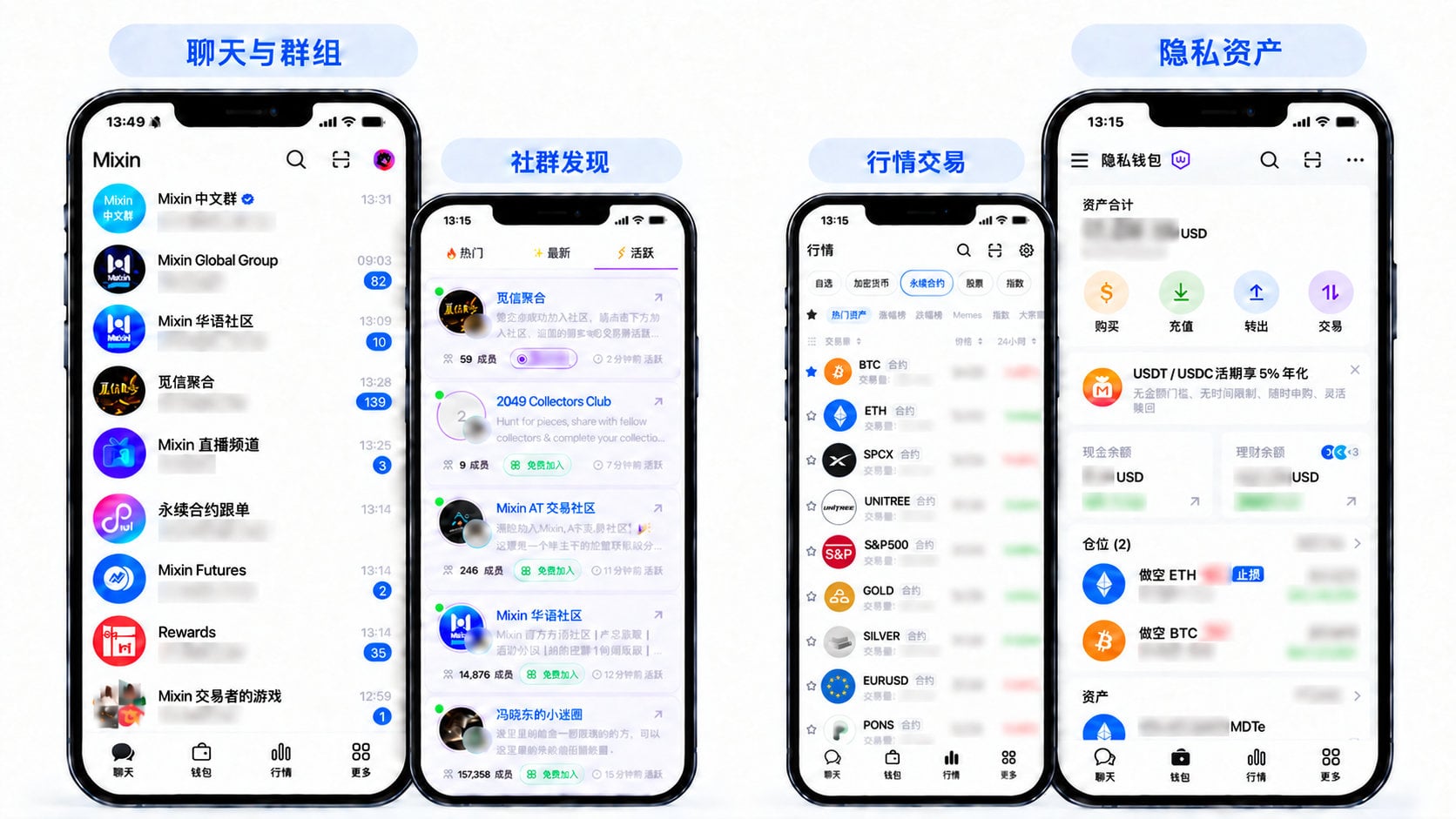
Therefore, since its launch in 2017, Mixin has centered on "privacy-first encrypted messaging + multi-chain wallet,"
striving to integrate communication, payments, trading, and asset management within a single application.
Simply put, Mixin does not just build a standalone trading tool, but a tightly woven network of relationships. Between users, interactions go beyond simple transfers to include chats, group coordination, and collaborative ties. Asset flow is no longer isolated but embedded into daily routines.
For this logic to run effectively, two key pillars are essential:
Usability: Expand entry points, allowing users to seamlessly enter the ecosystem through existing relationships;
Security: Solidify the foundation, enabling more people to confidently bring funds and social interactions in.
Following these two pillars, we can clearly see Mixin's development focus over the past few years:
On one hand, adhering to the core philosophy that "if a product requires a manual to use, it is not yet finished," the team introduced minimalist identity and asset controls like a 6-digit PIN for login or asset management, alongside features such as social recovery mechanisms, frictionless transfers, a bot ecosystem, and multi-service entry points, striving to deliver a Web2-level smooth experience;
On the other hand, with "protecting user asset and social security" as the core starting point, network-level security is guarded by a PoS + BFT + DAG architecture, complemented by mature cryptographic solutions like MPC and multi-signature. Furthermore, Mixin treats privacy as the default configuration for financial security in the digital age, embedding privacy design at the base layer while supporting end-to-end encryption based on the Signal Protocol, balance and transfer privacy protection, disappearing messages, private groups, etc., continuously reinforcing security and trust.
Since its establishment, Mixin has accumulated over 10 million users, with self-custodied digital assets exceeding $1 billion.
And this largely explains why, despite the real financial losses and collective user panic following the 2023 incident, Mixin survived and was able to complete the MDTu payout through continuous operation: one reason is
Transaction relationships are fragile, whereas social relationships are stable; these connections do not suddenly sever entirely;
The entry points remain, continuously lowering barriers to integrate more chains and assets;
The foundation of trust remains intact and continues to strengthen.
The 2023 security incident further highlighted the need for decentralized management, risk isolation, and security recovery mechanisms for large digital assets. Addressing the single-point risks of individual private keys and the limitations of traditional multi-sig in collaborative management and asset recovery, Mixin Safe offers a decentralized, non-custodial multi-signature cold wallet and asset management solution.
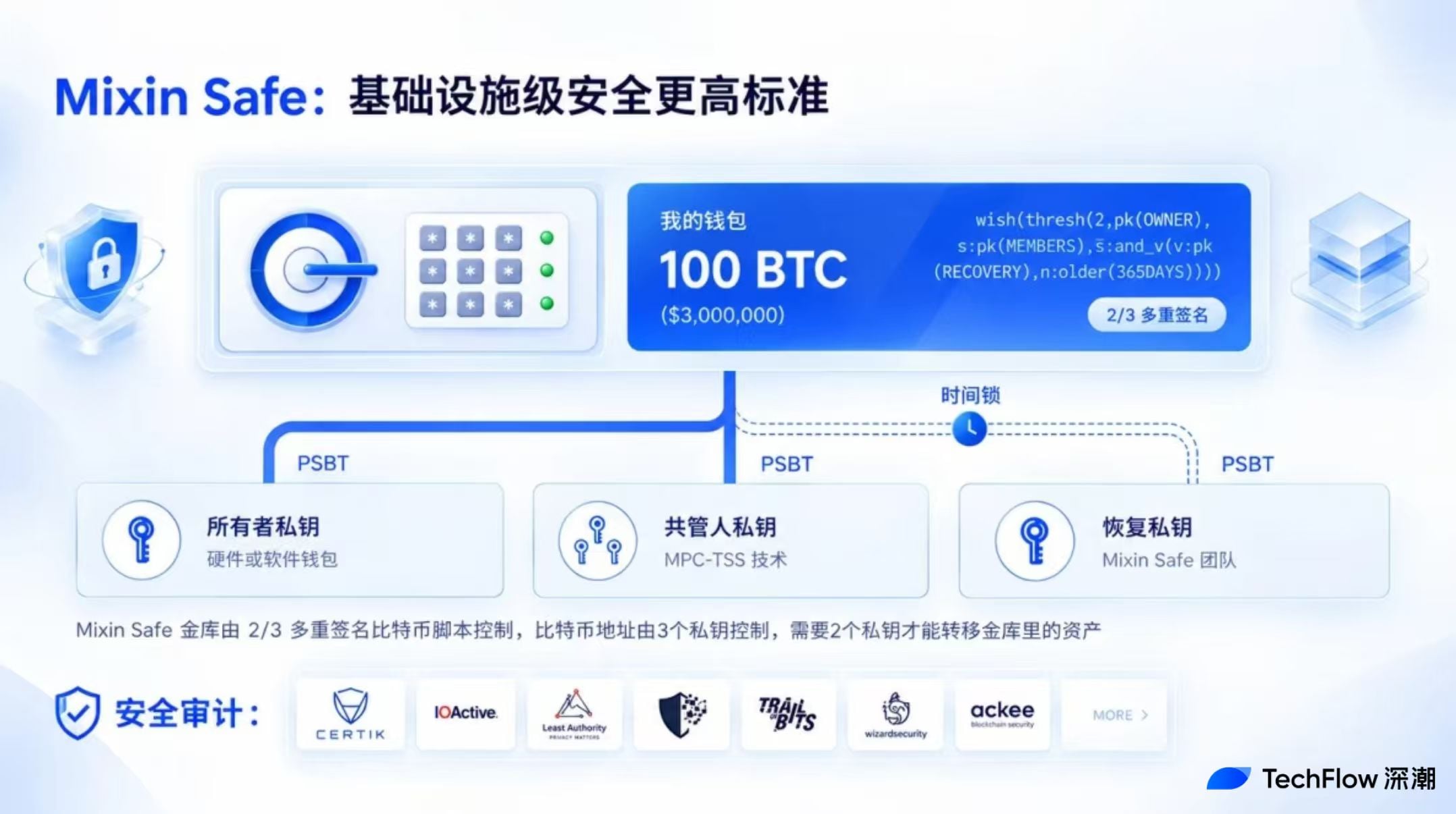
Taking the Bitcoin vault as an example, Mixin Safe combines native chain multi-sig, decentralized MPC, and time-lock mechanisms to build a layered security architecture through three types of keys:
- Owner Key (Owner Private Key): Independently stored by users via software or hardware wallets, used for final signature confirmation on asset transfers.
- Members Key (Co-owner Private Key): Jointly controlled by one or more co-managers through Mixin and a decentralized MPC network. Users can configure the number of co-managers and approval thresholds. Once M-of-N conditions are met, a valid signature for the Members Key is generated to create or approve transactions.
- Recovery Key (Recovery Private Key): Subject to on-chain time locks. Before the account remains inactive for a preset duration, the Recovery Key cannot participate in signing; once the time lock expires, it still requires cooperation with a valid Owner Key or Members Key to restore assets to a new address, and cannot transfer assets independently.
Routine transactions are jointly completed by the Owner Key and Members Key; the recovery path using the Recovery Key plus another valid key is only activated when one type of key is lost and the time-lock conditions are met.
The core of Mixin Safe's entire design is not to grant greater control to any single party, but to prevent any individual person, device, key, or institution from independently transferring assets, fully embodying the team's product philosophy regarding non-custody, asset safety, recovery, and joint management.
Through this architecture, Mixin Safe integrates user self-custody, multi-party joint management, and delayed recovery mechanisms, pushing security standards higher from "theoretical decentralization" to "practically resilient against infrastructure compromises," while deeply exploring scenarios such as large-asset protection, decentralized recovery, and inheritance.
Meanwhile, Mixin maintains a continuous security auditing process to further safeguard the security of all its infrastructure.
More importantly, security construction brings "pre-event trust," while the "post-event accountability" demonstrated by Mixin's payout has become a publicly verifiable credit record, informing all potential users of the platform's responsible stance after an incident. To a large extent, this will serve as additional trust endorsement before users choose Mixin.
Viewing this toward the future, the $23 million payout, represents Mixin's fulfillment of existing trust, and perhaps marks the beginning of Mixin's transition toward generating incremental trust.
Why This Fulfillment Deserves Serious Dissection?
The core reason lies in scarcity
In crypto, trust is the most expensive asset.
When a crypto project gets hacked, there are many possible subsequent outcomes. Regardless of which path unfolds, users who suffer real financial losses are always left passively swallowing the bitter pill. Mixin's response serves as a powerful rebuttal to this default ending:
Incidents are common, promises are common, but maintaining continuous operations and fulfilling commitments over the long term is genuinely rare in crypto.
From a project's perspective, the insights are equally grounded in reality:
Security incidents can shatter a project's trust, but they do not inevitably lead to termination. As long as the business retains vitality, a project can still resolve historical issues through continuous operations.
Beyond scarcity, for the path of fulfilling commitments through issuing Debt Tokens, Mixin also provides a clearer practical model.
Although issuing Debt Tokens after a hack is quite common, and positive precedents like Bitfinex's 100% fulfillment of its BFX token exist, the significance of Mixin's current payout does not lie in being the "first to do this."
However, given the more complex involvement of assets, Mixin more clearly strings several key actions into a complete fulfillment path:
Issuing payout vouchers, continuous operation, phased advancement, public timelines, and completing staged payouts
For many projects, Mixin's structured and verifiably advanced pathway provides a highly referenceable model.
If we elevate the perspective slightly, this payout may have prompted even more people to reflect on the most fundamental questions regarding "security assessment":
In the past, discussions around platform security often focused more on whether the technical architecture was secure enough, whether the risk control system was sufficiently robust, whether assets had ever been attacked…
These are certainly important, but the focus tends to be on "protection."
But as the old saying goes: It is easy to steal for a thousand days, but hard to guard against thieves for a thousand days.
As technology grows increasingly complex, hackers become more sophisticated, and attack methods grow more advanced, almost no platform can claim a guarantee of "never being compromised."
Therefore, while "protection" is undoubtedly important, it is hard to constitute the entirety of security.
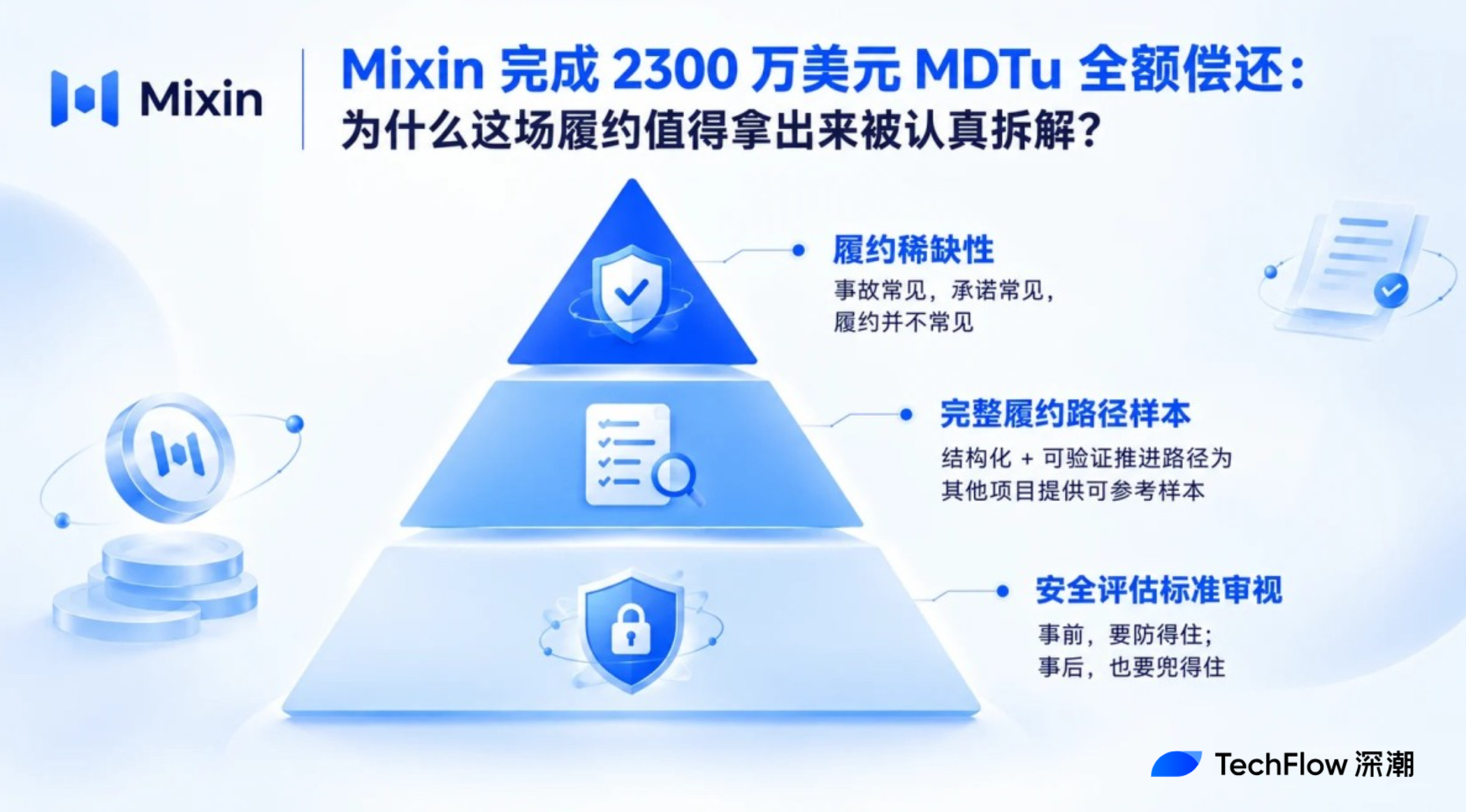
With the completion of Mixin's current payout, previously mentioned security standards are brought out for scrutiny once again:
In the pre-event stage, defenses must hold;
And in the post-event stage, responsibilities must be covered.
The former tests technology, risk control, and infrastructure;
while the latter tests responsibility, operational capability, and long-termism.
Three years ago, Mixin was pushed to the edge of a trust cliff by a security incident.
Over those three years, with the completion of the $23 million payout, Mixin has walked back from the edge, perhaps standing taller than before.
In an industry where promises are cheap and fulfillment is scarce, only those willing to continuously invest time, cost, and action for trust deserve to bear users' confidence and inspire them to look forward to the future. They are also the ones who can truly drive this industry to think, seek, and advocate for the most authentic security standards from the ground up.
Perhaps this is what truly makes this fulfillment worth remembering.
Join TechFlow official community to stay tuned
Telegram:https://t.me/TechFlowDaily
X (Twitter):https://x.com/TechFlowPost
X (Twitter) EN:https://x.com/BlockFlow_News
 深潮TechFlow